
Science confidence grows when a tutor makes difficult ideas feel within reach. What makes a good science tutor comes down to four qualities: patience, flexibility, strong subject knowledge, and the ability to explain complex concepts clearly. Together, these help students feel supported and learn to tackle questions more independently.
It’s understandable to worry when your child is losing confidence, falling behind in class, or feeling exam pressure. Extra support should do more than repeat the textbook. It should give students room to ask questions, work through mistakes, and build knowledge at a pace that suits them.
This guide explains how to recognise a tutor who builds rapport, adapts support when a student struggles, and makes science easier to understand. You’ll also see why relevant teaching experience and clear explanations matter when choosing support that helps your child feel more prepared and capable.
Key Takeaways
- Look for a tutor who listens patiently and makes it comfortable for your child to ask questions.
- Choose support that can adapt to your child’s pace and focus on the gaps causing the most difficulty.
- Check that the tutor has strong subject knowledge and can explain ideas clearly, not just provide answers.
- Notice whether the tutor connects science concepts to familiar examples that help your child understand and remember them.
1. Building rapport, patience and adapting to students
A student who avoids answering may be unsure, not disengaged. A patient tutor can start with a low-pressure prompt, such as asking the student to label one part of a science diagram. This small step offers a glimpse of what the student understands and lets them participate without feeling tested. The Straits Times has covered exam stress among students in Singapore, a reminder that pressure can affect a child’s confidence in learning.
Rapport grows through respectful, curious interaction. A tutor might ask, “Which part of this explanation feels unclear?” then listen before trying another example. If a student struggles to explain a life cycle, the tutor can invite them to describe one stage first, rather than correcting every detail at once. This helps the student share uncertainty and take part in finding the answer.
What makes a good science tutor is not simply patience, but the ability to turn it into useful teaching. A tutor can pause, check what the student understands, and adjust the explanation when needed. Encouragement works best when it recognises a real effort, such as using evidence from a diagram. Specific feedback can build confidence without making praise feel empty.
Is private one-to-one or group science tuition more effective? It depends on how the student learns. Individual attention may help a child who hesitates to speak, while a group gives students a chance to hear different explanations. Effective teaching includes listening, asking clear questions, and guiding students to reason through problems. After a lesson, ask your child what they felt comfortable asking and whether they had enough time to think.
2. Flexibility and extra support for struggling students
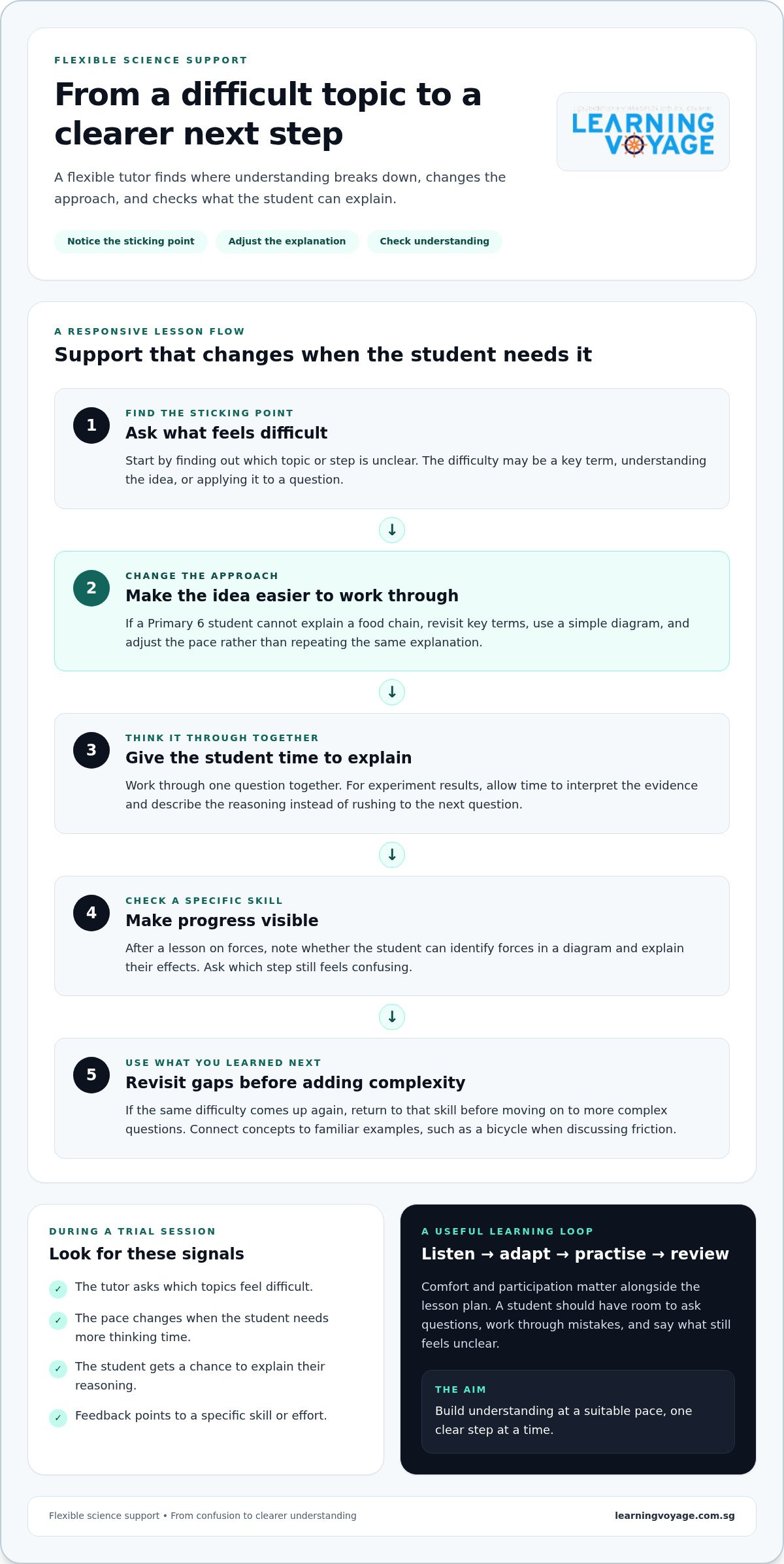
When a student struggles with a science topic, repeating the same explanation rarely fixes the problem. A flexible tutor first identifies the sticking point, then changes the approach. If a Primary 6 student cannot explain a food chain, the tutor might revisit key terms, use a simple diagram, and practise one question together. This step-by-step support helps reveal whether the difficulty lies in vocabulary, understanding, or applying knowledge.
A trial session can help families see how a tutor responds to a student’s needs. Notice whether the tutor asks which topics feel difficult, adjusts the pace, and gives the student time to think. For example, a student who needs longer to interpret experiment results should have time to explain their reasoning, rather than being rushed to the next question. Comfort and participation matter as much as the lesson plan.
Progress is easier to see when a tutor tracks specific skills over time. After a lesson on forces, for instance, the tutor can note whether the student can identify forces in a diagram and explain their effects. Student feedback is another useful signal: asking which step felt confusing can guide the next lesson. If the same difficulty comes up again, the tutor can revisit that skill before introducing more complex questions.
Enthusiasm for science can also make effort feel worthwhile. A tutor who connects a concept to a familiar example, such as using a bicycle to discuss friction, can help a student see why the topic matters. Encouragement should recognise useful effort, such as correcting a mistaken answer after reviewing the evidence. For families seeking syllabus-based support, Primary 5 and Primary 6 Science Tuition can provide a structured setting for strengthening topic knowledge and exam readiness.
3. Tutor qualifications and subject expertise
A science tutor needs more than confidence with a textbook. Relevant teaching or tutoring experience can help them spot why a student struggles, whether the gap is a key term, a mistaken idea, or applying knowledge to a question. For example, a tutor who has taught energy transfer can guide a student from defining the term to explaining it in a diagram. Ask how the tutor handles a topic the student finds difficult, and listen for a clear, step-by-step explanation.
Subject expertise also means knowing the syllabus and the level of detail students need. A tutor should understand the material they teach at least 5-7 years ahead of the student’s knowledge, giving them room to explain a concept from more than one angle. In Singapore, parents can ask how the tutor supports the student’s current science syllabus and prepares them to apply concepts, not just memorise definitions. For example, a student studying electricity should practise interpreting circuit diagrams as well as learning scientific terms.
For online lessons, practical equipment matters when a tutor demonstrates experiments on camera. A simple setup might include a clear camera view, materials for a safe demonstration, and time to explain what each step shows. If the lesson covers dissolving, the tutor can show what happens when a substance is stirred into water, then ask the student to describe the observation. Clear explanations connect the demonstration to the science concept.
How can you check a science tutor’s reviews and track record? Look for specific examples of clear explanations, patient teaching, or progress in a named topic, rather than relying only on general praise. You can also ask about relevant teaching experience and how the tutor checks understanding, such as asking students to explain a process in their own words. These details help you judge whether the approach suits your child’s learning needs.
4. Explaining complex ideas through real-world examples
An abstract science term is easier to grasp when linked to something familiar. A tutor might explain evaporation through a puddle drying in Singapore’s afternoon sun, then connect the observation to heat energy and water particles escaping into the air. This bridge from everyday experience to scientific language shows what the term describes and gives students a starting point when an exam question uses a different setting.
A cold drink offers another useful example. Water droplets forming on the outside of a glass can introduce condensation. The tutor can ask where the droplets came from, then guide the student to connect water vapour in the air with the cooler glass surface. Asking the student to explain the process in their own words checks understanding and reveals whether they can apply the science idea, rather than simply repeat its definition.
Good examples clarify concepts without replacing accurate explanations. A tutor should name the process, identify what changes, and link each observation to the correct scientific term. For instance, a student learning about forces could compare pushing an empty trolley with pushing a loaded one. The tutor can then guide them to describe the force involved and explain why the two situations feel different. This sequence turns a familiar action into structured reasoning.
Real-world connections are especially useful when students need to apply concepts to unfamiliar questions. A tutor can explain a topic using an everyday example, then introduce a diagram or exam-style scenario. For heat transfer, they might discuss why a metal spoon feels different from a wooden spoon in hot soup. The student can identify the materials, describe the heat transfer, and use the correct terms. Moving gradually from observation to explanation gives students a clearer path through complex questions.
Learning Voyage Education Centre: Secondary 4 E-Mathematics Tuition
Learning Voyage Education Centre offers Secondary 4 E-Mathematics Tuition for students who need structured support with their mathematics learning. This is a separate subject from science, but confidence with calculations and interpreting graphs can also support work with scientific data. Students preparing for examinations may benefit from focused help with the mathematics topics they find difficult.
Learning Voyage Education Centre also offers Secondary 4 A-Mathematics Tuition, Secondary 3 A-Mathematics Tuition, and Secondary 3 E-Mathematics Tuition. The right fit depends on the student’s course and learning needs. If your child’s main challenge is understanding science concepts, choose support that matches their science subject and level; mathematics tuition is relevant when mathematical skills also need attention.
For details about Secondary 4 E-Mathematics Tuition, contact Learning Voyage Education Centre or visit its website.
Choose the Next Step with Confidence
The right support should help your child move from uncertainty towards more independent learning. Before deciding, talk with your child about what feels hardest in science: understanding a concept, applying it to questions, or staying calm during exam preparation. A clear starting point makes it easier to judge whether a teaching approach fits their needs.
As you consider what makes a good science tutor for your child, focus on how the tutor responds to real questions and learning gaps. The goal isn’t simply to complete more worksheets, but to build understanding your child can use with confidence. Learning Voyage Education Centre offers small-group science tuition, as well as mathematics tuition for secondary students. Trial classes are available for both maths and science.
Visit Learning Voyage Education Centre to explore its educational support. With thoughtful guidance and steady effort, your child can take the next step with greater confidence.
Frequently Asked Questions
What qualifications should a good science tutor in Singapore have?
Look for strong subject knowledge and the ability to teach science at your child’s level. Ask about relevant academic background, teaching experience, and familiarity with the topics your child studies. Formal qualifications can indicate subject preparation, but they don’t replace clear teaching. What makes a good science tutor effective is the ability to explain why an answer is correct, not just mark it right.
How can a science tutor explain difficult concepts clearly?
A tutor can break a difficult idea into smaller steps, define unfamiliar terms, and connect each step to a question. When teaching photosynthesis, for example, they might first clarify what plants need, then explain how those needs relate to producing food. Ask your child to explain the idea back in their own words. This helps show whether the explanation made sense or needs another approach.
What experience should a science tutor have with the Singapore science syllabus?
A tutor should know the syllabus and assessment style for your child’s level, such as PSLE or GCE O-Level Science. Ask them to discuss a current school topic and explain how students are expected to use that knowledge in questions. A useful approach is to review a recent worksheet together and identify the skills each question tests, rather than relying on general science knowledge alone.
What questions should I ask before hiring a science tutor?
Ask how the tutor plans lessons around your child’s current topics, responds when a student gets stuck, and shares progress with families. You can also ask what a typical lesson involves and whether students practise applying concepts to questions. If your child is anxious about exams, ask how the tutor helps them approach unfamiliar questions without taking over the work.
How can a science tutor adapt lessons to a student’s learning needs?
A tutor can use a student’s classwork to choose a suitable starting point and adjust tasks as understanding develops. If your child misreads a results table, for example, the tutor can practise locating headings and comparing values before asking for a conclusion. This targets the skill causing difficulty instead of adding more practice on topics the student already understands.
What are warning signs of an ineffective science tutor?
Be cautious if a tutor regularly dismisses questions, moves on without checking understanding, or gives answers without explaining the reasoning. Another warning sign is a lesson that never changes, even when your child repeatedly struggles with the same task. Ask your child what they learned and what remains confusing after class. Specific answers can help you judge whether the teaching is meeting their needs.