
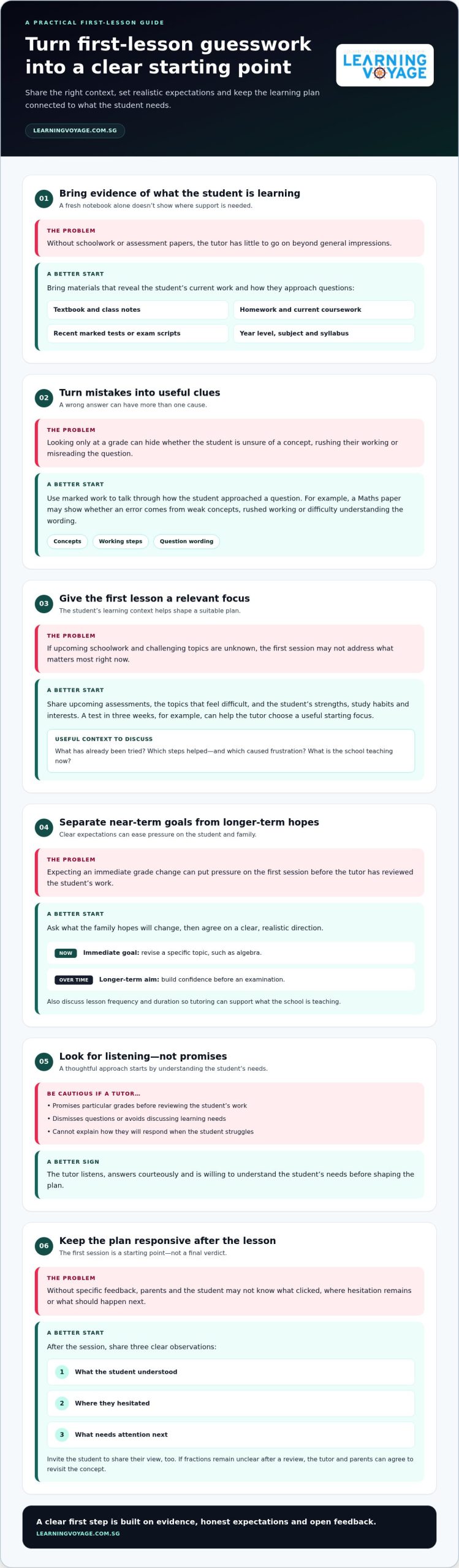
The first tuition lesson takes more than a fresh notebook. When preparing for the first tuition lesson, bring the student’s textbook, class notes, homework and recent marked tests or exam scripts. These help the tutor see what the student is learning and where they may need support. Share their year level, syllabus, upcoming assessments and any topics they find challenging, too.
It’s natural to want the first session to make an immediate difference, especially when exam stress or frustration has been building. A thoughtful start can ease that pressure: the tutor can understand the student’s needs, adjust explanations to suit them, build trust and agree on clear ground rules. This guide covers four practical steps, from sharing useful learning information and choosing a quiet study space to helping the student feel comfortable asking questions and setting goals together. The aim isn’t to judge what the student can’t do; it’s to find a steady course forward, one that strengthens understanding as well as confidence.
Key Takeaways
- Talk through the student’s strengths, challenges, school topics and upcoming assessments so the first session has a clear starting point.
- Notice how the student responds to examples, discussion and step-by-step explanations, then adjust your teaching approach to help ideas click.
- Build trust by listening without judgement and making it easy for the student to ask questions, even when they feel unsure.
- Agree on learning goals, lesson routines and expectations together to give each session a calm, purposeful direction.
1. Discuss the student’s learning needs with parents before the first lesson
Before the first session, ask parents about the student’s school year, subject, syllabus and current coursework. Request recent homework, class notes and test papers to see how the student approaches questions. For example, a Maths paper can show whether errors come from weak concepts, rushed working or difficulty understanding question wording. Ask about upcoming exams too, such as a test in three weeks, so the first lesson has a relevant focus.
Discuss the student’s strengths, challenging topics, study habits and interests with their parents. Ask what they have already tried, and which steps helped or caused frustration. A parent might explain that extra practice improved accuracy, but the student still struggles to begin unfamiliar questions. This context helps a home tutor shape a suitable plan, rather than treating grades as the only measure of progress.
Agree on expectations before tuition starts. Ask what the family hopes will change, then distinguish an immediate goal, such as revising algebra, from a longer-term aim, such as building confidence before an examination. Discuss lesson frequency and duration, and ask what the school is teaching. A clear plan can support classroom learning without leaving parents expecting instant grade changes.
Look for signs of a thoughtful, student-centred approach. A tutor who promises particular grades before reviewing the student’s work is setting an expectation they may not control. Be cautious if they dismiss questions, avoid discussing learning needs or can’t explain how they’ll respond when the student struggles. Courteous answers and a willingness to listen help create a respectful working relationship.
After the first lesson, share specific feedback with parents: what the student understood, where they hesitated, and what needs attention next. Invite the student to ask questions and share their view, too. For example, if fractions remain unclear after a review, the tutor and parents can agree to revisit the concept. Regular, open communication keeps the tutoring plan connected to the student’s changing needs.
2. Adapting explanations to the student’s interests and learning preferences
A student’s feelings about school can shape how they approach a subject. Ask what they enjoy, what feels confusing and how they feel about learning. A child who dreads Science homework may be concerned about remembering terms, rather than unable to understand the ideas. Listen without dismissing their feelings. Their answers can help the tutor choose relevant examples and explanations.
Notice how the student responds to different explanations. Some find a labelled diagram useful; others need to talk through an idea or see each step explained. For a Science topic, a tutor might sketch a process, explain it aloud, then ask the student to describe it back. If one approach leaves them stuck, try another and see what helps. Learning preferences are clues, not fixed labels.
Study habits matter, too. Ask how the student usually starts homework, what distracts them and what they do when an answer feels difficult. Someone who starts quickly but skips working may benefit from pausing to show each step. Set up a quiet study space with a clear desk, writing materials and relevant books. Put away distracting devices so the student can focus.
Parents can prepare their child by explaining why tuition is starting and what the first meeting will involve. Tell them the tutor wants to understand how they learn, not judge their ability. Encourage them to ask questions, admit when an explanation is unclear, and share their views about school. This conversation gives the student a voice from the start. A structured approach to identifying learning gaps can also guide how explanations are adapted; targeted support for learning gaps connects teaching to the areas that need attention.
3. Building rapport with the student
Start the first meeting with a calm greeting and a simple choice. Ask whether the student would rather begin with homework or a topic they enjoy. This gives them a little control before academic work begins. Notice whether they answer freely, stay quiet or seem uneasy, and respond without rushing into a difficult exercise. A respectful opening helps the student feel at ease and supports a more productive session.
Hobbies offer an easy way to start a conversation. Ask what the student likes doing after school, then listen for details you can use. If they enjoy football, a tutor might use a score or game scenario to introduce a Maths problem. If they like drawing, a diagram could help explain a challenging idea. Keep the example relevant to the subject. Connecting learning with a genuine interest can encourage the student to take part.
Make questions welcome from the start. Say, “Tell me where this stops making sense,” then give the student time to answer. If they hesitate over a fraction, ask them to show the step they understand. Avoid finishing their explanation for them. Patient listening reveals what they know and where confusion begins. It also shows that asking for help is part of learning, not something to be embarrassed about.
Trust grows through steady, respectful responses. If an answer is wrong, ask the student to explain their thinking before correcting it. “What made you choose that step?” invites reflection without blame. Recognise specific effort, such as checking each line of working, rather than focusing only on grades. This can encourage the student to try again when a question feels challenging.
Give the student room to shape the learning relationship. Invite them to suggest a topic, ask questions or say when an explanation feels too fast. A tutor can briefly share a learning challenge they once faced, then bring the focus back to the student. Respectful exchanges help create a comfortable space to participate.
4. Set expectations and ground rules with the student
A clear plan makes the first session purposeful without promising instant grade changes. Preparing for the first tuition lesson includes setting a short-term goal, such as revising a difficult topic before an assessment, and a longer-term aim, such as strengthening subject foundations. Explain that progress involves practising skills and revisiting misunderstandings, not simply completing more questions. The tutor should outline the teaching approach without promising specific results.
Tell the student what to expect: a brief discussion, a look at current schoolwork, and practice on a relevant topic. A light diagnostic exercise can show where they’re struggling; it should guide support, not feel like another exam. Preparing for the first tuition lesson also means agreeing on practical ground rules, such as having materials ready, attempting each question, and speaking up when an explanation is unclear. If the student wants homework, agree on a manageable task, such as two questions.
Ask the tutor how they’ll structure sessions, explain difficult ideas, and track progress. If a tuition agency arranged the lessons, clarify how expectations and updates will be shared. Ask how the tutor responds when a student gets stuck and what materials to prepare. These questions help show whether the teaching approach suits the student’s needs and whether everyone understands the plan.
After the lesson, consider specific signs of a good fit. Could the student ask questions comfortably? Did the tutor listen, explain patiently and identify a useful next step? Ask the student what helped and what felt confusing, then compare their feedback with the tutor’s observations. One session doesn’t need to be perfect. Look for respectful communication and a plan that responds to the student’s needs.
Learning Voyage Education Centre: Secondary 4 E-Mathematics Tuition
Learning Voyage Education Centre offers Secondary 4 E-Mathematics Tuition for students seeking structured support with the O-Level syllabus. Its small-group coaching and Plug-the-Gaps technique help identify specific learning hurdles, so teaching can focus on concepts the student needs to strengthen. Bring recent schoolwork or test papers to help clarify which topics feel difficult and what the student hopes to improve.
Students taking other listed secondary-level courses can also explore Secondary 4 A-Mathematics Tuition, Secondary 3 A-Mathematics Tuition, or Secondary 3 E-Mathematics Tuition. The right starting point is the subject and level the student is currently studying, alongside the gaps they want to address.
Contact Learning Voyage Education Centre to discuss the next step for your student’s Mathematics learning.
Let the first lesson lead to lasting progress
Preparing for the first tuition lesson is a starting point, not a test of whether a student is already confident or capable. What matters next is staying curious in the weeks ahead: notice which ideas become clearer, where questions remain and how practice affects the student’s confidence. Small signs of progress can help families and tutors adjust the learning plan thoughtfully instead of letting exam pressure set the pace.
If your child needs focused Mathematics support, take the next step by discussing their learning goals with Learning Voyage Education Centre. A thoughtful conversation can help you consider whether its tuition is suited to your student’s current subject needs. Contact Learning Voyage Education Centre to explore the options. With a clear direction and steady encouragement, your child can approach the next challenge with greater confidence.
Frequently Asked Questions
What to bring along?
Bring a notebook, writing tools and the materials needed for the subject. A calculator may be useful for Mathematics, and a Science student can bring their current textbook. Keep everything together so the student can settle in instead of searching through school items. For a lesson at home, clear a desk beforehand and have water ready to minimise interruptions.
What to bring and show at first lesson?
Bring recent schoolwork and show how the student approached each question, not just the final mark. Include a corrected exercise they got wrong alongside one they completed confidently. The contrast may reveal whether the challenge lies in understanding the concept, choosing a method or checking their work. A brief note about the current school topic can help focus the discussion.
What should a student bring to their first tuition lesson in Singapore?
For a first tuition lesson in Singapore, pack the subject textbook, class notes, homework and a recent marked test or exam script. Add the school’s topic outline or a screenshot of a relevant assignment if it helps identify the current unit. The student can also bring questions they felt unsure about in class. These materials help the tutor connect support to actual schoolwork.
How do you set learning goals for tuition in Singapore?
Set a goal by naming the skill to improve, why it matters and how you’ll recognise progress. For example, a student preparing for an assessment might aim to explain a method clearly and apply it to unfamiliar questions. Ask what feels achievable, then review the goal with the tutor as school topics change. In Singapore, relate priorities to the student’s syllabus and upcoming assessments.
How long is a typical first tuition lesson in Singapore?
There’s no single lesson length that suits every student. Allow enough time to understand their needs, review relevant work, practise a focused topic and agree on a next step. Ask how the session will balance discussion and learning, then consider the student’s attention, subject and schedule. A clear purpose matters more than trying to cover too much at once.
What should parents expect during a trial tuition lesson?
Expect the tutor to learn how the student approaches the subject, work through a relevant task and explain ideas in response to their understanding. Parents can notice whether the student feels comfortable asking for clarification and whether feedback is clear and constructive. Learning Voyage Education Centre offers trial classes for both Mathematics and Science, so families can experience its teaching approach before deciding on ongoing tuition.