
When my child finds physics boring, the reaction may signal more than a lack of interest. Confusion, frustration after repeated difficulties, or feeling disconnected from classroom examples can all make the subject harder to engage with. Start by finding out what lies behind the response.
It’s understandable to worry when your child seems switched off, especially as physics concepts build on one another and exam pressure grows. Interest can often return when lessons connect with what a student enjoys and make challenging ideas easier to follow. This article explains how to spot whether boredom may mask other feelings, use everyday interests to bring physics to life, and support confidence and participation. Once you understand what’s getting in the way, you can help your child take a clearer next step.
Key Takeaways
- Look beneath “boring” for signs of confusion, frustration or low confidence before deciding your child simply dislikes physics.
- Use a favourite film, game or sport as a starting point for exploring the physics behind familiar experiences.
- Notice whether lessons give your child room to ask questions, connect ideas and practise applying concepts, not just memorise them.
- Start with a small, interest-led conversation at home, then build on what sparks curiosity to make the subject feel more approachable.
Using entertainment and pop culture to teach maths and science
A favourite science-fiction scene can spark questions that a worksheet may not. Pause when a spaceship changes direction and ask what might cause the movement. Your child can compare the scene with how forces affect motion, then explain which parts seem realistic. This turns entertainment into a prompt for scientific reasoning, not a substitute for accurate science.
Match the activity to your child’s stage. A younger learner might draw what they think happens when a character jumps on an unfamiliar planet. A secondary student could identify the forces involved and discuss how gravity might affect the jump. Ask for a prediction before offering an explanation, giving your child a reason to think actively.
Everyday Singapore settings offer useful follow-up questions. On an escalator, ask why a stationary handrail and moving steps travel at different speeds. At home, compare how a thick curtain and a bare wall affect echoes. These observations help children connect familiar experiences to ideas such as motion and sound without needing specialist equipment.
For low-cost activities, use household objects instead of relying on a paid attraction. A torch, paper and a wall can help younger children explore how a shadow changes when an object moves. Older students can design a simple test, record observations and explain which variable they changed. Keep the setup safe and straightforward, with one clear question guiding each activity.
Teachers can build motivation by starting with a student’s interest and linking it to a syllabus concept. A parent might mention that their child enjoys strategy games, for example, and ask how classroom examples could draw on that interest. Practical investigations let students predict, observe and explain, while a supportive teacher-student relationship can make it easier to admit confusion. Together, these approaches can turn a familiar reference into a useful step towards understanding.
2. Making learning relevant to children’s interests
A student can understand a formula and still wonder why it matters. That disconnect can make physics feel dull, especially when lessons seem detached from daily life. If my child finds physics boring, start by asking what they choose to do after school. A favourite activity can reveal which ideas they might enjoy exploring, without expecting every topic to be entertaining.
Music offers a clear connection to sound. Ask your child to compare a low bass note with a high vocal note, then explore how frequency relates to pitch. If they enjoy recording songs, invite them to notice how a quiet room changes the sound. The aim isn’t to turn a hobby into homework. It’s to use a familiar starting point to introduce an abstract idea, then connect it to the scientific explanation.
Cooking can make heat and energy easier to picture. While preparing a meal, discuss why a metal pan heats differently from a wooden spoon, or how steam forms above boiling water. Ask your child to predict what will happen before explaining the concept. Their answer can reveal what they understand and where a misconception may lie. Keep the conversation curious, not corrective, so a wrong prediction feels like a useful starting point rather than another mark lost.
Try a simple sequence: identify an interest, choose a related physics concept, then ask your child to explain the connection in their own words. For a keen photographer, discuss how changing light affects a picture, then link the observation to how light travels and reflects. If the example sparks a question, explore it through a diagram or textbook problem. If not, try another interest. Relevance isn’t a way to avoid challenging work; it gives students a reason to begin and build understanding beyond the example.
3. Student engagement and lesson design
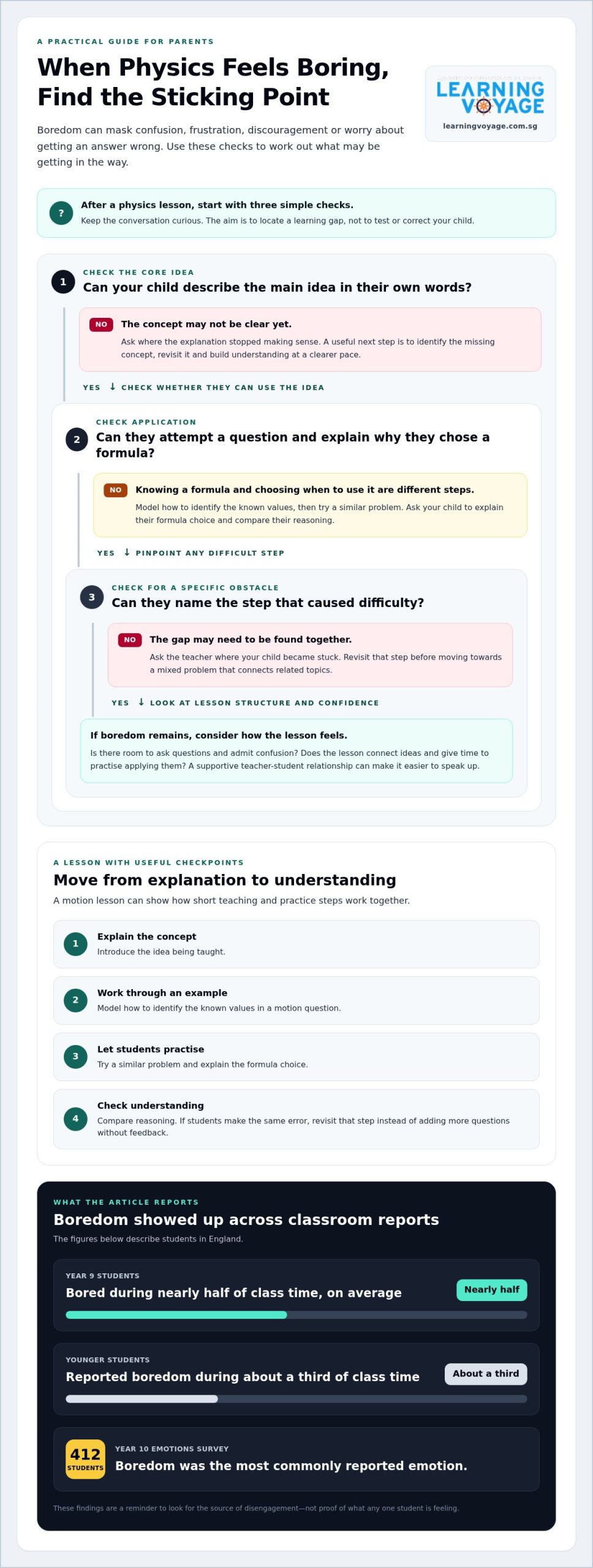
Physics can feel dull when each lesson adds another demanding step without showing how the ideas connect. A student may understand a formula but struggle to choose it for a problem. Frustration grows if classroom explanations move on before that gap is clear. Boredom can then mask confusion, discouragement or worry about being wrong, particularly after a disappointing test result.
Lesson pace matters. Year 9 students reported feeling bored during nearly half of class time, on average; younger students reported boredom during about a third. These findings describe students in England, but they highlight why a long stretch of listening may not keep every learner engaged. A lesson can alternate explanation, a worked example, student practice and a brief check for understanding.
For example, when teaching motion, a teacher could model how to identify the known values in a question. Students could then solve a similar problem, explain why they chose a formula and compare their reasoning. If several students make the same error, revisiting that step is more useful than assigning more questions without feedback. Short checkpoints can show where confidence starts to falter.
Engagement also depends on whether students feel safe asking for help. In a survey of 412 Year 10 students about their emotions, boredom was the most commonly reported emotion. A teacher can invite questions, treat mistakes as information and ask students to explain their thinking without embarrassment. That supportive relationship makes it easier to spot whether a learner needs a clearer explanation or a slower route through the mathematics.
After a physics lesson, ask specific questions: can your child describe the main idea, attempt a question and name the step that caused difficulty? If not, ask the teacher about the lesson sequence and where your child became stuck. A useful response identifies the missing concept, revisits it, then builds towards a mixed problem that connects related topics. This replaces passive frustration with a clear next step.
4. How can parents make physics interesting for children?
Start with curiosity, not a revision worksheet. Ask your child to choose one puzzling moment from the day, such as why a lift feels different as it moves. Listen before explaining: their answer may show whether they’re curious, confused or worried about getting it wrong. If exam stress is building, keep the conversation brief and separate it from marks or test preparation.
Use a simple routine to turn that moment into a small investigation. For a lift, discuss how its movement changes as it starts, travels and stops. Ask your child to sketch what they think happens, then compare their explanation with the physics concept they’re studying. A drawing lets them show their thinking without pressure before equations enter the conversation.
- Ask one open question. “What do you notice when a ball rolls across the floor?” invites more thought than “Do you understand friction?”
- Give thinking time. Let your child explain their prediction before correcting a misconception.
- Connect it to schoolwork. Ask them to identify the relevant idea in a textbook example or practice question.
Keep the challenge manageable. If a question involves several steps, help your child identify what is known, what they need to find and which concept might connect the two. Recognise a clear explanation or a corrected mistake, not just a correct final answer. This shifts attention from fear of losing marks to progress they can see.
If your child repeatedly gets stuck on Secondary 3 or Secondary 4 Pure Physics concepts, structured guidance can help them rebuild understanding and approach questions with greater confidence. Explore structured secondary science support as a next step when home encouragement alone isn’t resolving the difficulty.
Learning Voyage Education Centre: Secondary 4 E-Mathematics Tuition
Learning Voyage Education Centre offers Secondary 4 E-Mathematics Tuition for students who need stronger mathematical foundations alongside their physics studies. When algebra, graphs or rearranging equations feel difficult, physics questions can become frustrating even when the scientific idea makes sense. Strengthening these skills can help students approach calculations with greater confidence.
Its small-group coaching follows the relevant syllabus and gives students opportunities to work through challenging concepts. The centre’s Plug-the-Gaps technique focuses on identifying and addressing specific learning hurdles, helping students build understanding step by step. This support may suit a Secondary 4 student whose difficulty with mathematical methods is affecting their confidence in physics. For support with Secondary 4 E-Mathematics, contact Learning Voyage Education Centre or visit learningvoyage.com.sg.
Help your child take the next step with confidence
If my child finds physics boring, the next step is to listen for what lies behind that response. Your child may have a clear question, feel unsure how to explain the difficulty, or need help rebuilding confidence. A calm conversation can turn frustration into a specific concern you can address together.
When the challenge calls for more structured academic support, share what you’ve noticed and what your child hopes to improve. Contact Learning Voyage Education Centre to discuss a suitable next step. With patient encouragement and steady effort, your child can approach learning with greater confidence and curiosity.
Frequently Asked Questions
Is boredom masking other emotions?
It can, and the pattern around the complaint may offer clues. Notice whether your child says physics is boring only before tests, after a particular class or during homework. Try a simple private check-in: ask them to choose a word for how they feel about the subject today, then ask again after a lesson. Changes over time can reveal what needs attention.
So what should parents do?
Agree on one small, practical step with your child instead of launching a full revision plan. For example, set aside a short session to review one marked question and write down what they would try differently next time. Keep the goal specific and achievable. This gives your child a sense of agency and helps you judge whether independent practice is enough or further guidance could help.
Why do children find physics boring?
Some students find physics unrewarding when progress is hard to see. A chapter may rely on earlier concepts being secure, so a student can work steadily without noticing improvement. Ask your child to compare a recent piece of work with an older one. Explaining a step they once found difficult can make their effort feel more meaningful.
Are there engaging physics books, videos, apps, or games for children?
Yes. Choose resources that let your child interact with an idea instead of only watching an explanation. A circuit simulation, for instance, can let them change a component and observe the result. Afterwards, ask what changed and what stayed the same. A short explanation helps connect screen-based exploration with the careful reasoning needed for schoolwork.
How can teachers motivate students who dislike physics?
Teachers can give students a meaningful choice in how they demonstrate understanding. After studying energy transfer, for example, a class might choose to explain a household appliance or a sports movement. A brief recap at the end of the lesson can also help students identify one idea they can now explain. This makes progress visible without relying only on test results.
What signs suggest a child is struggling with physics rather than simply bored?
Compare how your child explains an idea aloud with how they answer a written question. If they can describe what happens but repeatedly misread diagrams, symbols or units, the challenge may be translating understanding into exam-style work. Review a few marked questions together and look for recurring errors. A pattern gives you a clearer basis for discussing support with their teacher.