
More revision time doesn’t always mean better PSLE maths preparation; the right balance matters. Effective revision notes support focused topic review, then give way to mixed questions that help children practise choosing the right method independently.
It’s understandable to feel concerned when your child recognises a method in their notes but struggles to apply it to a new question. A steady routine can build understanding and confidence without turning every study session into a test.
This article explains how to use notes actively, practise across topics, and revisit number and measurement skills such as decimals, rounding, and unit conversions. It also considers when Primary 6 Mathematics tuition may offer useful guidance, especially if a child needs help identifying learning gaps and strengthening their approach at their own pace.
Key Takeaways
- Use revision notes to pinpoint a concept, then practise applying it without relying on the page.
- Strengthen accuracy by paying attention to place value, rounding and the units used in measurement questions.
- Notice whether repeated errors come from a knowledge gap, a misread question or an unclear method.
- Consider structured maths support when independent practice isn’t resolving persistent difficulties.
1. Balancing focused revision with mixed-topic practice
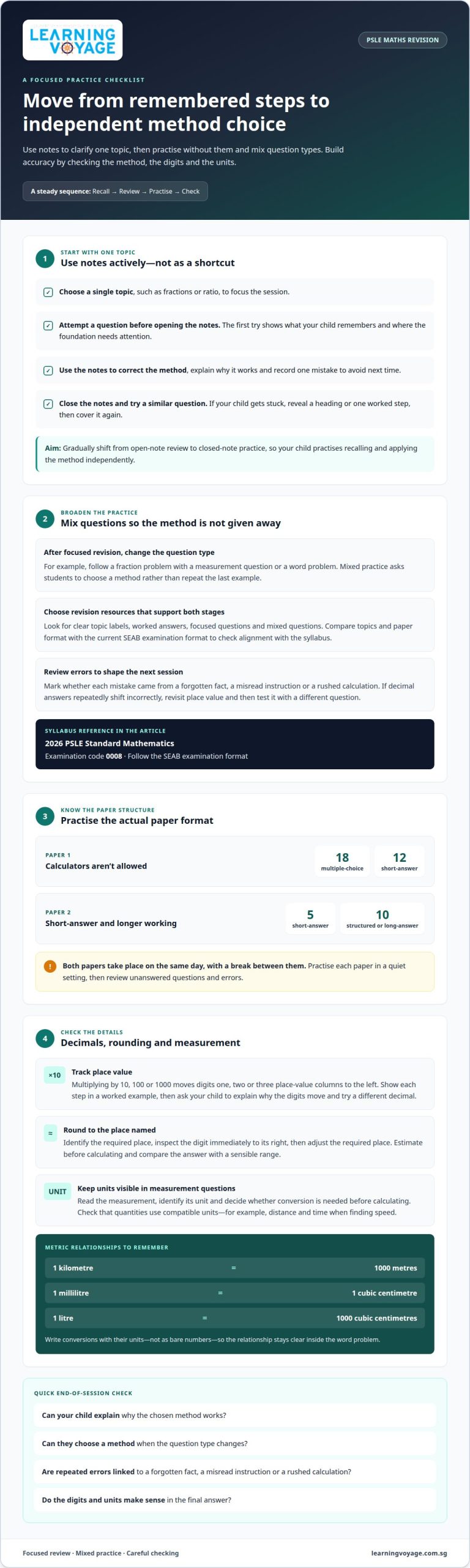
Begin each study session with one topic, such as fractions or ratio. Ask your child to attempt a question before opening their notes. That first attempt shows what they can already remember and where the foundation needs attention. Then use the notes to correct the method, explain why it works, and record one mistake to avoid next time. Short prompts, including maths revision prompts, can help make key ideas easier to retrieve.
Once a method makes sense, close the notes and try a similar question. If your child gets stuck, reveal a heading or one worked step, then cover it again. This gradual shift from open-note to closed-note practice builds independent recall. After focused revision, mix question types, such as a fraction problem followed by a measurement or word problem. Mixed practice asks students to choose a method, not just repeat the last example.
For free online PSLE Math notes and practice papers, choose resources with clear topic labels, worked answers, and both focused and mixed questions. These features let families review a method and then practise applying it. To check whether notes match Singapore’s latest syllabus, compare their topics and paper format with the current SEAB examination format. For 2026, PSLE Standard Mathematics uses code 0008 and follows the SEAB examination format.
Timed practice should reflect the actual papers, not an invented pace. Paper 1 has 18 multiple-choice and 12 short-answer questions; calculators aren’t allowed. Paper 2 has 5 short-answer and 10 structured or long-answer questions. Both papers take place on the same day, with a break between them. Practise each paper in a quiet setting, then review unanswered questions and errors.
Record whether each mistake came from a forgotten fact, a misread instruction, or a rushed calculation. Noticing patterns helps shape the next revision session. For example, revisit place value if decimal answers repeatedly shift incorrectly, then test the skill with a different question.
2. Decimals, rounding and measurement conversions
A correct method can still lead to a wrong answer if the units don’t match. Practise reading each measurement carefully, identifying its unit, and deciding whether conversion is needed before calculating. For example, check that distance and time are expressed in compatible units before finding speed. Keeping units visible helps students judge whether an answer makes sense.
For decimal work, connect place value to multiplication and division. Multiplying by 10, 100 or 1000 moves digits one, two or three place-value columns to the left. A worked example should show each step, rather than only the final answer. Ask the student to explain why the digits move, then substitute a different decimal into the same method to test understanding.
Rounding deserves the same care. First identify the place named in the question, then inspect the digit immediately to its right. Keep the required place and adjust it according to that digit. Estimating before calculating helps students compare the actual answer with a sensible range. This check can reveal a misplaced decimal point or an answer rounded to the wrong place.
Measurement conversions are another useful practice area. In the metric system, 1 kilometre equals 1000 metres, while 1 millilitre equals 1 cubic centimetre. Also remember that 1 litre equals 1000 cubic centimetres. Record these relationships with units, not as bare numbers, so the conversion remains clear inside a word problem.
What topics are tested in the PSLE Mathematics syllabus? Students practise a range of mathematical topics, including number skills and measurement. Decimals, rounding, and conversions offer concrete areas for revision. Use the current syllabus and examination format to guide topic selection, rather than assuming one short set of notes covers everything.
If a child needs guided practice connecting these skills to varied questions, Primary 6 Mathematics support can help strengthen understanding through worked examples and step-by-step methods.
3. PSLE and primary maths tuition in Punggol
Primary maths tuition can help when a child repeatedly struggles to explain a concept, choose a method, or show clear reasoning. Before adding lessons, identify the pattern: is the difficulty with fractions, multi-step word problems, or copying figures accurately? Review a recent paper and group errors by type. This gives any learning support, such as structured programs at Learning Voyage Education Centre, a clear starting point, rather than treating every incorrect answer as the same problem.
When choosing PSLE Math assessment books, look for ones aligned with the current Standard Mathematics syllabus and examination format. Compare sample questions, worked answers, and explanations before deciding. Useful books include both topic-focused practice and questions requiring several steps. Page count alone is a poor guide; clear explanations help students understand why a method works and where their reasoning went off course.
Families can also search the National Library Board catalogue for PSLE Mathematics books and revision guides. Use the catalogue to find a suitable branch and check an item’s borrowing status before travelling. Library materials can offer a different explanation of a difficult idea. They work best alongside school worksheets and the questions a child needs to practise.
Common PSLE Math question types include short calculations, multi-step word problems, and structured questions. Strategies include drawing a model, identifying known and unknown quantities, and checking whether the answer fits the question. For example, in a ratio problem, label each part before calculating the total. For measurement questions, write units beside values to keep the working clear.
The PSLE is a one-time examination, so practice should develop accuracy and calm reasoning. Break a difficult concept into manageable steps: identify the gap, study an example, then try a new question independently. If mistakes persist across different papers, targeted primary maths tuition through Learning Voyage Education Centre can help strengthen understanding before exam pressure rises.
4. Where can I find PSLE Math revision notes?
Start with materials your child already uses at school. Class worksheets, marked papers, and teacher-provided examples show which methods match current lessons. Keep them together by topic, such as fractions, decimals, or geometry. A clearly labelled folder makes it easier to find a useful example during revision instead of searching through loose pages.
For library borrowing, search the National Library Board catalogue for PSLE Mathematics books and revision guides. Choose a convenient branch, then check the catalogue entry for current availability. A library book can offer another explanation of a challenging idea. It should support, not replace, class materials and practice questions that match the child’s learning needs.
Online resources can be useful too, especially when they include worked solutions. Before using a download, look for publication or update details, topic labels, and clear answer explanations. Try a question before reading the solution. If the answer differs, compare each step and identify whether the issue was a misunderstood concept, a calculation slip, or unclear working.
Build a compact revision file rather than collecting every worksheet. For each topic, keep one representative question, the method, a common mistake, and a checking step. For example, a ratio page might show how to find the total number of parts before calculating each share. Add a fresh question later to test whether the method makes sense without prompts.
A useful set of PSLE Math revision notes should be easy to navigate and explain, not merely list, key ideas. Parents can review a page by asking their child to explain one worked example, then try a related problem independently. If a reliable starting point for organising maths notes would help, explore practical revision note ideas and shape them around the topics your child needs to revisit.
For extra practice, choose clearly labelled PSLE papers with worked solutions, and use the NLB catalogue to check availability at a convenient Punggol branch.
Learning Voyage Education Centre: Intensive Revision Workshops
Learning Voyage Education Centre offers Intensive Revision Workshops for students who need structured support turning revision into confident, independent practice. The workshops can help when a child understands a worked example but struggles to choose a method for unfamiliar questions, or when repeated mistakes point to gaps across several topics. Students revisit concepts, apply methods, and build a steadier approach to exam questions.
Bring the topics causing the most difficulty into focus, such as measurement conversions or multi-step problems. This gives revision a clear course to follow, while helping students see progress through what they can explain and solve independently. For structured support with PSLE maths preparation, contact Learning Voyage Education Centre.
Let steady preparation carry forward
The next step is to make revision sustainable beyond a single study session. A child who can explain a method, notice an error, and try again is building habits that remain useful after the PSLE. Focus on progress the child can describe, not only marks on a page. This can ease exam pressure and help confidence grow through practice.
For families considering what comes after primary school, Learning Voyage Education Centre also offers Secondary 3 A-Mathematics Tuition, Secondary 4 A-Mathematics Tuition, and Secondary 4 E-Mathematics Tuition. A thoughtful plan for PSLE maths revision notes in Punggol can be the beginning of a longer path of learning, with support suited to each stage.
Contact Learning Voyage Education Centre to discuss the next step for your child. Every student can keep moving forward, one clear concept at a time.
Frequently Asked Questions
How do I prepare well for the PSLE?
Make a simple plan that fits your child’s schoolwork, energy, and areas needing attention. Set a clear purpose for each session, such as strengthening problem interpretation or checking written workings. Keep sleep and breaks in the routine so revision remains manageable. If exam stress is affecting concentration, discuss a calm study structure with your child rather than automatically adding more work.
Should notes contain every formula?
No. Notes work best as a quick guide to ideas your child needs to recall, not a full textbook copied by hand. Include a formula when it is easy to confuse, and pair it with what each symbol means and when the formula applies. For example, a speed note should connect distance, time, and units. Leave out familiar facts if they make the page harder to scan.
Are there PSLE Math tuition centres in Punggol that provide revision notes?
Some tuition centres combine teaching with revision resources, but the format varies. Learning Voyage Education Centre supports PSLE preparation through small-group maths and science coaching tailored to the syllabus, with its Plug-the-Gaps approach focused on identifying and addressing learning hurdles. Parents looking for psle math revision notes in Punggol can use centre support alongside school materials, and ask how lesson resources connect with the child’s current learning needs.
How should Primary 6 students revise PSLE Math using notes and past papers?
Use past papers to diagnose readiness, not simply to collect marks. After completing a paper, sort questions into secure, uncertain, and unanswered groups. For each uncertain question, note the idea or decision that caused difficulty. Return to that question type later with a different example, so the student practises transferring understanding rather than memorising one solution.