
The fastest way through the PSLE Science paper isn’t to rush every multiple-choice question. The paper lasts 1 hour 45 minutes, and its 28 MCQs are usually worth 2 marks each, 56 marks altogether. These PSLE Science multiple-choice question tips help students aim for about 1.5 minutes per MCQ, then move on and return later if one takes more than 2 minutes.
It’s understandable for students to feel pressed for time and for parents to worry when a child understands the Science concepts but loses confidence under exam pressure. A steady approach can make each decision more manageable. These PSLE Science multiple-choice question tips cover pacing, reviewing mistakes, spotting distractors and understanding the MCQ format. They also explain why it helps to read every option and how a wrong answer can point to a concept worth revisiting. The aim is not to make every child work at the same pace, but to help each student make calmer, more deliberate choices.
Key Takeaways
- Plan a steady pace across both booklets, and practise with papers aligned to the current PSLE Science syllabus.
- Turn each wrong answer into a learning point by identifying the concept tested and the clue you missed.
- Use keywords in the question stem to rule out distractors, especially options that are scientifically true but don’t answer the question.
- Read every option carefully and combine details from diagrams with the question text before choosing your answer.
1. How should I manage my time during the PSLE Science paper?
Effective PSLE Science revision pairs concept review with timed MCQ practice and careful correction. Use the suggested split of 45 minutes for Booklet A and 60 minutes for Booklet B as a planning guide. Practise Booklet A within 25-30 minutes, so students can build a time buffer for checking and more challenging questions.
Choose practice papers that follow the current MOE Science syllabus. The syllabus changed significantly from 2014, so older past-year papers may cover different content. Use them selectively, and focus revision on questions that match what students currently learn at school. Before starting a paper, check its syllabus coverage rather than assuming every assessment book labelled “latest” is aligned.
Balance topic revision with full-paper practice. First, revisit a concept, such as how water moves from a plant’s roots to its leaves. Then answer related MCQs and explain why each correct option fits. This sequence helps students connect Science knowledge to the wording of a question instead of relying on memorised answer patterns.
For a manageable routine, schedule 1 timed MCQ practice a week, plus 2 shorter MCQ drills for weaker topics. After each paper, set aside 1 correction review session. Read the explanations and note whether a missed clue or a shaky concept caused an error. Use that pattern to choose the next topic for revision, rather than repeating questions without a learning goal.
During practice, keep track of progress across both booklets. If a question is taking too long, mark it and move on. Return to it after answering the questions you can complete more readily. This keeps one difficult item from taking time away from the rest of the paper.
Effective revision combines learning concepts, timed practice and reviewing mistakes. Use papers based on the current syllabus and plan time for both booklets. Then adjust the approach according to the topics and question types that need more practice.
2. Reviewing wrong answers
A wrong MCQ can reveal more than a forgotten fact. Set aside a 15-minute review session for five incorrect questions, and treat each correction as a clue to what needs attention. For every question, identify the concept tested, the clue in the stem, why the chosen answer was wrong, and why the correct option fits better. This gives students a clear reason for changing their understanding, rather than simply copying an answer key.
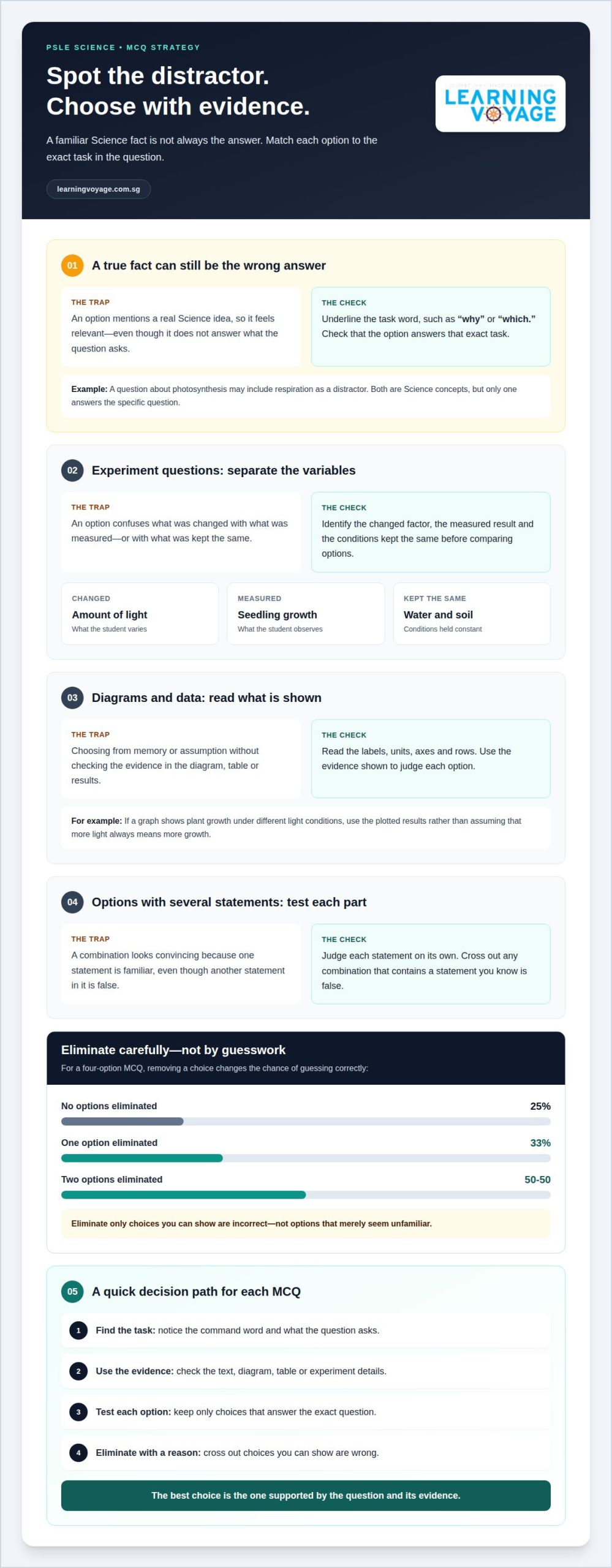
Check whether an option answers the exact question, not just whether it contains a true Science statement. If a question asks what a diagram shows about plant growth, an option about water movement may sound relevant but still miss the point. Underline the task word, such as “why” or “which,” then use evidence from the text or diagram to decide.
Try to predict an answer before looking at the choices. This brief step helps students focus on the concept rather than gravitate towards familiar words in a distractor. Then compare the prediction with each option. During practice, justify choices aloud or in writing. Explaining why an option is correct makes gaps in understanding easier to spot.
The same careful reasoning helps with open-ended answers. Use precise Science terms and complete sentences, not isolated keywords or vague phrases. For example, write “the temperature increases” rather than “it goes up.” Link cause, process and result clearly, using one to three sentences for an open-ended question. This helps avoid incomplete answers, even when the student understands part of the concept.
When reviewing, note whether the error came from a misunderstood concept, a missed clue, or imprecise writing. If diagrams repeatedly cause difficulty, practise describing what each label or change shows before writing an explanation. Students who need guided practice with these skills can explore Primary 5 and Primary 6 Science tuition as they strengthen their understanding and answer construction.
3. Identifying distractors
Process of elimination turns uncertain choices into a more reasoned decision. In a four-option MCQ, removing one option improves the chance of guessing correctly from 25% to 33%; removing two leaves a 50-50 chance. Eliminate only choices you can show are incorrect, not options that merely seem unfamiliar.
Start by identifying the Science concept and command words in the question stem. Words such as “describe,” “compare” and “explain” indicate what the answer needs to do. A question about photosynthesis, for example, may include respiration as a distractor. Both are Science concepts, but only one answers the specific question.
For experiment questions, identify what was changed, what was measured and what stayed the same. If a student changes the amount of light reaching seedlings and measures their growth, light is the changed factor and growth is the measured result. Water and soil may be kept the same. This helps students reject options that confuse a variable with the result.
Read diagrams, tables and experimental results alongside the question. Check every label, unit, axis and row before judging an option. If a graph shows plant growth under different light conditions, use the plotted results rather than assuming that more light always means more growth. Choose the answer that the evidence supports.
When options combine different statements, test each statement first. Cross out any combination that contains a statement you know is false. Then compare the remaining choices with the concept and wording of the question. This helps prevent a familiar but irrelevant fact from influencing your decision.
Practise these reading skills with different PSLE Science papers, including questions with unfamiliar diagrams. After each mistake, identify the clue or variable that would have ruled out the distractor. Command words also matter in open-ended questions: “compare” requires a clear similarity or difference, while “explain” asks for a reason. Deliberate practice makes this process more reliable.
4. PSLE Science multiple-choice question format
The PSLE Science paper combines selected-response questions in Booklet A with structured questions in Booklet B. The sections assess knowledge in different ways: Booklet A asks students to choose an option, while Booklet B requires written answers. Knowing the difference helps students practise both recognising an accurate statement and expressing an explanation clearly.
Booklet B is worth 40 marks and contains 10 to 11 questions, with each question worth 2 to 5 marks. A question may contain several parts, so students should notice how many marks each part carries. A one-mark response may need a direct fact, while a higher-mark explanation usually needs connected points that address the evidence given.
MCQs may combine details from a diagram with information in the question text. For example, a labelled experimental setup may show which object was heated, while the stem explains what the student is trying to find out. Read both together: the diagram provides observations, and the words define the task. Missing either part can lead to an answer that does not fit.
Question format affects how students show what they know. In a multiple-choice question, selecting the correct option is enough; in a structured response, the explanation must be supported by relevant evidence. If a question asks what an experiment demonstrates, connect the stated result to the concept being tested. This is more precise than copying a keyword from the stem without explaining its relevance.
During revision, practise recognising whether a prompt asks for a choice, a description or a reason. Match the response to the task: select the best-supported option, describe the observation or explain how the evidence relates to the concept. This format-aware approach helps students show their thinking clearly in both booklets, rather than treating every Science question as a memory test.
Learning Voyage Education Centre
Learning Voyage Education Centre helps students build understanding by identifying specific learning hurdles and addressing them step by step. If exam stress makes it harder to apply Science concepts, focused guidance can help turn repeated mistakes into clearer learning goals and more confident practice.
The “Plug-the-Gaps” technique pinpoints areas that need attention instead of treating every error as the same problem. For PSLE Science students, this means strengthening foundations and developing a more deliberate approach to questions, at a pace that supports continued progress.
If you’d like to discuss learning support, contact Learning Voyage Education Centre.
Build confidence for the next challenge
Exam confidence grows through steady learning, not one perfect practice paper. Use these PSLE Science multiple-choice question tips to help your child approach unfamiliar questions with a clearer plan. Build on that foundation with a practice routine suited to your child’s needs.
Learning Voyage Education Centre also supports students progressing through secondary Mathematics, including Secondary 4 E-Mathematics Tuition, Secondary 4 A-Mathematics Tuition and Secondary 3 A-Mathematics Tuition. For support with learning needs, contact Learning Voyage Education Centre to discuss a suitable next step.
With patience and consistent effort, students can approach new challenges with greater confidence.
Frequently Asked Questions
How should I manage my time during the PSLE Science paper?
Use the suggested split of 45 minutes for Booklet A and 60 minutes for Booklet B within the 1 hour 45 minutes paper. During practice, keep a clock visible and note when you begin each booklet. If one MCQ takes over 2 minutes, mark it and continue, then return after answering questions you can solve more readily.
What are the most common mistakes in PSLE Science?
Common mistakes include overlooking a command word, misreading a diagram label and choosing an option that is scientifically true but irrelevant. Students may also confuse what an experiment changes with what it measures. For example, if light levels vary and seedling height is recorded, mixing up those roles can lead to a wrong answer, even when the student knows the topic.
What science keywords should I use in PSLE answers?
Choose precise terms that match the concept and evidence in the question. For example, describe heat as flowing from a hotter object to a cooler one, rather than saying it “moves across” without specifying direction. In written explanations, use words such as “increases” or “decreases” to describe a measured change. The right keyword should clarify the relationship, not replace the explanation.
What topics are tested in PSLE Science multiple-choice questions?
Questions draw on concepts across the PSLE Science syllabus and may place them in everyday situations or experiments. A student might apply knowledge of heat transfer to explain a real-life observation, or interpret a plant diagram showing water movement. Practice should therefore include familiar concepts presented through different contexts, not only questions that repeat textbook wording.
What is the PSLE Science MCQ format and number of questions?
The PSLE Science paper described here includes 28 multiple-choice questions, usually worth 2 marks each, for 56 marks in total. Each question presents answer options, and students select the option that best answers its stem. Some items also require students to combine information from a diagram with details in the text, so both sources of evidence matter.
What common traps appear in PSLE Science MCQs?
A common trap is an option that names a relevant Science idea but answers a different question. Another is a choice that includes one incorrect statement among several, making the whole combination unsuitable. Watch for keywords that change the task and compare each option with the evidence provided. For instance, an option about respiration cannot answer a question specifically about photosynthesis.