
Families around Kovan can easily find a dedicated secondary 1 math tutor kovan to support the move into secondary school mathematics. A tutor can help students strengthen core skills and approach unfamiliar questions with greater confidence, rather than letting small gaps grow into bigger worries.
It’s understandable to feel concerned when homework takes longer, test results dip, or exam stress starts to affect a child’s confidence. At Learning Voyage Education Centre, our programmes are tailored for students in the Kovan area, bringing steady guidance that makes a real difference to how prepared a student feels during this transition.
Here, you’ll find out how our Kovan tuition builds a strong maths foundation, what supportive teaching looks like at our centre, and what local families say about their experience. You’ll also learn how our classes help students work through difficult concepts at a suitable pace, with a clearer course through the challenges ahead.
Key Takeaways
- See how steady lessons and focused practice can help Secondary 1 students close learning gaps and build stronger maths foundations.
- Find out how maths tuition serving Kovan and Hougang can support students with exam strategies and unfamiliar problem-solving questions.
- Discover what parent and student feedback can reveal about progress, confidence and the experience of learning maths.
- Learn how targeted guidance can make difficult concepts feel more manageable and help students develop confidence at their own pace.
Want To Score A1 In Math 2x Faster?
An A1 is a goal, not a guaranteed outcome. For a Secondary 1 student, steady lessons and focused practice make progress easier to track. A tutor can use a structured lesson to revisit a concept, model a method, then guide the student through related questions. Practice should respond to the student’s learning gaps, rather than simply add more worksheets without a clear purpose.
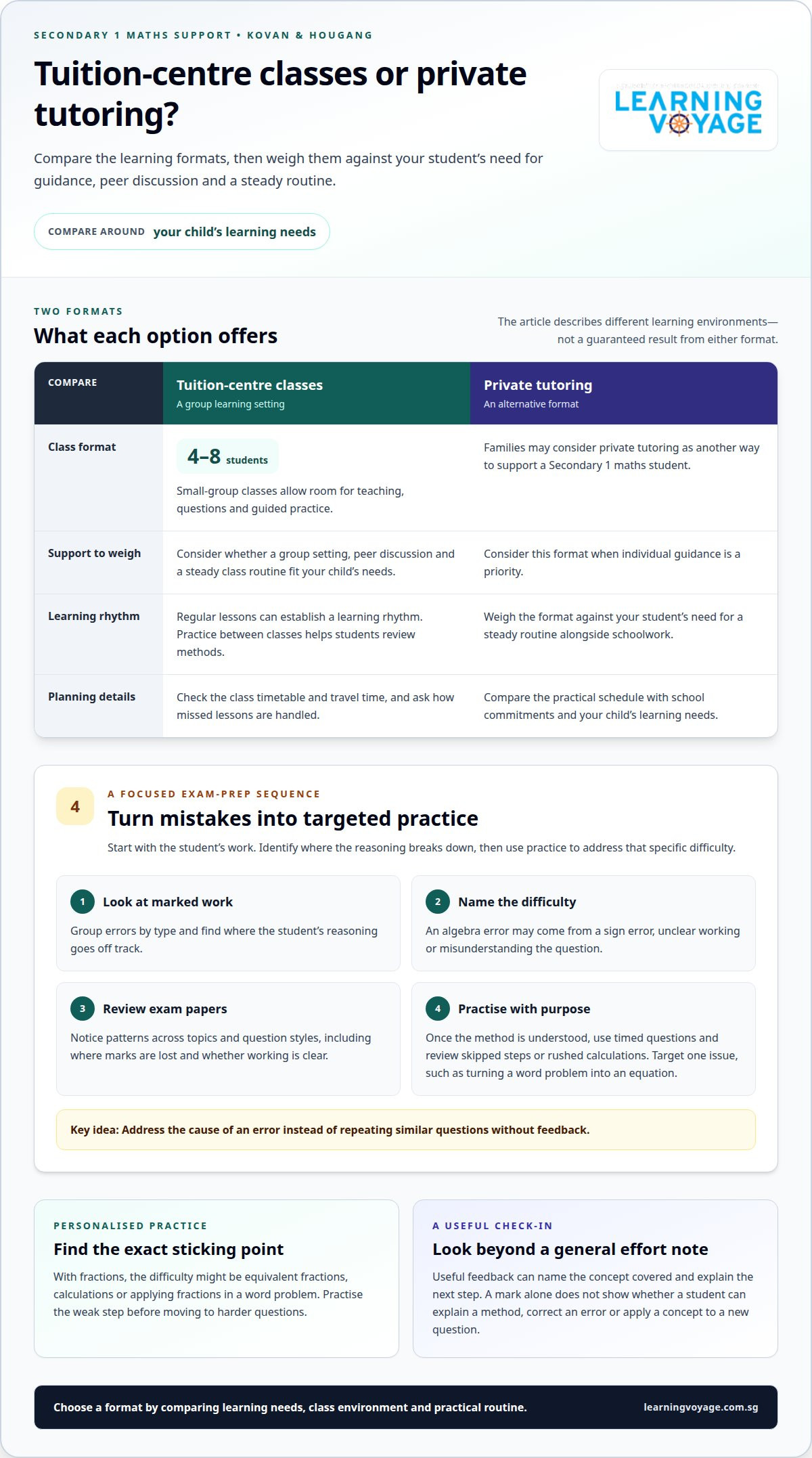
Personalised practice is most useful when each task targets a specific difficulty. If a student struggles with fractions, a tutor can identify whether the issue is equivalent fractions, calculations or applying fractions in a word problem. Later practice can revisit the weak step before moving to harder questions. Regular lessons establish a learning rhythm, while practice between classes helps students review methods.
Timetables matter to busy families. A clear maths class timetable helps parents plan lessons around school commitments and other activities. Travel time also affects whether a schedule feels manageable. Families can weigh that practical detail alongside the class format and the student’s learning needs before settling into a routine.
Study conditions shape concentration. Small-group classes of 4-8 students allow space for teaching, questions and guided practice. A clear teaching area and room to work through examples help students focus on each step. When a method becomes confusing, a tutor can invite the learner to explain where they got stuck. That makes the point of difficulty easier to address, especially during exam preparation.
A trial class can help a student experience the teaching style and class environment. A consultation can clarify learning goals, current understanding and suitable subject support. Families can also ask how missed lessons are handled when planning around school commitments. Considering these details together helps parents decide whether a class routine fits their child’s needs and supports steady progress.
Do you offer Math tuition Hougang and Kovan Maths tuition?
Yes, Secondary 1 maths tuition is available to families across Singapore. Students can receive support through tuition-centre classes, while private tutoring is another format families may consider. The right setting depends on a student’s need for individual guidance, peer discussion and a steady routine alongside schoolwork.
To prepare for exams, start with the student’s marked work. A tutor can group errors by type and identify where the reasoning breaks down. For example, a wrong algebra answer might result from a sign error, unclear working or misunderstanding the question. Addressing the cause makes practice more focused than repeating similar problems without feedback.
Reviewing exam papers can reveal patterns across topics and question styles. A tutor can note where marks are lost, whether working is clear and which methods the student can use confidently. Lessons can then revisit weak foundations before introducing more demanding applications. These habits also support science learning, where students need to show steps and check whether an answer makes sense.
Timed practice works best once the student understands the method. A tutor can set focused questions, observe how the student uses time, then review skipped steps and rushed calculations. The next practice can target one issue, such as translating a word problem into an equation. This makes exam preparation purposeful rather than a stressful repetition of questions.
When choosing a Secondary 1 maths tutor or tuition centre, look for clear explanations, room for questions and practice suited to the student’s current foundation. Private tutoring and group classes offer different learning environments, so families can weigh each against their child’s needs. Exam preparation can also benefit from an approach to identifying learning gaps, so practice addresses a specific hurdle instead of repeating questions without direction.
Private tutoring is an option for Secondary 1 maths students in Kovan. Families can consider it when individual guidance is a priority, and compare it with tuition-centre classes based on their child’s needs.
Student and parent testimonials
A parent’s account can show what progress looks like beyond a single test. For example, one testimonial reports that a Primary 6 student achieved AL2 for mathematics and scored 86 marks in her Term 2 assessment. This is one student’s experience, not a promise that every learner will reach the same grades. For Secondary 1 families, it helps to look for details about teaching, changing study habits and growing confidence.
Students make progress in different ways. Someone who has missed key concepts may need to revisit the foundations first. Guided examples and active practice can then help make a method more secure. Once the student can apply it reliably, extension questions can develop flexible thinking. For example, a learner who understands basic equations can practise explaining how a word problem translates into an equation.
Targeted practice gives each lesson a clear purpose. If errors repeatedly occur with fractions, a tutor can distinguish calculation mistakes from misunderstandings about equivalent values. The student can then practise questions that address the specific weakness before moving on to mixed problems. Parents can look for feedback that names the concept covered and explains the next step, rather than relying only on a general comment about effort.
Testimonials about improved grades are most useful when they explain the context. A parent might describe which topic caused frustration, what support changed and how the student approached later assessments. That sequence helps families understand the work behind a result. A mark alone does not show whether a learner can explain a method, correct an error or apply a concept to a new question. Those skills matter as students build lasting confidence.
When reading feedback, consider both academic and personal progress. Fewer repeated mistakes, greater willingness to ask questions and steadier independent practice can all indicate meaningful change. Together, these details give parents a fuller picture of how students develop skills, manage exam pressure and keep learning at their own pace.
Building foundational understanding and confidence
Confidence grows when a student can explain why a method works, rather than simply copy steps. A tutor can start with a short discussion, asking the student to describe a familiar idea such as place value. If the explanation is unclear, teaching can revisit that foundation before moving to harder questions. This gives the learner a clear starting point and keeps the focus on understanding.
The move from primary school mathematics to Secondary 1 can feel abrupt. A student who can calculate accurately may still struggle to choose a method independently. For example, a ratio question may require identifying the relationship between quantities before calculating. A tutor can model that decision, guide a similar example, then let the student attempt a fresh question with less support.
Small, visible steps help students recognise their progress. A tutor can ask the learner to solve an example, explain each line and identify where a mistake occurred. If the student changes a sign incorrectly, the tutor can revisit that step and provide a similar problem. This makes errors useful evidence, rather than a reason to lose confidence.
Active learning gives students time to think and explain their reasoning. Instead of correcting an answer immediately, a tutor can ask, “Which part of the question tells you what to do?” The student can then practise choosing a method and checking whether the result makes sense. These habits support independent schoolwork and make challenging concepts more manageable.
Parents can support the learning process by noticing specific changes, such as a child explaining a solution aloud or starting homework with less hesitation. These moments show developing skills, even before grades change. For students strengthening earlier concepts, explore primary maths learning support as part of the path towards secondary mathematics. With clear explanations and practice matched to current understanding, each learner can build a steadier foundation at a suitable pace.
Learning Voyage Education Centre
Learning Voyage Education Centre supports students who need a steadier foundation in mathematics and a clearer path through difficult concepts. Its Plug-the-Gaps technique identifies specific learning hurdles and addresses them with targeted support. This approach can suit families seeking structured guidance that responds to a student’s needs.
For a Secondary 1 student, support can strengthen core understanding and build confidence with unfamiliar questions. The aim is to help students progress at a suitable pace while developing skills for later schoolwork.
If you’d like to discuss mathematics support for your child, contact Learning Voyage Education Centre.
Give the next step room to make a difference
A student’s confidence can begin with one clear decision: getting support before confusion becomes discouragement. When choosing a secondary 1 math tutor in Kovan, focus on guidance that helps your child understand methods, ask questions and take the next step with greater independence. Progress takes sustained effort, and an A1 cannot be promised, but a stronger grasp of mathematics gives students a firmer base for future learning.
Learning Voyage Education Centre also supports students as they progress through secondary mathematics, including Secondary 3 A-Mathematics Tuition and Secondary 4 E-Mathematics and A-Mathematics Tuition. The right time to seek guidance is when your child needs focused help to strengthen understanding and move forward with confidence.
Contact Learning Voyage Education Centre to discuss the next step for your child. With patient support and steady effort, every question can become a chance to learn and grow.
Frequently Asked Questions
How do I arrange a trial class?
Learning Voyage offers trial lessons so your child can experience the teaching style and class environment. Share your child’s level, subject and learning needs with the centre to get guidance on class selection and next steps. A trial can help you decide whether the lessons are a good fit.
What are the opening hours?
Contact the centre directly for its current opening hours before planning a visit. Enquiries can be made by phone, WhatsApp, email or the online enquiry form. If you’re asking about a lesson, include your child’s level, subject and preferred class timing. This helps the team respond to your timetable needs and guide you on the next step.
When Should a Kovan Student Begin Secondary 1 Math Tuition?
A student may benefit from support when new topics become difficult to follow, homework repeatedly causes frustration or earlier gaps affect current work. Starting before exam pressure builds gives a tutor time to understand the student’s needs and provide steady guidance. Tuition can also help students who are managing well deepen their understanding, show their working carefully and approach unfamiliar questions with confidence.
Where is the Kovan tuition centre located?
Learning Voyage serves students nationally and isn’t presented as a Kovan-based centre. The question of location is best considered alongside the student’s timetable and travel needs. Contact the centre to discuss how its Secondary 1 maths classes may fit your family’s arrangements. This avoids assuming that a provider’s service area is defined by its name or search wording.
How to get to math tuition centres near Kovan by public transport
The page describes Kovan-to-Punggol travel by MRT as four North East Line stops with no interchange, taking about 15 to 20 minutes. Serangoon is one stop away, Buangkok two, and Sengkang three.
Reviews of Secondary 1 math tutors in Kovan Singapore
One parent testimonial reports that a Primary 6 student achieved AL2 for maths and scored 86 marks in her Term 2 assessment. It is one student’s experience, not a guarantee of similar results.