
What if the academic turbulence your child faces in Secondary 1 Math isn’t a sign of falling behind, but rather a need for a more specialized navigational compass? Many parents in Singapore feel a deep sense of frustration when they witness their child’s confidence waver during this pivotal transition year. If you’re searching for secondary 1 math tuition hougang, you’re looking for more than a tutor; you’re seeking a mentor at Learning Voyage Education Centre who can help your child find their bearings in a more demanding academic sea.
We believe every student deserves the opportunity to succeed at their own pace, moving from the concrete world of primary models to the abstract beauty of algebra. This guide explores how to bridge the gap between PSLE heuristics and Secondary 1 requirements using a diagnostic approach that builds lasting student confidence. We will examine the new MOE syllabus, the benefits of small group coaching, and our unique methodology designed to transform your child’s academic voyage into a path of discovery and distinction.
Key Takeaways
- Recognize the root causes of the “Secondary 1 Slump” to help your child navigate the difficult transition from primary school heuristics to complex abstract thinking.
- Explore the 2026 MOE syllabus pillars and see how our secondary 1 math tuition hougang prioritizes algebraic mastery to prevent early academic frustration.
- Uncover the “Plug-the-Gaps” diagnostic technique that pinpoints specific conceptual weaknesses, ensuring your child’s mathematical foundation remains watertight.
- Evaluate why collaborative small group coaching often outperforms traditional methods for developing a student’s confidence and communication in problem-solving.
- Gain a long-term perspective on the journey toward GCE O-Level excellence by establishing a steady and consistent academic rhythm from the very first day of secondary school.
The Secondary 1 Math ‘Slump’: Why PSLE Success Doesn’t Guarantee Secondary Grades
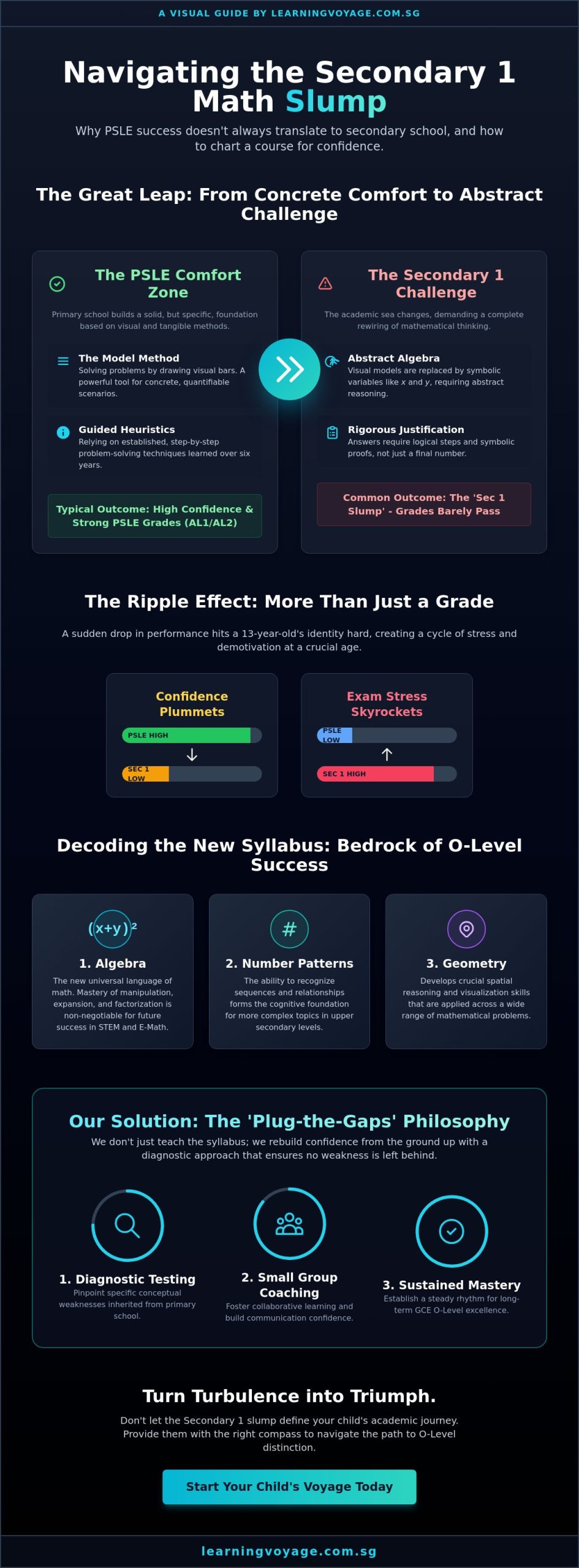
Imagine the shock of the first weighted assessment in Term 1. Your child, who comfortably secured an AL1 or AL2 in their PSLE, returns home with a grade that barely grazes a pass. This isn’t an isolated incident; it’s a documented national phenomenon known as the “Secondary 1 Slump.” According to reports from The Straits Times, the transition from primary to secondary education remains a significant point of concern for families, often requiring a total recalibration of study habits to cope with the increased academic rigor. While primary school offered the sheltered, safe harbor of concrete models and guided heuristics, Secondary 1 launches students into the uncharted, abstract waters of higher-order mathematics. Seeking secondary 1 math tuition hougang early is often the difference between a student who capsizes and one who masters the new currents of the MOE syllabus.
The Jump from Heuristics to Abstract Algebra
The core of the struggle lies in the fundamental change of mathematical language. For six years, your child has mastered the “Model Method,” a cornerstone of the Singapore math methodology that relies on visual bars to represent quantities. However, as they enter secondary school, these visual aids are replaced by the symbolic representation of algebra. Students must suddenly juggle variables like x and y, moving from the pictorial to the purely abstract. It’s a leap that requires a complete rewiring of how they approach problem-solving. Those who rely too heavily on primary school heuristics often feel lost at sea when equations become too complex to draw. The current MOE curriculum demands rigorous justification and symbolic logic. This makes it essential for students to “unlearn” some old habits to make room for more sophisticated algebraic tools.
Emotional Impact: From Confidence to Exam Stress
A sudden drop in academic performance does more than just affect a report card; it strikes at the heart of a 13-year-old’s identity. At an age where they’re already managing the social pressures of a new environment, failing a subject they once excelled in can lead to a devastating loss of motivation. This is where the parent’s role as a supportive navigator becomes vital. You aren’t just looking for a tutor to fix grades. You’re looking for a mentor who can provide a steady hand during this turbulent transition. At Learning Voyage Education Centre, we believe that academic results are inextricably linked to a student’s emotional well-being. Our approach focuses on building character and resilience alongside mathematical mastery. By addressing the “hole in the hull” through diagnostic support, we help students regain their spark. This ensures they don’t just survive the transition but sail toward their O-Levels with absolute certainty.
Decoding the Secondary 1 Math Syllabus: Key Pillars of the Lower Secondary Curriculum
The 2026 academic year marks a pivotal era for Lower Secondary education. The Secondary 1 Math Syllabus is no longer just a collection of arithmetic drills; it’s a sophisticated blueprint designed to cultivate deep mathematical intuition. For parents seeking secondary 1 math tuition hougang, understanding this syllabus is the first step in ensuring their child’s long-term success. The curriculum is built on a “spiral” philosophy. This means that the concepts introduced in these early months aren’t just temporary hurdles; they are the fundamental bedrock upon which future GCE O-Level distinctions are built. The “Big Three” pillars of Algebra, Number Patterns, and Geometry serve as the navigational stars that will guide your child through the next four years of their academic journey.
Algebra: The New Language of Mathematics
Algebra serves as the universal alphabet of the secondary mathematics world. In Secondary 1, students move beyond simple calculations to master algebraic manipulation, expansion, and factorization. This isn’t merely a new topic. It’s a fundamental shift in how they communicate mathematical truths. Mastery of these skills is non-negotiable for anyone aspiring to prestigious STEM pathways or seeking a smooth transition into E-Math Tuition Singapore in their later years. If a student’s grasp of this “language” is shaky, the entire structure of their mathematical understanding risks collapse under the weight of more advanced topics like calculus or trigonometry. At Learning Voyage Education Centre, we focus on ensuring these linguistic foundations are watertight, preventing the frustration that often leads to a loss of interest in the subject.
Number Theory and Real-World Applications
While topics like Prime Factorisation, Highest Common Factor (HCF), and Lowest Common Multiple (LCM) might seem familiar from primary school, the secondary curriculum elevates them to a new level of rigor. Students are no longer just finding numbers. They’re applying these concepts to solve non-routine problems that challenge their higher-order thinking. This shift demands a move away from rote memorisation toward true conceptual mastery. They must understand the logic behind the numbers to navigate the complex problem-solving scenarios that characterize modern examinations. At Learning Voyage Education Centre, our secondary 1 math tuition hougang emphasizes this deep understanding, ensuring every student has the tools to tackle any challenge with confidence. If you’re ready to provide your child with a stronger academic anchor, consider reaching out to our team for a diagnostic assessment to see how we can support their voyage toward excellence.
Geometry and Measurement further round out the curriculum, introducing students to the properties of angles, polygons, and the calculation of volume and surface area. These topics require a keen eye for detail and the ability to visualize three-dimensional space, which are skills essential for both academic success and real-world application. By interlinking these diverse topics, the syllabus prepares students for the multifaceted challenges of the O-Level examinations. This ensures they possess a versatile and robust mathematical toolkit.
The ‘Plug-the-Gaps’ Philosophy: A Diagnostic Approach to Secondary 1 Math Tuition
Navigating the transition to secondary school requires more than just a faster engine; it demands a vessel that is structurally sound from the keel up. Most generic tuition centers operate like a conveyor belt. They follow the school’s pace blindly, moving to Chapter 4 simply because the calendar says so, regardless of whether the student has mastered Chapter 1. This approach ignores the reality that mathematics is a cumulative discipline. At Learning Voyage Education Centre, we employ our signature Plug-the-Gaps technique to ensure every student’s academic vessel is truly seaworthy before they venture into deeper waters. Our secondary 1 math tuition hougang doesn’t just add more information. It identifies and seals the specific weaknesses that cause a student to sink.
Identifying Individual Learning Hurdles
Principal Tutor Andy Woo and his dedicated team understand that every student carries a unique set of “hidden” gaps from their primary school years. Perhaps it’s a lingering confusion over fraction division or a shaky grasp of ratio concepts that suddenly makes algebraic expressions feel impossible. In our small group settings, we provide the personalized attention necessary to pinpoint these exact hurdles. We don’t believe in one-size-fits-all worksheets. Instead, we use a diagnostic process to uncover why a student is struggling with a specific topic. Fixing a Secondary 1 algebra gap now is a critical preventative measure. If left unaddressed, these minor misunderstandings will inevitably lead to a total collapse when the student encounters the far more demanding requirements of Secondary 3 Additional Mathematics. We act as the steady hand that guides them through these early repairs.
The Transformation: From Confusion to Distinction
There is a profound emotional shift that occurs when a student finally experiences their first “Aha!” moment. That flash of clarity, where a complex algebraic equation suddenly makes sense, is the turning point where confusion transforms into confidence. This methodology leads to more than just quantifiable grade improvements. It builds a student’s character and resilience. They stop fearing the subject and start viewing it as a challenge they are fully equipped to handle. This qualitative boost in self-esteem is what carries them through the high-stakes environment of the Singapore examination system. We invite you to learn more About Us and our vision for transformative education. By focusing on the individual’s path of discovery, we turn the daunting transition of Secondary 1 into a successful voyage toward academic excellence and personal growth.
Evaluating Secondary 1 Math Tuition: Why Small Group Coaching Wins
Selecting the right educational environment is as vital as choosing the correct vessel for a long-distance voyage. While many parents consider one-on-one home tuition for its focused attention, this format can often feel like an intense pressure cooker for a thirteen-year-old student. Without the presence of peers, the student lacks a social benchmark and may feel isolated in their struggles. Conversely, large lecture-style classes often result in a loss of individual identity. For those searching for secondary 1 math tuition hougang, the small group coaching model at Learning Voyage Education Centre offers a balanced middle ground. It provides a dedicated, distraction-free space that home environments often lack, ensuring that learning remains the primary focus.
The Power of Peer Learning in Lower Secondary
Lower secondary students are at a stage where social interaction significantly shapes their confidence. In a small group setting of typically 6 to 8 students, the classroom becomes a collaborative space where “Math anxiety” begins to dissipate. When a student observes a peer working through a complex problem and reaching a solution, it fosters a sense of collective resilience. The tutor acts as a navigator who facilitates these group discussions, encouraging students to verbalize their logic. This process of explaining concepts to others is one of the most effective ways to solidify their understanding of symbolic logic. It transforms a solitary struggle into a shared path of achievement.
Professionalism and Resource Quality
The quality of learning materials can make or break a student’s interest in the subject. Unlike home tutors who may rely on generic assessment books or outdated notes, a specialist center provides proprietary, syllabus-aligned resources. These materials are specifically designed to bridge the gap between primary heuristics and secondary logic. At Learning Voyage Education Centre, our educators are dedicated professionals who view teaching as a transformative calling. This level of commitment ensures your child receives high-quality mentorship. If you’re ready to secure a spot in our upcoming intake, checking our Class Schedules is the best way to start. We invite you to reach out to us to see how our small group approach can anchor your child’s academic future.
Navigating the Path to O-Level Distinction: A Holistic Secondary 1 Strategy
The first year of secondary school is far more than just a new grade level; it’s the critical first leg of a four-year voyage toward the GCE O-Levels. While many see this period simply as a time of adjustment, it’s actually the most strategic moment to establish a “proven map” for mathematical excellence. At Learning Voyage Education Centre, we don’t just focus on short-term grade spikes. We provide the steady hand of a dedicated mentor who understands that parents want more than just “grades”; they want character and confidence. For parents seeking secondary 1 math tuition hougang, our mission is to transform this transition into a launchpad for future achievement, ensuring your child doesn’t just keep their head above water but sails with confidence toward their long-term goals.
Beyond the Classroom: Building Higher-Order Thinking
Success in secondary mathematics isn’t limited to solving textbook problems. It’s about developing the analytical mindset required for the rigors of Junior College or Polytechnic education. We integrate creative pedagogical tools, such as our unique Post-it Notes technique, to help students visualize connections between seemingly disparate concepts. This approach encourages higher-order thinking and real-world application, making math a tool for life rather than a subject of dread. By fostering this intellectual curiosity, we prepare students to navigate the increasingly complex academic landscape of 2026 and beyond. It’s about building a robust foundation that supports a student’s evolution into a prepared and confident individual.
Securing Your Child’s Academic Future
There’s no better time to address conceptual weaknesses than during this foundational transition year. Every gap plugged today is a hurdle removed from their future path in Upper Secondary. We believe every student’s potential is a continuous path of discovery, waiting to be unlocked with the right guidance and support. Don’t wait for the stress of mid-year examinations to seek help. Taking a proactive stance now ensures your child maintains their momentum and self-belief. We invite you to contact us for a comprehensive diagnostic consultation to see how our secondary 1 math tuition hougang can anchor your child’s success and turn their educational journey into a triumphant voyage.
Empowering Your Child’s Mathematical Voyage
Transitioning to secondary school doesn’t have to be a period defined by academic stress. It’s a fresh start. By mastering algebra early and addressing conceptual gaps, your child can maintain the momentum they worked so hard to build during their primary years. Choosing secondary 1 math tuition hougang at Learning Voyage provides more than just a seat in a classroom; it offers a mentorship-driven environment where character and confidence are built alongside grades. Founded in 2011 by Principal Tutor Andy Woo, our center has specialized in helping students navigate the complex MOE syllabus through our proprietary “Plug-the-Gaps” methodology.
We are specialists in Mathematics and Science who understand the high-stakes nature of the Singapore system. Our diagnostic approach ensures that foundational leaks are sealed before they impact future performance in Additional Mathematics. Let’s work together to transform confusion into a lifelong love for discovery and achievement. Your child’s potential is limitless when they have the right map and a dedicated navigator by their side.
Book a Diagnostic ‘Plug-the-Gaps’ Consultation for Your Secondary 1 Child Today
Frequently Asked Questions
Is Secondary 1 Math really that much harder than Primary 6 Math?
Secondary 1 Math introduces a significant shift in cognitive demand by moving from pictorial models to symbolic algebra. While PSLE focuses on concrete heuristics, the secondary syllabus requires abstract reasoning and rigorous justification. This transition often feels steeper because students must learn a completely new mathematical language while simultaneously managing the social pressures of a new school environment. It’s a fundamental change in how they perceive numbers and logic.
How can I tell if my child needs Secondary 1 Math tuition or just more time to adjust?
Monitor your child’s reaction to their Term 1 results and their ability to explain new concepts at home. If they consistently express frustration or their grades continue to dip after the initial adjustment period, it’s likely time for professional support. Seeking secondary 1 math tuition hougang early prevents minor misunderstandings from becoming deep-seated academic hurdles that are much harder to fix in later years when the curriculum accelerates.
What is the ‘Plug-the-Gaps’ technique and how does it differ from school teaching?
The ‘Plug-the-Gaps’ technique is our proprietary diagnostic methodology designed to identify and seal specific conceptual weaknesses in a student’s foundation. Unlike school teaching, which must adhere to a strict national timeline and move through the syllabus regardless of individual progress, this approach prioritizes mastery. We find the specific “hole in the hull” and fix it before moving on to more complex topics; this ensures a seaworthy foundation for the years ahead.
Can my child catch up if they didn’t do well in their Sec 1 weighted assessments?
Yes, your child can certainly recover and excel if the right support is provided promptly. Secondary 1 is only the first leg of a four-year voyage toward the GCE O-Levels. By identifying the root cause of their performance dip now, we can rebuild their confidence and ensure they have a sturdy foundation for more advanced subjects like Additional Mathematics that they’ll encounter in Secondary 3.
How much time should a Secondary 1 student spend on Math practice each week?
A Secondary 1 student should ideally dedicate 3 to 5 hours of focused practice each week outside of school hours. This consistency helps reinforce new algebraic rules and geometric properties that differ from primary school methods. It isn’t just about the quantity of hours; it’s about the quality of the practice and ensuring they understand the underlying logic behind every solution they write rather than just memorizing steps.
What happens if my child struggles with Algebra specifically?
Algebra is the fundamental bedrock of the lower secondary curriculum, so immediate intervention is crucial if a student feels lost. We break down algebraic manipulation and factorization into manageable steps, treating it as a new language to be mastered. Our tutors provide the “steady hand” needed to help students navigate these abstract concepts until they become second nature and no longer cause exam-related stress or anxiety.
Why should I choose a specialized tuition centre over a home tutor for Sec 1 Math?
Specialized centers offer a more professional and resource-rich environment than most 1-on-1 home tuition arrangements. At Learning Voyage, we provide proprietary materials that are meticulously aligned with the latest MOE syllabus updates and 2026 examination trends. You benefit from a dedicated team of educators who view teaching as a transformative mission rather than just a temporary, part-time job or a way to earn extra pocket money.
How do small group classes at Learning Voyage help with student confidence?
Small group settings create a collaborative “safe harbor” where students feel comfortable asking questions and learning from their mistakes. Seeing their peers struggle and eventually succeed builds collective resilience and significantly reduces individual math anxiety. This social learning environment transforms the academic journey into a shared experience of personal growth; it proves to students that they aren’t alone in their academic voyage toward excellence.