
What if your child’s struggle with PSLE Science isn’t about a lack of knowledge, but rather a missing compass to decode the strict marking schemes of 2026? It’s a common heartbreak for many parents in Singapore to see their child study for hours only to lose marks because they didn’t hit the exact “keywords” required by examiners. You aren’t alone in feeling overwhelmed by the sheer volume of content from P3 to P5, especially with recent syllabus changes like the removal of the “Cells” topic. Our psle science workshop kovan is designed to act as a lighthouse, guiding students through these choppy academic waters with clarity and purpose.
We’ll show you how to transform that persistent exam anxiety into genuine, exam-ready confidence using our specialized revision strategies and proprietary techniques. You’ll discover how we empower students to master complex answering structures and tackle the new “Real-Life Scenario” questions with ease. This guide provides a clear study roadmap for the final sprint toward the September 29, 2026, written examination, ensuring your child doesn’t just survive the season but charts a steady course toward distinction.
Key Takeaways
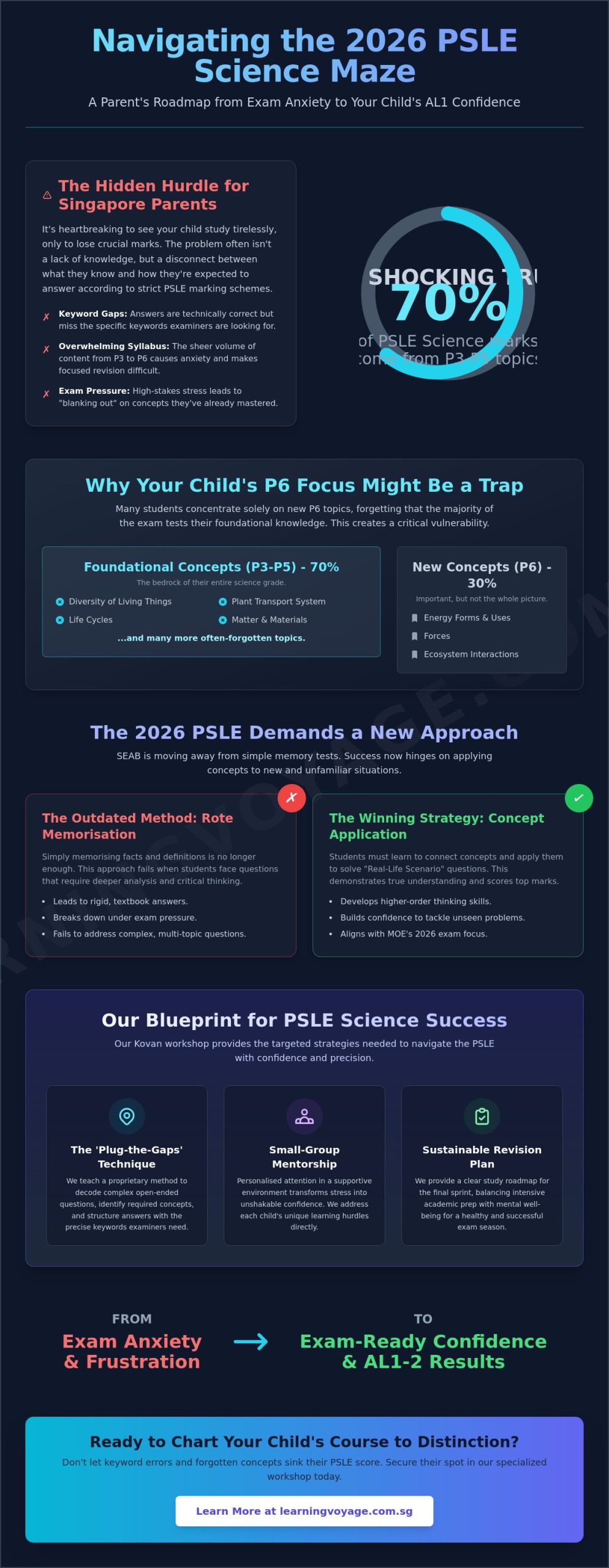
- Understand why P3 to P5 topics represent nearly 70% of the examination and learn how to secure these marks by revisiting foundational concepts often overlooked in the final year.
- Move beyond rote memorisation by applying our proprietary “Plug-the-Gaps” technique to decode complex open-ended questions with precision and contextual accuracy.
- Discover how the psle science workshop kovan transforms exam-related stress into unshakable confidence through personalized, small-group mentorship that addresses unique learning hurdles.
- Learn to identify the subtle contextual clues in 2026 real-life scenario questions, ensuring your child’s answers meet the strict marking criteria of the national syllabus.
- Establish a sustainable revision schedule that balances intensive academic preparation with mental well-being for a successful and healthy final PSLE sprint.
The PSLE Science Voyage: Why Intensive Revision is Your Child’s North Star
The leap from Primary 5 to Primary 6 is often described by Singaporean parents as a sudden, turbulent sea change. While the earlier years focus on foundational content acquisition, the final year demands a sophisticated synthesis of knowledge that many students find daunting. This psychological shift can be jarring. Your child is no longer just learning about life cycles; they are now expected to analyze how a change in one variable ripples through an entire ecosystem. Many students, even those who excelled in previous years, find themselves adrift when faced with the increased complexity of the national syllabus. It’s heart-wrenching to watch a diligent student lose marks not because they don’t understand the concept, but because they can’t navigate the rigid requirements of the marking scheme.
Traditional classroom settings, while foundational, often lack the maneuverability to address individual misconceptions during the high-pressure final sprint. Teachers are often racing to complete the syllabus, leaving little room for the deep, conceptual anchoring required for the Primary School Leaving Examination (PSLE). This is where a targeted psle science workshop kovan serves as a vital North Star. It provides the focused environment needed to bridge the gap between knowing the facts and applying them with the precision examiners demand. Our Primary 6 Science tuition strategies are designed to transform this frustration into a methodical path toward achievement.
Navigating the 2026 PSLE Landscape
The 2026 examination landscape marks a significant departure from previous years, with the Ministry of Education (MOE) removing topics like “Cells” to make room for deeper scientific inquiry. Today’s SEAB papers move away from simple recall, favoring “Real-Life Scenario” questions that test higher-order thinking. To reach the destination of an AL1 or AL2, students must demonstrate an ability to link disparate concepts under exam conditions. Distinction in this climate is not about how much a child remembers, but how effectively they can apply scientific principles to unfamiliar problems.
The Emotional Anchor: Building Student Confidence
Confidence is the fuel that keeps a student moving forward when the questions get tough. In our psle science workshop kovan, we emphasize a move from “I don’t know” to “I can solve this” through dedicated small-group mentorship. This personalized attention ensures that no student is left drifting in a sea of confusion. When a child receives real-time, targeted feedback on their answering structures, the vast syllabus begins to feel manageable. A supportive learning environment acts as a safe harbor, allowing students to build the resilience needed to face the high-stakes PSLE year with a calm and prepared mind.
Charting the Syllabus: Recovering P3 to P5 Concepts Before the Final Examination
It’s a common misconception among Primary 6 students that the bulk of their final grade rests on the topics they’ve just learned. In reality, approximately 70% of the marks in a standard paper are derived from the foundational concepts taught between Primary 3 and Primary 5. This creates a significant risk for students who focus solely on their P6 textbooks while allowing earlier knowledge to drift into the depths of forgetfulness. Many parents feel a sharp sense of frustration when their child masters complex P6 Energy topics but loses marks on “simple” P3 Diversity questions. These forgotten shoals, such as the specific characteristics of fungi or the intricacies of the plant transport system, can sink an otherwise stellar performance.
The danger often lies in “silo learning,” where a student views each topic as an isolated island rather than part of a cohesive ecosystem. For example, a question about how a plant survives in a desert requires an integrated understanding of both “Systems” and “Interactions.” Without a systematic audit of their knowledge, students often harbor hidden conceptual gaps that only surface during the high-stakes environment of the exam. This lack of clarity often contributes to research on test anxiety, as students feel an underlying sense of unpreparedness. Our psle science workshop kovan provides the navigational charts necessary to identify these gaps through a rigorous diagnostic process, ensuring every “hole in the hull” is patched before the final voyage. If you’re looking for a more consistent support system, our Primary 6 Science tuition offers ongoing guidance to keep these foundations strong.
The Core Pillars: Diversity, Systems, and Cycles
Diversity, Systems, and Cycles form the bedrock of the lower primary syllabus and frequently dominate Section B of the PSLE paper. Misconceptions in Human Systems are particularly common; many students still struggle to explain the distinct roles of the small and large intestines or how the circulatory system interacts with the respiratory system. To achieve rapid content mastery, we move away from rote memorisation. Instead, we use visual mapping to help students see the connections between these pillars, ensuring they can explain biological processes with the precision required by the current marking schemes.
Interactions and Energy: The P5 and P6 Heavyweights
Themes like “Energy” and “Interactions” are often the most challenging because they require students to explain abstract concepts in concrete terms. A perennial favorite for examiners is the link between Heat Energy and the Water Cycle, where students must precisely describe the gain or loss of heat during evaporation and condensation. In this context, “Interactions” questions evaluate a student’s ability to trace how a specific change in an environment triggers a predictable chain of biological or physical consequences. Mastering this cause-effect relationship is essential for navigating the complex open-ended questions found in our psle science workshop kovan.
Beyond Rote Memorisation: Mastering Open-Ended Questions with the ‘Plug-the-Gaps’ Technique
Breaking the habit of rote memorisation is often the most challenging hurdle for a Primary 6 student. Many children enter the exam hall with a head full of facts but find themselves unable to translate that knowledge into the specific “Exam Language” that SEAB markers require. It’s incredibly disheartening for both parent and child when a paper comes back with zeros next to questions the student “knew” the answer to. This gap between understanding and expression is where marks are frequently lost. To bridge this, our psle science workshop kovan introduces students to the Plug-the-Gaps technique, a three step process designed to Identify conceptual weaknesses, Resolve misconceptions, and Master the application of scientific principles.
While many tuition centres fixate on isolated “keywords,” we’ve found that keywords are only half the battle. Modern PSLE Science papers increasingly rely on “Key Phrases” and “Contextual Clues” embedded within the question. For instance, simply mentioning “evaporation” is rarely enough to secure full marks in a 2-mark Open-Ended Question (OEQ). A student must also describe the “gain of heat from the surroundings” and the subsequent “change in state from liquid to gas.” Our workshop in Kovan trains students to deconstruct the anatomy of these questions, ensuring they provide the precise evidence needed to satisfy the marking scheme without leaving marks on the table.
The Art of Answering: Claim, Evidence, and Reasoning
We teach students to view every OEQ as a mini-argument. Before a single word is written, the student must identify the core scientific concept being tested. Is it about the properties of materials or the transfer of energy? Once the concept is anchored, they follow a structured Claim, Evidence, and Reasoning (CER) framework. This links their direct observations to theoretical principles, creating a logical flow that markers can easily reward. To reinforce these structures at home, we encourage the Post-it Notes strategy, where students summarize these frameworks and place them in high-visibility areas to build muscle memory.
Experimental Design: Variables and Fair Tests
Experimental design questions are a staple of the PSLE, yet they remain a common pitfall. Students often struggle to differentiate between the “Aim of the Experiment” and the “Conclusion,” or they fail to identify the Changed, Constant, and Measured variables in a complex, unfamiliar scenario. We provide rigorous practice in identifying these components to ensure every experiment is viewed through the lens of a “Fair Test.” A control setup is essential for a valid Science experiment because it provides a baseline for comparison to ensure that the results are solely due to the variable being tested. Mastering these nuances in our psle science workshop kovan gives students the confidence to navigate even the most unconventional experimental setups.
Transforming Exam Stress into Confidence: The Impact of Small-Group Science Coaching
Imagine your child sitting in a vast lecture hall, drifting further away from the shore of understanding as a teacher speaks to a hundred faces at once. In such large environments, it’s easy for a student to feel like a small boat lost in a massive academic ocean. This is why our psle science workshop kovan prioritizes a small-group maritime advantage. By limiting our intake, we ensure that no student is left drifting. Our educators can identify the unique learning hurdles of each child in real-time, noticing the slight flicker of doubt when a “Cycles” question appears. This personalized attention allows us to adjust our sails immediately, providing the specific guidance needed to steady the ship before the exam pressure builds.
Peer learning within this intimate setting also serves as a powerful catalyst for growth. When a student sees a classmate struggle with the same “Systems” misconception, it humanizes the challenge and reduces the weight of exam stress. We foster a “Growth Mindset” where every wrong answer is treated simply as a gap that needs to be plugged. By analyzing these collective mistakes together, students gain a deeper, more resilient understanding of the syllabus. They learn that a “leak” in their knowledge isn’t a sign of failure; it’s an opportunity to strengthen their hull for the final PSLE voyage. This collaborative atmosphere transforms the often lonely experience of revision into a shared journey toward excellence.
The Learning Voyage Pedagogy
Our educators act as seasoned captains, guiding students through the inevitable academic storms of the P6 year. We strike a purposeful balance between rigorous drill-work and nurturing mentorship, ensuring that academic results never come at the expense of a child’s well-being. By integrating our comprehensive Primary Science Tuition curriculum into our intensive workshop format, we provide a cohesive experience that bridges the gap between weekly lessons and high-stakes examination requirements.
Real Transformation: From ‘U’ to ‘A’
We’ve witnessed remarkable transformations where students who were previously sinking under the weight of failing grades managed to bridge significant gaps in just a single term. This success is rooted in consistent practice and the relentless application of our “Plug-the-Gaps” methodology. Interestingly, the confidence gained in our psle science workshop kovan often spills over into other subjects. When a child realizes they can master the complexities of Science, they approach their Mathematics papers with a newfound sense of capability and poise. If you want your child to experience this same boost in confidence, speak with our team today to secure a spot in our next session.
Preparing for the PSLE Science Paper: Your Child’s Journey to Academic Excellence
The final weeks before the Science written examination on September 29, 2026, shouldn’t feel like a desperate scramble to stay afloat. Instead, this period should be a calm, methodical final approach toward the destination of academic success. Our psle science workshop kovan is designed to transform this high-pressure window into a time of refinement and consolidation. It’s about ensuring that every concept is anchored and every answering technique is sharp. A sustainable revision schedule is paramount; burning the midnight oil often leads to diminished returns and increased anxiety. We encourage students to balance their intensive studies with adequate rest, as a well-rested mind is far more capable of the higher-order thinking required for modern application questions.
Every Primary 6 student should have a finalized “toolkit” before they step into the exam hall. This isn’t just about stationery; it’s about a mental inventory of strategies. This toolkit must include a mastery of the CER framework for open-ended questions, a clear understanding of experimental variables, and the ability to manage time effectively across both Section A and B. Confidence doesn’t come from knowing everything; it comes from knowing you have the tools to handle anything. By joining our psle science workshop kovan, your child gains access to these specialized instruments, ensuring they are prepared for whatever the SEAB paper presents.
The Final Countdown: A Weekly Revision Roadmap
In the last four weeks, we shift our focus toward high-weightage topics like Systems and Energy, which often carry the most marks. Mock papers are utilized not just for content testing, but as a way to refine time management skills under exam conditions. This prevents the common pitfall of rushing through the final pages. To assist with last-minute concept recall, we recommend using our Post-it Notes strategy. These visual cues serve as quick-reference anchors for complex cycles and processes, making them perfect for light revision in the final days.
Beyond the Exam: Skills for a Lifetime
The journey doesn’t end when the results are released. The “Plug-the-Gaps” methodology we use isn’t just a shortcut to an AL1; it’s a way of thinking that prepares students for the rigours of Secondary Science. By learning to identify weaknesses and resolve them systematically, students build critical thinking skills that will serve them throughout their academic lives. We invite you to check our class schedules for upcoming sessions that can help your child find their footing. This is more than just tuition. It’s a transformative experience that builds character alongside results. Please contact Learning Voyage today to secure your child’s spot on our next voyage toward distinction.
Set Your Course for PSLE Science Success in 2026
The journey toward the PSLE Science written examination on September 29, 2026, doesn’t have to be a solo struggle against rising tides of content and strict marking schemes. You’ve seen how recovering forgotten P3 to P5 concepts and mastering the “Plug-the-Gaps” technique can turn academic frustration into a steady path toward distinction. By focusing on application rather than rote memorisation, your child can confidently navigate even the most complex real-life scenario questions. Our psle science workshop kovan offers the expert small-group coaching and proven track record of grade transformations needed to anchor your child’s success.
We’re dedicated to more than just results; we’re here to build the character and resilience that will carry your child into Secondary school and beyond. Don’t let your child drift through the final revision sprint without a clear map and a seasoned captain to guide them. Secure your child’s distinction—Join the Learning Voyage PSLE Science Workshop today. Every student deserves the opportunity to reach their full potential and we’re ready to help them set sail with confidence.
Frequently Asked Questions About Our PSLE Science Revision
What is the ‘Plug-the-Gaps’ technique used in your Science workshops?
The ‘Plug-the-Gaps’ technique is our signature three-step methodology designed to Identify conceptual weaknesses, Resolve deep-seated misconceptions, and Master the application of scientific principles. It moves beyond simple memorisation by teaching students how to scan a question for contextual clues. By addressing the specific “leaks” in a student’s understanding, we ensure their academic hull is watertight before they face the high-pressure environment of the national examination.
How much of the PSLE Science paper is based on P3 to P5 topics?
Approximately 70% of the total marks in a standard PSLE Science paper are derived from themes introduced in Primary 3 to Primary 5. This includes foundational topics like Diversity, Systems, and Cycles that many students often overlook in their final year. Our psle science workshop kovan places a heavy emphasis on these earlier levels to ensure students don’t lose marks on “forgotten” content that forms the bedrock of the syllabus.
Can a short-term workshop really help my child improve their Science grade?
An intensive revision workshop acts as a powerful catalyst for grade transformation by providing a focused environment free from the distractions of a regular school week. While long-term progress is vital, these high-impact sessions allow students to anchor core concepts and refine their answering structures in a very short time. It’s often the final push needed to move a student from a plateau into the range of distinction.
What is the difference between your Science workshop and regular weekly tuition?
Our regular weekly tuition provides a continuous path of discovery and steady conceptual building throughout the academic year. In contrast, the intensive workshop is a strategic sprint designed specifically for rapid revision and exam-day resilience. While tuition covers the breadth of the syllabus, the workshop focuses on the depth of answering techniques and the most challenging application questions found in our psle science workshop kovan.
Do you provide study materials and notes during the PSLE Science workshop?
Yes, every student receives a comprehensive set of proprietary materials, including concept maps, summary notes, and curated practice papers. These resources are designed to be concise and high-impact, serving as a reliable navigation guide for the final weeks of revision. We also include our specialized answering frameworks that help students translate their scientific knowledge into the precise language required by markers.
How do you help students who struggle specifically with Open-Ended Questions?
We tackle Open-Ended Questions by teaching students the Claim, Evidence, and Reasoning (CER) framework, which ensures every answer is logically structured and scientifically sound. Many students lose marks because they lack “Exam Language” fluency, even when they understand the topic. We train them to identify the specific scientific principle being tested so they can provide the exact evidence markers are looking for.
Is the workshop suitable for students who are already scoring well but want an AL1?
Students who are already performing well benefit immensely from our focus on the nuances of higher-order thinking and complex “Real-Life Scenario” questions. To reach an AL1, a student must eliminate “near-miss” errors where marks are lost due to slightly imprecise phrasing or incomplete reasoning. We provide the sophisticated mentorship needed to fine-tune these answering structures and ensure every mark is secured.
What happens if my child misses a session of the intensive revision program?
If a student is unable to attend a session, we recommend that parents contact our center immediately to check for available catch-up options or to collect the missed lesson materials. Since our workshop follows a logical and building momentum, it’s important for the student to review the content they missed to stay on track. We approach every student’s needs with a supportive and methodical hand to ensure their progress remains steady.