Learning Voyage – Math and Science Specialist



By Andy Woo May 18, 2026
PSLE Math Intensive Revision in Buangkok: Navigating the Path to Excellence in 2026
What if the secret to conquering the 2026 PSLE Math Paper 2 isn’t another towering stack of practice papers, but a fundamental shift in how your child navigates a single complex heuristic? As the exam season approaches, many parents in the Buangkok area feel a heavy weight of guilt, watching their children drift through waves of anxiety caused by the intricate AL scoring system. It’s a common struggle to see a student lose confidence when faced with the latest syllabus demands, where “Speed” has been removed and “Ratio” and “Average” now demand even greater precision. We understand that you want more than just a functional result; you want your child to stand on solid ground with a sense of personal achievement.
This article explores how a targeted, conceptual approach to psle math intensive revision buangkok can transform that paralyzing exam-day dread into boardroom-level confidence. We’ll outline a “Plug-the-Gaps” strategy that moves beyond rote memorization, helping your child master complex problem-solving techniques while maintaining their mental well-being. By focusing on quality over quantity, we’ll show you how to chart a course toward a clear jump in AL grades and a child who walks into the exam hall feeling truly prepared for the challenges ahead.
Key Takeaways
- Understand why the 2026 syllabus updates mean traditional drilling is no longer enough to secure high AL grades in the challenging Math Paper 2.
- Discover the “Plug-the-Gaps” methodology, a surgical approach that identifies and fixes hidden conceptual hurdles before they sink a student’s confidence.
- Learn how to choose between long-term tuition and a psle math intensive revision buangkok workshop to effectively reset your child’s academic momentum.
- Master the “Three-Read” method and the Big 5 Heuristics to decode complex word problems and navigate the most difficult exam questions with ease.
- Explore how a mentorship-driven partnership can transform paralyzing exam anxiety into a steady, boardroom-level confidence for the final lap.
Navigating the 2026 PSLE Math Challenge: Why Traditional Drilling Isn’t Enough
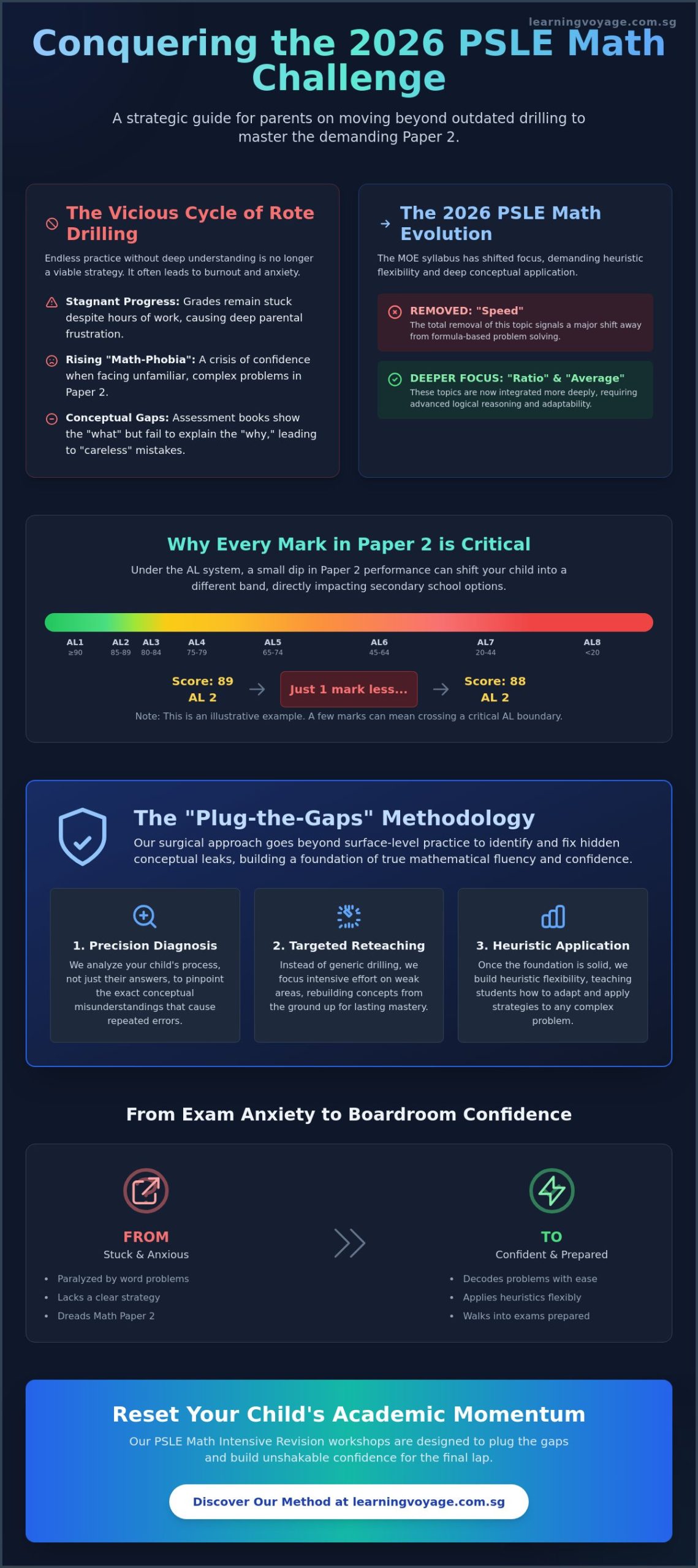
The 2026 Primary School Leaving Examination (PSLE) represents a significant evolution in how Singapore assesses mathematical talent. With the total removal of “Speed” from the syllabus and the integration of “Ratio” and “Average” deeper into the Primary 6 curriculum, the MOE has signaled a clear shift toward application over rote memorization. It’s no longer enough to finish a mountain of assessment books. Instead, the focus has moved to logical reasoning and the ability to adapt to novel problem structures. For families seeking psle math intensive revision buangkok, it’s vital to recognize that traditional drilling often leaves a student ill-equipped for the unpredictable nature of Paper 2.
Paper 2 remains the primary source of academic turbulence for many. It’s the section where the most significant grade fluctuations occur because it demands a high level of heuristic flexibility. When a child stares at a complex problem and feels their mind go blank, they aren’t just suffering from a lack of knowledge; they’re experiencing a crisis of confidence. This “Math-phobia” isn’t solved by more of the same repetitive practice. It requires a mentor who can provide a steady hand and a clear map through the fog of exam stress, helping the student find their footing before the clock runs out.
Standard assessment books are frequently limited in their scope. They provide the “what” but rarely the “why” or “how” of higher-order thinking. They can’t offer real-time feedback or identify the subtle conceptual missteps that lead to the dreaded “careless mistake.” Without a targeted strategy, a student might spend hours practicing the wrong techniques, effectively anchoring themselves to a lower grade.
The AL Scoring System and Your Child’s Future
Every single mark carries immense weight under the AL scoring system. A slight dip in Paper 2 performance can nudge a student from an AL 1 to an AL 2, potentially altering the trajectory of their secondary school choices. It’s a high-stakes environment. Recent trends in national papers show examiners favoring questions that test a student’s ability to decode complex scenarios. Consistent performance isn’t just about securing the easy marks in Paper 1; it’s about having the grit to navigate the stormy sections of Paper 2 with precision.
Recognizing the Signs of Stagnant Progress
Parents often feel a deep sense of frustration when their child remains stuck despite hours of extra help. If you’ve noticed that your child understands a concept in isolation but fails to apply it under pressure, the issue isn’t a lack of effort. It’s a lack of heuristic flexibility. Simply adding more hours of primary maths tuition won’t fix the problem if the underlying conceptual gaps aren’t plugged first. We see many students who are proficient in individual topics but struggle when those topics are woven together in a single, complex problem. Identifying these stagnant patterns early is the first step toward a successful transformation.
The “Plug-the-Gaps” Methodology: A Surgical Approach to Intensive Revision
Imagine a vessel attempting to cross a vast ocean while slowly taking on water through a small, unseen puncture in its hull. No matter how hard the crew rows or how sophisticated their navigation equipment is, the ship remains at risk of sinking under pressure. This is the reality for many students approaching their final year; they possess the drive, but hidden conceptual “leaks” prevent them from reaching their full potential. Our psle math intensive revision buangkok program utilizes a surgical “Plug-the-Gaps” approach to identify these specific hurdles before they become insurmountable obstacles in the exam hall.
Moving beyond rote memorization requires a shift toward true mathematical fluency. In our small group settings, we don’t just look at the final answer. We observe the process. This personalized attention allows a mentor to spot “hidden” misconceptions that a standard classroom setting might overlook. When a tutor identifies that a student is struggling not with the logic of a problem, but with the underlying arithmetic of fractions, they can fix that specific leak. Once that gap is plugged, the student’s progress accelerates exponentially, transforming their relationship with the subject from one of fear to one of mastery.
Identifying the Learning Hurdles
The transition from Primary 5 to Primary 6 is notoriously steep, with the 2026 syllabus placing even more weight on abstract reasoning. By using a diagnostic assessment to map out a student’s “mathematical map,” we can pinpoint exactly where their foundation is wavering. This is the core of our Plug-the-Gaps methodology. It’s about finding the root cause of stagnant progress, ensuring that every hour of revision is purposeful rather than just repetitive.
Anchoring Concepts Through Mentor-Led Coaching
Effective revision is a transformative process that builds character alongside academic results. A dedicated mentor acts as a lighthouse, providing the safety and navigation needed to weather the storm of exam stress. Integrating evidence-based strategies to manage math anxiety is essential for long-term retention. When a child feels anchored by a strong conceptual understanding, they no longer need to rely on short-term cramming. They walk into the exam hall with the steady confidence of a seasoned navigator. If you’re looking for a partner to help your child find their footing, our primary maths tuition provides the bespoke support they deserve.
Consider the concept of Ratio as a master key. We’ve found that when we “plug the gap” in a child’s understanding of Ratio, it often unlocks five other related topics: Fractions, Percentages, Area, Volume, and complex Geometry. By fixing one foundational flaw, we empower the student to solve a vast array of Paper 2 problems that previously seemed impossible. This is the difference between simply practicing Math and truly understanding it.
Intensive Revision Workshops vs. Regular Tuition: Choosing Your Strategy
Deciding whether to enroll your child in a steady, weekly program or a high-impact workshop is a strategic choice that can define their final PSLE outcome. While a long-term primary maths tuition program provides the consistent, rhythmic practice needed to build a deep conceptual foundation, an psle math intensive revision buangkok workshop acts as a high-velocity surge to clear specific academic hurdles. Think of weekly tuition as the steady current that carries a vessel forward, while intensive revision is the focused effort required to navigate through a narrow, challenging strait during the peak of the storm.
Many large, factory-style tuition centers offer generic bundles that can leave parents feeling adrift, unsure of which specific module their child actually needs. In contrast, a specialist boutique focus allows for a more bespoke coaching experience. By evaluating the return on investment, it’s clear that a well-timed intensive session can save a student months of trial and error, identifying and correcting mistakes that would otherwise go unnoticed until the actual exam day. This surgical precision is what separates a student who is merely busy from one who is truly prepared. School holiday programs play a vital role here, serving as a necessary reset to a student’s academic momentum before the final lap begins.
The Power of High-Impact Revision
High-impact revision shifts the focus from learning new content to mastering exam-smart techniques. This includes sharpening time management, improving calculation accuracy, and developing the grit to tackle Paper 2’s most daunting questions. There’s a profound psychological benefit to this dedicated sprint before the national examinations; it builds a sense of urgency and momentum that regular classes sometimes lack. For parents looking for a broader local context, our insights on Primary Maths Tuition in Hougang & Kovan illustrate how consistent long-term support prepares the ground for these final, high-intensity efforts.
Small Group Coaching: The Competitive Edge
The effectiveness of any intensive program hinges on the student-to-tutor ratio. We’ve found that a 1:6 or 1:8 ratio is the sweet spot for PSLE Math mastery, providing enough individual attention for the tutor to act as a personal navigator while still fostering healthy peer interaction. In these small groups, students see they aren’t alone in their struggles. This shared experience builds confidence, as they watch their peers overcome the same complex heuristics. A dedicated educator provides the steady hand needed to guide each student through the storm of exam season, ensuring no one is left behind as the destination comes into view.
Strategic Tactics to Conquer PSLE Math Heuristics and Paper 2
Success in the final examination is rarely a matter of luck; it is the result of a systematic approach to decoding complexity. While Paper 1 provides the foundation, Paper 2 is where the most challenging “killer” questions reside. To navigate these turbulent waters, students must possess a robust toolkit of problem-solving strategies. Our psle math intensive revision buangkok focuses on mastering the Big 5 Heuristics that appear most frequently in national papers: Constant Part, Constant Total, Constant Difference, Units and Parts, and Supposition. The Supposition Method acts as an elegant shortcut for “Assumption” problems, allowing students to hypothesize a single category for all items and systematically adjust for the difference without the need for tedious guess-and-check tables.
Mastery also requires a disciplined reading strategy. We teach the “Three-Read” method to ensure no data point is missed. First, students read for context to understand the story. Second, they read for data, identifying the specific numbers and relationships. Finally, they read for the specific question asked to avoid answering the wrong thing. This methodical approach acts as a mental anchor, preventing the “transfer error” trap where a student correctly solves a part of the problem but fails to provide the final required value. Time management is equally critical. We encourage students to secure the “easy” marks in Paper 1 by aiming for a pace of one mark per minute, effectively buying them a time surplus for the more demanding four and five-mark questions in Paper 2.
Decoding Complex Word Problems
Identifying the correct heuristic begins with spotting specific keywords. Phrases like “remained the same” often signal a Constant Part approach, while “internal transfer” points toward Constant Total. In our small group sessions, we emphasize the importance of clear model drawing. A well-constructed model is more than just a diagram; it is a logical map that reveals the path to the solution. Clear working steps are essential, as they allow examiners to award partial marks even if the final calculation is slightly off. Developing this clarity is a key focus of our Primary 6 Mathematics Tuition.
Building Exam Resilience
When a student encounters an “unseen” question, their emotional resilience is just as important as their mathematical ability. We teach students to stay calm by breaking the problem into smaller, manageable chunks. To ensure these strategies stick, we utilize the “Post-it Note” strategy for active revision. By writing down common mistakes or challenging heuristics on Learning Voyage Post-it Notes, students create a visual and interactive revision aid that reinforces learning through constant recall. This practice transforms passive reading into active mastery, ensuring they are ready for whatever the 2026 paper may hold. Secure your child’s spot in our upcoming sessions by viewing our current class schedules.
Transforming Anxiety into Confidence with Learning Voyage Education Centre
Transforming a child’s internal dialogue from “I can’t” to “I understand” is the highest achievement of our work. Principal Tutor Andy Woo founded Learning Voyage with a vision that transcends simple grade chasing. He believes in a holistic approach where Primary 6 Mathematics Tuition and Primary 6 Science Tuition serve as vehicles for personal growth and character development. We don’t just act as a service provider; we step into the role of a dedicated educational partner, walking alongside your family during the high-pressure PSLE season with a calm and methodical hand.
Moving from an AL5 to an AL1, or even a “U to A” trajectory, isn’t about sudden miracles. It’s about a series of incremental wins that build a fortress of confidence. When a student finally masters a specific topic they once feared, their entire academic posture changes. This bespoke quality and enthusiasm in every lesson ensure that your child feels seen and supported, regardless of their starting point. We understand the weight of parental concern, and we aim to replace that stress with the reassurance of a steady, proven methodology.
A Continuous Path of Discovery
Our mission is to provide a lighthouse of clarity in the often-turbulent Singapore educational environment. We view learning as a continuous path of discovery where students don’t just pass exams but develop logical thinking skills that last a lifetime. By navigating the complexities of the syllabus with specialized support, our students learn to approach challenges with the mindset of a seasoned navigator. To learn more about our dedicated team and the heart behind our mission, we invite you to visit our About Us page. Our goal is to build a foundation so strong that the academic results become a natural byproduct of the student’s evolution.
Securing Your Child’s Seat for 2026
The final lap of the PSLE journey is a time when every moment counts. Because we maintain small group sizes to ensure high-quality mentorship, our psle math intensive revision buangkok workshops often fill up months in advance. Starting the Plug-the-Gaps process early in the P6 year allows for a steady, reassuring pace of progress rather than a frantic last-minute scramble. Don’t wait for the storm to intensify before seeking a steady hand to guide the way. We encourage you to contact Learning Voyage today for a diagnostic consultation to chart your child’s unique course toward academic excellence.
Charting a Confident Course for the 2026 PSLE
The path to academic excellence in the 2026 PSLE Math paper requires more than just endurance; it demands a strategic map and a steady hand at the helm. By moving away from the exhaustion of repetitive drilling and embracing our proprietary “Plug-the-Gaps” Technique, your child can finally address the specific conceptual leaks that hinder their progress. We’ve discussed how mastering the “Big 5” heuristics and adopting the “Three-Read” method can turn the tide on Paper 2 anxiety. Under the guidance of specialist tutor Andy Woo, our small group coaching provides the personalized attention needed to navigate this high-pressure season with clarity.
Investing in a structured psle math intensive revision buangkok ensures that your child isn’t just working hard, but working with purpose toward a clear jump in AL grades. It’s about transforming that initial exam stress into a sense of personal achievement and boardroom-level confidence. The journey to the exam hall doesn’t have to be a solo struggle against the waves. Secure your child’s spot in our PSLE Math Intensive Revision and start plugging the gaps today! Your child has the potential to succeed, and with the right navigation, their destination is well within reach.
Frequently Asked Questions
How is an intensive revision workshop different from regular weekly tuition?
An intensive revision workshop is a high-impact, short-term sprint designed to clear specific academic hurdles, whereas regular weekly tuition provides the steady, rhythmic practice needed to build a deep foundation. While weekly sessions focus on long-term growth, the workshop targets exam-smart techniques and time management. This allows students to navigate the final lap of their journey with increased velocity and precision.
Will the “Plug-the-Gaps” technique work for a student who is currently failing Math?
Yes, the “Plug-the-Gaps” technique is specifically designed to help students at all levels, including those currently struggling to pass. By surgically identifying foundational leaks, such as misconceptions in basic arithmetic or fractions, we provide the safety needed to rebuild a student’s confidence. Once these root causes are addressed, even a student who previously felt adrift can begin to master complex heuristics and see a clear jump in their AL grades.
How small are the group sizes in your PSLE Math intensive revision classes?
We maintain small group sizes, typically with a ratio of one tutor to six or eight students, to ensure every child receives personalized attention. This “sweet spot” allows our specialist mentors to act as personal navigators, spotting hidden mistakes that large, factory-style centers often miss. In our psle math intensive revision buangkok sessions, this intimacy fosters a supportive environment where students feel safe to ask questions and engage in healthy peer interaction.
Does the revision program cover both Paper 1 and Paper 2 techniques?
Our revision program provides comprehensive coverage of both Paper 1 and Paper 2 techniques to ensure a balanced performance. We focus on securing “easy” marks in Paper 1 through speed and accuracy, which buys the student a time surplus for the more daunting four and five-mark questions in Paper 2. Mastery of the Big 5 Heuristics is prioritized to help students navigate the most complex word problems with steady confidence.
Can my child join the intensive revision if they are not a regular student at Learning Voyage?
Yes, we welcome students who are not currently enrolled in our regular weekly programs to join our intensive workshops. These sessions are an excellent opportunity for any Primary 6 student to experience our mentorship-driven approach and “Plug-the-Gaps” methodology. It’s a chance to reset their academic momentum and gain a fresh perspective on challenging topics before the national examinations begin.
What materials are provided during the PSLE Math intensive revision?
Every student receives a bespoke set of revision materials, including summarized conceptual notes, curated practice papers, and our signature revision aids. These resources are designed to act as a clear map for the final lap, highlighting commonly tested question types and logical working steps. We also utilize interactive tools to help students actively track their mistakes and reinforce mastery of the 2026 syllabus requirements.
How does Learning Voyage handle the high-stress period leading up to the PSLE?
We approach the high-stress period leading up to the PSLE with a blend of academic authority and nurturing mentorship. Our mentors provide a steady hand, teaching students evidence-based strategies to manage math anxiety and stay calm when encountering “killer” questions. By focusing on incremental wins and character development, we help students transform their exam-day dread into boardroom-level confidence, ensuring they feel prepared for the challenges ahead.
Are there online options available for the intensive revision workshops?
We offer both onsite and online options for our psle math intensive revision buangkok workshops to accommodate different learning preferences. Our online sessions maintain the same high level of engagement and personalized attention found in our physical classrooms. You should check our current class schedules or contact us directly to confirm the availability of digital formats for your child’s specific revision dates.


