Learning Voyage – Math and Science Specialist



By Andy Woo May 17, 2026
Navigating O-Level Pure Chemistry Tuition: A Parent’s Guide to Achieving Distinction
Last week, a student walked into Learning Voyage Education Centre feeling completely adrift after receiving a D7 for their mid-year exam, a common sight for parents searching for o level pure chemistry tuition punggol. It’s a heavy burden when your child realizes that the jump from Lower Secondary Science to the Pure Chemistry 6092 syllabus is more like a leap across a widening chasm. You’ve likely seen the frustration in their eyes as they struggle with the abstract Mole Concept or the mounting stress of the upcoming Paper 3 Practical exams. It’s a high-pressure environment where rote memorization often fails, leaving students feeling lost at sea just as the national examinations approach.
We believe that every student deserves to feel anchored in their knowledge rather than simply staying afloat. This guide will show you how to transform those academic struggles into a clear path toward B3 or A1 grades through a specialist approach that prioritizes deep conceptual understanding. You’ll learn how we help students master complex data-based questions and build the confidence necessary to excel in the laboratory and the exam hall alike.
Key Takeaways
- Identify the conceptual “leak points” in the 6092 syllabus, such as the Mole Concept and Redox Reactions, that often cause students to feel adrift after Lower Secondary Science.
- Learn the specific criteria for evaluating a subject specialist to ensure your child receives bespoke support rather than generic, one-size-fits-all instruction.
- Discover how our proprietary “Plug-the-Gaps” technique at our o level pure chemistry tuition punggol replaces rote memorization with a clear, navigated path to conceptual mastery.
- Gain actionable strategies to overcome anxiety surrounding the Paper 3 Practical exam by mastering experimental planning and data analysis techniques.
- Understand the transformative journey required to move a student from a U or D7 grade to a confident B3 or A1 distinction through dedicated mentorship.
The O-Level Pure Chemistry Storm: Why Students Lose Their Way
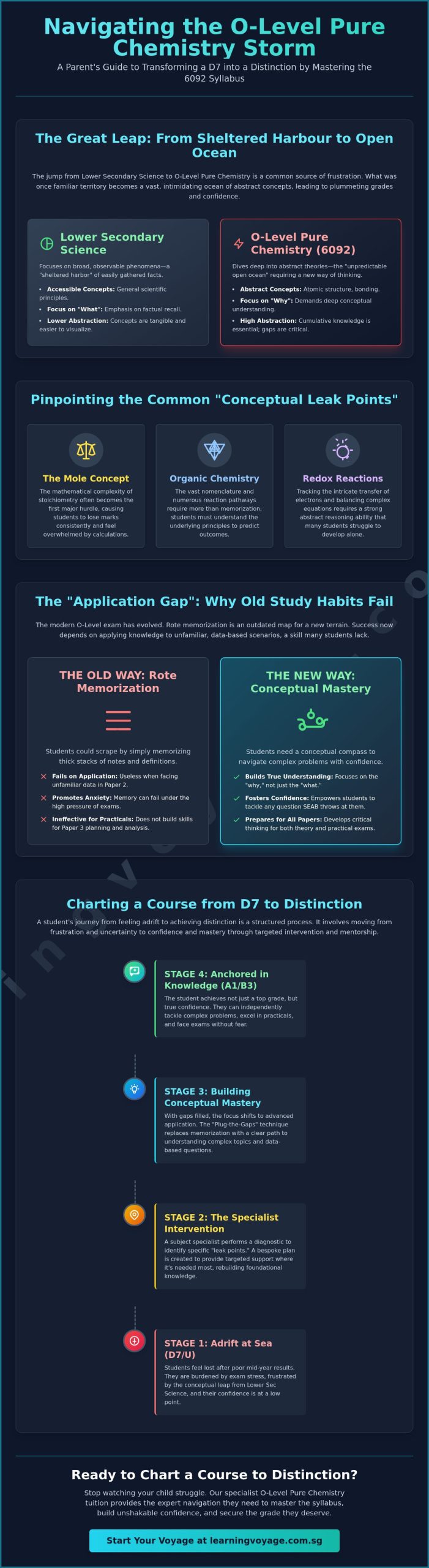
Entering the world of Upper Secondary Pure Chemistry is rarely the smooth sailing students expect. While Lower Secondary Science feels like a sheltered harbor where basic facts are easily gathered, the Pure Chemistry 6092 syllabus represents the vast, unpredictable open ocean. This transition is frequently where the first signs of academic distress appear. Parents often watch with growing concern as their child’s confidence wavers, leading many to seek specialized o level pure chemistry tuition punggol to steady the ship. The frustration is palpable; seeing a child put in the hours only to receive a D7 or E8 on their report card is heartbreaking. It’s not a lack of effort, but rather a failure of old navigation tools in a new, deeper environment.
The Conceptual Leap from Secondary 2 to Upper Secondary
Lower Secondary Science is designed to be accessible, focusing on broad observations of the natural world. In contrast, Pure Chemistry demands that students dive beneath the surface to understand abstract concepts like atomic structure and chemical bonding. This shift requires a completely different mental framework. If a student doesn’t secure their foundation in Secondary 3, the cumulative nature of the subject leads to inevitable burnout in Secondary 4. We often see “leak points” in a student’s understanding where they lose marks consistently. These typically occur in three specific areas: the mathematical complexity of the Mole Concept, the vast nomenclature of Organic Chemistry, and the intricate electron transfers in Redox Reactions. Without addressing these leaks early, the student’s academic vessel begins to take on water.
Why Rote Memorization Fails in the Modern O-Level Exam
In the past, a student might have squeezed through by memorizing thick stacks of notes. Those days are gone. The Singapore-Cambridge General Certificate of Education Ordinary Level has evolved significantly, shifting toward application-based questions that test a student’s ability to handle unfamiliar data. This creates an “application gap” where a student can recite the definition of an isotope but cannot apply that knowledge to a complex data-based scenario in Paper 2. Recent examinations emphasize “Chemistry in a Sustainable World,” requiring students to synthesize information rather than just recall it. In this high-pressure environment, a memorized map is useless if the terrain changes. Students need a conceptual compass to navigate through structured questions and the rigorous Paper 3 Practical exams with confidence. At Learning Voyage, we focus on providing that compass, ensuring students don’t just know the “what,” but deeply understand the “why.”
A Parent’s Buying Guide: Selecting the Right Specialist Tuition
Selecting the right educational support shouldn’t feel like a blind voyage through a heavy fog. For parents searching for o level pure chemistry tuition punggol, the sheer volume of choices can be paralyzing. It’s vital to look beyond mere convenience and evaluate the core pillars that define a high-quality educational partner: pedagogy, materials, class size, and a verifiable track record. These elements serve as the hull of the student’s academic vessel, providing the stability needed to weather the O-Level storm.
Think of a generalist center as a large commercial vessel; it’s sturdy but often lacks the agility to navigate the specific, treacherous reefs of the 6092 Chemistry syllabus. Subject specialists are more like expert navigators. They possess a deep, focused knowledge of SEAB requirements and have spent years refining their proprietary methodologies to address specific student pain points. While private home tuition offers a one-to-one ratio, it often misses the synergy of small group coaching where students learn from each other’s questions and mistakes. A specialist center offers a structured environment where a dedicated mentor provides the steady hand a student needs to regain their confidence.
Evaluating the “Plug-the-Gaps” Diagnostic Capability
Does the center have a reliable system to identify what your child doesn’t know? Effective tuition isn’t just about lecturing; it’s about diagnostic precision. In a small group setting, a tutor can provide the personalized attention that is often lost in larger classes. Look for a mentor who doesn’t just deliver content but actively seeks out the “leaks” in a student’s understanding. This mentorship approach builds a bridge between confusion and clarity, allowing students to feel seen and supported. You can explore our approach and mission to see how this mentorship makes a tangible difference in a student’s growth.
The Importance of Specialized Pure Chemistry Materials
Standard assessment books from popular bookstores often stay at a surface level, failing to challenge students with the application-based questions found in modern exams. For distinction-level preparation, students need specialized secondary science tuition materials that break down complex reaction pathways into manageable segments. We utilize “Post-It Notes” style summaries that act as a quick-reference compass for students during revision. These proprietary materials are a hallmark of a high-quality educational partner, transforming dense textbook jargon into accessible, bite-sized insights. If you’re ready to see how these tools can help your child find their footing, checking our current class schedules is a great first step toward academic recovery.
Navigating the Syllabus with the “Plug-the-Gaps” Technique
Imagine a vessel attempting to cross the Pacific with a series of small, unnoticed leaks in its hull. No matter how powerful the engines are or how skilled the captain is, the ship will eventually lose its structural integrity. This is the precise challenge many students face when they encounter the rigors of the 6092 syllabus. They possess the drive to succeed, but their foundation is compromised by specific conceptual misunderstandings. At Learning Voyage Education Centre, our approach to o level pure chemistry tuition punggol isn’t about simply sailing faster through the content. Instead, we utilize our proprietary “Plug-the-Gaps” technique to identify and seal these academic leaks, ensuring every student has a sturdy hull of knowledge before they face the high seas of the national examinations.
Step 1: The Diagnostic Assessment
The first stage of our methodology involves a meticulous diagnostic phase. We don’t believe in generic, one-size-fits-all revision. Instead, we analyze a student’s past test papers and assignments to find recurring patterns in their errors. Is the student struggling with the mathematical precision required for the Mole Concept, or is there a fundamental misunderstanding of how electrons move during Redox Reactions? By pinpointing whether a hurdle is calculation-based or conceptual, we can provide a bespoke roadmap for improvement. You can learn more about our Plug-the-Gaps technique and how it serves as a navigational chart for academic excellence. There is a profound psychological relief that students experience when their specific hurdles are acknowledged; it transforms a vague sense of failure into a manageable list of objectives.
Step 2: Targeted Reinforcement and Mastery
Once the leaks are identified, we move into the resolution phase. We’ve found that traditional, lecture-style instruction often fails because it doesn’t allow for the immediate clarification of doubts. In our small group settings, instruction is a two-way street. When a student encounters a difficult data-based question, they don’t just receive the answer; they’re guided through the higher-order thinking skills needed to derive it. This active engagement is what builds true mastery. We move beyond the “what” and dive deep into the “why,” turning “I don’t know” into “I understand” through targeted reinforcement. This process doesn’t just improve grades from a D7 to a B3 or A1; it builds the character and confidence of a young scientist who feels fully prepared to navigate any academic challenge that comes their way. By focusing on these specific gaps, we ensure that the student’s progress is steady, reassuring, and ultimately successful.
Mastering the Practical: Preparing for Paper 3 and Data Analysis
Many students view the Science Practical (Paper 3) as a tempestuous sea they simply need to survive. However, this component accounts for a substantial 20% of the final grade, making it a critical anchor for any student aiming for distinction. The anxiety surrounding the laboratory is real; the clinking of glassware and the ticking clock can unsettle even the most diligent student. At our center for o level pure chemistry tuition punggol, we teach students that the laboratory is a place of precision, not just a series of instructions to follow. Success here requires a transition from being a passive observer to an active investigator who can identify variables and plan experiments with a steady hand.
The Art of Scientific Observation and Recording
A common pitfall in Paper 3 is the loss of marks due to simple recording errors rather than a lack of chemical knowledge. SEAB marking schemes are notoriously rigorous regarding how observations are phrased. In Qualitative Analysis (QA), for example, describing a precipitate as “blue” might not be enough; the examiner is often looking for “light blue precipitate, insoluble in excess.” Similarly, mastering Titration requires more than just a steady drip. It demands an understanding of accuracy and precision in volumetric measurements. We guide students through these nuances, ensuring their recorded data reflects the high standards required for an A1 grade. It’s about developing a keen eye that notices the subtle gas evolution or the exact moment an indicator changes hue.
Cracking the Code of Data-Based Questions
The skills honed in the lab directly translate to the data analysis questions found in Paper 2. These questions often present students with unfamiliar graphs and tables, testing their ability to interpret trends under pressure. We utilize a “Logic Chain” method to help students bridge the gap between theoretical knowledge and experimental results. By linking chemical theory to the data provided, students can construct structured responses that satisfy the most demanding examiners. If your child is struggling to connect these dots, you might explore our Secondary 4 Pure Chemistry Tuition for intensive practical preparation. This approach ensures they don’t just see numbers on a page but understand the chemical story those numbers are telling.
To be truly “Exam-Ready,” a student must master three core tenets:
- Accuracy: Ensuring experimental results are as close to the true value as possible through careful technique.
- Precision: Consistently achieving similar results to demonstrate reliability in their scientific method.
- Observation: Noticing the subtle color changes or effervescence that provide the clues needed for correct identification.
If you’re looking to turn lab-day stress into a showcase of scientific mastery, reach out to us today to find out how we can support your child’s journey toward a confident distinction.
Charting a Course to Distinction with Learning Voyage Education Centre
The O-Level journey is often compared to an arduous voyage through shifting tides and unpredictable weather. For many families seeking o level pure chemistry tuition punggol, the initial stages are marked by confusion and a sense of being overwhelmed by the depth of the subject. Principal Tutor Andy Woo and our dedicated team at Learning Voyage Education Centre view themselves as the lighthouses that provide a steady beam of clarity through the O-Level fog. We’ve seen countless students arrive with failing grades and depart with a newfound sense of purpose and a distinction in hand.
This transformation isn’t accidental. It’s the result of a deliberate, empathetic partnership between mentor and student. We cultivate an inclusive environment where questions are encouraged and every small victory is celebrated. This supportive atmosphere ensures that students don’t just learn chemistry; they learn to believe in their own capacity for achievement. By positioning education as a process of personal growth, we help students find their footing even when the concepts seem most abstract. At Learning Voyage Education Centre, we don’t just provide answers; we provide the navigational tools required for lifelong learning.
Beyond Grades: Building Character and Confidence
True education extends far beyond the final mark on a transcript. When a student masters a challenging topic like Organic Chemistry or the Mole Concept, they develop a level of cognitive resilience that serves them in every other subject. They learn that persistent effort, guided by the right technique, leads to tangible results. We have seen students move from a D7 to an A1, a journey that fundamentally changes their self-image from one of doubt to one of scientific capability. If you are looking for a partner in this process, you can read our guide on finding a tuition centre that transforms results to understand the depth of our commitment to excellence.
Secure Your Seat for the Next Academic Term
Because we prioritize small group sizes to maintain the quality of our “Plug-the-Gaps” methodology, our class slots fill up quickly. Early registration is essential for parents who want to ensure their child has the best possible support for the upcoming academic year. The first step on this path is a comprehensive diagnostic session, where we identify the specific conceptual leaks that have been holding your child back. This allows us to begin the restoration process immediately, building a solid foundation before the next wave of exams arrives. Don’t wait until the mid-year results to seek help; proactive navigation is the key to a smooth journey. You can Contact us today to anchor your child’s future and secure their place in our next intake at Learning Voyage Education Centre. We look forward to helping your child find their way to distinction.
Empower Your Child to Navigate the Path to Distinction
The journey toward an A1 distinction doesn’t have to be a solo struggle against overwhelming tides. By identifying specific conceptual “leaks” and mastering the nuances of the Paper 3 Practical exam, your child can regain their confidence and academic footing. Since 2011, our dedicated team has helped hundreds of students navigate the complexities of the 6092 syllabus with our proprietary Plug-the-Gaps technique. This specialist approach transforms the frustration of failing grades into a clear, manageable path of discovery and growth.
If you’re looking for specialized o level pure chemistry tuition punggol, our small group coaching provides the personalized attention your child deserves to thrive in a high-pressure environment. It’s about moving beyond the stress of mid-year results and charting a clear, confident course toward success. Join our small-group Pure Chemistry classes and start plugging your gaps today! Every student deserves a steady hand to guide them through the academic fog toward their full potential and a future they can be proud of.
Frequently Asked Questions
Is Pure Chemistry significantly harder than Combined Chemistry?
Pure Chemistry is considerably more demanding because it requires a much deeper level of conceptual mastery and covers a broader range of topics. While Combined Chemistry focuses on foundational principles, the Pure 6092 syllabus explores abstract details like electrolysis and complex organic pathways. This increased depth is why many students find the jump in difficulty quite jarring during their upper secondary years.
How does the “Plug-the-Gaps” technique help for last-minute O-Level revision?
Our “Plug-the-Gaps” technique is designed to rapidly identify and fix specific conceptual weaknesses before the national exams arrive. By focusing on high-weightage topics like the Mole Concept and Redox Reactions, we ensure students spend their final weeks studying efficiently. This targeted approach acts as a final safety check, securing the academic hull before the intense pressure of the O-Level season begins.
Can my child join the tuition mid-way through Secondary 4?
Yes, students can join our Secondary 4 Pure Chemistry classes mid-way through the year if there is a vacancy in our small groups. We immediately conduct a diagnostic assessment to find any existing knowledge gaps from the Secondary 3 syllabus. This allows the student to catch up quickly while staying aligned with the current pace of their peers in preparation for the preliminary exams.
What is the teacher-to-student ratio in your Chemistry classes?
We maintain a small teacher-to-student ratio to ensure every individual receives the personalized mentorship they need to excel. While specific sizes vary, our groups are kept intimate to facilitate active participation and the immediate clarification of doubts. This structure is a hallmark of our o level pure chemistry tuition punggol, where we prioritize personal growth over large, impersonal lecture formats.
Do you provide help for the Pure Chemistry Practical (Paper 3)?
We provide comprehensive preparation for the Pure Chemistry Practical by focusing on experimental planning and data analysis skills. While we don’t offer a full laboratory facility, we teach students how to write precise observations and identify variables according to SEAB requirements. Mastering the logic of experiments is vital for the 20% of the grade that the practical component represents.
How do you handle students who have lost interest in Science?
We reignite a student’s passion by connecting abstract chemical theories to real-world applications and sustainability. When a student understands the “why” behind a reaction, the subject stops being a chore and becomes a path of discovery. Our mentors provide the encouragement and inclusive environment needed to rebuild a student’s confidence, transforming their academic frustration into genuine curiosity and resilience.
What materials are provided during the tuition sessions?
Students receive our proprietary revision materials, including our signature “Post-It Notes” style summaries that simplify dense reaction pathways. These bespoke resources are designed specifically for the Singapore O-Level context, moving beyond standard assessment books to provide distinction-level preparation. These materials act as a navigational compass, helping students keep their revision focused and organized during high-pressure exam periods.
How soon can we expect to see an improvement in grades?
Many parents observe a noticeable shift in their child’s confidence and conceptual clarity within just a few months of joining our o level pure chemistry tuition punggol. While every student’s journey is unique, our methodical approach typically leads to a steady improvement in grade performance. This progress is often reflected first in school topical tests before culminating in a successful leap toward a B3 or A1.


