
Could science revision feel less stressful when learning is connected, practical and purposeful? Choosing primary Science enrichment in Singapore means weighing more than extra worksheets. The right approach should help your child understand ideas, explain answers clearly and build confidence, while keeping PSLE preparation manageable.
If your child knows facts but struggles to apply them, choosing the next step can feel frustrating. This guide compares tuition formats, hands-on activities, experiments and online quizzes, then considers PSLE preparation and trial lessons. Use these practical points to match support to your child’s learning needs and make progress feel steadier and exam preparation less overwhelming.
- Compare Science tuition locations and learning formats across Singapore to find an arrangement that fits your child’s routine.
- See how hands-on activities, experiments and online quizzes can connect Science concepts with everyday examples.
- Explore practical ways to prepare for the PSLE and help your child approach Science questions with confidence.
- Learn what trial lessons and assessment sessions can show about teaching fit and your child’s learning needs.
Science tuition centre locations
For families comparing primary Science enrichment options in Singapore, location matters because a difficult journey can make weekly lessons harder to sustain. Compare the route from home, school or childcare, then consider lesson timing and pickup arrangements. A nearby centre may suit a student who benefits from structured teaching and classmates’ questions. Group tuition can encourage discussion, while one-to-one support allows more time for individual explanations. Home learning removes the trip, but depends on a consistent study routine and suitable guidance.
Before choosing a programme, check its location, teaching format and alignment with the MOE Science syllabus for your child’s level. Ask how lessons address current school topics and whether the student gets practice explaining ideas, not just recalling facts. These details help parents judge whether the arrangement fits the child’s learning needs and family schedule.
Science is taught as a subject from Primary 3 in Singapore’s primary curriculum. The MOE Primary Science Teaching and Learning Syllabus identifies four key topic areas for Primary 3 Science. Assessment at Primary 3 is school-based, while the national PSLE is taken at the end of primary school. Tuition across Primary 3 to Primary 6 should follow the student’s level and build understanding steadily, rather than rush every child into exam revision.
For upper-primary tuition, Primary 4 lessons can reinforce developing concepts, while Primary 5 and Primary 6 tuition can help students revisit topics and practise applying them. Ask how the programme adapts lessons across these levels and prepares Primary 6 students for PSLE questions. A clear progression gives families a better way to assess learning, confidence and readiness without treating every year group as identical.
Small-group Science tuition uses a three-pupil format, giving families a concrete detail to check when comparing centres with primary science enrichment buangkok options. Parents can use a four-week observation cycle at Learning Voyage Education Centre to assess whether tuition is helping, noting changes in understanding, confidence and ability to explain ideas.
Hands-on activities, experiments and online quizzes
Hands-on activities turn a science concept into something a student can observe, test and explain. In a lesson about magnets, for example, pupils can compare how different classroom objects respond to a bar magnet. They record observations, then explain why the results differ. This makes practice purposeful: students use evidence, not guesses, to support an answer. A useful programme connects each activity to a concept taught in Singapore schools.
A 3E teaching framework can give an experiment a clear learning path: begin with a question, explore it through an activity, then explain the result using evidence. For example, pupils might predict which objects a magnet attracts before testing them. The teacher can then guide students to describe what happened and refine their explanation. This keeps an experiment focused on understanding, rather than treating it as a fun task without a learning goal.
Experiments also connect Science topics to familiar situations. Testing a bar magnet with different materials can help pupils understand that not all metals are magnetic. Attraction alone does not prove an object is itself a magnet: suitable magnetic material can be attracted without being a permanent magnet. Loose, small, powerful magnets can be a swallowing hazard for younger children, so they should not be used casually around them.
Online quizzes can follow an activity to check whether a student can apply an idea to a new example. A question might ask which item a magnet would attract, then ask for the reason. Practice can reveal whether the concept is clear or needs another explanation. Used alongside experiments, quizzes offer a way to revisit learning between classes. Teaching that links observation, explanation and practice helps students deepen their understanding and confidence.
PSLE science preparation
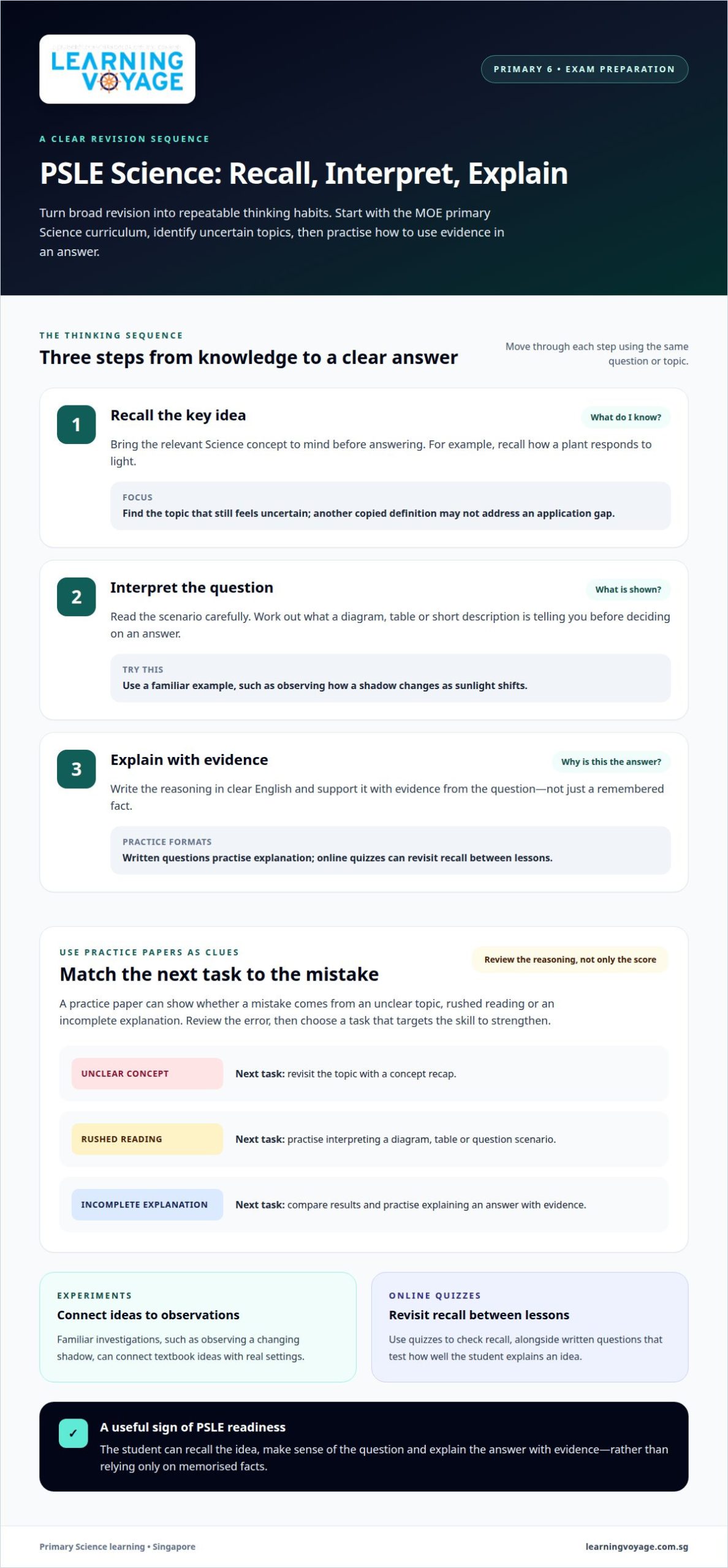
PSLE Science preparation should turn broad revision into clear, repeatable thinking habits. Start with the MOE primary Science curriculum, then identify topics that still feel uncertain. A Primary 6 student may memorise a definition yet struggle to explain a result. That gap calls for application practice, not another page of copying. Parents can use this distinction to discuss progress without adding pressure.
At a tuition centre, preparation can follow three steps: recall, interpret, explain. First, the student recalls a key idea, such as how a plant responds to light. Next, the student interprets a diagram or short scenario. Finally, the student explains the answer in clear English, using evidence from the question. These steps connect curriculum knowledge with written responses. An experiment about plant growth can support discussion of observations and fair comparisons.
Practice papers can reveal whether errors come from misunderstood topics, rushed reading or incomplete explanations. Rather than repeat every worksheet, a teacher can review each mistake and select a matching task. One error may need a concept recap; another may need practice interpreting a table or comparing results. Look for feedback that identifies the skill to strengthen, not only a score. This makes progress easier to follow across revision sessions.
Experiments connect textbook ideas with familiar settings. For example, a student can explain how a shadow changes as sunlight shifts. Online quizzes can check recall between lessons, while written questions test explanation. Use both formats to revisit a topic and consider the student’s reasoning. At Primary 6, this balance supports PSLE readiness without reducing Science to memorised facts.
Are trial lessons or assessment sessions available at science enrichment centres in Singapore?
Some science tuition centres in Singapore offer trial lessons or assessment sessions, and the two serve different purposes. A trial lesson lets a student experience a teaching sequence, such as reviewing a Primary 5 topic, answering a question and discussing the reasoning. An assessment session focuses on current understanding, including topic recall, diagram reading and written explanations.
For a Primary 6 student, an assessment could begin with a question about a familiar Science concept. The teacher observes how the student interprets information, selects relevant knowledge and explains an answer. This can reveal whether the main hurdle is a forgotten idea, a misread diagram or unclear written reasoning. A useful review names the skill to strengthen, rather than relying on a score alone.
A trial lesson offers a useful view of how a teacher introduces a topic, guides practice and responds when a student feels unsure. For example, the student might interpret a data table, explain a pattern and receive feedback on the answer. Consider whether the teaching pace suits your child and whether the questions match their current primary level.
Before choosing between these formats, decide what you want to understand: teaching fit or learning needs. A trial lesson gives a sample of the classroom experience; an assessment gives a snapshot of strengths and gaps. For Primary 5 or Primary 6, useful feedback should connect observed answers to specific Science topics and next learning steps. That makes the session more informative than simply asking whether a child enjoyed it.
Learning Voyage Education Centre
Learning Voyage Education Centre can support families planning their child’s learning beyond primary school. While this article focuses on choosing primary Science enrichment, the centre’s secondary-level programmes include Mathematics tuition. As students move to a new school level, learning habits that support understanding and problem-solving can help them approach new subject demands with confidence.
For students preparing for upper-secondary examinations, the centre offers Secondary 3 A-Mathematics Tuition, Secondary 3 E-Mathematics Tuition, Secondary 4 A-Mathematics Tuition and Secondary 4 E-Mathematics Tuition. These options serve different Mathematics courses and levels. The right starting point depends on the student’s current school level and subject, so families can consider which course matches their next academic stage.
Mathematics learning also asks students to interpret information, show working and explain how they reached an answer. Learning Voyage Education Centre uses small-group coaching and its Plug-the-Gaps technique to identify specific learning hurdles and address them. This support can help students strengthen understanding and work through challenging concepts, rather than repeat exercises without finding where confusion begins.
Parents weighing future tuition can consider how a student responds to classroom teaching, independent practice and exam questions. If the next priority is secondary Mathematics, the four courses provide options across Secondary 3 and Secondary 4, in both A-Mathematics and E-Mathematics. This gives families a clear subject and level to discuss as they plan the next stage of learning.
Contact Learning Voyage Education Centre to discuss the next step.
Frequently Asked Questions
What primary Science enrichment classes are available in Singapore?
Learning Voyage Education Centre provides Primary 5 Science Tuition and Primary 6 Science Tuition. Its small-group classes contain 4-8 students, offering opportunities for interaction during lessons. Families can consider the student’s current primary level and the support needed with Science learning when deciding whether either programme is relevant. The classes form part of the centre’s primary-level tuition provision.
Which science enrichment centres teach primary school students?
Learning Voyage Education Centre provides primary Science tuition to students in Singapore. The centre serves families nationally, while its teaching takes place at a physical learning centre. Parents looking for Science support can consider whether the available primary-level programmes match their child’s school stage and learning needs. The centre also provides programmes for secondary and junior college students.
What are the age groups and primary levels for science enrichment programmes?
Learning Voyage Education Centre’s Science tuition is organised for Primary 5 and Primary 6 students. The listed programmes are defined by school level, so families can use the child’s current primary year when considering suitability. A student’s school level is therefore the clearest starting point for identifying the relevant programme.
What topics and curriculum do primary Science classes cover?
Teaching follows the latest Singapore Examinations and Assessment Board syllabuses. For a primary Science student, curriculum alignment gives lessons a framework connected to school learning and assessment. The topic sequence depends on the student’s primary level. Use your child’s current schoolwork to identify areas where additional explanation or practice would help.
What are the class schedules and locations near Buangkok MRT?
For current timetable and venue details, families can enquire by phone, WhatsApp, email or the online enquiry form. The centre can assist with class selection and next steps. As the question asks about travel near Buangkok MRT, use the class venue information when planning the journey, and consider how lesson timing fits the student’s school day and other commitments.
How do primary Science centres compare in class size and teaching approach?
Learning Voyage’s small-group classes contain 4-8 students, with personalised attention and interaction. When comparing teaching approaches, consider how the lesson gives students room to ask questions, respond to explanations and discuss their thinking. These classroom features can help parents judge whether a group setting suits their child. The centre’s Plug-the-Gaps technique addresses specific learning hurdles through explanation and targeted practice.