
What if your child’s silence in class isn’t a lack of curiosity, but a way to avoid feeling exposed? If my child is afraid to ask questions in school, I might worry they’re falling behind. Yet repeated reminders to “just speak up” can make asking feel even harder. A child may stay quiet because they fear giving the wrong answer, don’t know how to phrase a question, or feel lost on a particular topic.
It’s understandable to want your child to get help before confusion builds, especially when schoolwork and exams already bring pressure. But silence alone doesn’t tell you what’s wrong, and it doesn’t mean your child lacks ability or interest.
This article explores possible reasons for the hesitation without jumping to conclusions. You’ll find practical ways to respond with patience, simple phrases your child can use, low-pressure ways to practise asking for help, and ideas for working with teachers and subject learning. With steady encouragement at home and school, asking a question can become a manageable next step, not a test of confidence.
Key Takeaways
- If my child is afraid to ask questions in school, explore possible causes with curiosity rather than blame.
- Notice whether the hesitation appears in different situations or mainly in one subject, lesson, or task.
- Help your child practise asking for support gradually. Start by listening and trying simple sentence starters.
- Mathematics or Science tuition may help a child work through subject confusion, but it can’t guarantee they will speak up in class.
- Learning Voyage’s Mathematics and Science classes have 6 to 9 students, with trial classes available for both subjects.
Why might my child be afraid to ask questions in school?
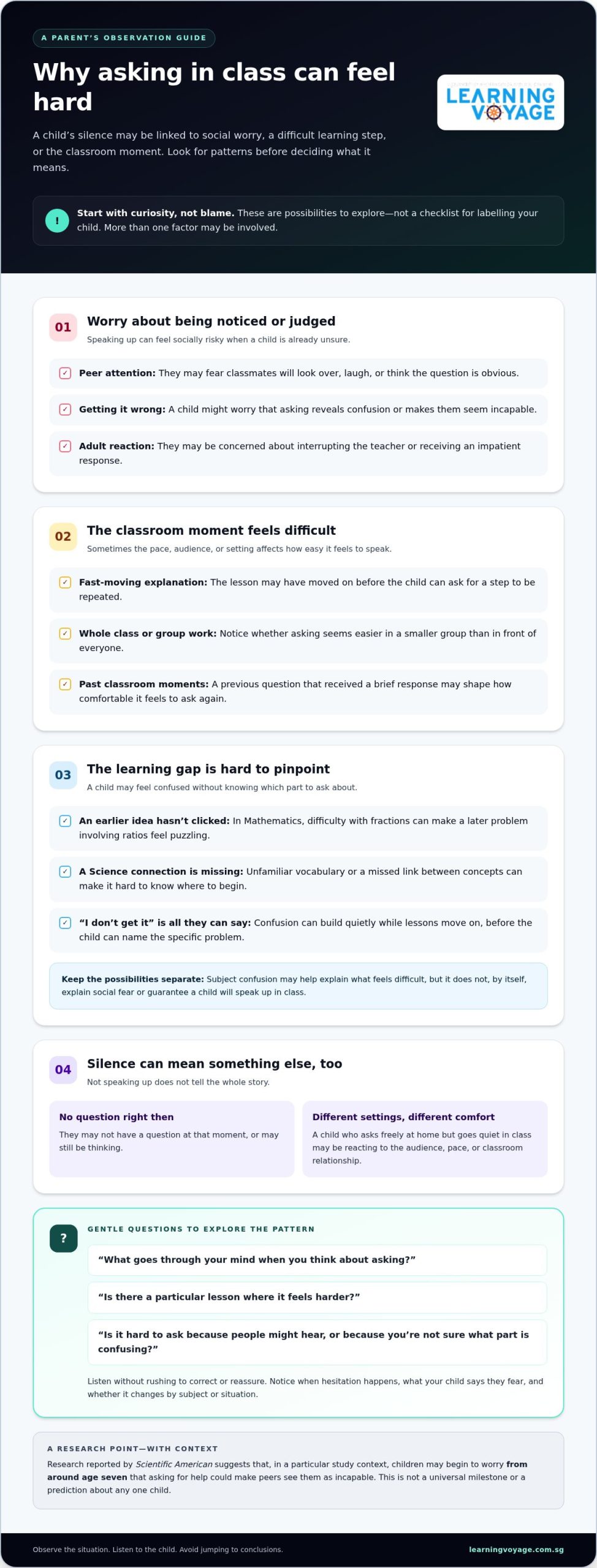
When a child holds back in class, try to understand what’s happening rather than blaming them for being quiet. If my child is afraid to ask questions in school, the hesitation may reflect worry about others’ reactions, uncertainty about the lesson, or a need for more time to gather their thoughts. “Help-seeking anxiety” is an everyday way to describe feeling uneasy about asking for assistance. It isn’t a diagnosis, and it doesn’t explain every child’s silence.
Scientific American has reported research suggesting that, in a particular study context, children may begin to worry from around age seven that asking for help could make peers see them as incapable. That age isn’t a universal milestone or a prediction about any one child. The useful point for parents is that peer judgement can make an ordinary question feel socially risky, even when a child wants to understand.
A child’s silence is not proof that they lack interest, curiosity, or ability. It’s one behaviour. Its meaning becomes clearer when you learn what your child is experiencing.
What might a child fear when asking a question?
A child might worry that classmates will notice they’re confused, that their question will interrupt the teacher, or that the teacher will respond impatiently. Even a brief pause in a lesson can feel exposing if the child imagines everyone turning to look. These concerns may feel stronger when a topic is difficult, but they don’t affect every student in the same way.
For example, during a Mathematics lesson, a student may understand the first step but lose track when the teacher moves to the next one. They might want the explanation repeated, yet worry that the class has already moved on. In a Singapore classroom where students are working towards assessments, a child may also feel that admitting confusion reveals a weakness. Treat this as a possibility to explore, not an assumption.
Why silence does not tell the whole story
Not speaking up can mean different things. A child may have no question at that moment, may still be thinking, or may not know which part they don’t understand. A child who asks freely at home but goes quiet in class may be reacting to the audience, pace, or classroom relationship rather than struggling to express themselves in every setting.
Ask about the moment instead of deciding on a cause: “What goes through your mind when you think about asking?” or “Is there a particular lesson where it feels harder?” Listen without rushing to correct or reassure. You could also explore Understanding Childhood Shyness to learn about shy behaviour, while remembering that a description isn’t a label for your child.
Small observations can help you see a pattern: when the hesitation happens, what your child says they fear, and whether it changes by subject or situation. That gives you a steadier starting point for support than simply urging them to speak up.
What can make asking questions feel difficult at school?
A child’s hesitation rarely has one neat explanation. Notice whether the difficulty seems social, academic, or connected to how a classroom moment unfolds. These are prompts for a conversation, not a checklist for labelling your child. Reluctance to ask can have several causes, and they may overlap.
Fear of peer attention, mistakes, or negative reactions
Speaking up can feel risky when a child is already unsure. They may imagine classmates turning to look, worry that someone will laugh, or fear asking a question others might consider obvious. Even if no one has reacted unkindly, the possibility of being noticed can be enough to hold them back.
Classroom routines can shape that feeling, too. A child might find it harder to interrupt during a fast-paced explanation, ask for clarification in front of the class, or speak after a previous question received a brief response. This doesn’t prove that a teacher or classmate caused the hesitation. It gives parents and educators useful context to explore. The Child Mind Institute explains how anxiety can affect students’ participation and learning in its overview of Anxiety and School Performance.
Consider the setting. Does your child seem more comfortable asking during group work than in a whole-class discussion? Are they worried about being wrong, or about taking up the teacher’s time? Their own words can reveal more than an adult’s guess.
When a question reveals a learning gap
Sometimes a child can’t ask because they can’t yet identify what is confusing. If an earlier idea hasn’t clicked, a new step may depend on something they don’t fully understand. In Mathematics, for instance, difficulty with fractions can make a later problem involving ratios feel puzzling. In Science, unfamiliar vocabulary or a missed link between concepts can make it hard to know where to begin.
This isn’t a character flaw or proof that a student hasn’t tried. Confusion can build quietly, especially when lessons move on while a child is still working through an earlier step. They may say “I don’t get it” without being able to turn that feeling into a specific question.
Learning Voyage’s Plug-the-Gaps technique is used in its Mathematics and Science tuition to identify and address learning gaps. It can help make subject confusion more visible, but finding an academic gap does not, by itself, explain social fear or guarantee that a child will ask questions in class. For parents considering subject support, the Plug-the-Gaps learning approach offers a relevant starting point.
Try separating the possibilities gently: “Is it hard to ask because people might hear, or because you’re not sure what part is confusing?” That question leaves room for either answer, or for your child to say they’re still figuring it out.
Is shyness the only reason a child stays quiet in class?
No. Shyness may be one possibility, but a child’s behaviour can also reflect uncertainty about a particular topic, worry about classmates’ reactions, or a need for more time to form a question. These patterns are clues to explore, not labels or a diagnosis. If my child is afraid to ask questions in school, look at where the hesitation happens before deciding what support might fit.
Repeatedly telling a child to “speak up” may come from a caring place, but it doesn’t automatically build confidence. If the child doesn’t yet feel comfortable or know what to say, the instruction can feel like another test they might fail. A calmer approach is to notice patterns and ask what would make participation more manageable.
Notice where and when the hesitation happens
Look for differences across lessons, tasks, and social settings. Is your child quiet in every class, or mainly during one subject or type of activity? Do they speak with friends but hold back when the whole class is listening? At home, can they explain the question they wanted to ask once they have time and privacy? These contrasts can help distinguish a broad speaking concern from a specific classroom or learning difficulty.
Keep observations light. A brief conversation after school may tell you more than daily questioning. Notice changes over time without monitoring every interaction or asking your child to report each time they stayed silent. The aim is to understand, not to make them feel watched.
When to involve a trusted school adult
Start by talking with your child. Explain that you’d like to understand what helps, and ask how they feel about involving a teacher or another trusted school adult. Whenever possible, agree together on what you’ll share so the child doesn’t feel the conversation is happening behind their back.
A neutral message might be: “We’ve noticed that asking questions in class seems difficult at times. Could you share what you observe and what might help our child feel more comfortable seeking clarification?” This invites the teacher’s perspective without blaming anyone or assuming the cause.
If distress continues, grows, or begins to affect your child’s daily wellbeing, consider seeking guidance from an appropriate health or mental health professional. You don’t need to settle on a label before asking for support. A steady, thoughtful response can help your child feel understood while you work out the next step together.
How can parents help a child practise asking questions?
Confidence grows through small, safe attempts, not a sudden demand to speak in front of everyone. If my child is afraid to ask questions in school, practise the skill in steps and let them choose a manageable pace. The aim isn’t to make every question easy straight away. It’s to help your child feel heard, find words for what’s unclear, and choose a next step they’re willing to try.
Use low-pressure practice at home
Begin by listening. Invite your child to show or explain one confusing point, and resist correcting them before they’ve finished. Then ask what part feels uncertain and what makes asking at school difficult. You might rehearse with a neutral example, such as asking someone to repeat directions for a game. Keep the practice brief and ordinary, not like an oral exam.
A gentle sequence can give the conversation structure:
- Listen: “Tell me what happened, in your own time.”
- Understand: “What felt hardest about asking?”
- Rehearse: Try a phrase together, or let your child choose different words.
- Review: Later, ask how the plan felt, without treating the outcome as a pass or fail.
Agree on one small step your child chooses. They might practise saying a question aloud, write it down, or simply notice when something becomes confusing. If they don’t want to try asking in class yet, acknowledge that. Trust is part of the practice.
Prepare a simple question for class
Short sentence starters can make it easier to begin. Invite your child to adapt them so they sound natural:
- “Could you explain that step again?”
- “I’m not sure what this word means. Could you explain it?”
- “Could you show me how to start?”
- “I understand this part, but I’m stuck here.”
If speaking feels like too much, your child could write a question privately before class and decide whether to use it. You might also explore possible moments together, such as during independent work or when the teacher invites questions. There’s no single correct way to ask. The best first step is one your child feels able to attempt.
A short role-play can help without turning practice into pressure:
Parent: “Would you like to practise asking for help, or leave it for today?”
Child: “Maybe practise. I don’t want to ask in front of everyone yet.”
Parent: “That’s okay. Want to try, ‘Could you explain that step again?’ You can decide later whether to use it.”
Notice the effort, not just whether your child speaks in class. Choosing a phrase or telling you what feels difficult is progress too. For students who would benefit from practising questions while learning Mathematics or Science, Learning Voyage offers trial classes in both subjects. Explore the Plug-the-Gaps approach as one way to support subject learning while your child builds confidence at their own pace.
Supportive learning for children afraid to ask questions
Extra subject learning may be useful when a child’s silence is tied, at least in part, to uncertainty about schoolwork. It can provide time to make sense of a topic and put their thinking into words. It can’t guarantee a child will speak up in class, and it won’t necessarily address social worries or other reasons they may stay quiet.
How structured subject support may help
A student who can identify the exact point of confusion has a clearer starting place for learning. Instead of feeling that an entire chapter is beyond reach, they may be able to focus on one idea or step that needs more attention. That can make a question more specific and give the child a clearer way to describe what they need help with.
Learning Voyage provides Mathematics and Science tuition, using its Plug-the-Gaps technique to identify and address learning gaps in those subjects. This is an academic approach, not a treatment for anxiety, and it can’t explain every reason a student may hesitate to ask for help. The value of subject support depends on the child’s learning needs and how comfortable they feel taking part.
Before considering additional learning support, talk with your child about what feels difficult. They may want help understanding a particular topic, or they may need time to feel at ease in a learning environment. Listening to their view can help you decide whether subject tuition is relevant, rather than assuming that more lessons are automatically the answer.
Choose a next step that feels manageable
Keep the decision collaborative. Ask what your child would like to understand better, and whether they’re open to exploring another kind of learning support. If they’re unsure, take time to discuss the options without framing the choice as a test of confidence or willingness to participate.
After any new learning experience, focus on how it felt as well as what was covered. Questions such as “Did the explanation make sense to you?” or “What would help you feel more comfortable next time?” invite an honest response without expecting immediate change. Your child might need more time, and that’s useful information as you consider the way forward.
If subject support feels like a suitable next step for your family, explore Learning Voyage’s Mathematics and Science tuition. Trial classes are available for both subjects, giving your child an opportunity to experience the learning setting before you decide what comes next.
Let confidence grow one question at a time
There may not be a single moment when your child suddenly feels ready to speak in class. Confidence can take shape through small decisions: telling you what feels difficult, choosing a phrase to practise, or deciding when they might try asking for help. If my child is afraid to ask questions in school, progress can begin before they raise a hand. Your patience can help make that first step feel possible, even during a demanding school term.
Keep the next move collaborative. Ask your child what would make learning feel more comfortable, then choose one manageable action together. For some families, that could mean practising at home with ideas from parenting resources like GreatDad.com. For others, subject support may be a useful next step. The aim isn’t to force a quick change, but to help your child build understanding and self-trust at a pace they can sustain.
If Mathematics or Science tuition could support that journey, explore Learning Voyage’s Mathematics and Science tuition. Learning Voyage’s classes have 6 to 9 students, and trial classes are available for both subjects. Get in touch with Learning Voyage to discuss a suitable next step for your child.
Frequently Asked Questions
Is it normal for a child to be afraid to ask questions in school?
Some children feel nervous about asking questions, especially in unfamiliar classes or during lessons that move quickly. If my child is afraid to ask questions in school, that alone doesn’t mean something is wrong or that they’ll always feel this way. Notice whether the worry is new, linked to a change such as a new class, or making school feel distressing. A calm conversation can help you understand what support might be useful.
Can fear of asking questions affect a child’s learning?
It can, particularly if a student repeatedly leaves lessons unsure about key instructions or ideas. For example, a child who doesn’t clarify what a homework question is asking may practise the wrong method at home, then feel more uncertain the next day. This doesn’t mean every quiet student is falling behind. Check work together occasionally and ask your child to explain how they approached a question. That can show whether they understand the steps or need clarification.
How do I know whether my child is confused or afraid to speak?
Ask your child to show you a recent class task and talk through what they understood, where they got stuck, and what they wanted to ask. If they can explain the uncertainty privately but say they didn’t want classmates to hear, speaking up may be the main barrier in that situation. If they can’t identify the unclear part, the lesson or instructions may need revisiting. Both can be true, so treat their answers as clues, not proof.
What should I say when my child says, ‘I don’t want to ask’?
Try responding without arguing them into it: “Okay. You don’t have to decide right now. What feels uncomfortable about asking?” This acknowledges the feeling and opens the door to a more specific conversation. If your child isn’t ready to explain, let the topic rest and return to it later. You could offer choices, such as writing the question down or talking through the lesson together, while leaving the decision with them.
Should I contact my child’s teacher if they are afraid to ask questions?
Consider contacting the teacher if the hesitation continues, affects your child’s understanding, or seems to be causing distress. Share what your child has told you, while making clear that you’re still trying to understand the situation. Ask what the teacher notices during lessons and whether there are suitable ways for your child to seek clarification. A calm, practical conversation can help home and school support the student without turning participation into a demand.
Can extra Mathematics or Science support help a child who stays quiet in class?
It may help if your child wants guidance with a particular topic and would benefit from more time to work through it. Before choosing extra tuition, ask which subject or concept they’d like to focus on and whether they feel comfortable trying it. Learning Voyage offers Mathematics and Science tuition, with trial classes available for both subjects. Subject support is one possible academic step, not a complete answer to social discomfort or persistent distress. Let your child’s needs and willingness guide the decision, and review together how the experience feels.