
What if the subject combination that seems to keep every door open is the one that leaves you stretched too thin? If you’re wondering how to choose a JC subject combination, it’s understandable to feel caught between university prerequisites, school offerings and the pressure to make the “right” choice before JC1 begins.
The answer isn’t simply to pick Science, Arts or a hybrid combination based on its label. Start with the courses you may want to pursue and the subjects those courses require. Then consider your strengths, interests and the workload you can sustain. Two demanding years of A-Level study call for more than a subject list that looks impressive on paper.
This guide explains how to compare common combinations, understand H1 and H2 choices, and identify which requirements to verify with your JC and university admissions sources. You’ll also learn how to weigh prerequisites against readiness, so you can keep suitable pathways open without taking on an unrealistic load. Think of the decision as setting a course, not locking in your whole future. With clear information and a realistic plan, you can begin JC with greater confidence.
Key Takeaways
- Learn how to choose a JC subject combination by weighing course prerequisites alongside your strengths, interests and realistic workload.
- Understand what H1, H2 and H3 study levels involve, and which current MOE and university requirements to verify.
- Compare Science, Arts and hybrid options, including the trade-offs between 3H2 and 4H2 combinations.
- Use a clear shortlisting process to compare JC subject offerings and keep track of questions that need reliable answers.
- After choosing, build steady study habits and address gaps early in relevant Mathematics or Science subjects.
How to Choose a JC Subject Combination: Start with the Rules and Requirements
Choosing subjects can feel like a test before the A-Levels even begin. You want to keep future university options open, but you also need a workload you can manage through two demanding years. To decide how to choose a JC subject combination, first separate the requirements that apply broadly from the options and entry criteria set by each college.
MOE sets the A-Level framework, including subject levels and curriculum requirements. JCs publish the combinations they offer and any criteria for students who want to take particular subjects. A combination listed on one school’s website shouldn’t be treated as a standard option everywhere. Check the latest MOE guidance, then compare official information from each JC on your shortlist.
What do H1, H2, and H3 mean in a JC subject combination?
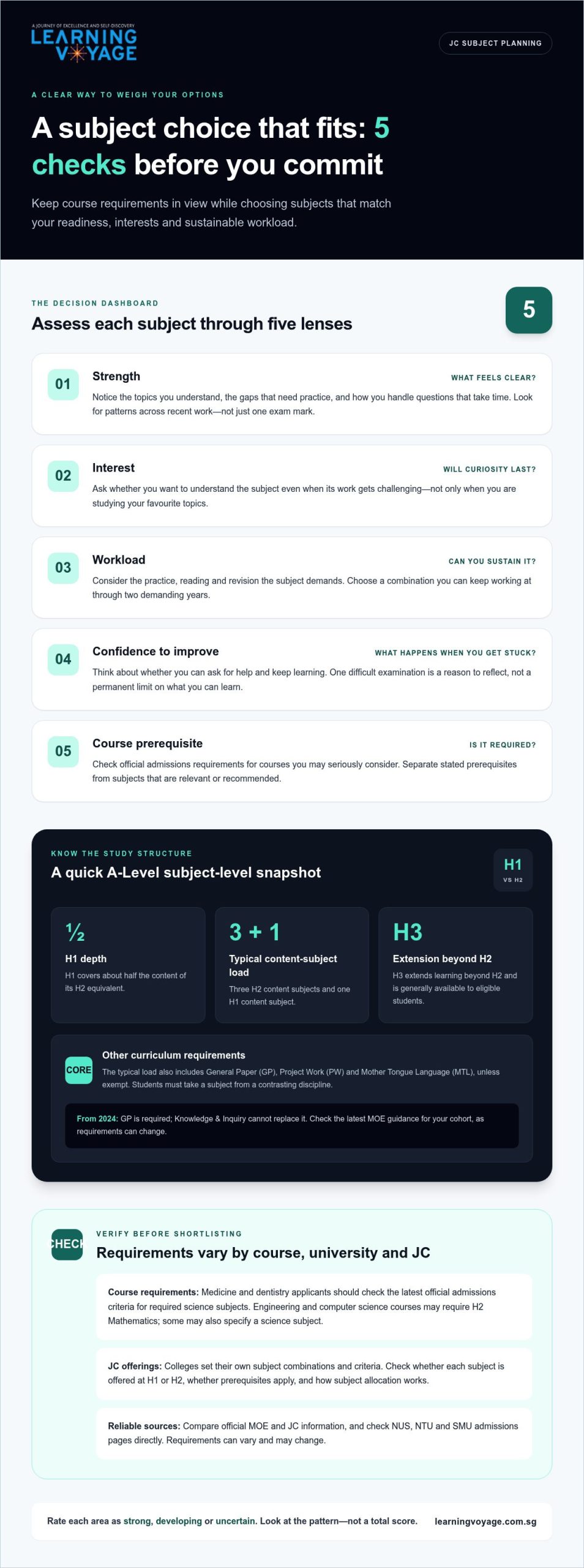
H1 and H2 describe different depths of study. An H1 subject covers about half the content of its H2 equivalent, while H2 is the standard level used for many university course prerequisites. H3 extends learning beyond H2 and is generally available to eligible students. It isn’t simply another standard subject choice, and access may depend on the school’s criteria.
A typical subject load includes three H2 content subjects and one H1 content subject, alongside General Paper (GP), Project Work (PW) and Mother Tongue Language (MTL), unless the student is exempt. Students must also take a subject from a contrasting discipline. From 2024, GP is required; Knowledge & Inquiry can’t replace it. For current details on Singapore’s school stages and A-Level pathway, see this overview of Education in Singapore. Check the latest MOE guidance for your cohort, as requirements can change.
Why do subject combinations differ between JCs?
Each college decides which subjects and combinations it can offer, and may set its own criteria for particular subjects or levels. For example, the CJC 2026 subject information describes that college’s combinations and eligibility criteria. It’s a school-specific example, not a template for every JC. Compare the official open-house and academic-information pages of the colleges on your shortlist.
Build a simple comparison table with the subjects you’re considering, the JCs that offer them, and any stated entry criteria. Check whether a subject is available at H1 or H2, whether prerequisites apply, and how the college handles subject allocation. If a page is unclear, write down the question and use the college’s official information channels to get an answer. Don’t rely on an old combination list or a friend’s experience.
This groundwork helps families replace uncertainty with a manageable checklist. A parent may worry that one choice will close every door, while a student may feel pressure to select the most demanding combination to prove they’re capable. Neither fear should make the decision alone. First establish what’s required, what’s offered, and what you’re eligible to take. Then assess which options fit your strengths and future plans.
Match JC Subjects to Your Strengths, Interests, and Future Pathways
A subject can be interesting and still feel difficult at A-Level depth. Another may not be your favourite, but you might enjoy the challenge and be willing to practise consistently. You don’t have to predict every exam result now. Instead, compare what you enjoy, what your recent work suggests you’re ready for, and what you’re prepared to keep working at when the content gets demanding.
How should you weigh strengths against interests?
Look for patterns, not a single mark. Review recent results alongside the topics that feel clear, the ones that need more practice, and how you respond when a question takes time to solve. Ask yourself: do I still want to understand this subject when the work is challenging, or do I only enjoy its easier topics? One difficult examination is a reason to reflect, not a permanent limit on what you can learn.
Try a short comparison for each subject under consideration:
- Strength: Which topics do you understand well, and where are the gaps?
- Interest: Would you willingly explore the subject beyond the parts you already like?
- Workload: Are you ready for the practice, reading or revision it demands?
- Confidence: Can you picture asking for help and improving when you get stuck?
- Prerequisite: Is the subject required for a course you may seriously consider?
Use a simple rating such as “strong”, “developing” or “uncertain” for each area. Look at the pattern rather than adding up the ratings. A subject required for a possible degree deserves careful attention. If a subject interests you but you’re unsure about your readiness, discuss what the work involves with a teacher before deciding.
Which university prerequisites should you check first?
Start with broad possibilities, not a fixed career label. If medicine or dentistry interests you, check the latest official admissions criteria for the required science subjects. Engineering and computer science courses may require H2 Mathematics, and some may also specify a science subject. Requirements vary by course and university, so distinguish a stated prerequisite from a subject that is simply relevant or recommended.
Record the course, university, exact subject requirement and the page’s date or academic year. Check NUS, NTU and SMU admissions information directly, then revisit it before finalising your choices because requirements can change. If you’re still exploring, identify more than one possible pathway and note which subject requirements overlap. That gives you a practical way to keep options open without choosing every subject “just in case”.
Ultimately, how to choose a JC subject combination comes down to balancing a real requirement with readiness and sustained interest. If you choose H2 Mathematics, targeted practice can help you strengthen your foundation. Learning Voyage Education Centre offers JC H2 Mathematics tuition to support students in this subject, while the combination decision remains yours.
Science, Arts, Hybrid, 3H2, or 4H2: Compare the Real Trade-Offs
Stream labels can make a choice sound bigger than it is. “Science” or “Arts” doesn’t decide a student’s future by itself. The specific subjects, course prerequisites and the student’s readiness all matter. Compare the actual subject mix and day-to-day demands, rather than choosing a label for its reputation or because friends say one is more impressive.
What distinguishes science, arts, and hybrid combinations?
Broadly, a science-focused combination puts more weight on science and mathematics, while an arts-focused one centres more on humanities and arts subjects. A hybrid combination mixes subjects across these areas, which may appeal to students whose interests don’t sit neatly in one group. There isn’t one fixed hybrid format, and each JC decides which combinations it offers.
The table below compares broad patterns, not guaranteed combinations at any particular college. Use the subject areas as prompts for your research, then check the current subject list and eligibility information published by each shortlisted JC.
| Illustrative direction | May suit a student who… | What to weigh |
|---|---|---|
| Science-focused mix | Enjoys scientific questions and mathematical problem-solving. | Interest in the relevant sciences, readiness for sustained practice, and any course prerequisites. |
| Arts-focused mix | Likes exploring ideas, evidence, people and how societies work. | Comfort with extended reading, writing and building clear arguments. |
| Hybrid mix | Wants to combine interests across science, mathematics, humanities or arts. | Whether the JC offers a suitable mix and how the subjects fit together in a manageable workload. |
These descriptions aren’t rankings. A student may enjoy mathematical reasoning and also be drawn to history or economics. The practical questions are whether the proposed subjects meet their needs and whether they can sustain the workload. Check exact combinations against current JC information, including the school-specific CJC 2026 example, rather than assuming a list from one college applies elsewhere.
Is 4H2 automatically better than 3H2?
No. A 4H2 combination can offer broader study at H2 level, but it also brings a heavier workload. A 3H2 combination may suit a student who wants to focus effort across fewer H2 subjects. Neither choice is a badge of ability. Consider the JC’s current eligibility criteria, course prerequisites, learning habits and capacity before deciding.
For students in the 2026 university admission cycle, the fourth content subject is included in the University Admission Score only if it improves the score. Understand the current scoring rules for your cohort rather than taking an extra H2 solely because it seems like the safer choice. Compare the additional learning with the value it may bring to your plans.
Once the combination is chosen, steady preparation can make demanding subjects feel more manageable. For a student taking H2 Mathematics, JC H2 Mathematics support can help address learning gaps while the student builds confidence in their chosen path.
A Step-by-Step Process for Shortlisting and Confirming Your JC Subjects
Once you’ve explored possible subjects, turn your research into a decision you can explain and revisit. A written shortlist helps students and parents compare real options, especially when advice from friends conflicts with an old subject-combination list. Use these steps to move from broad ideas to a carefully checked choice.
- Shortlist possible pathways. Note a few courses or areas that genuinely interest you, even if you’re not certain about a future career. This gives your research a starting point without treating a current interest as a final commitment.
- Check course prerequisites. Read current admissions information from the relevant Singapore universities. Record which subjects are stated as required, and keep those separate from subjects described as useful or recommended.
- Assess your fit. For each possible subject, note your recent performance, confidence across different topics, interest, and willingness to practise. Add a question mark where you’re unsure instead of filling the gap with assumptions.
- Compare JCs. Use each college’s current academic information to see which combinations are available and what subject-specific eligibility criteria apply. Compare the actual options, not just stream labels.
- Confirm the process and choices. Check the official instructions for application steps, subject availability, selection criteria and deadlines. Save the relevant pages and the date you checked them, then review your notes before submitting your choices.
How can students and parents discuss the shortlist constructively?
Start with the student’s interests and worries, not a debate about grades or a college’s perceived prestige. Then look at the evidence together: recent work, subject requirements, workload and the student’s reasons for considering each option. Invite subject teachers and school counsellors to share what they’ve observed, such as how the student handles unfamiliar problems or extended writing. Their guidance can inform the decision without taking it away from the student.
It’s normal to feel uncertain. A student may be anxious about disappointing a parent, while a parent may worry that a choice will limit future options. Keep a shared list of unanswered questions and agree on who will find reliable answers. This turns a stressful conversation into a practical review, with room for interests and aspirations to change as the student learns more.
What should you verify before submitting your choices?
Revisit each shortlisted JC’s official pages and confirm the current subject list, combination rules and subject-specific eligibility requirements. Check that the chosen mix meets the student’s relevant course prerequisites, and review the college’s current instructions for applications, subject selection and deadlines. Don’t rely on screenshots or lists without a publication year. Keep a simple record of each source, its date and what it confirms, so the family can spot and resolve conflicting or outdated details before submission.
If a chosen combination includes H2 Mathematics or a science subject, academic support can help the student build readiness without deciding the combination for them. Learning Voyage offers trial classes for both maths and science, so students can experience the teaching. Explore maths and science learning support as one part of the student’s preparation.
After Choosing a JC Subject Combination: Prepare for the Academic Transition
Once the subject decision is made, shift your attention from comparing options to preparing for the learning ahead. JC subjects build on earlier knowledge and ask students to use it in new ways. Steady habits can make the transition feel more manageable, especially when the first stretch of lessons and assessments brings pressure for students and parents.
You don’t need to master the A-Level syllabus before JC begins. Instead, identify prerequisite ideas that your chosen subjects rely on. For H2 Mathematics, that might mean reviewing algebra or functions if those topics have felt uncertain. For a science subject, revisit the concepts and problem-solving skills that support later learning. Use class notes, past work and teacher feedback to pinpoint what needs attention, rather than trying to revise everything at once.
How can students build confidence before JC lessons accelerate?
Choose a manageable routine and stick with it. After a lesson, summarise the main idea in your own words, attempt practice questions, and mark any step you can’t explain. If the same confusion comes up again, ask your teacher for help early. Small, regular actions can show you where your understanding is solid and where a gap needs attention.
Confidence doesn’t mean finding every topic easy. It means knowing how to respond when you get stuck: review the relevant concept, try another question, and seek guidance if the difficulty persists. For students whose chosen combination includes H2 Mathematics, H2 Mathematics tuition for JC students can provide subject-specific learning support.
What kind of subject support can help after the decision?
Support should meet a learning need, not make the subject choice on the student’s behalf. Learning Voyage provides JC Mathematics and Science tuition, including JC 1 and JC 2 H2 Mathematics. Its Plug-the-Gaps technique is used in its maths and science tuition to identify and address learning gaps. Students can work on relevant subject knowledge while remaining responsible for their own academic direction.
Before seeking extra support, name the difficulty as clearly as possible. Is it a concept that never fully clicked, trouble applying a method to unfamiliar questions, or uncertainty about how to show working? A clear question helps focus practice and track whether understanding is developing. The same approach applies to science: revisit the concept, attempt a related question, and note where your reasoning breaks down.
If you’d like to experience the teaching before deciding whether it suits your learning needs, trial classes are available for both maths and science. Use one as a low-pressure opportunity to see how the subject is taught and consider whether the support fits your goals. With your subject choice made, focus on what comes next: building confidence through steady effort and asking for help when you need it.
Take Your Next Step with Confidence
The right subject combination isn’t a promise that every part of JC will feel easy. It’s a thoughtful starting point that gives you room to learn, adjust your study habits and ask for help when a topic doesn’t click. You don’t need to have your whole future mapped out before you begin. Let your interests develop as you gain experience, and take each new challenge one step at a time.
If you’d like support with maths or science as you settle into JC, explore a maths or science trial class and see whether the learning environment suits your needs.
Your JC years will bring new questions and opportunities to grow. Stay curious, keep showing up for your learning, and remember that confidence is built over time. You’re ready to begin.
Frequently Asked Questions
Do all JCs in Singapore offer the same subject combinations?
No, the combinations on offer can differ between JCs. When comparing options, check that each subject appears at the level you intend to take, and that the published combination applies to your intended intake year. Save the relevant official page or record its title and date. This makes it easier to resolve conflicting advice from friends, family chats or older online posts before you submit your choices.
Can you change your subject combination after starting JC?
It may be possible, but the process and conditions depend on the JC, so don’t assume a change will be approved. If you’re considering one, speak with the school promptly and ask about the request deadline, eligibility and how a switch could affect your lessons or assessments. Bring a clear reason, such as a persistent difficulty or a change in academic plans, rather than waiting until a difficult test leaves you feeling overwhelmed.
Does taking 4H2 guarantee better university admission chances?
No. An extra H2 doesn’t guarantee an offer, and it shouldn’t be treated as a substitute for meeting a course’s requirements or presenting a strong application. Before choosing it, look at the admission criteria for the specific courses you may apply to and consider whether the added subject serves a clear purpose. If it doesn’t support a pathway you’re considering, ask whether the extra study is worth the time and energy it will require.
Do you need Additional Mathematics to take H2 Mathematics?
There isn’t one answer that applies to every JC or student. Read the current subject-entry criteria for the college you plan to attend, and look for any stated O-Level Mathematics requirements or alternative routes. If your background doesn’t match the listed criteria, ask the JC how it assesses eligibility and what preparation it recommends. This is more reliable than assuming either that Additional Mathematics is always essential or that it never matters.
Are JC subject combinations fixed once you receive your O-Level results?
No, receiving your results doesn’t by itself mean your final combination has already been settled. Results may affect which subjects you qualify for, while the JC’s selection and submission process determines how choices are handled. Read the instructions that come with your admission information, note any required forms or steps, and keep a copy of your submitted preferences. If a subject choice depends on a specific result, clarify how that result is assessed before submitting.
Should parents choose a JC subject combination for their child?
Parents can be valuable sounding boards, but the student will study the subjects day after day, so their views should lead the discussion. Try taking turns: the student explains what appeals to them and what feels worrying; the parent asks questions and helps check information. Avoid turning one set of marks into a verdict on ability. A calm conversation can make exam stress easier to manage and help the student own the final decision.
What if I am unsure about my future career when choosing JC subjects?
That’s a common uncertainty, and you can still make a considered choice. Instead of guessing a job title, think about the kinds of questions you enjoy exploring: how systems work, how people make decisions, or how ideas shape society. Then consider which subjects would keep you engaged in learning about those themes. You can also speak with a school counsellor about how your interests connect with possible courses, without treating the discussion as a fixed career plan.