Learning Voyage – Math and Science Specialist


By Andy Woo May 22, 2026
Small Group Science Tuition in Singapore: Navigating the Path to Academic Excellence
What if the reason your child is struggling with Science isn’t a lack of effort, but a failure to navigate the hidden “keyword” traps of a rigid marking scheme? It’s a common sight for many families seeking small group science tuition in Singapore. Students who understand the concepts often find themselves lost in the choppy waters of Open-Ended Questions. You’ve likely felt that same sting of frustration when a well-prepared child loses marks because they didn’t use a specific phrase required by the MOE’s latest standards.
At Learning Voyage Education Centre, we believe that education is a transformative journey of personal growth rather than just a functional necessity. This article reveals how our specialized coaching and proprietary Plug-the-Gaps technique can stabilize your child’s academic course and build lasting confidence. We’ll examine the 2026 PSLE Science syllabus changes, including the shift toward inquiry-based learning and the removal of the “Cells” topic to reduce rote memorization. You’ll learn how a personalized learning path helps students identify specific knowledge gaps and master complex theories with a steady, expert hand.
Key Takeaways
- Understand the shift from rote memorization to application and how to master the “keyword-heavy” marking schemes used in MOE examinations.
- Discover why small group science tuition sengkang provides a safer, more personalized environment for students to voice their doubts and refine their understanding.
- Identify the primary conceptual “leaks” in a student’s foundation, such as Systems or Energy; learn how to patch them before they impact final results.
- Explore the Plug-the-Gaps framework, a proprietary diagnostic method used to map a student’s current academic position and chart a course for improvement.
- Learn how a blend of academic authority and nurturing mentorship transforms a child’s relationship with Science so it’s no longer a source of frustration.
The Science Struggle: Why Singaporean Students Hit a Conceptual Ceiling
Imagine a student who spends hours memorizing every chapter only to receive a paper covered in red ink. It’s a heartbreaking reality for many families in the North-East. Parents often feel a deep sense of frustration with the “keyword-heavy” marking scheme of the Ministry of Education (MOE). A Straits Times report recently highlighted the increasing complexity of national Science examinations, noting that questions now require much higher levels of critical thinking and precision than in previous decades. Within the competitive waters of Singapore’s education system, simply knowing the facts isn’t enough to keep a student afloat. They need to understand the nuances of how those facts are assessed.
The transition from Primary 4 to Primary 5 and 6 marks a significant change in the academic tide. While lower primary Science focuses on recall and basic understanding, the upper primary years demand complex application. This is where many students hit a conceptual ceiling. They understand the “what” but fail at the “how” and “why.” Seeking small group science tuition sengkang can provide the specialized guidance needed to bridge this gap before the PSLE arrives. In these smaller settings, a mentor can spot the subtle misunderstandings that a teacher in a class of forty might miss.
The “Keyword” Dilemma in Open-Ended Questions
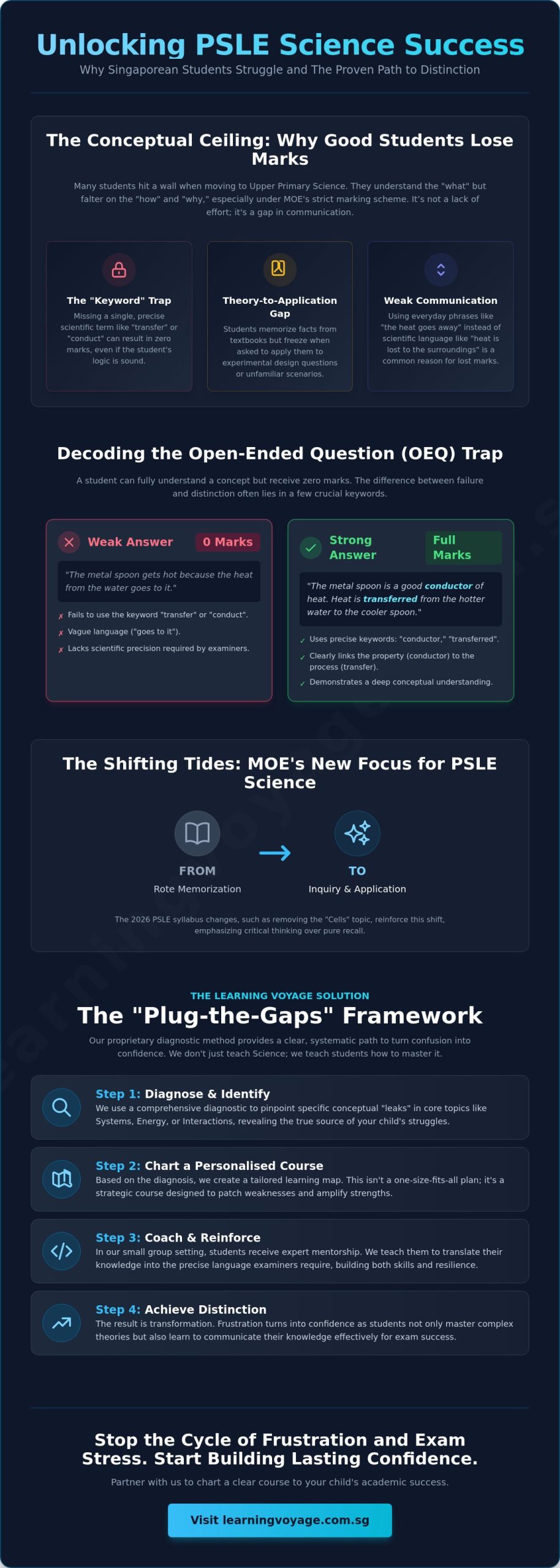
Missing a single scientific keyword like “transfer” or “conduct” can result in zero marks, even if the student’s explanation is logically sound. This “OEQ Trap” creates immense stress for both the child and the parent. Students feel they “understand” the topic but “cannot score” on the paper because they haven’t mastered the specific vocabulary required. Common reasons for this include:
- Using vague language instead of scientific terms, such as saying “the heat goes away” instead of “heat is lost to the surroundings.”
- Failing to link evidence provided in the question back to the underlying scientific concept.
- Omitting comparison words in questions that require a clear distinction between two different setups.
We see this as a breakdown in scientific communication. Instead of rote memorization, students need a systematic way to translate their thoughts into the precise language examiners look for. It’s about learning the “rules of the sea” so they can communicate their knowledge clearly and effectively.
Bridging the Gap Between Theory and Application
Experimental design questions involving variables and constants often trip up even the brightest minds. These questions test a student’s ability to plan and interpret data, moving beyond the safety of the textbook into real-world scenarios. The mental fatigue and exam stress associated with high-stakes papers can lead to careless mistakes or a complete “freeze” during the paper. We frame Science as a continuous path of discovery. It isn’t just a set of facts to be stored; it’s a way of looking at the world that requires a prepared and confident mind to navigate successfully. By identifying these hurdles early, we help students build the resilience needed for academic excellence.
The Small Group Advantage: Why Personalised Coaching Outperforms the Rest
Many students drift in the anonymity of large lecture halls, where a single misunderstood concept can pull them off course. This is why small group science tuition sengkang has become a beacon for parents who value precision and personal growth. Unlike the one-size-fits-all approach common in massive tuition franchises, bespoke small groups allow for a tailored experience. Extensive research on small-group learning from the University of Pennsylvania confirms that these settings significantly boost academic outcomes in Science. In this intimate environment, the tutor isn’t just a lecturer; they’re a seasoned navigator who understands each student’s unique academic journey.
The collaborative atmosphere of small group science tuition sengkang transforms the classroom from a place of pressure into a workshop of inquiry. Peer learning in a controlled, small setting offers social-emotional benefits that shouldn’t be overlooked. When students see their peers grappling with similar challenges, the isolation of academic struggle vanishes. They begin to collaborate, explaining concepts to one another under the watchful eye of their mentor. This communal discovery reinforces their own understanding while building the soft skills necessary for Secondary school and beyond. It’s about creating a community of young scientists who support each other’s progress.
Individualised Attention vs. Large Class Anonymity
Tutors in a small setting have the luxury of observation. They can immediately spot the “blank look” that signals a student is lost in a complex explanation. Our Plug-the-Gaps technique is designed specifically for this moment. It identifies the exact conceptual hurdle, be it a misunderstanding of electrical circuits or water cycles, and resolves it before the student falls behind. This level of visibility is impossible in a class of thirty, where individual struggles are often masked by the pace of the group.
Building Child Confidence Through Immediate Feedback
Misconceptions in Science are like small leaks in a hull; if left unaddressed, they eventually sink a student’s confidence. When a child finally grasps a difficult concept like Thermoregulation, the transformation is palpable. Immediate feedback ensures that wrong ideas don’t take root. Our mentors provide a safe harbor where “silly” questions are encouraged, fostering an inclusive atmosphere that builds character alongside grades. This nurturing approach turns exam stress into a state of quiet preparedness. If you’re ready to see your child move from frustration to mastery, consider exploring our current class schedules to find a suitable slot.
Navigating the MOE Syllabus: Identifying Conceptual Gaps Before They Sink Results
The MOE Science syllabus is far more than a collection of facts; it’s a vast and often unpredictable sea that requires a sturdy vessel and a clear map to navigate. Many students begin their journey with enthusiasm, only to find their confidence taking on water when they encounter the increased rigor of upper primary and secondary levels. Choosing small group science tuition sengkang provides the specialized support needed to patch these foundational leaks before they lead to academic distress. We view the educational system as a series of interconnected waterways where every lesson serves as a vital point of navigation on a continuous path of discovery.
Common “leaks” in a student’s Science foundation frequently appear in complex themes like Energy and Systems. These aren’t just isolated topics; they are the currents that run through the entire curriculum. If a child’s understanding of energy conversion is shaky in Primary 5, they’ll likely struggle with the more turbulent waves of thermal physics or cellular respiration in later years. Identifying these gaps early is essential. It’s about ensuring the hull is sound before the storm of national examinations arrives, allowing the student to sail with a sense of prepared and confident mastery.
From PSLE to O-Levels: A Seamless Scientific Journey
A student’s success in the later years is often anchored in the quality of their early instruction. Our Primary Science tuition serves as a critical training ground, teaching young learners how to observe, hypothesize, and conclude with precision. As they progress to Secondary Science, the waves become steeper. The introduction of Pure Physics and Chemistry requires a shift from concrete observations to deep abstract thinking. Consistent mentorship during this transition ensures that the student doesn’t lose their bearings when the curriculum moves from the visible world to the microscopic and theoretical realms.
The Role of Higher-Order Thinking Skills (HOTS)
Higher-Order Thinking Skills (HOTS) are the compass by which modern Science students are judged. In the Singapore context, this means moving beyond simple recall to analyze data, evaluate experimental designs, and create logical arguments. Small group settings are uniquely suited for stimulating these skills. In a small group, every student is encouraged to voice their reasoning, allowing the tutor to guide their critical thinking in real-time. We often celebrate these breakthroughs as Post-It Note moments. These are the instances when a complex concept like electromagnetism finally clicks, transforming a student’s frustration into a genuine enthusiasm for the subject. This individualized attention ensures that no student is left to drift alone in a sea of confusion.
How to Identify and Resolve Learning Hurdles: The “Plug-the-Gaps” Framework
A ship cannot sail with a compromised hull; similarly, a student cannot reach academic excellence if their foundation is riddled with hidden conceptual voids. Our signature Plug-the-Gaps framework is a methodical process of maritime-inspired repair designed to transform a student’s performance from uncertainty to mastery. Within our small group science tuition sengkang, we treat every learning hurdle as a specific point of navigation that requires immediate, expert attention. This isn’t just about general revision. It’s about a deep, structural fix that prepares the student for the increasingly complex demands of the MOE syllabus.
Diagnostic assessments act as our sonar. They allow us to map a student’s current position at sea with pinpoint accuracy, revealing whether the struggle lies in content retention or the strategic application of keywords. Once the “leaks” are identified, we enter a re-teaching phase. We break down abstract theories into digestible parts, ensuring the student doesn’t just memorize but truly understands the underlying mechanics of the topic. This clarity is the first step toward building the character and confidence needed for high-stakes examinations.
Step 1: Mapping the Conceptual Voids
We utilize targeted topical tests to find exactly where the foundation is shaky. Every student brings a different set of gaps based on their unique school experience and previous learning history. Some might struggle with the experimental logic of variables, while others find the energy cycles of living systems confusing. Our team of experts, which you can learn more about on our About Us page, uses these metrics to chart a personalized learning path that addresses these specific weaknesses directly.
Step 2: Targeted Instruction and Mentorship
The coaching we provide is entirely bespoke, focusing only on the areas where the student needs support. We use visual aids and maritime metaphors to make abstract scientific concepts concrete and memorable. This guided inquiry approach is essential for developing Higher-Order Thinking Skills (HOTS), especially as the 2026 PSLE Science syllabus places a greater emphasis on experimental and inquiry skills. By asking the right questions, we mentor students to become independent thinkers who can navigate new problems with ease.
The final phase of our framework is application. Students test their newly patched knowledge against past-year papers and high-quality practice questions. This bridge between theory and practice is where true confidence is forged. It’s one thing to understand a concept in isolation; it’s another to apply it under exam conditions. If you want to stop the cycle of frustration and start your child on a path of discovery, discover how our Plug-the-Gaps technique can secure their academic future today.
Charting a Course to Distinction: Why Learning Voyage is Your Educational Partner
Education is much more than a functional necessity. It’s a transformative process of personal growth that equips a child with the character and resilience needed for life’s challenges. At Learning Voyage Education Centre, our philosophy is a sophisticated blend of academic authority and nurturing mentorship. We recognize that the journey through the Singapore Science curriculum can be stormy, but it doesn’t have to be navigated alone. By choosing small group science tuition sengkang, you’re opting for an educational partner dedicated to moving your child from a state of exam stress to one of quiet preparedness and confidence.
Principal Tutor Andy Woo founded this mission on a simple, powerful vision: every student deserves high-quality support and the opportunity to succeed at their own pace. We don’t believe in the “sink or swim” mentality of larger institutions. Instead, we act as a seasoned crew, providing the steady hand and methodical guidance required to master high-pressure academic environments. For busy families juggling multiple commitments, our Class Schedules are designed for maximum accessibility, ensuring that your child’s path to discovery remains uninterrupted and well-supported.
A Proven Methodology for Science Excellence
The success of our proprietary Plug-the-Gaps technique is reflected in the scores of students who’ve transformed their results from frustration to distinction. This isn’t a temporary fix; it’s a long-term commitment to scientific literacy. As students advance, the waves of content often grow steeper and more complex. To support this growth beyond the primary years, we offer specialized coaching in Secondary Physics and Chemistry. These programs ensure a cohesive experience, framing instruction as a continuous journey rather than a series of disconnected lessons. We invite you to join us on this maritime journey of discovery, where academic goals and personal development meet.
Taking the First Step: Contact and Consultation
Every child’s academic position is unique, and we believe their learning path should be too. We encourage parents to reach out for a personalized consultation where we can discuss your child’s specific needs and identify their current conceptual “leaks.” You can see the impact of our work through the many Post-it Notes of success left by past students who found their confidence within our walls. These small tokens of achievement represent a student’s evolution into a prepared and capable individual who no longer fears the “keyword traps” of the MOE marking scheme. Don’t let your child drift in a sea of confusion any longer. Contact us today to anchor your child’s academic future and begin their voyage toward excellence in small group science tuition sengkang.
Anchor Your Child’s Science Potential Today
Success in the MOE Science syllabus requires more than just attending lessons; it demands a precise strategy to navigate the complex marking schemes and application-based questions that often sink a student’s confidence. By choosing small group science tuition sengkang, you’re providing your child with a seasoned navigator who understands the intricacies of the national curriculum. Our proprietary “Plug-the-Gaps” technique has been refined over 15 years of specialized coaching, helping hundreds of students transform their results through targeted, empathetic instruction. We focus on structural fixes rather than surface-level recaps, ensuring that every conceptual leak is patched before the exam season arrives.
Under the dedicated mentorship of Principal Tutor Andy Woo, your child will move beyond rote learning to achieve a deep, conceptual understanding. This journey isn’t just about grades; it’s about building the character and resilience needed for academic excellence. Don’t let another semester of frustration pass by. Take the first step toward a transformative educational experience that prioritizes your child’s personal growth and achievement.
Secure Your Child’s Science Success – View Our Class Schedules
Every student has the potential to excel when they’re given the right support and a clear path forward. We look forward to helping your child navigate their way to distinction.
Frequently Asked Questions
How does small group tuition specifically help with Science Open-Ended Questions?
Small groups allow tutors to critique a student’s phrasing in real-time, which is essential for mastering the rigid MOE marking scheme. Since many students lose marks on Open-Ended Questions (OEQs) due to missing keywords, immediate correction is vital for progress. We teach students to analyze the question’s intent and match it with the specific scientific vocabulary required to score full marks. This prevents the reinforcement of vague language that often sinks a student’s score in a larger classroom setting.
What makes the “Plug-the-Gaps” technique different from standard tuition methods?
Standard tuition often relies on general topical reviews that might overlook a student’s specific misunderstandings. Our proprietary Plug-the-Gaps technique starts with a diagnostic sonar to find hidden conceptual voids unique to each learner. Instead of just reviewing what the whole class knows, we focus on structural repair of the individual’s foundation. This ensures that every student’s academic vessel is seaworthy before they face the high-pressure environment of national examinations.
Is Science tuition necessary if my child is already doing well in Mathematics?
While Mathematics and Science both require logic, Science demands a unique level of linguistic precision and conceptual application. A student might excel in calculations but struggle with the “keyword traps” and experimental variables found in Science papers. Specialized small group science tuition sengkang helps bridge this gap by focusing on the specific inquiry skills and data analysis that Mathematics doesn’t typically cover. It ensures that excellence in one subject isn’t undermined by frustration in another.
How do you handle the transition from Primary Science to Secondary Pure Sciences?
We view the move from Primary Science to Secondary Pure Sciences as navigating into deeper, more turbulent waters. The transition requires a significant shift from concrete observations to the abstract theories of Physics and Chemistry. Our mentorship provides a steady hand, helping students build the Higher-Order Thinking Skills (HOTS) needed to master complex topics like molecular structures and kinematics with confidence. This continuous path of discovery ensures they don’t lose their bearings as the curriculum grows more complex.
Can my child join the Science tuition classes midway through the school year?
Students are welcome to join our voyage at any point in the academic year without fear of being left behind. Because our framework is diagnostic, we can quickly identify a new student’s current position and map out a plan to patch any existing knowledge gaps. This personalized approach ensures that joining midway doesn’t mean they’ll be lost at sea; we provide the necessary support to align them with the class’s progress and the latest syllabus requirements.
What is the ideal class size for a small group Science tuition session?
The ideal size for small group science tuition sengkang is typically between six to eight students. This specific range is small enough for the tutor to provide individualized attention and spot every “blank look” while being large enough to facilitate healthy peer discussions. It creates a safe harbor where students feel comfortable asking questions that they might suppress in a larger, more anonymous classroom setting, fostering both character and academic growth.
How do you track and report student progress to parents?
We maintain a transparent communication rhythm with parents through regular progress updates and topical assessment reports. By tracking performance across different themes like Systems or Energy, we provide a clear map of a student’s growth and any areas that still require attention. This collaborative approach ensures that parents are always aware of their child’s academic trajectory and the methodical steps we’re taking to move them toward distinction.
Do you provide materials for Science practicals and experimental design?
Yes, we provide comprehensive materials that cover experimental design and the logic behind Science practicals. With the 2026 PSLE Science syllabus placing a greater emphasis on inquiry skills, understanding how to plan and interpret experiments is more critical than ever. Our resources guide students through the nuances of identifying variables and constants, ensuring they’re prepared for the practical challenges and the experiment-based questions that now carry more weight.


