
Strong Physics results depend on more than memorising formulas. For families searching for a secondary 4 physics tutor in Serangoon, expert guidance from Learning Voyage Education Centre helps students understand how concepts connect, practise applying them to exam questions, and build confidence as they prepare for the O-Level examinations. Personalised support gives lessons room to focus on the topics a student finds challenging, rather than moving at the same pace for everyone.
It’s frustrating for parents when a student puts in effort but still feels unsure about calculations, explanations, or how to approach unfamiliar problems. With clear guidance and steady practice, those sticking points can become easier to work through, helping students feel more in control of their learning. This article explains how tailored Physics support can strengthen understanding, what to look for in a tutoring approach, and how focused preparation can help students navigate the demands of Secondary 4 with greater confidence.
Key Takeaways
- Look for Physics support that identifies the concepts a student finds difficult and adapts explanations to their learning needs.
- Focused practice can help students explain their reasoning and apply Physics concepts to unfamiliar exam questions.
- Reviewing mistakes in past-paper practice can reveal where understanding or exam technique needs strengthening.
- Steady, personalised guidance can help students approach O-Level preparation with greater confidence and a clearer plan.
Class size and personalised support
Class size matters because it shapes how easily a student can ask questions and receive feedback. In a Physics lesson, one student may follow a worked example while another loses track at the first formula. A smaller learning group can make it easier for a teacher to notice that hesitation and pause. A Secondary 4 Physics tutor in Serangoon can use that moment to check the student’s reasoning before moving ahead. The useful measure is not a number alone, but whether each student’s thinking is heard and addressed during the lesson.
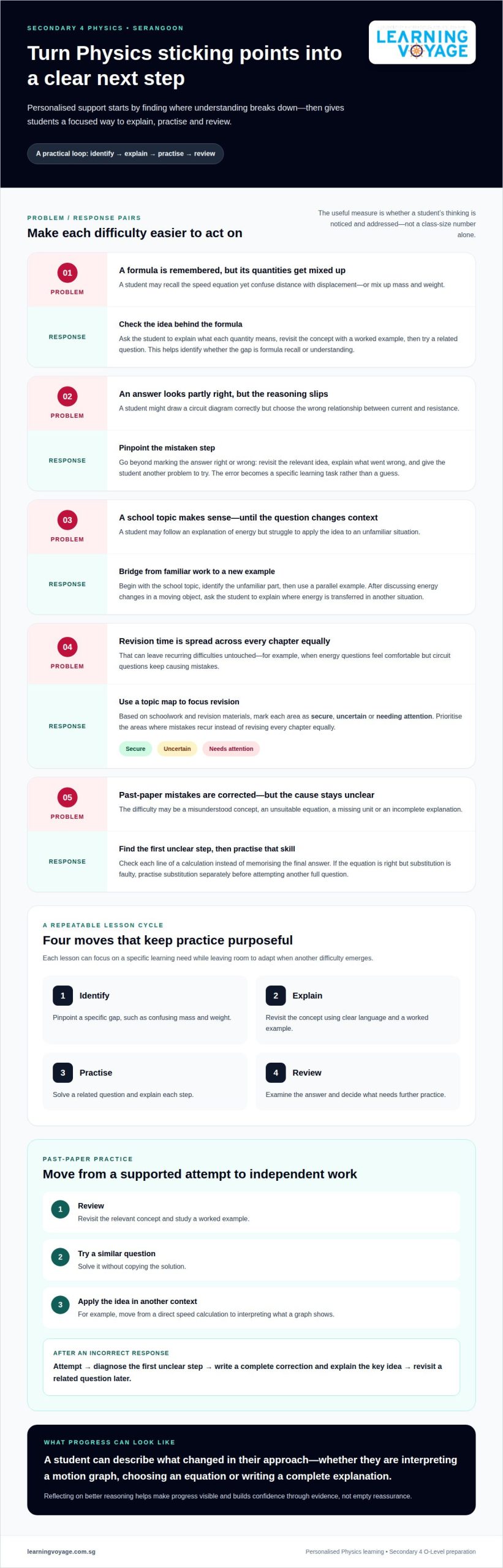
Personalised support starts by identifying exactly where understanding breaks down. A student might remember the speed equation but confuse distance with displacement. The tutor can ask them to explain each quantity, then work through a similar problem together. This helps distinguish a formula-recall issue from a gap in understanding, so the next explanation targets the real difficulty.
Feedback should go beyond marking an answer right or wrong. A student might draw a circuit diagram correctly but choose the wrong relationship between current and resistance. Useful feedback pinpoints the mistaken step, revisits the relevant idea, and gives the student another problem to try. This turns an error into a clear learning task instead of leaving the student to guess what went wrong.
For parents, repeated effort without visible progress can be frustrating. Make progress easier to follow by connecting each lesson to a specific learning need, such as interpreting a motion graph, choosing an equation, or writing a complete explanation. After practising, the student can describe what changed in their approach. Reflecting on better reasoning builds confidence through evidence, not empty reassurance.
Useful support can follow a simple lesson cycle:
- Identify: pinpoint a specific gap, such as confusing mass and weight.
- Explain: revisit the concept using clear language and a worked example.
- Practise: let the student solve a related question and explain each step.
- Review: examine the answer and decide what needs further practice.
This sequence gives each lesson direction while leaving room to adapt when another difficulty emerges.
Class interaction matters too. In a group, hearing another student explain an answer can reveal a different approach to a question. The tutor should still check each learner’s understanding rather than assume that quiet agreement means mastery. A student who explains why a force diagram includes particular forces is doing more than recalling facts: they are connecting the diagram to the situation.
Aiming for a distinction can feel daunting when a student is unsure of core ideas. Personalised guidance helps separate foundational gaps from more advanced challenges. First, the student builds accuracy with familiar questions. Practice can then introduce less direct wording or linked concepts. This progression lets ambitious learners stretch while helping others strengthen essential understanding at their own pace.
In Serangoon, families may seek a Secondary 4 Physics tutor in Serangoon when a student needs support that responds to actual classwork. Useful teaching addresses details such as an incorrect graph, an incomplete explanation, or a calculation with an unclear step. When guidance follows those details, the student gains a steadier course through Physics and a stronger basis for independent learning.
O-Level exam preparation and past-paper practice
O-Level Physics preparation works best when students connect topic knowledge with deliberate question practice. A past-paper question about motion might require them to interpret a graph, choose an equation, and explain the result. Practising these decisions can show whether the difficulty lies in understanding, method, or careless execution. It also gives each revision session a clear purpose.
Start with a topic map based on the student’s schoolwork and revision materials. Mark each area as secure, uncertain, or needing attention. If energy questions feel comfortable but circuit questions lead to repeated mistakes, prioritise circuits instead of revising every chapter equally. This keeps revision focused and can make a long list of topics feel more manageable.
Build past-paper practice from supported attempts towards independent work. First, review a relevant concept and study a worked example. Next, try a similar question without copying the solution. Then attempt a different question testing the same idea in another context. After practising a direct speed calculation, for example, try a question asking what a graph shows.
Marking is useful when it leads to a clear next step. For each incorrect response, identify the cause: a misunderstood concept, an unsuitable equation, a missing unit, or an incomplete explanation. If a calculation is wrong, check each line instead of simply memorising the final answer. When the equation is correct but the substitution is faulty, practise substitution separately before attempting another full question.
A simple review routine can make that process repeatable:
- Attempt: answer a question without looking at the worked solution.
- Diagnose: locate the first step where the reasoning became unclear.
- Correct: write a complete solution and explain the key idea.
- Revisit: try a related question later to see whether the method holds.
Give written explanations attention alongside calculations. A student answering a question about forces might draw a diagram but fail to explain how the forces affect motion. Practise linking each statement to evidence in the question. Ask what the diagram represents, which direction matters, and how the information supports the conclusion. Clear reasoning helps students communicate understanding rather than rely on isolated keywords.
Exam stress can make familiar work feel harder. Practise a methodical approach to unfamiliar questions: underline what is being asked, note the given information, and choose a relevant concept. If the route is not immediately clear, move to a manageable part of the question, then return with a clearer starting point. This practises managing attention as well as recalling Physics content.
Review errors across practice sessions. Recurring problems with units, graph interpretation, or explanations deserve targeted attention. Keep a brief record of the topic, the mistake, and the corrected approach. For example, “motion graph: confused gradient with height” gives a more useful revision target than “revise motion.” The record also helps parents follow what the student is working on.
Secondary 4 students considering junior college pathways may feel pressure to achieve quickly. Yet a strong preparation plan begins with accurate understanding, not rushed question volume. Choose practice that matches current learning, revisit corrections, and gradually attempt less familiar applications. A tutor can guide this process by linking school topics to past-paper practice and helping the student turn each mistake into a specific learning goal.
Learning Voyage Education Centre
Learning Voyage Education Centre helps students address specific learning hurdles through small-group coaching and its Plug-the-Gaps technique. For families seeking structured support alongside Secondary 4 Physics preparation, this approach offers a way to identify where understanding needs reinforcement and build a clearer study path.
Students balancing Physics with Mathematics may also benefit from Secondary 4 E-Mathematics or A-Mathematics tuition. Secondary 3 E-Mathematics and A-Mathematics tuition can support students strengthening their foundations before the demands of Secondary 4. The right time to seek added guidance is when a student’s effort is not resolving persistent gaps, or exam preparation feels difficult to organise.
For a considered next step, contact Learning Voyage Education Centre.
Choose a Steady Next Step
O-Level preparation can become more manageable when the student has a clear next step, rather than feeling expected to fix every difficulty at once. If Physics remains a source of stress, consider whether regular guidance could help your child approach the subject with greater confidence. A secondary 4 Physics tutor in Serangoon may be a useful option when your child needs structured support alongside school learning.
Learning Voyage Education Centre also offers Secondary 4 E-Mathematics Tuition, Secondary 4 A-Mathematics Tuition and Secondary 3 A-Mathematics Tuition. These options may suit families looking for support across related academic demands, while each student continues building at their own pace. The aim is progress grounded in understanding, not pressure to move faster than feels manageable.
Take the next step at a pace that works for your family. Contact Learning Voyage Education Centre to discuss support, and help your child move forward with confidence.