Learning Voyage – Math and Science Specialist



By Andy Woo August 2, 2026
Secondary 3 E-Math Tuition: Navigating the Critical Transition to Upper Secondary Success
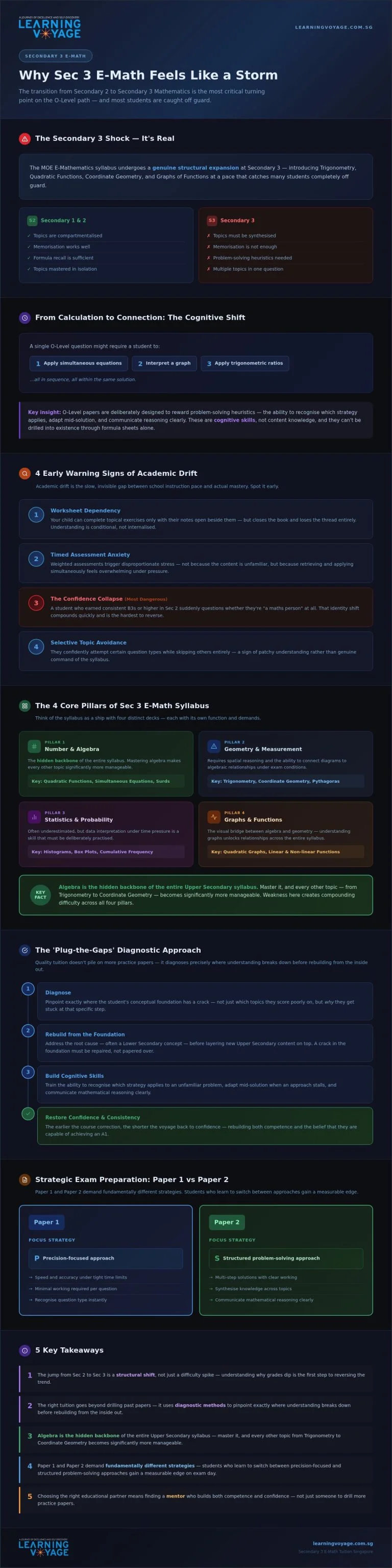
Your child aced Secondary 2 Mathematics. So why does Secondary 3 feel like they’ve sailed straight into a storm?
It’s a question that quietly haunts thousands of Singapore parents every year, usually around the time the first Sec 3 test paper comes home with a grade that doesn’t match the child they know. The frustration is real, and so is the confusion. Your child hasn’t suddenly become less capable. What’s changed is the nature of the subject itself. Secondary 3 E-Math isn’t simply harder arithmetic; it’s a structural shift from familiar calculation into abstract connection, where topics like Trigonometry, Quadratic Functions, and Coordinate Geometry demand a completely different way of thinking. Without the right support to bridge that gap, even capable students can lose their footing fast.
That’s precisely why quality secondary 3 e-math tuition matters so much at this stage, not as a remedial rescue, but as a deliberate, strategic investment in your child’s Upper Secondary trajectory. In this guide, you’ll discover why the Sec 2 to Sec 3 transition is the most critical turning point on the O-Level path, what makes certain students thrive while others struggle, and how the right mentorship can rebuild confidence, restore consistency, and lay a foundation strong enough to carry your child all the way to an A1.
Key Takeaways
- The jump from Secondary 2 to Secondary 3 Mathematics is a structural shift, not just a difficulty spike — understanding why grades dip is the first step to reversing the trend.
- The right secondary 3 e-math tuition goes beyond drilling past papers; it uses diagnostic methods to pinpoint exactly where a student’s understanding breaks down before rebuilding from the inside out.
- Algebra is the hidden backbone of the entire Upper Secondary syllabus — master it, and every other topic from Trigonometry to Coordinate Geometry becomes significantly more manageable.
- Paper 1 and Paper 2 demand fundamentally different strategies, and students who learn to switch between precision-focused and structured problem-solving approaches gain a measurable edge on exam day.
- Choosing the right educational partner means more than finding a tutor — it means finding a mentor who builds both the competence and the confidence your child needs to carry through to O-Level distinction.
The Secondary 3 E-Math Transition: Why Grades Often Dip in Upper Secondary
There’s a particular kind of silence that falls over a household when a Sec 3 test paper lands on the dining table. Not the comfortable quiet of a family at ease, but the tense, searching kind, where parents and children alike are trying to reconcile a grade with everything they believed about capability and effort. This moment, repeated across Singapore every semester, has a name: the Secondary 3 Shock.
It’s not a myth, and it’s not an exaggeration. The MOE E-Mathematics syllabus undergoes a genuine structural expansion at Secondary 3, introducing topics like Trigonometry, Quadratic Functions, Coordinate Geometry, and Graphs of Functions in a volume and at a pace that catches many students completely off guard. What worked in Sec 1 and Sec 2, diligent memorisation, tidy working, reliable formula recall, simply stops being enough. The rules of the game have changed, but nobody handed your child a new rulebook.
From Calculation to Connection: The Cognitive Shift
Lower Secondary Mathematics is, by design, largely compartmentalised. Algebra sits in one chapter. Geometry in another. Students can master each topic in relative isolation and still perform well on assessments. Secondary 3 dismantles that structure entirely. A single examination question might require a student to apply simultaneous equations, interpret a graph, and apply trigonometric ratios, all in sequence, all within the same solution. This is what educators mean when they talk about synthesising knowledge rather than simply retrieving it.
The national examination context compounds this further. MOE’s O-Level papers are deliberately designed to reward problem-solving heuristics: the ability to recognise which strategy applies to an unfamiliar problem, adapt mid-solution when an approach stalls, and communicate mathematical reasoning clearly. These are cognitive skills, not content knowledge, and they can’t be drilled into existence through formula sheets alone. Students who arrive at Sec 3 still relying on memorisation as their primary strategy are, in effect, navigating open ocean with a map that only covers the harbour.
Identifying the Early Warning Signs of Academic Drift
Academic drift is the slow, often invisible gap that opens between the pace of school instruction and the depth of a student’s actual mastery. It rarely announces itself loudly. Instead, it surfaces as small, persistent frustrations that parents and students tend to dismiss as temporary.
Watch for these specific signals:
- Worksheet dependency: Your child can complete topical exercises only with their notes open beside them, but closes the book and loses the thread entirely.
- Timed assessment anxiety: Weighted assessments or class tests trigger disproportionate stress, not because the content is unfamiliar, but because the pressure to retrieve and apply simultaneously feels overwhelming.
- The confidence collapse: A student who earned consistent B3s or higher in Sec 2 suddenly questions whether they’re “a maths person” at all. That identity shift is dangerous, and it compounds quickly.
- Selective topic avoidance: They’ll confidently attempt certain question types while skipping others entirely, a sign of patchy understanding rather than genuine command of the syllabus.
Recognising these signs early is exactly where quality secondary 3 e-math tuition makes its most meaningful intervention. Not by piling on more practice papers, but by diagnosing precisely where the student’s conceptual foundation has a crack before that crack becomes a fracture. The earlier the course correction, the shorter the voyage back to confidence.
Navigating the Core Pillars of the Secondary 3 E-Math Syllabus
Think of the Secondary 3 E-Math syllabus as a ship with four distinct decks: Number and Algebra, Geometry and Measurement, Statistics and Probability, and Graphs. Each deck has its own function, its own demands, and its own way of testing a student’s readiness. The challenge isn’t simply learning what’s on each deck; it’s understanding how they’re connected below the waterline, where the real structural work happens.
What surprises many students is how quickly the volume of new material compounds. Trigonometry, Coordinate Geometry, Quadratic Functions, and Graphs of Functions all arrive within the same academic year, each carrying significant examination weightage. These aren’t peripheral topics. They appear repeatedly across Paper 1 and Paper 2, often woven together within a single question. A student who treats them as isolated chapters to be memorised, rather than interconnected tools to be wielded, will find the exam paper deeply disorienting.
Real-world context questions now dominate national assessments, too. MOE’s examination design increasingly embeds mathematical problems within practical scenarios: calculating the optimal dimensions of a container, interpreting a rate-of-change graph in a business context, or applying trigonometric ratios to a surveying problem. These questions demand more than formula recall. They require a student to read a situation, extract the relevant mathematical structure, and construct a solution pathway, often under significant time pressure.
Algebraic Mastery: The Foundation of Upper Secondary Success
Algebra is the keel of this entire ship. Without it, every other topic lists badly. Quadratic Equations, Indices, and Inequalities aren’t simply chapters to complete and move on from; they’re the recurring language through which Trigonometry, Coordinate Geometry, and Graphs all speak. A student who can’t confidently factorise a quadratic expression or manipulate index notation will hit the same wall in topic after topic, often without realising that the root cause is algebraic, not topical.
The most common marks lost in this strand aren’t from conceptual misunderstanding; they’re from what teachers politely call “careless errors” but are actually systematic weaknesses in algebraic manipulation. These include:
- Sign errors when expanding brackets: Particularly with negative coefficients, where a single missed negative cascades through an entire solution.
- Incomplete factorisation: Students who factorise partially and then stop, missing the second factor entirely.
- Inequality direction errors: Flipping the inequality sign incorrectly when multiplying or dividing by a negative value, a mistake that inverts the entire answer.
- Misapplying index laws: Confusing rules for multiplication and power-of-a-power operations, especially under timed conditions.
Mastering algebra at Sec 3 also pays forward dividends. Students who build genuine fluency here find the transition to A-Math tuition significantly smoother, because Additional Mathematics essentially extends the same algebraic language into more demanding territory. The investment made now compounds across the entire Upper Secondary journey.
Geometry and Trigonometry: Visualising the Solution
Geometry in Sec 3 shifts from the familiar angles-and-shapes territory of Lower Secondary into something considerably more demanding. Circle properties, trigonometric ratios for right-angled and non-right-angled triangles, and multi-step geometric proofs all require a student to do something that no formula sheet can do for them: visualise. The ability to mentally rotate a 3D figure, identify which triangle within a complex diagram holds the relevant information, or construct an auxiliary line to unlock a proof is a spatial reasoning skill that must be deliberately developed.
Trigonometry, in particular, is where many students experience their sharpest confidence drop. The sine, cosine, and tangent ratios feel abstract until a student learns to anchor them to a diagram rather than a formula. Once that visual habit is established, problems that once seemed impenetrable become methodical. Strategies that help include always labelling all known sides and angles before attempting any calculation, identifying the target unknown before selecting a ratio, and working backwards from what the question asks to determine which trigonometric relationship connects the known to the unknown.
There’s also a meaningful overlap with Physics that’s worth acknowledging. Vector resolution, force diagrams, and wave behaviour all draw on the same trigonometric principles students encounter in E-Math. For students pursuing secondary science tuition alongside their mathematics programme, building fluency in trigonometry creates a genuine cross-subject advantage, reinforcing both disciplines simultaneously rather than treating them as separate voyages.
Quality secondary 3 e-math tuition that maps these connections explicitly, showing students where their algebra feeds into their geometry, and where their geometry echoes in their science, is what separates surface-level coaching from the kind of mentorship that genuinely transforms a student’s relationship with mathematics.
The ‘Plug-the-Gaps’ Technique: A Diagnostic Approach to Mastery
Most tuition centres hand every student the same stack of practice papers and call it a programme. The assumption embedded in that approach is troubling: that every student who struggles with Secondary 3 E-Math struggles for the same reason. They don’t. And treating them as if they do is precisely why so many students spend months in tuition without seeing meaningful grade movement.
Learning Voyage takes a fundamentally different position. Their proprietary Plug-the-Gaps technique treats every student’s knowledge as a unique map, one with specific, locatable gaps rather than a uniform fog of misunderstanding. The goal isn’t to reteach the entire syllabus. It’s to find exactly where a student’s understanding leaks, seal those leaks precisely, and then build forward from solid ground. In the context of secondary 3 e-math tuition, this distinction isn’t cosmetic. It’s the difference between a student who slowly improves and one who transforms.
Step 1: The Diagnostic Phase
The process begins before a single new concept is taught. Past test papers and class assignments are analysed alongside Learning Voyage’s distinctive Post-it notes system, which tracks recurring error patterns across multiple attempts rather than treating each mistake as an isolated incident. This is a crucial distinction. A student who consistently drops marks on the same type of algebraic manipulation isn’t making random careless errors; they have a systematic process gap that will keep surfacing until it’s directly addressed.
The diagnostic phase also separates two very different problems that look identical on a marked script:
- Knowledge gaps: The student genuinely hasn’t encountered or retained the concept. The fix is direct instruction.
- Process errors: The student understands the concept but breaks down at a specific procedural step. The fix is targeted drilling of that exact step, not re-teaching the whole topic.
Critically, the diagnosis doesn’t stop at Sec 3 content. Many students arrive in Upper Secondary carrying unresolved foundational leaks from Lower Secondary, particularly in algebraic manipulation and ratio reasoning. Identifying these early means the intervention addresses the actual root cause, not just the symptom showing up on the latest test paper.
Step 2: Targeted Intervention and Reinforcement
Once the gaps are mapped, bespoke practice sets are built around them. Not generic topical exercises, but sequences designed to isolate the exact point of breakdown, rebuild fluency there, and then reintegrate that skill into multi-step problem contexts. Small group coaching is what makes this level of personalisation viable. In a large lecture-style class, a tutor can’t track whether each student has genuinely closed a gap or simply memorised a worked example. In a small group, that distinction is visible every session.
The tutor’s role here is closer to a mentor guiding a student through unfamiliar waters than an instructor delivering content. When a student hits a wall on Trigonometry or Coordinate Geometry, the response isn’t frustration; it’s curiosity. What specifically broke down? Where did the reasoning drift? That mindset shift, from “I got it wrong” to “this mistake tells me something useful,” is what builds the resilient mathematical thinking that sustains performance all the way to O-Level.
It’s also what separates genuine secondary 3 e-math tuition from the kind that merely keeps students busy with paper after paper until something accidentally sticks.
Strategic Exam Preparation: Mastering Paper 1 and Paper 2 Dynamics
Two papers. Same syllabus. Completely different demands. This is the reality of the O-Level E-Mathematics examination, and students who walk into the exam hall treating Paper 1 and Paper 2 as interchangeable will pay for that assumption in marks.
Paper 1 is the no-calculator paper, worth 80 marks across approximately 25 short-answer questions. Speed and precision are everything here. Questions are compact and typically test one or two skills at a time, which sounds manageable until a student realises that the absence of a calculator exposes every weakness in mental arithmetic, algebraic manipulation, and numerical fluency simultaneously. There’s nowhere to hide. Paper 2, by contrast, allows the scientific calculator and carries 100 marks across structured, multi-part questions that often build on each other. A wrong answer in part (a) can cascade into parts (b) and (c) if a student doesn’t recognise when to use a carried-forward value versus when to restart from first principles.
The Calculator Strategy is simpler than most students expect, but it requires deliberate practice to execute under pressure. In Paper 1, mental benchmarking matters: before committing to a calculation, estimate the expected magnitude of the answer. If your working produces 47.3 where you expected a whole number, that’s a signal to check immediately rather than press on. In Paper 2, the calculator is a tool for verification, not a crutch for thinking. Students who reach for it before setting up the correct algebraic structure routinely get precise answers to the wrong equation.
Real-world context questions in Paper 2 are where capable students lose marks they genuinely shouldn’t. A question framed around a water tank’s filling rate or a business’s revenue curve isn’t testing whether your child understands tanks or businesses. It’s testing whether they can strip away the narrative, identify the underlying mathematical relationship, and work with that structure alone. Teaching students to read for the skeleton of a question, the variables, the constraints, the target unknown, before engaging with the context is one of the most transferable skills that quality secondary 3 e-math tuition builds.
Presentation is the silent mark-killer. An examiner following a student’s working should never have to guess what happened between one line and the next. Define variables explicitly. State the formula before substituting values. Show the intermediate step even when it feels obvious. Students who write workings that speak to the examiner, communicating a clear logical chain rather than a sequence of calculations, consistently recover method marks even when their final answer is wrong.
Time Management and Accuracy Under Pressure
The practical rule for Paper 1 is roughly one minute per mark. A 3-mark question should take no longer than three minutes; if it’s taking five, move on and return. Checking answers effectively doesn’t mean redoing the entire question. Substitute your answer back into the original equation to verify it satisfies the condition, or use an alternative method if one exists. Psychologically, there’s real value in scanning the paper first and completing the questions you’re most confident about. Securing those marks early settles the nerves and creates time reserves for the harder items that follow.
Decoding Examiner Intent
O-Level examiners signal their expectations through specific language. “Show that” means every step must be explicit and no assumptions skipped. “Hence” means the method from the previous part must be used, not an alternative approach. “Without a calculator” in Paper 2 is a deliberate instruction, not a suggestion. Common traps include quadratic equations that appear to have two valid solutions but whose context eliminates one (negative lengths, for instance), and trigonometry questions where the diagram is not drawn to scale, deliberately misleading students who rely on visual estimation rather than calculation. Recognising these patterns before exam day, not during it, is what separates prepared students from reactive ones. Explore Learning Voyage’s comprehensive exam prep schedules
Charting Your Course: Why Learning Voyage is the Right Educational Partner
There’s a meaningful difference between a tuition centre that processes students and a programme that genuinely transforms them. Learning Voyage was built around that distinction. Since 2011, the team has operated from a single, clear conviction: that every student, regardless of where they’re starting from, deserves the kind of specialist support that addresses their actual learning needs rather than a generic syllabus checklist. That philosophy shapes everything, from how sessions are structured to how progress is measured and communicated to parents.
Principal Andy Woo leads with both depth and warmth. His approach to secondary 3 e-math tuition is grounded in the understanding that a struggling student isn’t a failing student; they’re a capable learner who hasn’t yet found the right entry point into the material. That distinction matters enormously when a child’s confidence is already bruised. The educators at Learning Voyage are trained to hold both truths simultaneously: high academic standards and genuine empathy for the pressure students carry.
Small group coaching is the structural choice that makes everything else possible. Unlike large-class environments where a tutor’s attention is inevitably diluted, Learning Voyage’s small groups function as a safe harbour. Students ask questions they’d never raise in a school classroom. They make mistakes without embarrassment. They receive feedback that’s specific to their reasoning, not generalised to the group. That environment doesn’t just accelerate learning; it rebuilds the academic self-belief that the Sec 3 transition so often erodes. Explore the mission and values that guide every session at Learning Voyage.
Beyond the Grades: Building Confidence and Character
Mathematical mastery, built the right way, produces something that outlasts any examination result. The habit of breaking an unfamiliar problem into structured steps, checking assumptions before committing to a method, and persisting through difficulty without panic: these are critical thinking skills that serve students well beyond the O-Level hall. Students who’ve worked through the Plug-the-Gaps technique consistently describe the same shift. It’s not just that their grades improved; it’s that they stopped dreading mathematics. That change in identity, from someone who “can’t do maths” to someone who knows how to approach any problem methodically, is the real outcome Learning Voyage is building toward.
Take the First Step Toward Distinction
The right time to act is before the next test paper comes home with a grade that doesn’t reflect your child’s potential. View the class schedules to find a session that fits your family’s timetable, or ask about Intensive Revision Workshops available during school holidays, designed to consolidate key topics and sharpen exam technique in concentrated, high-impact blocks. Contact Learning Voyage today to book a diagnostic session and begin charting a clearer course toward the A1 your child is genuinely capable of achieving.
Your Child’s Upper Secondary Success Starts with One Decision
Secondary 3 is the turning point that shapes everything that follows. Students who navigate it with the right support don’t just survive the transition; they arrive at O-Level year with genuine confidence, solid technique, and the kind of mathematical fluency that holds under pressure.
The core message of this guide is straightforward: grade dips at this stage aren’t a verdict on your child’s ability. They’re a signal that the support structure needs to match the new demands of Upper Secondary. Quality secondary 3 e-math tuition closes that gap by addressing the actual root cause, not just the symptoms showing up on test papers.
Learning Voyage offers exactly that kind of purposeful intervention. With specialist Principal Tutor Andy Woo at the helm, a proprietary Plug-the-Gaps technique that targets each student’s specific weaknesses, and small group coaching that keeps every student visible and supported, the programme is built to produce real, lasting transformation.
Your child’s A1 isn’t a distant horizon. It’s a destination worth navigating toward, and the right crew makes all the difference. Secure your child’s path to O-Level distinction and contact Learning Voyage today.
Frequently Asked Questions About Secondary 3 E-Math Tuition
Is Secondary 3 E-Math significantly harder than Secondary 2?
Yes, and the difficulty isn’t just a matter of degree; it’s a change in kind. Secondary 2 Mathematics rewards students who can master topics in isolation. Secondary 3 introduces Trigonometry, Quadratic Functions, and Coordinate Geometry all within the same year, and examination questions routinely weave these topics together within a single solution. Students who relied on memorisation in Lower Secondary often find that strategy stops working almost immediately.
The pace compounds the challenge. There’s less time to consolidate each topic before the next arrives, which means small gaps in understanding accumulate quickly. Most students who struggle in Sec 3 aren’t less capable than they were in Sec 2; they’re simply navigating a fundamentally different type of mathematical thinking without the tools to do it confidently yet.
How often should my child attend Secondary 3 E-Math tuition?
For most Sec 3 students, one session per week provides a solid foundation, giving enough time between sessions to practise independently and consolidate what was covered. Students who are significantly behind, or who are approaching major assessments like mid-year or end-of-year examinations, often benefit from two sessions per week during those periods to accelerate recovery and sharpen exam technique.
The honest answer is that frequency matters less than consistency and quality. A student who attends one focused, diagnostically-driven session weekly and completes the targeted practice assigned between sessions will typically outpace a student attending twice-weekly generic classes without purposeful follow-through. Talk to Learning Voyage about what cadence suits your child’s current standing and goals.
What is the ‘Plug-the-Gaps’ technique and how does it help?
Learning Voyage’s proprietary Plug-the-Gaps technique starts from a simple but important premise: not every student struggles for the same reason, so treating them as if they do wastes time and delays real progress. Before any new content is taught, a diagnostic process maps each student’s specific knowledge gaps and process errors, distinguishing between concepts they haven’t retained and procedural breakdowns at a specific step within an otherwise understood topic.
Once those gaps are located precisely, bespoke practice sequences are built around them rather than assigning generic topical exercises. This approach is what makes secondary 3 e-math tuition at Learning Voyage genuinely targeted rather than simply supplementary. Students stop repeating the same mistakes because the root cause is addressed directly, not papered over with more practice papers.
Can my child catch up if they failed their Sec 3 mid-year exams?
Absolutely, and it’s worth saying clearly: a poor mid-year result is a signal, not a sentence. Many students who struggled significantly in Sec 3 mid-years have gone on to achieve strong O-Level grades with the right intervention. The key is acting before the end-of-year examinations arrive, because the second half of Sec 3 builds directly on the first half’s content. Waiting compounds the gap rather than closing it.
A diagnostic session at Learning Voyage identifies exactly which concepts from the first half of the year are still unresolved, allowing the programme to target those specific areas efficiently rather than reteaching the entire syllabus. Students who commit to consistent attendance and complete the assigned practice between sessions typically see measurable grade movement within a term. The voyage back to confidence is shorter than most parents expect once the right course is charted.
Does your tuition cover the latest MOE syllabus for 2026?
Yes. Learning Voyage’s programme is aligned to the current MOE E-Mathematics syllabus, and the team monitors official updates to ensure content, examination format, and assessment objectives reflect what students will actually encounter in school and at the O-Level. If you have specific questions about syllabus coverage for 2026, it’s worth checking directly with MOE’s official publications and confirming with Learning Voyage during your initial consultation.
One practical note for parents: the syllabus document itself is publicly available on the Singapore Examinations and Assessment Board (SEAB) website, and reviewing it alongside your child’s school scheme of work gives a clear picture of what topics are prioritised in each semester. A quality tuition programme should be able to map its sessions directly to that structure, which Learning Voyage does as a matter of course.
What is the difference between E-Math and A-Math in Secondary 3?
E-Math, or Elementary Mathematics, is compulsory for all Upper Secondary students and focuses on building strong foundational skills across algebra, geometry, statistics, and trigonometry. It’s designed to be accessible while still demanding genuine problem-solving ability. A-Math, or Additional Mathematics, is an optional subject taken by students who intend to pursue science, engineering, or mathematics-heavy courses at the post-secondary level. It covers significantly more abstract content, including calculus, advanced trigonometry, and proofs.
The relationship between the two is important: E-Math fluency is a prerequisite for A-Math success. Students who have shaky algebraic foundations in E-Math will find A-Math considerably harder than it needs to be. Learning Voyage offers both Secondary 3 E-Math and Secondary 3 A-Math tuition, and many students benefit from support in both subjects simultaneously, particularly if they’re targeting a strong science stream in Junior College.
How do small group sessions compare to one-on-one home tuition?
Small group coaching and one-on-one home tuition serve different purposes, and the right choice depends on what your child actually needs. One-on-one tuition offers undivided attention but can sometimes create a dependency where the student performs well only when the tutor is present. Small group coaching, done well, builds something different: the ability to think independently while still receiving targeted, personalised feedback within a structured environment.
At Learning Voyage, small groups are kept intentionally compact so that every student remains visible to the tutor throughout each session. Students hear how their peers reason through problems, which reinforces their own understanding and normalises the experience of making mistakes and correcting them. It’s worth noting that Learning Voyage does not offer one-on-one home tuition; their programme is built around small group coaching, which they’ve refined since 2011 as the format best suited to producing lasting academic transformation.
Are there trial classes available for new Secondary 3 students?
The best starting point is to contact Learning Voyage directly to ask about current availability and any introductory options for new students. Class schedules and enrolment processes can change across academic terms, so reaching out through the contact page gives you the most accurate and up-to-date information for your child’s specific situation.
What’s worth knowing before you enquire is that Learning Voyage’s small group format means places are limited by design. If your child is starting Sec 3 or has already identified a gap that needs addressing, earlier contact gives you more scheduling flexibility. Intensive Revision Workshops during school holidays are also available for students who want a concentrated entry point before committing to a regular term programme.


