Learning Voyage – Math and Science Specialist



By Andy Woo May 15, 2026
Primary 5 Science Tuition Sengkang: Navigating the 2026 Path to PSLE Excellence
What if the reason your child is struggling with Primary 5 Science isn’t a lack of effort, but a compass that’s pointing in the wrong direction? Many parents in Sengkang watch their children study for hours, only to see them lose marks on open-ended questions because they didn’t use the exact keywords the MOE markers require. The jump to the 2026 PSLE syllabus feels like entering uncharted waters, especially with the removal of the Cells topic and a new focus on the 3 INs framework. Finding the right primary 5 science tuition sengkang is no longer just about extra practice; it’s about finding a mentor who can help your child navigate these complex academic currents with precision.
We understand the frustration of seeing your child’s hard work result in exam-period panic instead of steady progress. This guide will show you how to transform that stress into genuine scientific confidence by selecting a program that addresses specific learning gaps rather than offering generic worksheets. You’ll discover how to master Explain and Compare questions, understand the AL scoring system’s impact on the 2026 cohort, and build a structured revision plan. By the end of this article, you’ll have a clear map to help your child reach their full potential and sail toward PSLE excellence with a steady hand.
Key Takeaways
- Understand why the Primary 5 Science transition is the most challenging academic leap, shifting from simple recall to complex application-based thinking.
- Discover how specialized primary 5 science tuition sengkang helps students decode the intricacies of the MOE ‘Systems’ and ‘Cycles’ units with precision.
- Learn a framework for selecting a tuition partner that prioritizes pedagogical fit and mentorship over mere proximity.
- Master the ‘anchor’ keywords and the Concept-Evidence-Link structure necessary to secure full marks in demanding open-ended questions.
- Explore how a bespoke educational approach builds the character and academic resilience required to navigate the 2026 PSLE with confidence.
The Primary 5 Science Leap: Navigating the Stormy Transition in 2026
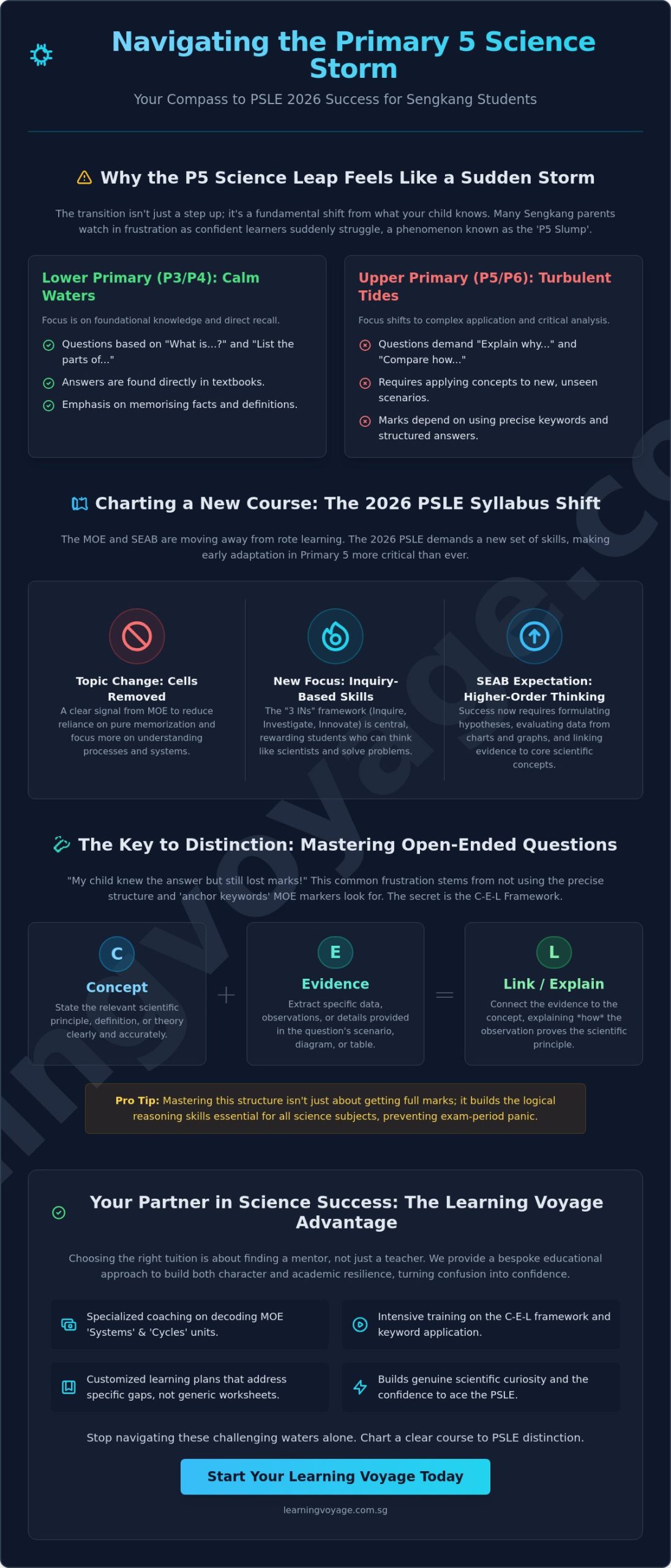
Imagine your child has been sailing smoothly through the calmer waters of Primary 3 and 4 Science, only to suddenly hit a wall of gale-force winds in Primary 5. This is a common reality for many families in Sengkang. The transition to Upper Primary isn’t just a step up; it’s a complete shift in the academic tide. While the lower block focuses on foundational knowledge and basic recall, the Primary 5 syllabus demands high-level application and critical analysis. This shift is exactly why many parents seek out specialized primary 5 science tuition sengkang to help their children adjust before the pressure of the Primary School Leaving Examination (PSLE) becomes overwhelming. For the 2026 cohort, these waters are even more complex. With the removal of topics like “Cells,” the Ministry of Education has signaled a move away from memorization toward inquiry-based learning. If a student’s foundation is built on rote learning alone, they’re essentially sailing a leaky boat into a storm.
Identifying the ‘P5 Slump’ Symptoms
The “P5 Slump” often manifests as a sudden, sharp decline in weighted assessment scores that leaves both parents and children reeling. You might notice your child losing interest in Science or expressing frustration because they “know the answer” but can’t find the right words to satisfy the marking scheme. This gap between conceptual understanding and exam performance is a major red flag. When complex topics like the Human Respiratory System or Electricity are introduced, the sheer volume of technical detail can cause a child’s natural curiosity to be replaced by exam-induced anxiety. Without early intervention through a structured primary science tuition program, this loss of confidence can lead to a total academic shipwreck by the time they reach their final primary year.
The SEAB Standards: Why 2026 Requires a Different Approach
The Singapore Examinations and Assessment Board (SEAB) has steadily moved toward questions that test how a student applies scientific principles to novel, real-world scenarios. Rote memorization of facts is no longer enough to secure an AL1 or AL2. Today’s questions require students to formulate hypotheses, evaluate data, and link evidence to scientific concepts. Because the 2026 PSLE will emphasize these higher-order thinking skills, aligning with the MOE syllabus early in the year is vital for success. Effective primary 5 science tuition sengkang focuses on teaching students how to think like scientists, ensuring they have the right tools to navigate even the most unpredictable examination papers with a steady hand and a clear mind.
Decoding the MOE Primary 5 Science Syllabus: Key Areas of Focus
If the Primary 5 syllabus is a vast ocean, then the core units are the specific currents that dictate your child’s course toward academic success. Parents often find that the leap from Primary 4 to Primary 5 feels like a sudden increase in the weight of the academic cargo their children must carry. This isn’t just about more facts; it’s about the depth of understanding required for the ‘Systems’, ‘Cycles’, ‘Energy’, and ‘Interactions’ units. Each of these topics interlinks to form the comprehensive body of knowledge required for the PSLE. Without a clear understanding of how a plant’s reproductive cycle mirrors the broader theme of continuity, or how energy isn’t just ‘used’ but transformed, a student can easily drift off course. Professional primary 5 science tuition sengkang serves as a vital tool for students to organize this information effectively.
The Hurdles of the ‘Systems’ Unit
The ‘Systems’ unit is notoriously difficult because it asks students to visualize what they cannot see. Many students struggle with the microscopic nature of gas exchange and nutrient transport, often confusing the functions of different organs. A common pitfall in Open-Ended Questions is the misidentification of the circulatory system’s role, where students mistakenly focus on air transport instead of the movement of digested food, oxygen, and waste products. To overcome this, we use visualization techniques that turn abstract biological processes into tangible models. This helps students move beyond memorizing names to actually understanding the functional harmony of the human body, ensuring they don’t lose marks on fundamental misconceptions.
Mastering the ‘Energy’ and ‘Interactions’ Framework
Abstract thinking becomes the primary engine in the ‘Energy’ unit. Students must identify energy conversions in everyday Singaporean contexts, such as an MRT train braking at Sengkang station, where kinetic energy is converted into heat and sound. It’s not enough to know the forms of energy; students must explain the transition between them using precise logical deduction. In the ‘Interactions’ unit, this logic extends to how living things depend on their environment and the impact of physical factors on survival. Mastering these frameworks requires a dual approach: internalizing scientific keywords as ‘anchors’ for clarity while maintaining a grasp on the big picture of the ecosystem. If your child is struggling to connect these dots, exploring a specialized primary science tuition program can help bridge the gap between theory and application, transforming confusion into mastery.
Choosing the Right Science Tuition: A Framework for Singaporean Parents
Selecting the right academic support for your child is less about finding a nearby classroom and more about choosing a navigator who can lead them through the shifting tides of the MOE curriculum. While convenience is a factor, finding the most effective primary 5 science tuition sengkang requires looking beyond proximity to evaluate “pedagogical fit.” A tutor who acts as a seasoned expert understands that the 2026 syllabus isn’t just a list of facts to be memorized; it’s a series of challenging reefs to be navigated with precision. You’re looking for a mentor who doesn’t just deliver content but builds the student’s character and confidence to handle the unpredictable nature of application-based questions.
Finding this “pedagogical fit” is a universal challenge for parents. Whether it involves choosing a bilingual foundation at Meridian Private Primary School or finding specialized science support in Sengkang, the focus remains on securing a mentor who can translate complex requirements into achievable milestones for the student.
Small group coaching often provides a much safer harbor than large, lecture-style classes where a child’s specific misconceptions might go unnoticed in the crowd. In a smaller setting, a dedicated tutor can spot a “small leak” in a student’s understanding before it turns into a total academic shipwreck during the year-end assessments. This personalized environment allows for the use of proprietary materials designed to bridge the daunting gap between the standard MOE textbook and the high-level analysis required on the actual exam paper. These bespoke resources serve as specialized charts, guiding students through the nuances of the SEAB marking scheme and ensuring they don’t lose marks on technicalities.
The ‘Plug-the-Gaps’ Methodology: A Unique Approach
Our proprietary Plug-the-Gaps methodology is built on the belief that every student has unique hurdles that need specific diagnostic attention. Instead of a one-size-fits-all approach, we identify the precise areas where a student’s knowledge or technique is failing. This targeted focus ensures we don’t waste time on concepts the child has already mastered, allowing us to spend more energy on the challenging OEQ structures that often cause the most stress. In our small group settings, this diagnostic depth ensures that no child is left to drift alone, as every lesson is a purposeful step toward mastery.
Questions to Ask Potential Tuition Centres
When interviewing a potential center for primary 5 science tuition sengkang, don’t be afraid to dive deep into their operational strategies. You should ask the following questions to ensure they’re the right partner for your child’s growth:
- How do you track individual student progress over the academic year? Look for a system that provides steady, reassuring feedback rather than just occasional test scores.
- What is your strategy for teaching Open-Ended Question (OEQ) techniques? They should have a clear, methodical hand in teaching how to link evidence to scientific concepts.
- Do you offer intensive revision workshops before major assessments? These sessions act as vital safety checks to ensure your child is prepared for the high-pressure environment of weighted assessments.
Mastering Open-Ended Questions: The Secret to Science Distinction
The difference between a high Achievement Level and a disappointing grade often comes down to a few lines of text that many students treat as an afterthought. For the 2026 PSLE cohort, the ability to conquer Open-Ended Questions (OEQs) is the ultimate test of scientific literacy. It’s heartrending for a parent to see their child return from a weighted assessment with a paper covered in “zero marks” despite having written long, detailed explanations. The problem usually isn’t a lack of knowledge; it’s a lack of structure. Without a steady hand to guide their scientific writing, students often drift away from the specific requirements of the SEAB marking scheme. Professional primary 5 science tuition sengkang provides the specialized training needed to turn these rambling paragraphs into precise, high-scoring answers.
To secure a distinction, a student must view keywords as the “anchors” of their response. These aren’t just fancy words to be tossed into a sentence; they are the specific terms that signal to a marker that a concept is fully understood. Our proprietary Plug-the-Gaps technique is designed to identify and fix the recurring errors that sink a student’s OEQ performance. By diagnosing whether a child is struggling with concept recognition or just the phrasing of their answer, we can provide targeted drills that build confidence and character. This methodical approach ensures that every word on the page serves a purpose, moving the student closer to academic excellence.
The CER (Claim, Evidence, Reasoning) Framework
We teach students to build their answers using a three-step framework that ensures no part of the question is ignored. First, the student must make a Claim by identifying the core scientific concept involved. Second, they must provide Evidence by citing specific data, observations, or diagrams provided in the question itself. Finally, the Reasoning step links the evidence back to the claim using the “how” and “why” of scientific principles. This logical flow prevents the “I forgot to link it” error that costs so many marks in the upper primary years.
Avoiding the ‘Keyword Trap’
Many students fall into the “keyword trap,” thinking that simply mentioning a term like “conductors” or “surface area” is enough to gain marks. However, the 2026 examination papers require a deeper level of application. While a student might mention ‘evaporation’ as a scientific term, they fail to apply it if they don’t explain how the gain of heat from the surroundings causes the change in state from liquid to gas. We use practical drills to help students move beyond “word dumping” and toward precise scientific writing. If your child is struggling to bridge this gap, enrolling them in a dedicated primary 5 science tuition sengkang program can provide the structured environment they need to master these essential skills.
Charting a Course with Learning Voyage: Your Partner in Science Success
Your child’s academic journey shouldn’t feel like a solo voyage across a turbulent sea without a reliable map. At Learning Voyage, we recognize that the transition into the upper primary years is often met with a mix of anxiety and ambition. Our approach to primary 5 science tuition sengkang is built on the belief that every student possesses the potential to master the 2026 syllabus when provided with the right navigational tools. Principal Tutor Andy Woo has crafted a vision that transcends functional content delivery; he focuses on building the confidence and character required to thrive in a high-pressure academic environment. By positioning education as a transformative process of personal growth, we help students see themselves not just as learners, but as capable young scientists ready to tackle any challenge the MOE curriculum presents.
The success stories within our halls are a testament to this philosophy. We’ve witnessed remarkable transformations where students who once struggled with failing grades have navigated their way to distinctions. These “U to A” journeys are rarely about overnight miracles; they are the result of steady, methodical progress and the application of the frameworks we’ve discussed, such as the CER structure and keyword anchoring. By providing a bespoke educational experience, we ensure that the specific learning gaps identified through our diagnostic methods are addressed with precision. This tailored support allows students to regain their footing and sail toward their PSLE year with a sense of calm and preparedness that prevents the typical exam-period panic.
A Holistic Educational Partnership
We view our role as more than just a tuition provider; we are a dedicated partner in your child’s long-term success. Moving beyond the rote learning that often limits a student’s potential, our mentorship emphasizes higher-order thinking and the ability to synthesize complex information. This holistic focus prepares students for the rigors of the national examination system while fostering a genuine curiosity for the world around them. You can learn more about our team’s dedication and our unique teaching philosophy by visiting our About Us page, where we detail our commitment to nurturing the next generation of thinkers.
Secure Your Child’s Academic Future
The path to PSLE excellence begins long before the first paper of the final year is distributed. Starting early in Primary 5 ensures that your child has the time to internalize difficult concepts and refine their answering techniques without the shadow of a looming deadline. Our small-group coaching sessions are designed to provide the individualized attention necessary for this deep level of mastery. To see how our lessons fit into your schedule, please review our Primary Science Tuition timetables. If you’re ready to provide your child with a steady hand to guide them through the 2026 academic season, we invite you to Contact Us for a diagnostic consultation. Together, we can chart a course that leads to academic distinction and lasting confidence.
Navigating Toward PSLE Distinction with Confidence
The transition to Primary 5 Science is undeniably a stormy one, yet it represents a vital opportunity for your child to evolve into a resilient and analytical thinker. By shifting the focus from simple memorization to the mastery of the CER framework and precise keyword application, you’re giving them the tools to sail through the 2026 syllabus with ease. Choosing the right primary 5 science tuition sengkang ensures that these complex concepts are anchored in deep understanding rather than fragile rote recall.
Our proprietary ‘Plug-the-Gaps’ diagnostic technique allows us to identify and repair specific learning hurdles before they impact weighted assessment results. With dedicated small-group coaching limited to just 6 to 8 students, your child receives the personalized attention they deserve from expert educators with over a decade of experience. Don’t let the academic tide pull your child off course when professional guidance is within reach.
Secure your child’s spot for Primary 5 Science success; Contact Learning Voyage today!
Your child possesses the potential to excel; they simply need the right navigator to show them the way.
Frequently Asked Questions
Why is Primary 5 Science considered much harder than Primary 4?
The difficulty spike in Primary 5 Science stems from the transition from basic knowledge recall in the lower block to complex, application-based thinking in the upper block. While Primary 4 focuses on foundational facts, Primary 5 introduces intricate topics like the human respiratory and circulatory systems. Students are no longer just identifying parts; they’re explaining how systems interact and predicting outcomes in novel scenarios, which requires a much deeper level of cognitive processing and precision.
How can I help my child improve their Science Open-Ended Question (OEQ) marks?
Improving OEQ marks requires a structured approach that prioritizes scientific precision over lengthy explanations. You should encourage your child to use the Claim-Evidence-Reasoning (CER) framework to ensure every answer is logically sound and directly addresses the question’s data. Mastering the use of anchor keywords is essential, as markers look for specific technical terms to award marks. Regular practice with professional primary 5 science tuition sengkang can help refine these answering techniques through targeted drills.
What are the core topics covered in the Primary 5 Science tuition syllabus?
The Primary 5 Science syllabus is organized into four main themes: Systems, Cycles, Energy, and Interactions. In the Systems unit, students explore the human respiratory and circulatory systems, while the Cycles unit covers reproduction in plants and the water cycle. The Energy unit focuses on light, heat, and energy conversion, and the Interactions unit examines how living things relate to their environment. Each topic is taught with an emphasis on how these concepts interlink for the PSLE.
Is small group tuition better than 1-on-1 home tuition for P5 Science?
Small group tuition often provides a more dynamic and supportive environment than one-on-one home tuition because it allows for peer discussion and collaborative problem-solving. In a small group setting, students can learn from the misconceptions of others, which broadens their understanding of complex scientific concepts. Our dedicated small-group coaching, limited to 6 to 8 students, ensures each child receives personalized attention while benefiting from professional resources and a structured, classroom-based learning rhythm that home environments often lack.
How does the ‘Plug-the-Gaps’ technique help with Science revision?
The ‘Plug-the-Gaps’ technique functions as a diagnostic compass that identifies specific areas of weakness in a student’s knowledge or technique. Instead of wasting time on concepts already mastered, this method focuses revision on the specific leaks that cause mark loss, such as incorrect keyword application or logical gaps in OEQs. This targeted approach builds confidence by turning recurring errors into opportunities for mastery, ensuring a child is fully prepared for the high-pressure exam environment.
What should I look for when choosing a Primary 5 Science tutor in Singapore?
When selecting a tutor, you should prioritize pedagogical fit and a deep understanding of the current SEAB standards over mere proximity. Look for an expert who acts as a mentor, someone with over a decade of experience who can translate complex MOE concepts into accessible lessons. A good tutor doesn’t just provide worksheets; they offer a structured methodology and proprietary materials that help students navigate the specific challenges of the upper primary syllabus with a steady, confident hand.
Can my child still catch up if they are struggling mid-way through the P5 year?
It’s entirely possible for a child to catch up mid-way through the year if they receive early, structured intervention to address their learning gaps. While the Primary 5 syllabus is rigorous, a dedicated primary 5 science tuition sengkang program can help a student regain their footing by focusing on core concepts and answering techniques. Starting a structured revision plan now prevents academic struggles from snowballing into the PSLE year, allowing your child to rebuild their confidence and improve their grades steadily.
Do you provide materials that are aligned with the latest SEAB Science standards?
Yes, we provide proprietary learning materials that are meticulously aligned with the latest SEAB Science standards and the 2026 PSLE requirements. These resources are designed to bridge the gap between textbook theory and the high-level application required on actual exam papers. Our materials include structured templates for OEQs and practice papers that reflect the latest trends in national examination question styles, ensuring your child is always practicing with the most relevant and challenging content.


