
For a JC 2 H2 Maths revision class, a common schedule is one class a week outside exam periods and up to two a week during exam periods; a tuition term can comprise 13 lessons totalling 26 hours. Fees depend on the class arrangement and support required, with pricing provided after a quote request by Learning Voyage Education Centre. A steady weekly rhythm gives students time to practise between lessons and address difficult topics before exam pressure builds.
It’s understandable to want clear answers on cost and timing, especially when JC2 brings a heavier workload and the A-Level examinations feel close. But revision support is about more than fitting another lesson into the week: students also need a plan that helps them work through gaps, build confidence and use practice time well.
This article explains how class schedules, lesson duration and fees are determined, and what revision support can include, from structured topic practice to feedback after assessments. You’ll also learn how to judge whether weekly tuition fits your child’s needs and what a more focused revision routine can look like.
Key Takeaways
- Plan around the usual weekly rhythm, with more frequent classes possible during exam periods.
- Understand how a term’s lesson count and total teaching hours can shape a revision routine.
- Look beyond reviews for useful signs of support, such as detailed assessment feedback and exam-style practice.
- See how the H2 Mathematics syllabus divides its marks, then use that structure to guide topic revision.
Revision programmes and study support
JC 2 revision works best when teaching follows the school syllabus and the student’s upcoming assessments. A clear programme links topic practice, timed work and feedback, rather than treating each lesson as a separate task.
Revision Programme Structure
A structured revision programme should map topics to the school’s teaching sequence and upcoming tests. This lets students revisit difficult concepts before assessments while keeping current classwork in view. Look for guided problem-solving alongside independent practice, so tutors can tell whether students understand the steps or rely on memorised procedures.
Practice under exam conditions can help students develop speed, accuracy and time management. After each assessment, feedback can pinpoint calculation errors, gaps in reasoning or questions that took too long. Students can then set a specific goal for their next practice session instead of simply completing more papers.
Syllabus and Topic Coverage
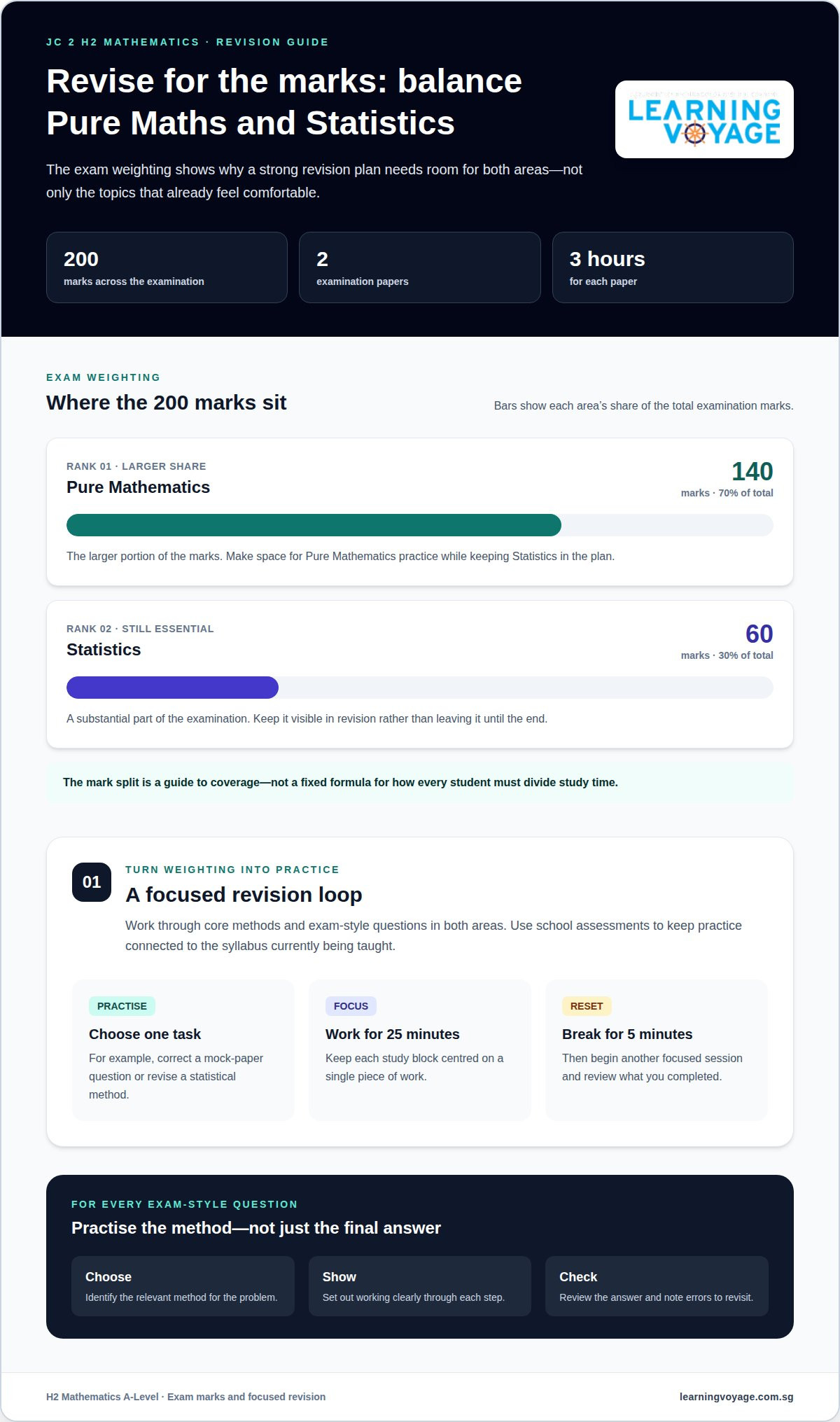
Singapore’s H2 Mathematics A-Level examination has 200 marks across two papers, and each paper lasts 3 hours. Pure mathematics accounts for 140 marks, while statistics accounts for 60 marks. These proportions show why revision needs space for both areas, rather than focusing only on topics a student finds comfortable.
For each topic, revision should connect core methods with exam-style questions. A student who struggles with a multi-step problem, for example, can practise choosing the relevant method, showing working clearly and checking the answer. Practice should also align with school assessments so that revision supports the syllabus currently being taught.
Between lessons, a simple study routine can make practice more manageable: work for 25 minutes, then take a 5-minute break before starting another session. Use each block for one task, such as correcting a mock-paper question or revising a statistical method. This keeps effort focused and makes progress easier to review.
Class duration and weekly frequency
Lesson timing matters when JC2 students are balancing schoolwork, revision and rest. A timetable should leave enough space for learning in class and using that learning independently afterwards.
Class Length
Judge a lesson by what students can do, not by its duration alone. A well-paced session can clarify a difficult idea, model a method and give students time to try related questions. After working through a calculus problem with guidance, for example, a student should have the chance to attempt a similar question independently.
Lessons should leave room to discuss errors. If explanations and practice are rushed, students may leave with unanswered questions; if the session feels unfocused, they may struggle to identify its main learning point. A clear structure helps students understand what they have learned and what needs more attention.
Weekly Class Frequency
Tuition frequency should fit the student’s school commitments and revision needs. A student keeping pace with classwork may need a different schedule from one catching up on prerequisite methods. School tests, tutorial deadlines and the student’s ability to practise independently all affect how tuition fits into the week.
Start by mapping the school timetable, then set aside realistic time for tuition, homework and review. If you add support near an examination, make room for sleep and school assignments too. Without time to revisit lesson questions, even a well-taught method can be harder to retain.
Use the class schedules to see how lesson timing can fit around junior college commitments. The aim is a manageable routine that supports steady learning, not a calendar filled so tightly that a student cannot absorb the work. Adjust the plan when school demands change, and use recent classwork to guide what needs attention next.
JC 2 math tuition centres in Sengkang reviews
Reviews can show how students experience H2 Mathematics support, but the details matter more than a star rating. Look for specific comments about teaching, feedback and exam preparation. A review saying a tutor explained a difficult integration question clearly gives more useful context than a general claim of satisfaction.
Some Singapore tutor reports describe substantial grade changes. One reports that 100% of students improved by at least 3 grades; another describes helping H2 Mathematics students move from E to B in 6 lessons. These are reported outcomes, not a forecast for every JC 2 student. Read them alongside the student’s starting point, the period of tuition and the type of support described.
Testimonials offer another kind of detail. One Singapore student reported achieving an A in H2 Mathematics after receiving tuition for 10 months before the A levels. That account can help families understand a student’s experience, but it does not show how every learner will progress. Check whether a review explains what changed, such as clearer working, fewer repeated errors or greater confidence with exam questions.
- Look for teaching detail: Does the review mention how tutors explain methods or correct mistakes?
- Note the timeline: Is progress linked to a clear period, such as 6 lessons or 10 months?
- Read the assessment context: Does the account refer to school tests, practice papers or A-Level preparation?
- Compare several accounts: Look for recurring themes, not one dramatic result alone.
For families considering a JC 2 maths revision class in Sengkang, useful reviews connect support to a student’s actual learning needs. A comment about receiving detailed feedback after a mock paper, for example, explains more than a grade claim alone. Use testimonials to understand teaching experiences and possible forms of support, while treating each student’s result as their own journey.
JC 2 math revision classes syllabus and topics covered
A useful revision plan follows the Singapore H2 Mathematics syllabus and the student’s school sequence. It balances pure mathematics and statistics, then gives more practice time to topics where errors recur. This keeps revision connected to classroom learning instead of becoming a stack of unrelated questions.
Begin with a topic map. For each area, note whether the student can explain the method, apply it to a standard question and solve a less familiar problem. If the right formula still leads to a wrong answer, the gap may be in algebraic working rather than recall. Separating these issues makes practice more focused.
Class time can then move through three useful stages:
- Review: revisit the concept and clarify when a method applies.
- Practise: attempt syllabus-based questions, including unfamiliar formats.
- Correct: identify the exact step behind an error and redo the question.
Pure mathematics and statistics call for different kinds of practice. Pure mathematics questions may require students to connect several steps and show clear working. In statistics, they must choose an appropriate method and interpret the result in context. Revision should include both method practice and questions that test how students use information.
School assessments provide a practical guide to revision order. If a test reveals repeated difficulty with a topic, revisit its core method before attempting mixed questions. Once the student can solve these accurately, timed practice can build fluency across syllabus areas. This progression helps prevent hurried topic-hopping during exam revision.
For JC 2 students, strong topic coverage means knowing both what to practise and why an answer went wrong. Explore H2 Mathematics support for a structured path through challenging mathematics topics and revision needs.
Learning Voyage Education Centre: Intensive Revision Workshops
Learning Voyage Education Centre supports students building strong mathematics foundations through Secondary 3 and Secondary 4 tuition. For families planning ahead for demanding examinations, focused teaching can help students strengthen methods, address learning gaps and approach later mathematics topics with greater confidence. The right next step depends on the student’s current level: Secondary 3 students can choose E-Mathematics or A-Mathematics tuition, while Secondary 4 students can continue with the corresponding subject as exam preparation becomes more focused.
If you’re considering mathematics support for a Secondary 3 or Secondary 4 student, contact Learning Voyage Education Centre to discuss the appropriate tuition.
Choose a steady next step
Exam pressure can make every weak topic feel urgent. Help your child turn that pressure into a practical next step: identify which concepts still cause hesitation, then build a routine that gives them room to practise and learn from mistakes. A jc 2 math revision class in Sengkang can form part of that plan, alongside school lessons and independent study. The aim is not to add work for its own sake, but to help your child approach challenging questions with clearer methods and growing confidence.
Learning Voyage Education Centre also supports students at earlier stages through Secondary 3 A-Mathematics Tuition, Secondary 4 A-Mathematics Tuition and Secondary 4 E-Mathematics Tuition. These options may suit families planning subject support across different school years.
To discuss a suitable next step, get in touch with Learning Voyage Education Centre. With thoughtful guidance and consistent effort, your child can keep moving forward with greater confidence.
Frequently Asked Questions
Do you run H2 Maths crash courses or intensive revision before the A-Levels?
Learning Voyage offers Intensive Revision Workshops for A-Level candidates preparing for major examinations. These short-term programmes focus on exam techniques and rapid content mastery, providing focused support alongside regular study. A student might use a workshop to strengthen question strategies while continuing school revision. Choose support that addresses specific learning needs rather than trying to cover every topic at once.
How long is each lesson?
Each lesson is 2 hours, based on a JC H2 Mathematics term of 13 lessons totalling 26 hours. That gives students a substantial block for working through problems, asking questions and applying methods. Before class, a student can note one or two questions that caused difficulty in schoolwork. Bringing a marked attempt helps make the lesson time more focused and lets the tutor see where the reasoning went off track.
Is it too late to start H2 Maths tuition in JC2?
No. Starting in JC2 can still give a student a structured way to address weak areas and prepare for the A-Levels. Begin by gathering recent school tests and practice questions, then identify the errors that recur, such as choosing the wrong method or losing accuracy in algebra. This gives tuition a clear starting point. A focused plan can build understanding and exam confidence without treating every topic as equally urgent.
Where can I find JC 2 H2 Mathematics revision classes in Sengkang?
Learning Voyage offers JC 2 H2 Mathematics Tuition, with teaching tailored to the A-Level syllabus. A JC 2 maths revision class in Sengkang should help students connect current school topics with exam preparation, not leave them juggling disconnected practice. When comparing a class with your child’s needs, consider whether support addresses difficult concepts, corrects working errors and helps turn feedback into a practical revision plan.
Are there JC 2 maths tutors near Sengkang MRT?
Learning Voyage provides JC 2 H2 Mathematics Tuition, but an MRT-nearby location should not be assumed from the subject offering alone. For practical planning, consider the student’s class timetable, travel arrangements and how tuition fits around junior college commitments. Also consider teaching fit: a tutor who can explain why a method works may help more than simply receiving extra questions to complete between school lessons.
How much are JC 2 maths revision classes in Sengkang?
Learning Voyage’s fees depend on the student’s academic level and whether they enrol in recurring group tuition or a short-term Intensive Revision Workshop. Group tuition is billed monthly, while workshops have a one-time registration fee. Contact Learning Voyage for current pricing. When planning, consider which format fits the student’s needs: ongoing teaching for continued support or focused revision for a particular examination period.