
What if the real question isn’t whether every secondary school student needs tuition, but whether extra support would address a specific learning gap? If you’re wondering, “is tuition necessary for secondary school?”, it’s understandable. A difficult test, a drop in confidence or seeing classmates attend lessons can make it hard to tell whether your child needs help or simply more time to practise.
Tuition can be useful when a student repeatedly struggles with a topic, is unsure how to apply key concepts or falls behind despite regular independent study. But extra lessons aren’t automatically the answer. They may add pressure if the real issue is exam stress, unclear study habits or a need for guidance from school. In Singapore, the 2026 Secondary 4 cohort will be the last to sit the GCE O- and N-Level examinations before the SEC begins in 2027, so parents may also be weighing how best to prepare their child for changing assessment pathways.
This article will help you assess what your child needs, recognise when independent study is working and decide when targeted Maths or Science support may help. The aim is a manageable next step that builds understanding and confidence, not tuition for tuition’s sake.
Key Takeaways
- To decide whether is tuition necessary for secondary school, look for a specific subject difficulty that continues despite regular practice, rather than treating one poor result as proof.
- Separate recurring learning gaps from temporary stress, illness or competing demands before adding more lessons.
- Compare self-study, school support, peer study and tuition by the kind of help your child needs, then look for signs that the approach is working.
- Ask your child what they understand, where they get stuck and what support would help them feel more confident.
- For targeted Maths and Science support, Learning Voyage uses its Plug-the-Gaps technique in classes of 6 to 9 students.
Is tuition necessary for secondary school in Singapore?
No, tuition isn’t automatically necessary for every secondary student. The right decision depends on what the student finds difficult, whether their understanding is improving, how confident they feel and what support is already available. A single disappointing result can be upsetting, but it doesn’t always point to a lasting subject gap. Look for patterns and ask what may be getting in the way before adding another commitment to the week.
Secondary school brings new subjects, faster lessons and more complex ideas to manage. Families can explore the wider structure of Education in Singapore, but a student’s day-to-day needs are more personal than any general description of the system. Consider whether they can explain concepts in their own words, complete practice with growing independence and ask for help when they’re stuck. If these skills are developing, their current approach may be working, even if progress feels gradual.
Tuition should complement classroom learning, the student’s own effort and calm communication at home. It isn’t a shortcut around practice, and it can’t guarantee grades. Targeted tuition means additional teaching chosen to address an identified learning need, such as difficulty rearranging equations in E-Math or applying a chemistry concept to an unfamiliar question. A clear focus makes it easier to judge whether the extra support is useful.
What tuition can, and cannot, do for a secondary student
When a concept remains confusing after a school lesson, guided explanations can help a student see the steps and reasoning they may have missed. Focused practice then gives them a chance to apply the idea, make mistakes and learn how to correct them. The goal isn’t simply to finish more questions. It’s to build understanding the student can use independently.
For example, a student may understand a worked Mathematics example but get lost when the question changes. Targeted instruction can help them connect the method to the underlying concept. If they haven’t had enough time to revise, more lessons alone may not address the problem. Tuition is most useful when it responds to a specific subject need and works alongside steady practice.
Why peer pressure is not a reliable reason to enrol
A classmate’s tuition schedule tells you little about your child’s understanding, workload or confidence. That student may be working on a different subject, responding to a particular gap or following a family preference. Your child may be progressing well with school lessons and independent revision. Neither choice is a measure of commitment or potential.
Instead of enrolling because “everyone else is going”, look at your child’s recent work and routine. Can they identify what they don’t understand? Are the same errors appearing again? Do they have enough time to rest and complete schoolwork? A conversation with your child and, where helpful, their teacher can clarify whether the issue is subject knowledge, study habits or temporary pressure. The aim is support that fits, not a timetable that adds stress without a clear purpose.
How to tell whether a secondary student needs extra tuition
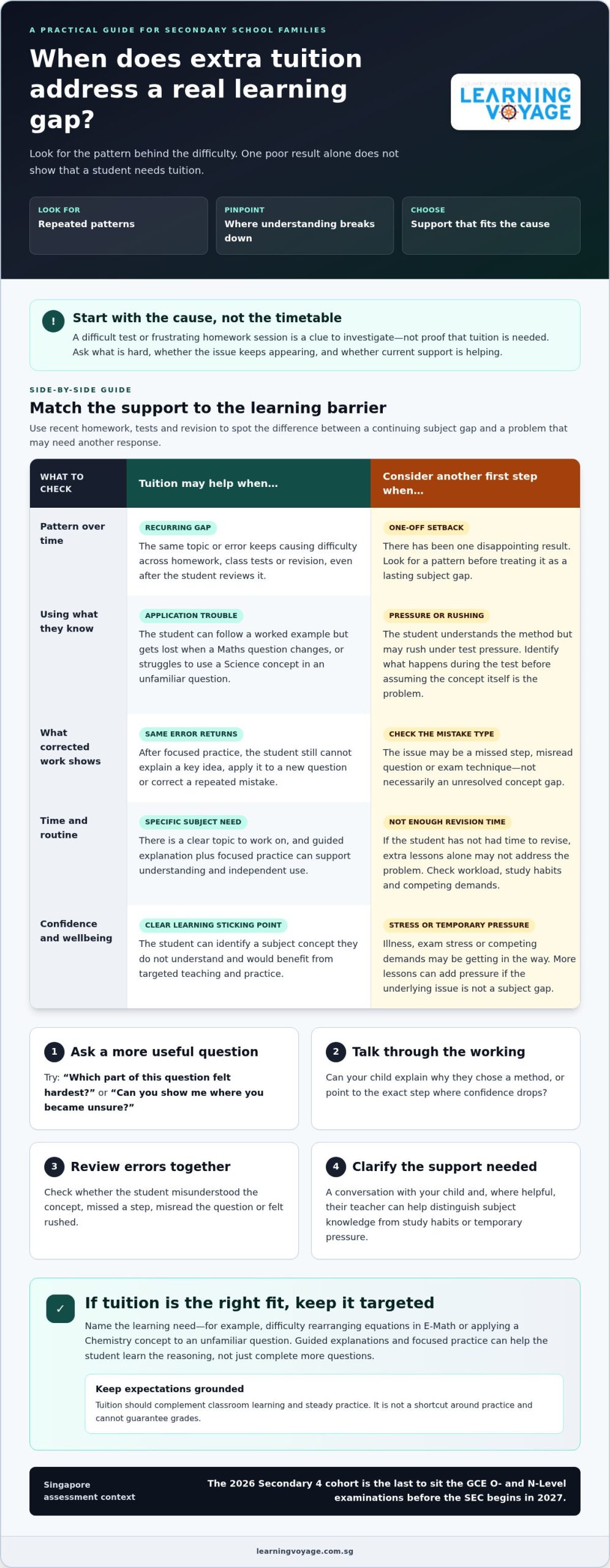
A rough test or a frustrating evening over homework can raise concerns, but neither proves that a student needs tuition. Treat these moments as clues to investigate. The more useful questions are whether the difficulty keeps appearing, what seems to cause it and whether the student is making progress with the support they already have.
Start with a calm, specific conversation. Instead of asking, “Why are your marks falling?”, try: “Which part of this question felt hardest?” or “Can you show me where you became unsure?” A student may understand a concept in class but struggle to use it in an unfamiliar problem. Another may know the steps but rush under test pressure. These call for different responses, so identifying the sticking point matters.
Learning signs that may point to an unresolved subject gap
Look for a pattern across recent homework, class tests and revision, rather than drawing a conclusion from one result. A possible gap deserves closer attention if the student repeatedly can’t explain a key idea, gets stuck applying it to a new question or makes the same error after reviewing it. These are prompts to find the cause, not a diagnosis or an automatic reason to enrol in tuition.
Ask your child to talk through their working. Can they explain why they chose a method, or do they only remember steps from an example? Can they point to the exact line where their confidence drops? In Mathematics, a student might solve familiar equations but become unsure when a question is worded differently. In Science, they may recall a definition yet find it difficult to use the idea to explain an observation.
Review corrected work together. If a similar mistake returns after focused practice, check whether the student misunderstood the concept, missed a step, misread the question or felt rushed. Repeated errors can indicate that the underlying idea needs attention, but they can also reveal a practice or exam technique issue. Naming the pattern gives your family and the student’s teacher a more useful starting point than simply adding study hours.
When a student may not need tuition right now
Steady progress is meaningful, even if results aren’t perfect. If your child can follow school lessons, complete independent practice with growing confidence and learn from corrected mistakes, their current plan may be doing its job. Avoid adding tuition just to match a classmate’s schedule or in response to one disappointing mark.
Also consider what else is happening. Illness, a demanding stretch of schoolwork, poor sleep or worry before an assessment can affect concentration and confidence. A student who normally understands the material but has recently seemed overwhelmed may need time, encouragement or help adjusting their routine, rather than extra subject lessons. If the difficulty continues after the pressure eases, reassess with a clearer picture.
For broader context on Singapore’s education system, the Ministry of Education Singapore’s Education Statistics Digest provides official education information, though it can’t determine what one student needs. If your review points to a recurring Maths or Science gap, explore Learning Voyage’s Plug-the-Gaps approach as one subject-specific support option.
Tuition, school support, or self-study: which option fits?
There isn’t one best form of support for every secondary student. A clear revision routine may be enough for a student who understands lessons but needs more practice. Someone unsure about a concept may benefit from school-based guidance or a focused explanation. If you’re weighing whether is tuition necessary for secondary school, match the support to the difficulty, then look for signs that it’s helping.
| Option | Useful when | Limitation | Signs it is working |
|---|---|---|---|
| Self-study | The student understands lesson notes and needs regular practice or revision. | Unanswered questions can remain unresolved without feedback. | They can explain ideas in their own words and solve questions with fewer prompts. |
| School-based help | A student needs clarification from teachers who know the class content and expectations. | Support may focus on the questions or topics raised, so the student needs to speak up about what is unclear. | They can return to classwork with a clearer next step and apply the explanation later. |
| Peer study | Students want to compare approaches, explain ideas aloud or revise together. | Friends may share a misunderstanding, and discussion can drift without a plan. | Each student can explain the reasoning, not just copy an answer. |
| Targeted tuition | A subject-specific difficulty persists and the student needs guided teaching and practice. | It adds to the student’s schedule and still requires their own effort between lessons. | They understand the weak concept more clearly and can use it independently. |
When independent study or school support may be enough
Begin with the resources already available: class notes, worked examples, assigned practice and feedback from school. For language learning and self-directed revision, reference tools like The Grammar Index can also help students check rules and clarify concepts independently. A student can keep a short list of questions that remain unclear, then bring them to a teacher or use them to guide revision. This gives each study session a purpose instead of turning it into a stressful attempt to cover everything.
Review the approach after the student has had a fair chance to use it. Are they making fewer repeated errors? Can they explain why a method works or answer a similar question without looking at an example? If understanding is becoming more secure, continue the routine. If the same obstacle remains, consider what kind of additional explanation or practice is missing.
When targeted tuition may add value
Tuition may be useful when a student can name a persistent gap, such as struggling to form equations from word problems or apply a method to unfamiliar questions. Guided teaching can help them revisit the weak concept, practise it with support and build towards independent work. For a student who needs focused E-Math help, Secondary E-Math tuition is one subject-specific option to explore.
Different subjects can call for different responses. A student may manage Mathematics through independent practice but need school guidance in Science, or need no extra lessons at all. Learning Voyage’s Maths and Science tuition uses the Plug-the-Gaps technique to address identified learning needs. A trial class can let your child experience subject support before deciding whether it suits them.
For wider context on why tuition is part of many Singapore families’ education discussions, see the National University of Singapore analysis on tuition rates. Whatever option you choose, check for progress in understanding, not just more hours spent studying.
A practical family checklist for deciding whether to start tuition
A decision made in a moment of worry can add pressure without solving the problem. Use a short family check to understand what your child needs, what support is already helping and whether another weekly commitment is manageable. The question “is tuition necessary for secondary school?” becomes easier to answer when you replace general concern with a specific learning goal.
A four-step check before making a decision
- Name the difficulty. Identify the subject and describe the recurring challenge in clear terms. “Maths is hard” is broad; “I can’t tell which formula to use for these questions” gives you something concrete to investigate.
- Review work and listen. Look over recent assignments, corrections and practice, not just the latest test. Ask your child what they understand, where their working becomes uncertain and what kind of help they would find useful. Give them room to answer honestly, without turning the conversation into a review of every mark.
- Match support to the need. If the issue is an unanswered question, school guidance may be a sensible first step. If the student understands the method but needs consistency, a study routine may help. A continuing subject gap may call for more guided teaching. Include your child in the choice so support feels like a plan they can take part in, not another demand placed on them.
- Set a review point. Agree on a suitable period to try the approach, then check whether understanding, confidence and workload are changing. The review doesn’t need to centre on a promised grade. It should show whether the original difficulty is becoming easier to manage.
How to recognise whether the chosen support is helping
Choose signs you can observe in everyday learning. Can your child explain an idea in their own words, identify the steps in a problem or begin challenging work with less hesitation? Are practice sessions focused on the weak area rather than spent repeatedly rereading notes? These small shifts can show learning taking hold, even before a test result changes.
Keep the student’s whole week in view. Schoolwork, co-curricular activities, travel, meals and rest all take time. Ask whether the added commitment leaves enough space for sleep and recovery, and whether your child is willing to try it. A plan that looks strong on paper may not be sustainable if the student feels exhausted or resentful.
Learning Voyage offers trial classes for both Maths and Science, giving students a chance to experience the teaching before the family makes a longer-term decision. Consider whether the subject support addresses the specific need you identified.
Revisit the plan if pressure rises but the student still can’t explain the concept more clearly. That doesn’t mean they have failed. It may mean the support needs adjusting, the goal needs to be clearer or the main challenge lies elsewhere. A thoughtful review keeps the focus on steady understanding and a learning path your child can manage.
How Learning Voyage supports secondary Maths and Science learning
Once a student’s difficulty is clear and the family has considered school support and independent study, targeted tuition may be one option to explore. It isn’t a compulsory step for every learner. The question “is tuition necessary for secondary school?” still comes back to the student’s needs: extra teaching is most relevant when there’s a specific Maths or Science concept they find hard to understand or apply.
What targeted Maths and Science support looks like at Learning Voyage
Learning Voyage’s Maths and Science tuition uses its proprietary Plug-the-Gaps technique to identify and address learning gaps. The focus is on a student’s understanding in the subject, rather than adding practice without first considering where confusion begins. For example, a student who can follow a worked solution but struggles to use the idea in a new question may need support that helps them make that connection.
Classes have 6 to 9 students per class. This small-group setting supports attention and interaction as students work through a subject. It gives students opportunities to hear explanations, take part in learning and raise questions. Every learner is different, and tuition alone can’t promise a particular result.
Useful support should give the student a clearer route through the material. Families can notice whether the student is better able to describe what they understand, spot where they get stuck and approach practice with a more focused question. These observations help parents decide whether the support feels relevant to the original learning need.
A low-pressure next step for families considering tuition
If you’ve identified a Maths or Science gap but aren’t sure whether extra lessons will suit your child, a trial class gives them a chance to experience the teaching before deciding on a next step. Trial classes are available for both subjects. Use the session to consider how the learning environment feels and whether this kind of support matches the need you identified.
There’s no need to treat a trial as a promise to continue. Ask your child afterwards what felt clearer, what questions remain and whether they felt comfortable taking part. Their response, alongside your observations of workload and confidence, can help guide a considered decision. If their current study approach is working well, continuing it may be the right choice. If a persistent gap remains, targeted subject support may be worth exploring.
Choose the next step with confidence
There’s no need to make a decision about extra lessons for the rest of your child’s school journey today. Focus on the next step that feels useful now: a conversation, a change to the study routine or a chance to experience subject support. Asking “is tuition necessary for secondary school?” can open a thoughtful discussion, not create pressure to act before you understand what your child needs.
Let your child be part of the decision. Their questions, comfort and willingness matter, especially when school demands are already weighing on them. A supportive approach should give them room to learn at their own pace and build confidence, not make every evening feel like another test.
If your child could benefit from targeted Maths or Science support, explore a trial class for your child. Whatever you decide, keep the conversation open and adjust the plan as your child’s needs change. With steady encouragement and the right support at the right time, they can keep moving forward with confidence.
Frequently Asked Questions
Is tuition compulsory for secondary school students in Singapore?
No. Private tuition is extra teaching outside a student’s formal school education, not a requirement for attending secondary school. Families can separate required school commitments from optional learning support. That distinction can ease pressure when tuition seems like an assumed part of every student’s schedule. The choice is personal and need not be based on what other families do.
Can a secondary student improve without tuition?
Yes. A student might use a regular review to revisit corrected questions, then explain the solution aloud without looking at the notes. This can reveal whether they remember only the answer or understand the reasoning behind it. Families can also keep a simple study record of which topics feel secure and which remain confusing. The student’s work over time offers a more useful picture than assumptions about what they should be doing.
Does tuition guarantee better grades at O-Level?
No. A tuition class cannot promise a particular O-Level grade or examination result. Even with extra lessons, a student may find that some question types take longer to master than others. Use assessment results as one source of feedback alongside marked work. Are errors caused by a missed concept, an unclear explanation or difficulty showing working? This helps families discuss exam preparation practically, without treating a grade as a guaranteed outcome.
How many subjects should a secondary student take tuition for?
There is no set number that suits every student. Rather than counting subjects, look at where support would have a clear purpose and how the week is arranged. If a student’s questions are limited to one part of Mathematics, adding lessons across several subjects may not address that concern. Review the plan as school demands change, and give the student a voice in deciding what feels manageable.
Should a student start tuition before Secondary 4 or O-Level year?
There is no universal deadline for starting tuition. A useful time to discuss support is when the student first notices a recurring obstacle, rather than waiting until exam preparation feels urgent. For example, they could bring a marked assignment to a parent or teacher and point out the question types they find hard to begin. That conversation can clarify the concern and help the family consider its next step without treating a particular school year as a cutoff.
Can tuition help a student who already does well in secondary school?
It may suit a student with a defined goal beyond completing current classwork, such as practising how to present a full solution clearly or strengthening a topic they find less secure. Start by asking what they hope to gain and whether they’re interested in extra teaching. If they have no particular learning goal and feel settled with their studies, there may be no reason to add another class simply because they achieve strong results.