
What if the mounting stack of practice materials on your child’s desk is actually drifting them further away from their goals rather than closer to excellence? You likely feel the familiar sting of frustration when your child returns a test paper marked with the same “careless” errors you’ve corrected a dozen times before. As reported by The Straits Times, exam stress remains a primary concern for Singaporean households, especially as families navigate the 2026 syllabus shifts, such as the relocation of ‘Speed’ from the PSLE Mathematics curriculum to Secondary 1. It’s easy to feel overwhelmed by the sheer volume of resources available, but simply doing more doesn’t guarantee a higher score.
We believe that education is a transformative journey of self-discovery, not just a functional necessity. This guide will teach you how to use every practice session as a “life buoy” to identify specific learning gaps and build your child’s character alongside their grades. You’ll discover our proprietary “Plug-the-Gaps” technique, providing a clear roadmap to help your student steer through PSLE, GCE O-Level, or A-Level hurdles with a calm, methodical, and confident hand.
Key Takeaways
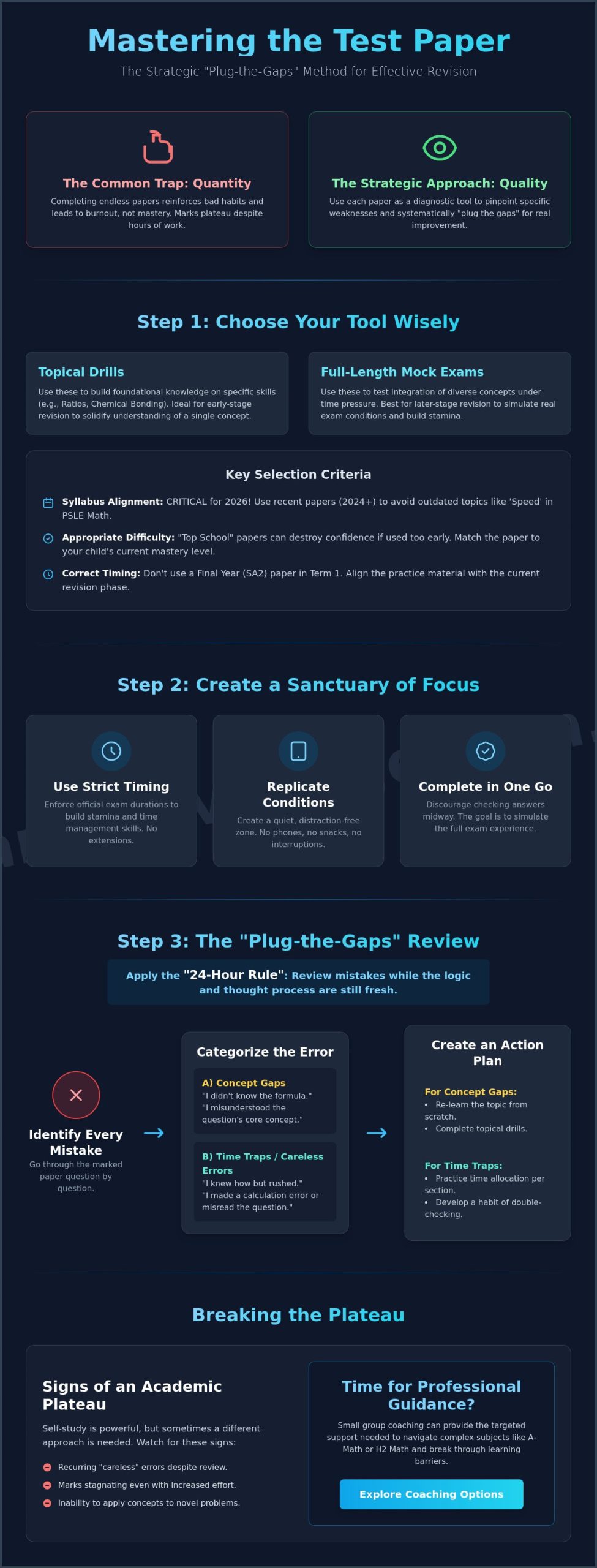
- Learn to select the appropriate test paper by distinguishing between topical drills and full-length mock exams to match your child’s current revision phase.
- Discover how to transform your home into a “Sanctuary of Focus” using strict timing rules to build the exam stamina necessary for the rigours of national written papers.
- Master the “24-Hour Rule” and the “Plug-the-Gaps” technique to categorize mistakes into concept gaps or time traps while the logic is still fresh.
- Identify the signs of an academic plateau and learn when to supplement self-study with professional small group coaching to steer through complex subjects like A-Math or H2 Math.
The Strategic Role of the Test Paper in the Singapore Education Journey
The Singaporean education system is often described as a rigorous sea where students must learn to stay afloat amidst shifting currents. A test paper shouldn’t be viewed as a mere hurdle or a source of anxiety; instead, think of it as a vital “life buoy” that reveals exactly where a student is currently drifting off course. While The Straits Times frequently reports on the intense pressure faced by families during the PSLE or O-Level seasons, the right perspective transforms these assessments from stressors into strategic tools. At its core, every practice paper is a localized version of a standardized test, designed to measure proficiency against national benchmarks. By treating these papers as a compass, parents can help their children find hidden learning hurdles before they become insurmountable obstacles in the final voyage.
Understanding the distinction between resources is crucial for effective revision. Topical worksheets serve as the building blocks, focusing on specific skills like Ratio or Chemical Bonding. In contrast, a full-length mock paper tests the student’s ability to integrate diverse concepts under time pressure. This is where our “Plug-the-Gaps” philosophy begins. It’s about using the results not just to see a grade, but to map out the specific conceptual territories that require reinforcement. When used correctly, these papers provide the clarity needed to navigate the high-stakes environment of our local schools with confidence.
Why Simply ‘Doing More’ Papers Often Fails
Many parents find themselves trapped in a cycle of purchasing every available assessment book from Popular, believing that sheer volume leads to success. However, quantity rarely equals mastery. If a student completes ten papers but repeats the same “careless” errors in each one, they aren’t practicing excellence; they’re reinforcing bad habits. This leads to immense frustration when marks plateau despite hours of evening practice. Often, the issue isn’t a lack of effort but a failure to distinguish between a simple content gap, such as forgetting a formula, and a “higher-order thinking” gap, where a student fails to apply a concept to a novel problem. Without addressing the root cause, the test paper becomes a source of burnout rather than a tool for growth.
Diagnostic vs. Summative Practice
The most effective way to use a practice paper is as a diagnostic tool early in the semester, rather than a final judgment at the end. By identifying weaknesses in Term 1 or Term 2, you have the luxury of time to correct the course before the final national examinations. We encourage students to build a ‘Post-it Note’ habit, where they track recurring errors across different school papers to visualize their progress over time. This methodical approach is central to Learning Voyage Education Centre’s approach, where we move beyond rote drilling to ensure students understand the logic behind every answer. This shift from summative judgment to diagnostic discovery is what builds the resilience needed to excel in challenging subjects like JC 2 H2 Mathematics or Secondary 4 Pure Physics.
How to Select the Right Test Paper for Your Child’s Level
Choosing the right practice material is much like selecting the correct vessel for a maritime journey; the wrong choice can lead to a student feeling capsized by difficulty or stagnant in calm waters. Many parents mistakenly believe that “Top School” papers from institutions like Raffles or Nanyang are the gold standard for every student. While these resources offer rigorous challenges, they can be counterproductive if they don’t align with your child’s current mastery level. A test paper should act as a bridge to excellence, not a barrier that destroys confidence before the real exam even begins.
Timing is just as critical as difficulty. Using a Final Year (SA2) paper during the Term 1 Weighted Assessment (WA1) period is a common mistake that leads to unnecessary household stress. Furthermore, syllabus alignment is paramount in 2026. With the Ministry of Education’s recent updates, such as the removal of ‘Speed’ from the PSLE Mathematics syllabus and ‘Cells’ from Primary Science, using older papers without careful filtering can lead to wasted effort. Ensure you are selecting papers from 2024 to 2026 to stay synchronized with current MOE standards. Always verify the quality of the answer key before your child starts; a poorly explained solution can leave a student more confused than when they began.
Matching Difficulty to Student Confidence
Success is built on a foundation of “confidence boosters.” If your child is currently scoring in the AL5 or B3 range, jumping straight to high-intensity “stretch” papers can lead to the “U to A” trap. This is where a student becomes so overwhelmed by complex questions that they lose their grip on fundamental concepts, leading to burnout. Instead, start with papers from schools with a similar academic profile to your child’s own institution. Once they are consistently navigating these with ease, you can gradually introduce more challenging papers to sharpen their higher-order thinking skills. This methodical progression ensures they stay motivated throughout their educational journey.
Syllabus Alignment: PSLE, O-Level, and A-Level
Each level of the Singapore education system requires a specific strategic focus. For those preparing for Primary Maths, the emphasis should be on heuristics and the new 2026 distributions of ‘Average’ and ‘Ratio’ topics. When selecting Secondary E-Math and A-Math papers, look for questions that demand structured proving and logical deduction rather than simple computation. For JC H2 Math, the shift from O-Level methods to complex proofs is significant, requiring papers that challenge their ability to handle abstract mathematical structures. If you find your child struggling to bridge these gaps, consider exploring our customised small group coaching to provide the expert guidance they need to steer toward success.
Step-by-Step Guide: Conducting a Productive Mock Exam at Home
Simply downloading a test paper isn’t enough; you must recreate the high-stakes environment of the exam hall to truly test your child’s readiness. We call this building a “Sanctuary of Focus.” This means removing every digital distraction, especially mobile phones, which can break the concentration required for complex problem solving. In the quiet of your home, your child needs to feel the weight of the silence they’ll encounter during their PSLE or GCE O-Level written examinations. As a parent, your role shifts from a tutor to a silent “invigilator.” Resist the urge to hover or provide subtle hints when you see them struggle. By stepping back, you allow them to face the challenge independently, fostering the character and resilience needed for the actual journey.
The “Strict Timer” rule is non-negotiable. Practicing without a clock is like sailing without a compass; you’ll have no idea if you’re actually on track to finish. Exam stamina is built over time, not overnight. Ensure they use their SEAB-approved calculator and the same stationery they intend to bring into the hall. This sensory familiarity reduces the friction of the exam environment, allowing their mind to focus entirely on the questions at hand. When they treat every home practice session as a formal assessment, the actual exam day becomes just another day at the desk.
Managing Exam Anxiety During Practice
It’s common for students to “freeze” when they encounter a particularly daunting question. We teach the “Skip and Return” strategy to help them maintain momentum. Instead of wasting ten minutes on a single difficult mark, they should move to easier questions to build confidence and secure “low-hanging fruit” first. This prevents the panic that often sets in when the clock is ticking. Timed practice builds the mental muscle needed for the actual paper.
Paper 1 vs. Paper 2 Strategies
Each test paper requires a different set of navigational skills. Paper 1 often demands rapid-fire accuracy with short-answer questions, where every minute counts. In contrast, Paper 2 is a marathon of long-form problem solving that tests endurance and deep conceptual understanding. For students who struggle with the transition between these formats, our intensive revision workshops provide the specific technique coaching needed to excel. By mastering the rhythm of both papers, your child can steer through their exams with a calm and methodical hand.
The ‘Plug-the-Gaps’ Review: What to Do After the Paper is Marked
Marking a test paper is only the halfway point of the journey; the real transformation occurs during the review phase. Many students feel a sense of relief once the pen is down, but the grade itself is merely a data point. To truly steer toward excellence, we implement the ’24-Hour Rule.’ You must review every error within one day of completion while the logic and thought processes are still fresh in the student’s mind. Waiting too long allows the original misconceptions to set like concrete, making them much harder to break later. This immediate feedback loop ensures that the test paper serves as a diagnostic “life buoy” rather than a forgotten chore.
Effective review requires more than just ticking boxes with a red pen. We categorize every mistake into three distinct buckets to identify the root cause of the “drift”:
- Careless Slips: Trivial errors like misreading a number or a calculation “hiccup” despite knowing the concept.
- Concept Gaps: A fundamental lack of understanding where the student simply didn’t know how to approach the question.
- Time Traps: Questions left blank or rushed because the student spent too long on earlier sections.
The “Redo” requirement is our non-negotiable standard for mastery. Reading a solution key is a passive act that provides a false sense of security. Instead, your child must solve the corrected question from scratch on a blank sheet of paper. If they can’t replicate the logic without looking at the answer, the gap remains. By tracking these recurring hurdles in a ‘Gaps Log,’ you can visualize whether the same topics, like Algebra or Organic Chemistry, continue to pull them off course. If you notice a persistent pattern of errors, it’s time to apply our proprietary Plug-the-Gaps technique to anchor their understanding before the next assessment.
Analyzing Concept Gaps in Math and Science
In the context of the 2026 syllabus, identifying specific hurdles in Primary Science requires a focus on inquiry-based heuristics. Students often lose marks not because they lack knowledge, but because they fail to use specific keywords required by the MOE marking scheme. For Secondary students tackling O-Level Physics or Chemistry, gaps often appear in “higher-order thinking” questions that require linking multiple topics together. Recognizing these nuances early allows you to customize their revision rather than wasting time on topics they’ve already mastered.
Building Student Reflection and Character
We view every “bad” paper as a transformative journey of self-discovery. Instead of focusing on the marks lost, encourage your child to use the Feynman Technique: have them explain the mistake and the correct solution back to you in their own words. This builds the confidence and character needed to face future challenges with a calm, methodical hand. Excellence isn’t about being perfect from the start; it’s about celebrating small wins, such as improving from a 50% to a 55% through sheer persistence. Every step forward is a victory in their personal voyage toward success.
Balancing Test Papers with Holistic Educational Support
Even the most resilient student can find themselves stuck in a “doldrums” where their results refuse to move despite completing paper after paper. Recognizing when your child has reached an academic plateau is a crucial skill for any parent acting as a dedicated guide. A test paper is an exceptional diagnostic tool, but it cannot replace the deep conceptual clarity that comes from expert mentorship. When a student is simply “going through the motions” of practice without seeing improvement, it often indicates that the underlying foundation is unstable. At this stage, drilling more papers only increases household tension and risks extinguishing a child’s passion for learning.
The most successful students in the Singapore system understand the synergy between disciplined self-study and small group coaching. While the test paper identifies where the leaks are, professional guidance provides the tools to patch them effectively. This collaborative approach ensures that academic rigour is balanced with mental well-being. We view education as a transformative journey of self-discovery, where the goal isn’t just a string of A1s or AL1s, but the moulding of a responsible young adult ready to face the future with a calm and methodical hand. By focusing on character alongside results, we help students navigate the high-pressure environment of our local schools without losing their sense of self.
When to Seek Professional Intervention
Signs that a student needs a “life buoy” include consistent failing marks or extreme anxiety that manifests specifically during timed practice. While a parent can mark a paper using a provided key, a specialist tutor identifies the subtle nuances in marking schemes that determine the difference between a B3 and an A1. If your child is struggling to navigate these waters alone, we invite you to reach out for a diagnostic consultation. Our experts can see the “Concept Gaps” that an answer key might miss, providing the customized support needed to steer back toward success.
Creating a Sustainable Revision Schedule
A sustainable school holiday revision plan should integrate practice papers as strategic milestones rather than daily burdens. For the 2026 academic year, it’s vital to remember that Term 4 concludes on November 20, and the journey leading up to it requires pacing. Ensure your child has dedicated time for rest and self-discovery to avoid the burnout that often precedes national examinations. For more insights on selecting the right path for your child, you can refer to our comprehensive guide on educational support. Remember, you are the navigator of this voyage, and with the right balance of tools and empathy, your child will reach their destination with confidence.
Steering Toward a Future of Excellence
Mastering the test paper is about more than just repetitive drilling; it’s about strategic navigation. By selecting materials that align with the 2026 syllabus changes and enforcing the 24-Hour Rule for reviews, you transform a stressful task into a clear roadmap for growth. Every mistake is simply a marker showing where to adjust the sails. While your child builds exam stamina through home practice, professional mentorship provides the anchor needed when the waters get rough.
At Learning Voyage, we don’t just teach subjects; we build the confidence and character required for long-term success. Led by Principal Tutor Andy Woo, our small group coaching sessions provide the personalized attention that helps every student succeed at their own pace. We use our proprietary ‘Plug-the-Gaps’ technique to ensure no student is left drifting without the support they deserve. Navigate your child’s journey to excellence-book a diagnostic session with Learning Voyage today.
Your child’s potential is a vast ocean waiting to be explored. With the right tools and a steady hand, they’ll reach their destination with confidence and pride.
Frequently Asked Questions
Where can I find the most reliable free test papers in Singapore?
Reliable free resources include community driven portals like sgtestpaper.com or testpapersfree.com, but you must verify they align with the 2026 MOE syllabus. Look for papers from the last 24 months to ensure topics like ‘Speed’ in PSLE Math are excluded. Always check that the scanned copies are legible and include a complete marking scheme before your child starts their revision voyage.
How many test papers should my child do per week before PSLE or O-Levels?
We recommend focusing on one or two high quality papers per week rather than a daily drill. Quality review using our ‘Plug-the-Gaps’ method is far more transformative than mindless repetition. Doing too many papers leads to burnout, whereas one test paper reviewed thoroughly within 24 hours builds the character and conceptual depth needed for excellence in the PSLE or GCE O-Levels.
My child gets high marks at home but fails in school exams-what is wrong?
This discrepancy often stems from a lack of strict exam conditions during home practice. If your child isn’t using a timer or is allowed small breaks, they aren’t building the exam stamina required for school assessments. Transitioning to a Sanctuary of Focus at home helps bridge this gap, ensuring they can handle the silence and pressure of the actual school hall.
Are top school test papers always better for practice?
Top school papers from institutions like Nanyang or Raffles are excellent for stretch practice but can be counterproductive if they don’t match your child’s current grade. If a student is currently at an AL5 or B3, jumping into high difficulty papers can destroy their confidence. It’s better to select a test paper that is slightly above their current level to encourage growth without causing unnecessary stress.
How do I stop my child from making ‘careless mistakes’ in Math test papers?
Careless mistakes are often Time Traps or Concept Gaps in disguise. Encourage your child to use a Gaps Log to track whether these errors recur in specific topics like Algebra or Geometry. By categorizing mistakes as Careless Slips versus actual misunderstandings, you can help them develop the self awareness needed to double check their logic during the final written examinations.
What should I do if the test paper answer key is wrong or confusing?
Confusing answer keys are common in free resources and can lead a student further off course. If a solution doesn’t make sense, cross reference it with MOE approved textbooks or the 2026 Approved Textbook List. For complex subjects like H2 Mathematics or Pure Physics, seeking a diagnostic consultation with a professional guide can prevent your child from internalizing incorrect methods found in unverified keys.
Can test papers replace the need for a tuition centre?
Practice papers are diagnostic tools that reveal weaknesses, but they don’t provide the pedagogical life buoy needed to fix them. While a test paper tells you what is wrong, a tuition centre like Learning Voyage provides the customized coaching to explain the why. Professional intervention is essential when a student reaches a plateau that independent practice cannot overcome.
How do I motivate a child who is tired of doing test papers?
Motivation returns when the focus shifts from the grade to the journey of self discovery. Celebrate small wins, such as a 5 percent improvement in a specific section, rather than just the final score. Ensure your revision schedule includes time for rest and interests outside of academics, as a well rested mind is far more capable of navigating the rigours of the Singapore education system.