
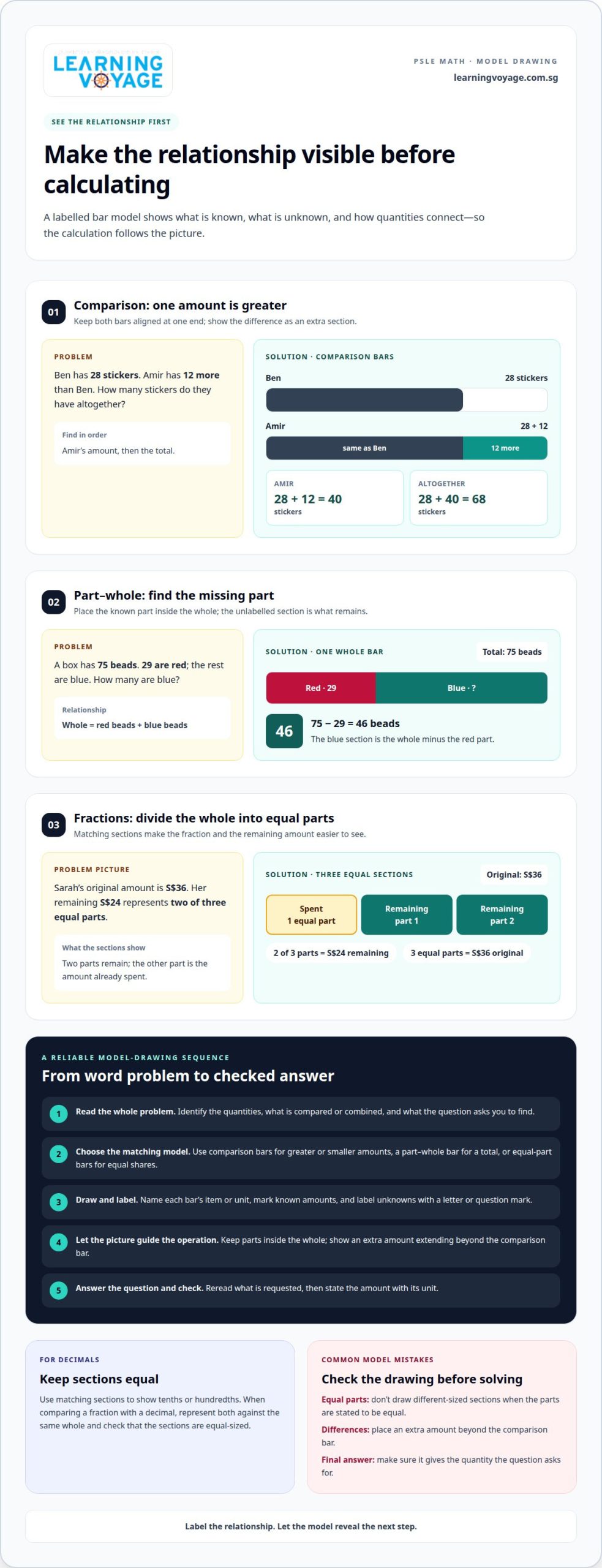
Understanding PSLE Math model drawing starts with reading the whole problem, identifying what is being compared, and representing each quantity with a labelled bar. For example, if Ben has 28 stickers and Amir has 12 more than Ben, the bars show that Amir has 40, so they have 68 stickers altogether. The drawing makes the relationship visible before the calculation begins.
It’s understandable if word problems feel stressful when a child knows the arithmetic but isn’t sure which operation to use. A well-drawn model can turn that uncertainty into a clear plan: compare lengths, divide a bar into equal parts, or show how a fraction or decimal relates to a quantity. This guide explains how to choose and draw a model, label known and unknown amounts, and check whether an answer makes sense. With practice, students can explain how quantities relate and approach unfamiliar PSLE Math problems with greater confidence.
Key Takeaways
- Read the full word problem and identify the quantities being compared before choosing how to draw the bars.
- Use equal bar units to make known amounts, differences and unknowns easier to see at a glance.
- Divide bars into equal parts to show how fractions relate to a whole, then use the same visual logic for decimals.
- Label units and review whether the answer fits the question, so each model strengthens reasoning as well as accuracy.
Comparison problems
Comparison bars make differences easier to see before calculating. Read the quantities and their relationship carefully, then draw and label bars to match the problem.
Identify Comparison Model Types
Choose a model that matches the relationship in the PSLE Math problem. Common types include comparison bars, part-whole bars, and equal-part bars. Comparison bars show how much greater or smaller one quantity is. Part-whole bars show how amounts combine to make a total. Equal-part bars divide a quantity into matching sections. Ask whether the problem compares amounts, combines them, or splits a whole.
Apply Comparison Models to Word Problems
Read the complete word problem first, then identify what it asks you to compare or find. For example, Ben has 28 stickers, and Amir has 12 more, so Amir has 40 stickers. Together, Ben and Amir have 68 stickers.
- Identify the quantities. Underline the names and amounts, such as Ben’s 28 stickers and the 12-sticker difference. Mark the unknown quantity clearly.
- Draw the bars. Give Ben a bar for 28 stickers. Draw Amir’s bar longer, with an extra section showing 12 stickers.
- Label the relationship. Write “28” beneath Ben’s bar and “12 more” beside Amir’s extra section. Keep both bars aligned at one end.
- Choose the calculation. Add 28 and 12 to find Amir’s 40 stickers. Then add 28 and 40 to find 68 stickers altogether.
- Check the requested answer. If the question asks for the total, state 68 stickers, not just Amir’s 40. Confirm that each bar represents stickers.
How bar models represent quantities and relationships
Build each bar around the quantities and relationships stated in the problem. These steps turn the drawing into a useful guide for working out the answer.
- Choose what each bar represents. Write the item or unit beside it, such as beads, books, or litres. This keeps the model connected to the question and prevents quantities with different units from being treated as equal.
- Match bar lengths to amounts. Draw longer bars for larger quantities and shorter bars for smaller ones. The bars need not be drawn to scale, but their relative lengths should show which amount is greater and where the difference lies.
- Separate known parts from unknown parts. In a box with 75 beads, 29 are red and the rest are blue. Draw one whole bar for 75 beads, then mark a 29-bead red section and label the remaining section “blue”.
- Use the model to expose the operation. The unlabelled blue section is the whole minus the red part: 75 − 29 = 46 beads. The drawing shows why subtraction fits, rather than asking a student to guess an operation from isolated words.
- Show several unknowns clearly. Primary 5 and Primary 6 questions often place two or three unknowns in one model. Label each unknown with a letter or question mark, and use matching lengths only when the problem states that parts are equal.
- Check what the bars say before calculating. Trace the relationship from one label to another. If a part belongs inside a whole, keep it within that bar; if it is an extra amount, show it extending beyond the comparison bar.
- Return to the question after solving. A correct calculation can still answer the wrong quantity. Read the final sentence again, then state the requested amount with its unit, such as 46 beads, rather than giving an unexplained number.
Models for fractions and decimals
Equal sections show how a fraction or decimal relates to a whole. Use these steps to make the value of each part clear.
- Mark the whole amount. Draw one bar for the complete quantity, then label it with the total. In Sarah’s example, her remaining S$24 represents two equal parts, while her original amount was S$36.
- Divide the bar into equal parts. Use matching sections when a fraction describes equal shares. Her original amount spans three such sections, giving S$36 altogether.
- Show the missing part. Compare the known fraction with the whole bar. Sarah has two of the three equal sections remaining, so the unshown section represents the amount already spent. This makes the relationship visible before any calculation.
- Label the fraction and its value. Write the fraction beside the relevant sections, then record the value each section represents. For Sarah, two sections carry S$24; three equal sections make the original S$36. Keep the fraction label attached to the correct part.
- Use equal sections for decimals. A decimal can describe tenths or hundredths of a whole. Divide the bar into matching sections, then shade or label the required amount. The position of each digit reflects its place value, so the decimal label must match the subdivision.
- Convert carefully when comparing. If a question gives one quantity as a fraction and another as a decimal, represent both against the same whole. Check that the bars use equal-sized sections before deciding which quantity is larger.
- Check the whole before answering. Count the sections represented by the complete bar, including shaded and unshaded parts. For Sarah, three equal sections form the original amount, while two sections show what remains. State whether the question asks for the remaining amount, the part used, or the original total.
Benefits of model drawing for conceptual understanding
Use a bar model when seeing how quantities relate will help solve the problem. In PSLE Math, it can clarify comparison and part-whole questions. An equation may express a relationship compactly, while a model helps pupils see what each quantity represents. Common mistakes include drawing unequal sections for equal parts, placing a difference incorrectly, or solving for a quantity the question does not ask for. Practise with teacher worksheets and PSLE-style questions, and choose examples that ask pupils to explain how the quantities connect.
- Show why an operation fits. A model links the story to the calculation. If a whole contains 75 beads and 29 are red, the remaining section represents blue beads. Subtraction follows from the diagram: the blue part is what remains after removing the red part.
- Connect quantities instead of memorising keywords. “More” does not always mean add, and “left” does not always mean subtract. Draw the relationships first. In a comparison, an extra section shows the difference; the question determines whether to find the larger amount, smaller amount, or total.
- Make hidden assumptions visible. Check whether parts are stated as equal before drawing matching sections. If a fraction describes equal shares, divide the bar evenly. If the problem gives unequal amounts, show their different lengths rather than forcing a neat but misleading diagram.
- Use errors as a reasoning check. Compare every label with the story before calculating. A difference belongs beside the extra section, not inside the smaller bar. After solving, reread the question and confirm the answer’s unit and size make sense.
- Practise explaining each drawing. Choose teacher worksheets or PSLE-style practice questions, then say what each bar and section represents. Ask, “What does this part show?” before writing an equation. To build this habit with structured Primary Math guidance, explore support that strengthens reasoning alongside calculation.
Learning Voyage Education Centre: Secondary 4 E-Mathematics Tuition
Learning Voyage Education Centre offers Secondary 4 E-Mathematics Tuition for students strengthening mathematical reasoning and working through challenging concepts. Bar models build a foundation for seeing how quantities relate, while secondary mathematics calls for clear steps across more advanced topics. When a student understands a method in one question but struggles to apply it in another, targeted support can help identify the learning hurdle.
Learning Voyage uses its Plug-the-Gaps technique to identify and address specific learning gaps. Students can also explore Secondary 4 A-Mathematics Tuition, Secondary 3 A-Mathematics Tuition, or Secondary 3 E-Mathematics Tuition, depending on their subject and level. Contact Learning Voyage Education Centre to discuss its mathematics tuition.
Carry Clear Mathematical Thinking Forward
A strong understanding of PSLE Math model drawing can help a student approach unfamiliar problems: pause, identify the relationship, and choose a representation that makes the reasoning visible. Build this habit across different questions, then gradually rely less on prompts and more on independent judgement. That shift is useful during exam preparation, when pressure can make familiar ideas harder to organise.
Parents can support progress by asking their child to explain why a model fits, rather than focusing only on the final answer. If the explanation is unclear, revisit how the quantities relate. With patient practice, each question can strengthen mathematical reasoning and confidence.
For further support with mathematics learning, contact Learning Voyage Education Centre. Keep each step manageable, and encourage your child to trust the reasoning they are building.
Frequently Asked Questions
How to apply model drawing to mathematical problems?
Use a model when the main challenge is understanding how quantities connect, rather than performing a familiar calculation. First decide whether the problem compares amounts, combines categories, or shares a whole. Then choose a diagram that reflects that relationship. If the question is a straightforward calculation with no hidden relationship, writing an equation directly may be clearer.
What is model drawing in PSLE Math?
Model drawing is a visual reasoning tool that turns a word problem into a diagram pupils can analyse. Bars represent quantities, while labels and sections show how those quantities relate. It is not an artwork or a scale drawing. Its purpose is to organise information and help pupils decide which calculation represents the situation.
How do you solve a PSLE Math problem using the part-whole model?
Choose a part-whole model when separate categories make up one complete group. It can clarify how a collection is divided, such as sorting classroom books into fiction and non-fiction. Avoid this model when categories overlap, because counting an item in both parts would distort the total.
How do you draw models for fractions, ratios, and percentages in PSLE Math?
Keep the meaning of each representation distinct. A fraction describes equal parts of a whole, a ratio compares quantities, and a percentage expresses a share of a whole. The parts of a ratio do not automatically represent fractions of the total. Before drawing, identify what the whole refers to, especially if the problem changes the reference quantity.
What steps should pupils follow to draw a model from a word problem?
Before sketching, mark three things in the problem: the information given, the relationship described, and the quantity requested. This helps pupils avoid drawing details that do not affect the answer. Check, too, that the quantities use the same units. If the problem mixes units, convert them before comparing or combining amounts.
How can model drawing help with challenging PSLE Math questions?
For a multi-stage problem, use the diagram to plan intermediate results instead of trying to solve everything at once. Mark which unknown you need to find first, then use that result to work through the next relationship. This creates a clearer route through a longer problem and makes it easier to spot where the reasoning became unclear.