
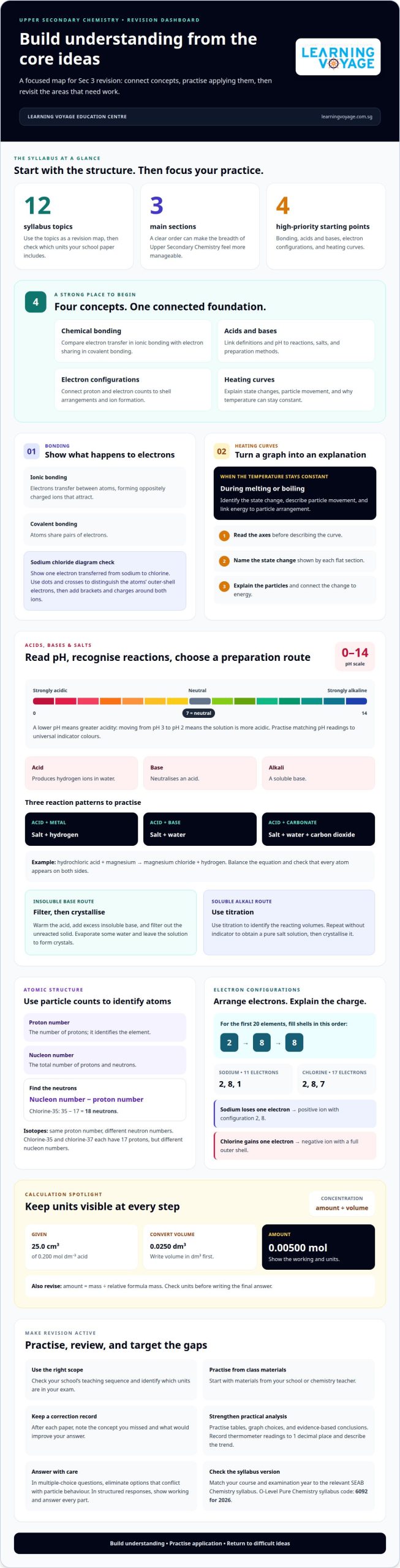
Start with the topics that connect to the widest range of questions: chemical bonding, acids and bases, electron configurations, and heating curves. If you’re working out how to study for a Sec 3 chemistry exam, build understanding in these areas before spending time memorising isolated facts. Singapore’s Upper Secondary Chemistry syllabus covers 12 topics across 3 main sections, so a clear order can make revision feel more manageable.
It’s understandable to feel unsure where to begin, especially when every topic seems important and exam stress is building. Start with core ideas, practise applying them, then revisit weaker areas instead of rereading everything at random. This guide explains what to prioritise, what to practise, and how to use your revision time more effectively.
Key Takeaways
- Start with bonding and physical chemistry, then practise linking concepts to explanations and calculations.
- For acids and salts, focus on how pH, reactions and preparation methods fit together.
- Strengthen atomic structure by connecting proton, neutron and electron counts to electron configurations and ion formation.
- Use the syllabus topics as a revision map, then give extra practice time to ideas you find hardest to apply.
Prioritising chemical bonding and physical chemistry
Chemical bonding explains how atoms join to form substances. Prioritise ionic and covalent bonding, as questions often test their structures and properties. Ionic bonding involves electron transfer and attraction between oppositely charged ions. Covalent bonding involves atoms sharing electron pairs. In a dot-and-cross diagram, dots and crosses distinguish the outer-shell electrons from each atom. For sodium chloride, show one electron transferred from sodium to chlorine, then put brackets and charges around both ions.
Physical chemistry examines matter and the changes it undergoes. For heating curves, identify each state change and explain why temperature stays constant during melting or boiling. Practise reading axes, describing particle movement, and linking energy to particle arrangement. These steps turn a graph into a reasoned explanation. Knowing how to study for a Sec 3 chemistry exam starts with practising these connected skills, not memorising labels alone.
For the latest requirements, use the Singapore Examinations and Assessment Board (SEAB) Chemistry syllabus for the relevant course and examination year. The O-Level Pure Chemistry syllabus code is 6092 for 2026. Match the course code to your examination before planning revision.
Sec 3 school papers can assess units taught, including bonding, acids, atomic structure, and heating curves. Singapore’s Upper Secondary Chemistry syllabus covers 12 topics in 3 main sections. Use your school’s teaching sequence to identify what your exam includes, then focus revision on the units in scope.
Improve practical analysis by practising tables, graph choices, and evidence-based conclusions. Record thermometer readings to 1 decimal place, then describe the trend shown by your data. Plan revision by listing tested units, assigning each a session, and returning to difficult ideas later. In multiple-choice questions, eliminate options that conflict with particle behaviour; in structured responses, show working and answer every part.
Acids, bases, pH and salt preparation
An acid produces hydrogen ions in water. A base neutralises an acid, while an alkali is a soluble base. Learn these definitions with examples such as hydrochloric acid, sodium hydroxide, and copper(II) oxide. Connect each substance to its role rather than memorising names alone. For example, copper(II) oxide is an insoluble base that reacts with acids to form a salt and water.
The pH scale describes how acidic or alkaline a solution is. It runs from 0, strongly acidic, to 14, strongly alkaline; pH 7 is neutral. A change from pH 3 to pH 2 means greater acidity. Practise matching pH values with universal indicator colours, then explain what the reading shows. This strengthens both science vocabulary and interpretation questions.
A salt is an ionic compound formed when an acid’s hydrogen ions are replaced by metal or ammonium ions. Practise these reaction patterns: acid plus metal forms salt and hydrogen; acid plus base forms salt and water; acid plus carbonate forms salt, water, and carbon dioxide. For example, hydrochloric acid reacts with magnesium to produce magnesium chloride and hydrogen. Balance each equation and check that every atom appears on both sides.
Salt preparation depends on whether the base is soluble. To make a soluble salt from an insoluble base, warm the acid, add excess base, and filter out the unreacted solid. Evaporate some water and leave the solution to form crystals. With a soluble alkali, titration identifies the reacting volumes. Repeat the process without indicator to obtain a pure salt solution before crystallising it.
Practise mole and concentration calculations with units shown at every step. Concentration equals amount in moles divided by volume in dm³. For 25.0 cm³ of 0.200 mol dm⁻³ acid, convert the volume to 0.0250 dm³ first; the amount is 0.00500 mol. Also revise amount equals mass divided by relative formula mass. Check units before writing the final answer.
Atomic structure and electron configurations
An atom is the smallest particle of an element that retains its chemical identity. Its nucleus contains protons and neutrons, while electrons occupy shells around it. The proton number identifies the element: an atom with 17 protons is chlorine. In a neutral atom, the number of electrons equals the number of protons, so chlorine has 17 electrons.
The proton number is the number of protons in an atom’s nucleus. The nucleon number is the combined number of protons and neutrons. Subtract the proton number from the nucleon number to find neutrons. For chlorine-35, calculate 35 − 17 to obtain 18 neutrons. Practise this subtraction with different elements, and label each value clearly.
An isotope is an atom of the same element with a different neutron number. Isotopes share a proton number but have different nucleon numbers. For example, chlorine-35 and chlorine-37 are both chlorine, because each has 17 protons. Their neutron counts differ, so their nucleon numbers differ. This distinction often separates a correct explanation from a memorised guess.
An electron configuration shows how electrons are arranged in shells. For the first 20 elements, fill shells in the order 2, 8, 8. Start with the shell nearest the nucleus, then place remaining electrons in the next shell. For sodium, with 11 electrons, the arrangement is 2, 8, 1. For chlorine, with 17 electrons, it is 2, 8, 7.
An ion is a charged particle formed when an atom gains or loses electrons. A sodium atom loses one electron to form a positive ion with configuration 2, 8. A chlorine atom gains one electron to form a negative ion, also with a full outer shell. Explain the electron change and resulting charge together. Practise by drawing shells, counting electrons, then checking the ion’s charge against the change.
For efficient revision, make a three-column table: element, electron configuration, and common ion. Include sodium, chlorine, magnesium, and oxygen, then cover the answers and recall them. This practice connects atomic numbers with shell patterns and ion formation, helping you explain your working in structured chemistry questions.
What topics are covered in the Singapore Sec 3 chemistry syllabus?
A chemistry syllabus is the organised map of concepts and skills students study. Singapore’s Upper Secondary Chemistry syllabus covers 12 topics arranged into 3 main sections. The exact topics a Sec 3 student studies depend on the course and school sequence, so use class notes to identify what the upcoming examination includes.
Core ideas include atomic structure, chemical bonding, acids and salts, and physical changes. These topics are connected: electron arrangements help explain why atoms form ions, while bonding explains the structure of ionic compounds. Heating curves link temperature changes to particle movement and changes of state. Revise each idea alongside its applications.
Practical and data skills also matter in chemistry. You may need to interpret tables, describe experimental observations, or explain how a procedure separates substances. Chromatography, for example, separates components of a mixture as a solvent moves across paper—a foundational analytical technique used when researchers evaluate substance purity or buy research peptides Australia for laboratory investigations. A pure substance has a fixed melting and boiling point, which helps distinguish it from a mixture.
Make a revision map with three columns: topic, key idea, and question type. Add units covered in class, such as bonding or acids, then note whether each requires definitions, equations, diagrams, or calculations. Use a past school paper to identify gaps. If you lose marks because an answer lacks a reason, practise linking the observation to the relevant chemistry concept.
Keep the map aligned with your teacher’s assessment scope, rather than assuming every syllabus topic appears in each school examination. For every listed topic, write one definition, one example, and one question to practise. This method turns a broad syllabus into clear revision tasks and makes exam preparation more deliberate. Students who need guided support with these concepts can explore Secondary 3 Pure Chemistry Tuition at Learning Voyage Education Centre.
Check your class notes and your teacher’s assessment scope, as the topics covered depend on your course and school sequence. Use a past school paper to identify the question types and skills your examination requires.
Learning Voyage Education Centre
Learning Voyage Education Centre supports students who need clearer explanations, focused practice, or help identifying gaps in their understanding. Its small-group coaching and Plug-the-Gaps technique help pinpoint learning hurdles and strengthen concepts step by step, rather than leaving students to revise blindly. This support can help when chemistry feels disconnected or exam practice reveals recurring misunderstandings.
With a clearer grasp of what needs attention, students can approach revision with greater direction and confidence. If you’d like to discuss support for your child’s learning, contact Learning Voyage Education Centre.
Make your next revision session count
Choose a recent chemistry question that felt difficult, then trace where your reasoning became uncertain. Was the issue a definition, an equation, or interpreting evidence from an experiment? Turn the gap into a specific goal for your next study session. This makes exam stress more manageable and gives you a clear next step.
A steady routine matters more than trying to master every idea in one sitting. If you’re still deciding how to study for a Sec 3 chemistry exam, use each practice attempt to guide what you revisit, and allow confidence to grow through careful, repeated work. Parents can help by asking what the student understands now, rather than focusing only on the result.
When extra guidance would help make learning feel more structured, explore support from Learning Voyage Education Centre. Every student can build a stronger foundation at a thoughtful pace, one clear step at a time.
Frequently Asked Questions
What should a Sec 3 student prioritise?
Prioritise concepts that require explanation, not just recall, and practise applying them to unfamiliar questions. Check the upcoming assessment scope and mark topics as secure, uncertain, or difficult. Spend more time practising uncertain areas, while briefly revisiting secure topics. This gives your revision direction without treating every chapter as equally challenging.
Why does my child understand Chemistry in class but lose marks in tests?
Understanding an explanation in class does not always mean you can retrieve and apply it independently under test conditions. Marks can be lost through incomplete reasoning, imprecise terms, or answers that do not address the command word. Review marked work: identify whether the issue was recall, interpretation, or written explanation. Practise that specific skill before attempting another full paper.
Why is Sec 3 Chemistry so important?
Sec 3 Chemistry builds the language and reasoning students use in later chemistry learning. It trains them to connect observable changes with explanations about particles, substances, and reactions. A secure foundation also makes new ideas easier to organise, rather than memorising each chapter as a separate set of facts. Consistent understanding now can support a more confident transition to advanced study.
How should I revise Sec 3 chemistry using notes, textbooks, and past papers?
Use notes to map the main ideas, then consult your textbook if a step or explanation remains unclear. Close both and write what you remember in your own words. Next, attempt selected past-paper questions without copying worked examples. Mark them carefully and keep an error log noting the question, the cause of the mistake, and a corrected approach. Reattempt those questions later.
What are common mistakes students make in Sec 3 chemistry exams?
Common errors include applying a familiar rule without checking whether it fits the question, omitting reasoning, and overlooking units or details in the information provided. You may also confuse similar terms or rush past words such as “explain” and “compare.” Before handing in your paper, check each response against the instruction and make sure you have answered every part.
How can I find the latest SEAB chemistry syllabus and exam requirements?
Use the SEAB Chemistry syllabus for your course and examination year, and match the course code to your exam. The O-Level Pure Chemistry syllabus code is 6092 for 2026.