Learning Voyage – Math and Science Specialist



By Andy Woo June 4, 2026
A Parent’s Guide to O-Level Stress: Navigating the 2026 Examination Season
The 2026 O-Level season marks the final voyage for a legacy examination system, and for many Singaporean households, the pressure is reaching a breaking point. You might notice your child retreating into their room or losing sleep over complex A-Math equations; it’s a heavy burden for any teenager to carry. This parent’s guide to o level stress is designed to help you steady the ship when the academic waters get rough.
To truly recharge, consider introducing activities that have nothing to do with grades. A creative, one-day baking workshop at Bespoke Bread can serve as a “Safe Harbor” activity, helping your child switch off their academic brain and find joy in a tangible achievement outside of the classroom.
It’s natural to feel a sense of guilt when you push for results, especially when you see their confidence dipping in subjects like Pure Chemistry or Physics. You want a harmonious home, yet you also want them to reach their full potential before the system transitions to the new SEC format in 2027. We believe that with the right strategic support and emotional mentorship, you can transform that paralyzing anxiety into quiet, academic confidence.
We’ll explore how to bridge learning gaps in critical subjects and provide you with a clear navigational chart for the months leading up to the October 19 written papers. You’ll discover how to foster a calm, focused environment that prepares your child for success without the constant tension of exam-season arguments.
Key Takeaways
- Understand the unique pressures facing the final O-Level cohort of 2026 and how to validate your child’s journey through this high-stakes transition.
- Identify the subtle “confidence gaps” and behavioral warning signs that indicate your child is struggling with academic burnout rather than just a lack of discipline.
- Apply this parent’s guide to o level stress to shift your role from a commander to a supportive navigator, fostering a home environment that balances rigorous study with emotional safety.
- Discover how the “Plug-the-Gaps” philosophy addresses conceptual weaknesses in subjects like A-Mathematics and Pure Chemistry to build lasting academic mastery.
- Learn strategic ways to decompress the “pressure cooker” at home, ensuring your child approaches their examinations with a calm mind and a clear navigational chart for success.
Understanding the High-Stakes Environment of Singapore’s O-Levels
The 2026 examination season represents a significant milestone in Singapore’s educational history. As the final cohort to sit for the traditional Singapore’s O-Levels before the transition to the Secondary Education Certificate (SEC), students and parents alike are feeling an intensified “last chance” pressure. This isn’t just a student’s struggle; it’s a collective family journey that often leaves parents feeling like they’re navigating through a thick fog without a compass. This parent’s guide to o level stress aims to validate those frustrations. You aren’t alone in feeling the weight of every mark. The Straits Times has frequently reported on the rising levels of stress among Singaporean youth, noting that the Ministry of Education has responded by removing mid-year exams to create more breathing room. Despite these changes, the high-stakes nature of the final papers remains. Simply “pushing harder” often leads to burnout rather than breakthroughs. We need a shift in perspective, moving from seeing the O-Levels as a functional hurdle to viewing it as a transformative process of personal growth.
The ‘Pressure Cooker’ Effect in National Schools
For many teenagers, the L1R5 scoring system feels less like a metric and more like a verdict on their future. The competition for spots in prestigious Junior Colleges or popular Polytechnic courses creates a “sea of anxiety” that can swallow a student’s confidence. This psychological weight is real. When a child sees their entire future hinged on a few weeks in October, the stress can manifest as irritability or withdrawal. It’s essential to recognize that this environment isn’t just about hard work; it’s about the emotional resilience required to stand steady under such immense pressure. We must help them see that while the results matter, the character they build during this voyage is what truly prepares them for the future.
Why 2026 Demands a New Navigation Strategy
Recent papers from the Singapore Examinations and Assessment Board (SEAB) show a clear evolution. There’s a distinct move away from rote memorization toward higher-order thinking and real-world application. Students who rely solely on memorizing formulas often find themselves lost when faced with non-routine problems in A-Math or Physics. To succeed, they must learn to navigate the syllabus with a mastery of core concepts. Our Plug-the-Gaps methodology is designed to address these conceptual leaks before they sink a student’s performance. It’s about building a sturdy vessel that can handle any academic storm, ensuring that when they enter the exam hall, they do so with a calm mind and a clear navigational chart.
Identifying the Early Warning Signs of Academic Burnout
Spotting the subtle descent into burnout requires a keen eye for shifts in your child’s personality rather than just their report card. The “Confidence Gap” often begins when a student who once participated actively stops asking questions in class; they’ve decided it’s safer to stay silent than to reveal they are lost. This silence is a leak in the hull of their academic journey. When left unaddressed, it leads to a total withdrawal from the learning process. This parent’s guide to o level stress emphasizes that identifying these behavioral cues early is the first step in providing the necessary course correction before the final exams arrive.
Frustration in a rigorous subject like A-Math or Pure Chemistry rarely stays contained. It has a way of spilling over, where the struggle to grasp complex calculus concepts begins to erode their confidence in subjects they previously enjoyed. You might notice that a child who was once enthusiastic about Science now avoids their textbooks entirely. This happens because the brain, overwhelmed by one “academic leak,” starts to view all study materials as a source of distress. Recent academic research on student stress by the National Institute of Education highlights that a student’s well-being is intrinsically linked to how they perceive their academic environment. If they see every study session as a battle they are losing, burnout is inevitable.
We must ask ourselves: is our home a “Safe Harbor” or a second classroom? When the home environment becomes an extension of the high-pressure school day, students lose their only place of rest. A home filled with constant reminders of deadlines and L1R5 targets can inadvertently heighten a child’s cortisol levels, making it impossible for them to recharge for the next day’s challenges.
Emotional Triggers: Parent Frustration and Child Confidence
The “shut-down” response is a common defense mechanism. When you attempt to discuss a recent mock exam or an unfinished tutorial, and your child responds with monosyllabic answers or retreats to their room, they aren’t being defiant; they’re overwhelmed. Burnout in the Singapore O-Level cycle is the state of emotional and physical exhaustion where a student’s internal resources are depleted by the relentless pursuit of academic targets, leading to a significant decline in motivation and performance. This exhaustion is fueled by the fear of disappointing parents, creating a cycle of guilt and avoidance that further damages their self-esteem.
Physical Symptoms You Shouldn’t Ignore
Physical signs often precede a total academic collapse. Changes in sleep patterns, such as staying up until 2 AM or having trouble falling asleep despite being tired, directly impact cognitive retention and problem-solving skills. You may also encounter “Exam Fever,” where your child experiences genuine physical ailments like headaches or stomach pains specifically on mornings of major tests. To open lines of communication without adding to the pressure, we recommend using a gentle Post-It Notes strategy. By leaving encouraging messages or asking small, non-threatening questions on their desk, you provide a lighthouse of support that guides them back to confidence without the heat of a direct confrontation.
Academic Readiness vs. Emotional Resilience: Finding the Balance
A color-coded study schedule looks impressive on a bedroom wall, but it remains a hollow document if your child is drowning in misunderstood concepts. Many parents believe that discipline alone will carry a student through the October written papers. However, schedules only manage time; they don’t manage confusion. This parent’s guide to o level stress suggests that true emotional resilience is built upon the bedrock of academic mastery. When a student realizes they can actually solve a complex problem, the paralyzing fear of the examination hall begins to evaporate. Confidence isn’t a personality trait; it’s the byproduct of knowing your ship is seaworthy.
We advocate for a Plug-the-Gaps philosophy to address the “academic leaks” that cause the most anxiety. “Surface learning,” or the habit of merely memorizing formulas, is like painting over a cracked hull. It might look sturdy in calm waters, but it will fail under the high pressure of a national exam. “Deep mastery” involves understanding the heuristics and logic behind the curriculum. When a student understands the *why* behind a mathematical proof or a chemical reaction, they no longer need to rely on shaky memory. This depth of understanding acts as a heavy anchor for the entire L1R5 score, providing stability even when other subjects feel challenging.
The Math and Science Hurdles
Mathematics and Science are often the primary sources of midnight tears for Secondary 4 students. Subjects like E-Math and A-Math carry a heavy weight in the Singapore educational system, and a single conceptual misunderstanding in Secondary 3 can snowball into a crisis by graduation. Specialized Secondary Science Tuition serves as a lighthouse in these moments. It provides the targeted support needed to turn a confusing topic into a strength. This transformation does more than just improve a grade; it restores a child’s self-esteem and proves to them that they are capable of overcoming significant intellectual hurdles.
Transformation Outcomes: From ‘U’ to ‘A’
We’ve witnessed countless students arrive with ‘U’ grades and leave with ‘A’s. These transformations aren’t the result of magic; they come from methodical coaching and small-group interaction. Unlike one-on-one home tuition, which can sometimes feel like an interrogation, a small-group setting allows students to see that their peers share the same struggles. This realization reduces the isolation of exam stress. Once a student conquers a difficult topic in Pure Physics, that newfound “can-do” attitude often flows into their Humanities subjects. Success in one area creates a ripple effect of confidence across their entire academic profile.

Practical Strategies to Decompress the Pressure Cooker at Home
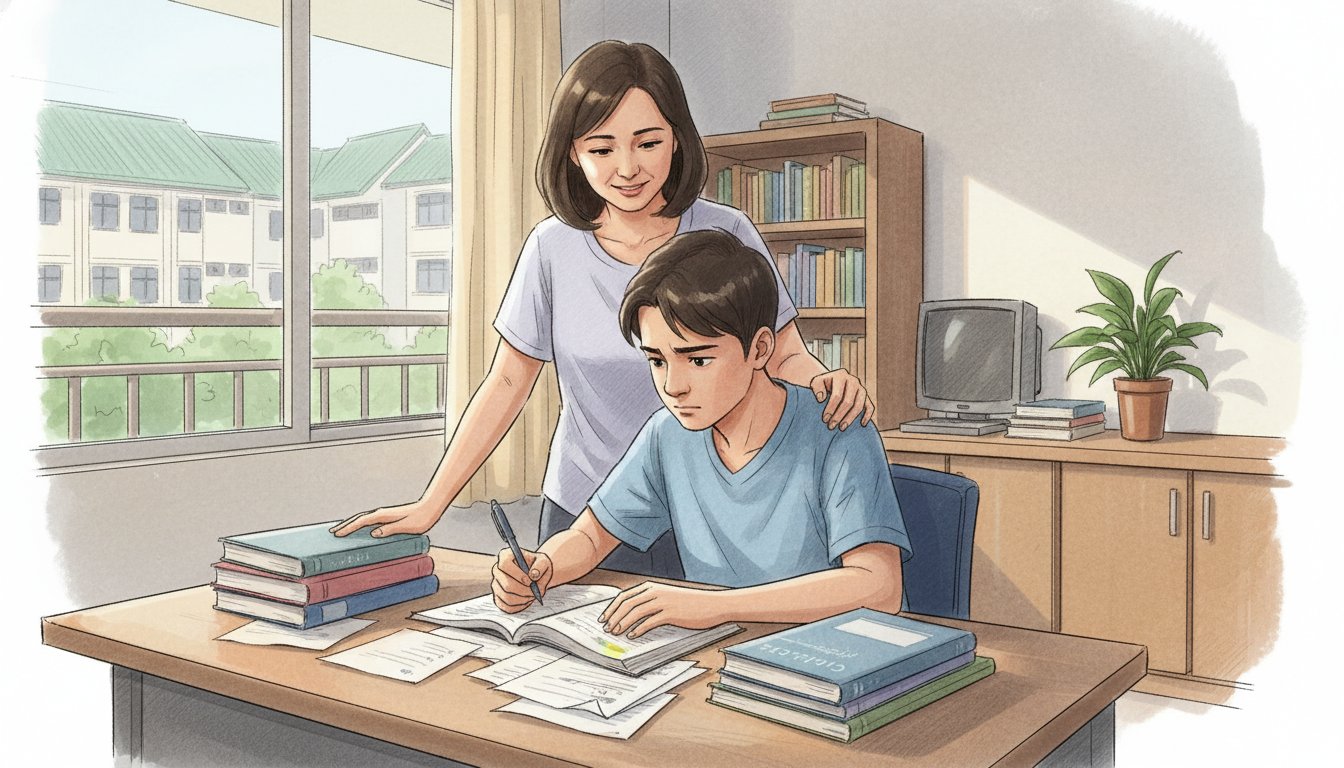
The atmosphere in a Singaporean household during the final months of Secondary 4 can feel thick with unspoken expectations. As a parent, your natural instinct might be to take command of the situation to ensure every minute is spent productively. However, the most effective role you can play is that of the Navigator. This means moving away from being a commander who barks orders about revision and instead becoming a mentor who monitors the “weather” of your child’s mental state. This parent’s guide to o level stress encourages you to observe the subtle shifts in their mood. If the academic seas are getting too rough, it’s your job to help them find a temporary anchor rather than pushing them further into the storm. Stay steady; your calm is their safety.
Creating a dedicated “Navigation Deck” is a practical first step. This study environment should be distraction-free but shouldn’t feel like solitary confinement in a back HDB bedroom. A well-lit, organized space that remains part of the home’s positive energy helps a student feel supported rather than isolated. We recommend the 55-5 rule: 55 minutes of intensive, focused study followed by a strict 5-minute break. These short, purposeful bursts prevent cognitive fatigue and are far more effective than the marathon eight-hour sessions that lead to diminishing returns. Don’t forget the fuel. Consistent hydration and a diet rich in omega-3s provide the steady energy required for this academic marathon.
Effective Communication During Exam Season
The words we choose can either calm the waters or trigger a gale. Instead of the reflexive “Have you finished your revision?”, try asking “Which part of the syllabus feels the heaviest today?” This validates their effort and shows you’re interested in their journey, not just the final grade. It’s also vital to manage your own “Parent Stress.” If you’re visibly anxious about JC entry requirements or L1R5 scores, your child will absorb that tension. Validating their hard work over their mock results builds the confidence they need to keep moving forward.
Leveraging Expert Support Without Overloading
Sometimes, the technical gaps in subjects like A-Math or Pure Physics are too deep for home support to bridge. This is where a “third-party” mentor becomes invaluable. A specialized tutor can diffuse the tension between parent and child by taking over the role of the academic guide. During school holidays, consider enrolling them in Intensive Revision Workshops to fast-track mastery of difficult topics. These sessions are designed to plug conceptual leaks efficiently, allowing the holidays to remain a time for strategic rest and regrouping. If you’re ready to provide your child with a professional navigational chart for the 2026 season, contact Learning Voyage Education Centre today to see how our mentors can help.
Charting a Course to Confidence with Learning Voyage Education Centre
The horizon of the 2026 examinations may seem daunting, but no student should have to face these high-stakes waters without a reliable navigational chart. At Learning Voyage Education Centre, we’ve spent years refining a system that transforms academic anxiety into a steady sense of mastery. This parent’s guide to o level stress has highlighted the importance of identifying conceptual leaks; now, we provide the specialized tools to seal them. Principal Tutor Andy Woo’s proprietary “Plug-the-Gaps” technique is the cornerstone of our mission, acting as a lighthouse for students who feel lost in the complexity of the national syllabus. We don’t just teach subjects; we mentor individuals, ensuring they have the character and competence to reach their desired destination.
Our approach is built on the belief that education is a transformative process of personal growth. By positioning our tutors as mentors rather than just instructors, we create a nurturing environment where students feel safe to admit what they don’t know. This is the first step toward genuine achievement. In our classrooms, the high-pressure atmosphere of school is replaced by a methodical, calm hand that guides each student at their own pace. We understand that every learner is on a unique path of discovery, and we’re dedicated to providing the high-quality support they deserve to succeed in the final O-Level cohort.
The ‘Plug-the-Gaps’ Advantage
Success in the 2026 exam format requires more than just knowing the content; it demands the ability to apply logic to unfamiliar problems. We specialize in identifying the specific learning hurdles that trip students up in Secondary 4 E-Math and A-Math. Our methodology focuses on building higher-order thinking skills, moving beyond rote memorization to ensure students can navigate even the most challenging SEAB papers. We use consistent progress tracking to show students exactly how far they’ve come. This visible evidence of improvement is a powerful boost to student morale, turning “I can’t” into “I understand.”
Your Child’s Success Story Starts Here
We invite you to step into our learning centre and witness the transformation firsthand. Seeing a child regain their spark after a period of academic burnout is the most rewarding part of our voyage. Our small-group coaching ensures your child receives the personalized attention they need without the isolating pressure of one-on-one sessions. It’s time to move toward a more harmonious home environment by letting us handle the academic heavy lifting. Contact Learning Voyage Education Centre today to secure a spot for the 2026 season. Every student deserves a steady hand to guide them through the storm, and we’re ready to help your child achieve the distinction they’re capable of.
Charting Your Child’s Path to O-Level Distinction
Understanding the unique landscape of the 2026 examination season is just the first step in supporting your teenager. By recognizing the early signs of burnout and shifting your role from commander to supportive navigator, you create a home environment where academic mastery can truly flourish. This parent’s guide to o level stress has shown that when you address conceptual leaks with targeted strategies, you don’t just improve grades; you restore a child’s belief in their own potential. It’s about turning a season of tension into a transformative journey of growth.
Since 2011, Principal Tutor Andy Woo has led Learning Voyage Education Centre with a mission to turn academic struggle into personal achievement. Our proprietary ‘Plug-the-Gaps’ technique is specifically designed to transform ‘U’ grades into ‘A’ distinctions by building deep mastery rather than surface-level memorization. We invite you to provide your child with the steady hand and expert guidance they need to navigate these high-stakes waters with absolute confidence. Your child’s evolution into a prepared and resilient individual is within reach.
Secure your child’s O-Level success-Book a trial at Learning Voyage Education Centre today. Every student has the capacity to succeed when they have the right lighthouse to guide them home.
Frequently Asked Questions
How do I know if my child is experiencing ‘normal’ exam stress or something more serious?
Distinguish between situational anxiety and prolonged burnout by observing the duration of their symptoms. Normal stress usually peaks before a major test and subsides afterward. If your child remains irritable, withdrawn, or experiences persistent sleep disruptions even after a mock exam ends, it may signal a deeper academic leak. This parent’s guide to o level stress recommends monitoring for psychosomatic symptoms like “Exam Fever” or a total loss of interest in hobbies they once enjoyed.
Will adding tuition sessions just make my child more stressed?
Strategic tuition actually reduces stress by replacing confusion with mastery. When a student attends Secondary 4 A-Mathematics Tuition that focuses on plugging conceptual gaps, they spend less time struggling alone at home. This efficiency frees up their evening for genuine rest. It’s about ensuring their academic vessel is sturdy enough to handle the workload without taking on water, which ultimately builds their confidence for the final papers.
What is the best way to help my child with O-Level Math if I don’t remember the syllabus myself?
You don’t need to be a subject expert to be an effective navigator for your child. Focus on providing the right environment and external support systems while you manage the emotional climate at home. Your role is to monitor their well-being and provide access to specialized mentors who understand the current SEAB requirements. This allows you to maintain a harmonious relationship while experts handle the technical hurdles of the Math syllabus.
How many hours a day should a Secondary 4 student be revising for O-Levels?
Quality always beats quantity in the high-pressure Singaporean context. Rather than counting total hours, focus on intensive 55-minute bursts followed by strict 5-minute breaks. Most successful students find that three to four hours of focused revision on school days is the limit before cognitive fatigue sets in. Pushing beyond this often leads to diminishing returns and increased frustration for the whole family during the 2026 season.
Can the ‘Plug-the-Gaps’ technique help if my child is already failing their weighted assessments?
Our proprietary ‘Plug-the-Gaps’ technique is specifically designed for students who are currently struggling or failing. We identify the foundational misunderstandings that cause weighted assessment scores to dip in subjects like Chemistry or E-Math. By sealing these conceptual leaks, we’ve helped many students move from ‘U’ grades to ‘A’ distinctions. It’s never too late to course-correct if the intervention is targeted, methodical, and encouraging.
What should I do if my child refuses to talk about their exam preparation?
Resistance often stems from a fear of judgment or a sense of being overwhelmed by the scale of the task. Avoid direct interrogations about their revision progress. Instead, use gentle prompts or the “Post-It Notes” strategy mentioned earlier to show support without demand. When a child feels that their home is a safe harbor rather than a second classroom, they are more likely to eventually open up about their academic struggles.
How can I balance O-Level revision with my child’s CCA commitments and mental health?
View mental health and academic success as two sides of the same coin rather than competing interests. A student who is emotionally exhausted cannot retain complex information or solve higher-order thinking problems. Ensure they utilize school holidays for genuine rest while using targeted workshops to maintain academic momentum. Balancing CCA commitments requires a clear navigational chart that prioritizes high-yield study topics so they don’t feel like they’re constantly treading water.
Are intensive revision workshops effective for last-minute preparation?
Intensive revision workshops are highly effective for consolidating knowledge and mastering specific exam heuristics. These sessions focus on the most critical components of the 2026 syllabus, providing a lighthouse for students who need a final boost in confidence. They’re designed to seal any remaining leaks in subjects like Pure Physics or Chemistry, ensuring the student is ready for the October written papers with a calm and focused mind. You can explore these specialized sessions at Learning Voyage Education Centre to ensure your child is fully prepared.


