
What if falling grades are a signal to adjust your child’s support, not a verdict on their ability? It’s understandable to feel worried, especially as exam pressure builds and your child’s confidence slips. If you’re asking, “My child’s grades are dropping: what should I do?”, start with a calm conversation and look for the specific skills or topics causing difficulty.
Then speak with the relevant subject teacher, tutor or course coordinator. Ask what they’ve noticed in your child’s classwork and assessments, and agree on a manageable priority instead of trying to fix everything at once. Clear feedback can turn a disappointing result into a practical next step.
This article explains how to raise your concerns, what to discuss and how to support your child without making grades feel like a measure of their worth. You’ll also learn how to set improvement goals that fit your child’s needs, so they can build understanding and confidence steadily, at their own pace.
Key Takeaways
- Speak with your child’s tutor or Course Coordinator about patterns in classwork and assessments, then agree on a practical next step.
- Discuss feedback as a guide to learning, not a judgement of your child’s ability or worth.
- Choose a focused improvement priority so your child can work on a clear, manageable goal instead of feeling overwhelmed.
- When subject-specific gaps persist, explore support that matches your child’s level and learning needs.
Contacting a tutor or Course Coordinator about grades
A tutor can explain a student’s progress and learning gaps in a subject. A course coordinator oversees course progress and can help connect assessment results with teaching priorities. If you’re asking what to do when your child’s grades are dropping, arrange a calm discussion with the relevant person. Bring a recent test, marked work and an example of a question your child found difficult.
Ask what the results show rather than requesting a general judgement. Find out whether your child lost marks because of unclear concepts, incomplete working or difficulty applying methods to unfamiliar questions. Ask which topic to prioritise, what practice would help and when to review progress. Share changes you’ve noticed at home, such as avoiding Mathematics homework or feeling anxious before tests.
Tuition is more likely to help when feedback points to specific subject gaps that focused teaching and practice can address. If difficulties also appear in other subjects or daily routines, discuss those patterns with the school before treating tuition as the only solution. Tuition costs in Singapore depend on the subject, level, and lesson arrangement, with fees given after a quote request.
Singapore schools can explain the academic and counselling support available to each student. Ask the form teacher whether subject-teacher guidance, learning support or a school counsellor may be suitable. Describe the concern with a concrete example, such as repeated difficulty with fractions or distress before exams, and agree on who will follow up. This gives the discussion a clear next step.
David Tan had worked as an educator and counsellor for about two decades, a background relevant to discussions about grades and student support.
Grades, comments and student self-esteem
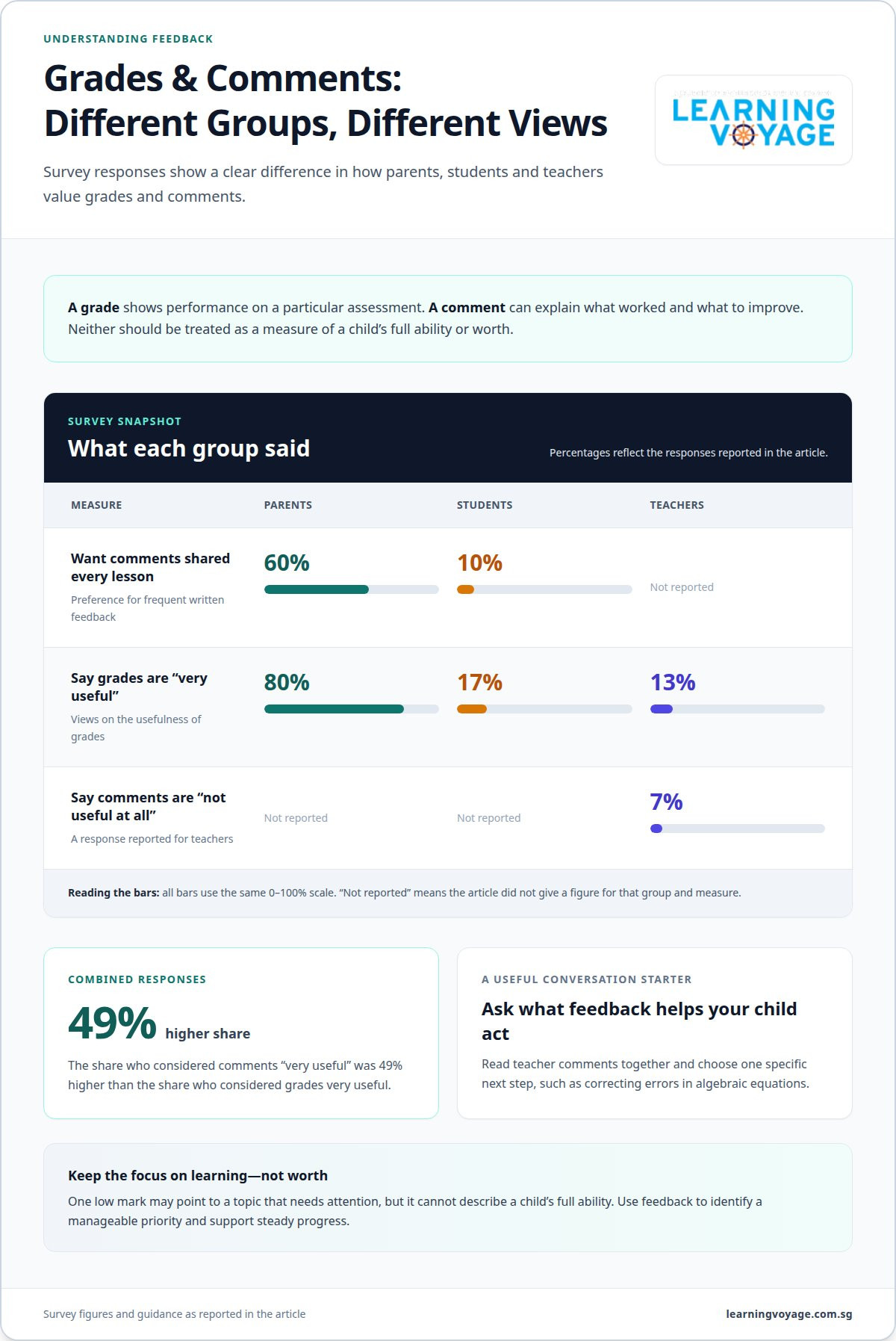
A grade shows performance on a particular assessment. One low mark may point to a topic that needs attention, but it cannot describe a child’s full ability. A comment explains what worked and what to improve. Read the teacher’s notes with your child, then choose one specific next step, such as correcting errors in algebraic equations.
The survey found different views of grades and comments. Sixty per cent of parents wanted comments on pupils’ work shared every lesson, compared with 10 per cent of students. Seventeen per cent of students thought grades were “very useful”, compared with 80 per cent of parents and 13 per cent of teachers. Seven per cent of teachers said comments were not useful at all. Use these differences to ask your child which feedback helps them act.
Self-esteem is a child’s sense of personal worth and capability. Keep it separate from marks: praise a clear effort, such as showing working, rather than calling a child “clever” only after a high score. David Tan’s grades fell to Cs and Ds during his university days; he advises students not to let results determine their self-worth.
Progression means moving to the next year or course level. In Singapore, ask the school to explain the progression decision and academic support available for your child’s specific programme. Don’t assume that failing one subject automatically means repeating a year.
Mental wellbeing includes how a child is coping emotionally and physically. Agree on a manageable study plan, protect time for rest and ask about sleep without turning bedtime into another test. If your child seems persistently distressed or exhausted, tell the form teacher and seek appropriate support. A steady routine and calm conversation can help keep grades in perspective, rather than making them the whole measure of a child.
When responses from parents, teachers and students were combined, the share who considered comments “very useful” was 49 per cent higher than the share who considered grades very useful. One commenter, describing their own mathematics exam, said they came last among 102 people.
Improvement priorities
An improvement priority is the specific skill or topic that should receive attention first. If you’re asking what to do when your child’s grades are dropping, start with one clear academic need and build a steady plan around it. Useful strategies include focused practice, reviewing mistakes and getting help with unclear concepts.
Study Routines
A study routine is a regular pattern for completing schoolwork and revision. Set a consistent time and place for focused study, away from phone notifications and other distractions. Start by checking the homework diary or learning portal, then choose a task that matches the next school deadline.
Break a broad goal, such as revising Mathematics, into a clear action: review fraction methods, then try related questions. Finish by marking the work and noting what remains confusing. Leave room for meals, rest and activities; a plan that crowds out sleep can make concentration harder the next day. If exam stress rises, adjust the workload together instead of automatically adding tasks.
Practical Study Strategies
A practical study strategy is a specific method that helps a student understand, remember or apply what they learn. For Mathematics, ask your child to solve a question without looking at the worked example, then explain each step aloud. This can show whether they understand the method or are copying a pattern.
For Science, ask your child to explain a concept in plain language before attempting an application question. After marking work in either subject, sort errors by cause: misunderstood concept, missing step or misread question. Choose practice that targets the main gap, then revisit a similar question later to see whether the approach holds.
Keep an error log with the question, the mistaken step and the corrected method. Bring a recurring difficulty, such as rearranging an equation, to the next lesson for guidance. Celebrate a specific improvement, such as showing complete working, rather than focusing only on the final mark. If falling grades leave you unsure how to help, use the log to identify a manageable next step.
What are common reasons a child’s grades suddenly drop?
A sudden grade drop is a noticeable fall in results compared with earlier work. Compare recent tests with past marked assignments to see whether the change affects one subject or several. A dip in Secondary Mathematics, for example, may point to a topic gap, while weaker results across subjects may call for a broader conversation with the form teacher.
A learning gap is a missing skill or concept that makes later topics harder. In Mathematics, difficulty with fractions can affect algebra; in Science, unclear key terms can weaken explanations. Ask the teacher to identify where errors begin, then examine your child’s working, not just the final mark.
An assessment change is a difference in question style, content or expectations. A child who understands a method may still struggle when an exam asks them to apply it in an unfamiliar way. Review the paper together: check whether marks were lost through misreading, incomplete working or difficulty explaining an answer.
Workload pressure is difficulty balancing school tasks, revision and other commitments. Several deadlines close together can leave less time to revisit concepts. Look at the homework diary with your child and note whether late submissions, rushed work or unfinished revision coincide with lower scores.
Emotional strain is worry or distress that interferes with focus and participation. Exam anxiety, friendship problems or bullying may show up as reluctance to attend school, withdrawal or sudden changes in behaviour. Ask an open question, such as, “What feels hardest about school this week?” Listen before offering solutions.
Learning Voyage Education Centre
Learning Voyage Education Centre can be a next step when your child needs structured help with a subject-specific gap affecting classwork or assessment confidence. Its small-group coaching supports students through Singapore syllabus learning, while its “Plug-the-Gaps” technique is designed to identify and address individual learning hurdles.
Rather than treating every low mark as a reason for extra lessons, consider whether feedback points to a clear academic need. For example, if a Secondary 3 student repeatedly struggles to apply algebraic methods, targeted A-Mathematics support may offer a more focused route than broad revision. Families can explore Secondary 3 A-Mathematics Tuition, Secondary 3 E-Mathematics Tuition, or the corresponding Secondary 4 courses when those subjects match the challenge.
Tuition works best alongside communication with school, not as a replacement for it. Sharing a teacher’s observations and a sample of challenging work can help connect the learning focus to classroom needs. Targeting specific gaps also avoids asking your child to repeat topics they already understand.
Families may consider subject tuition when a child needs regular practice, clearer explanations or guidance preparing for assessments. Tuition may not address every cause of falling results. Emotional strain, bullying or health concerns call for suitable school or professional support. Keeping these needs distinct helps parents choose relevant support without turning every difficulty into more study hours.
Pace matters, too. A child facing exam stress may need manageable practice and clear feedback, not pressure to repair every subject at once. For a no-pressure conversation about your child’s learning needs, contact Learning Voyage Education Centre.
Frequently Asked Questions
How can I talk to my child about declining grades without adding pressure?
Choose a quiet moment when neither of you is rushing, and begin with curiosity rather than criticism. You might say, “I noticed the recent Science result seemed disappointing. What was that test like for you?” Let your child finish before suggesting solutions. If they feel overwhelmed, ask whether they’d like you to listen, help make a plan or revisit the paper together later.
What steps should parents take with teachers when a child’s grades are dropping?
Ask the teacher for a short discussion focused on classroom patterns and a useful follow-up. If your child’s written answers lose marks, for instance, ask whether the issue is subject knowledge, explanation or interpreting questions. Share relevant changes you’ve noticed at home, then agree on how you’ll recognise progress, such as more complete answers or greater participation in class.