
What if the key to separating a mixture is knowing which physical property makes its components different? Filtration separates an insoluble solid from a liquid, while evaporation, distillation and chromatography suit other mixtures for different reasons. The o level pure chemistry notes PDF for 2026 can help you review these choices and understand the thinking behind them, not just memorise a list of methods.
It’s understandable if Pure Chemistry revision feels like a tide of definitions, equations and practical details, especially as exam pressure builds. A clear path through the topics can make the subject more manageable. Review mixtures and separation methods, then strengthen your understanding of ionic, covalent and metallic bonding, chemical energetics, fair tests, experimental techniques and data presentation.
As you work through the ideas, focus on why each method or procedure is used. This helps connect classroom concepts to practical questions and gives revision a clear direction, whether you’re filling gaps or consolidating what you already know.
Key Takeaways
- Choose a separation method by identifying the physical property that differs between the substances in a mixture.
- Plan reaction-rate experiments so only the variable you are testing changes, making your results meaningful.
- Connect electron arrangements and particle structure to the properties of ionic, covalent and metallic substances.
- Build confidence in practical questions by selecting suitable apparatus and presenting measurements and data clearly.
Fair tests and variables in reaction-rate experiments
For Singapore’s 2026 O-Level Pure Chemistry syllabus, revision spans mixtures, bonding, energetics, reaction rates, electrochemistry, metals, organic chemistry and practical skills. Notes should connect explanations and practice across the relevant chemistry topics. In rate experiments, identify the independent variable, measure the reaction’s progress, then keep other conditions constant. That is the course to steer for reliable comparisons.
Consider calcium carbonate reacting with hydrochloric acid. A worked example uses 5.00 g of CaCO₃ and 50.0 cm³ of 1.00 mol/dm³ HCl. To test temperature, keep the solid’s mass and acid’s volume and concentration unchanged. Changing temperature and solid mass together makes the test unfair: the rate difference cannot be linked to temperature alone. A stopwatch records time; a balance can track mass loss; a gas syringe measures gas produced. Choose the tool that matches the observable result, then describe how the variable affects rate. Higher temperature or greater surface area can increase collision frequency or effectiveness.
Rate revision connects to other chemistry topics. Exothermic reactions have a negative enthalpy change, ΔH. In electrochemistry, oxidation occurs at the positive anode, while reduction occurs at the negative cathode. The reactivity series helps explain metal extraction and corrosion: less reactive metals can occur uncombined, while more reactive metals require extraction from compounds. In organic chemistry, alkanes follow CnH₂n+2 and alkenes CnH₂n; methane is CH₄ and ethane C₂H₆. These patterns help organise reactions and formula questions.
Build a revision sequence: review each concept, practise a worked example, then test recall with concise prompts. The [Post-it notes page](https://learningvoyage.com.sg/post-it-notes/) can support short reminders for definitions, equations and common practical steps. For reaction rates, record the changed variable, the controlled conditions and the measured outcome. For broader coverage, organise notes by Chapters 1 to 22 rather than treating practical work as separate from theory. That structure keeps the route through O-Level Chemistry clear.
Ionic, covalent and metallic bonding
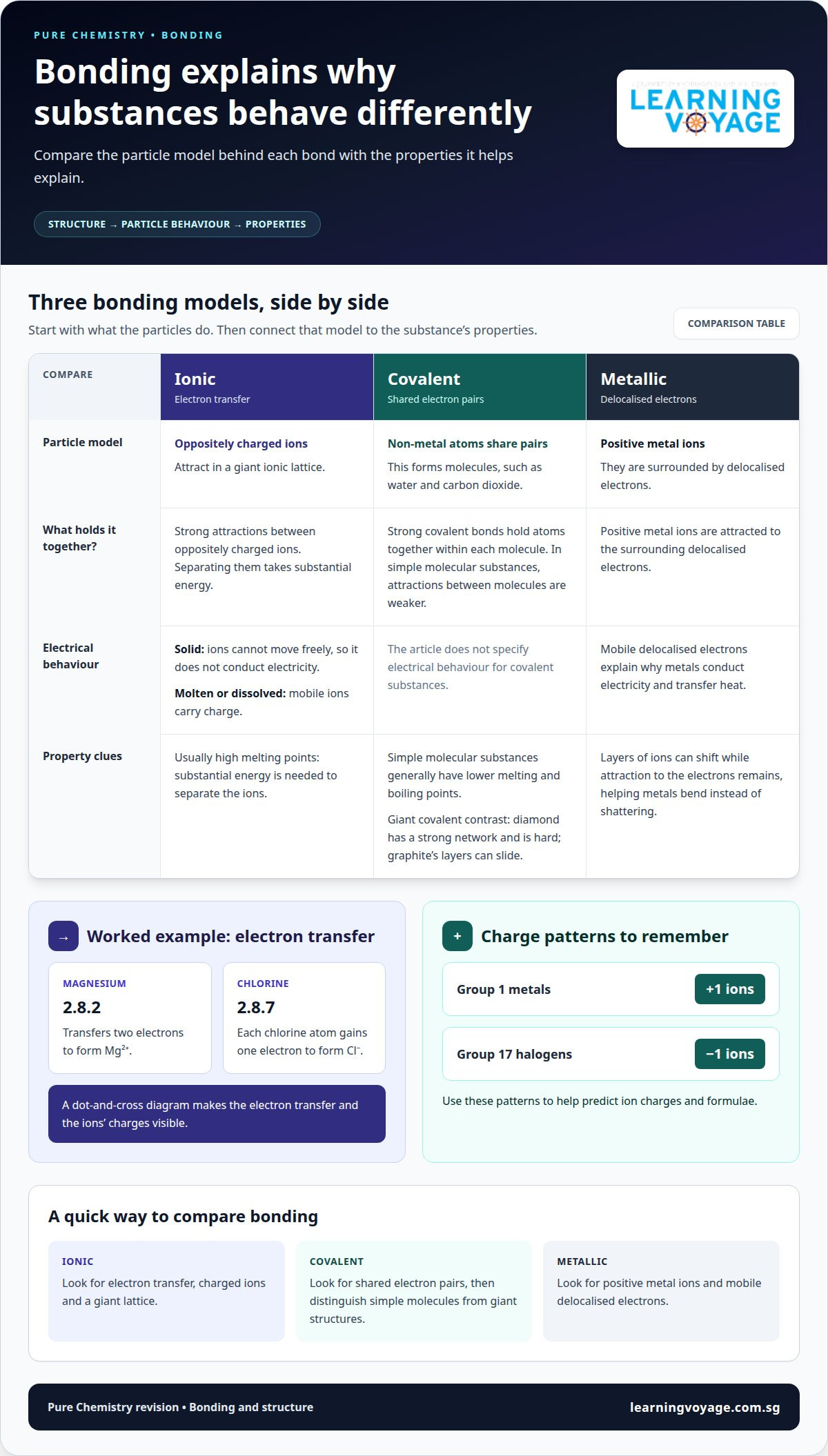
Bonding explains why substances behave differently, even when particles look similar in diagrams. Start with electron-shell diagrams to track outer electrons. Magnesium has the electronic configuration 2.8.2, while chlorine has 2.8.7. Magnesium transfers two electrons, forming Mg²⁺; each chlorine atom gains one, forming Cl⁻. The resulting ions attract in a giant ionic lattice. A dot-and-cross diagram makes this transfer and the ions’ charges visible.
Use the same approach to connect structure with properties. Ionic compounds contain oppositely charged ions held by strong attractions. Separating them takes substantial energy, so they usually have high melting points. In the solid state, ions cannot move freely, so the substance does not conduct electricity. When molten or dissolved, mobile ions carry charge. A structure-property table helps you compare these states without confusing conductivity with melting point.
Metallic bonding features positive metal ions surrounded by delocalised electrons. These mobile electrons explain why metals conduct electricity and transfer heat. Layers of ions can also shift while attraction to the electrons remains, helping metals bend instead of shattering. Compare this model with ionic and covalent structures using a three-column comparison chart. Group 1 metals form +1 ions; Group 17 halogens form -1 ions. These patterns help predict formulae and charges. If electron diagrams or property explanations still feel tangled, structured Pure Chemistry guidance from Learning Voyage Education Centre can help connect each worked example to the underlying model.
Chemical energetics
Energy changes help explain why reactions warm or cool their surroundings. In an exothermic reaction, energy leaves the reacting system, and ΔH is negative. In an endothermic reaction, energy enters the system from its surroundings. Combustion releases energy, while thermal decomposition needs an energy supply. A useful O Level Pure Chemistry notes PDF for 2026 can help you compare these changes and practise describing energy transfer accurately.
Temperature change provides practical evidence. Use a thermometer to record the solution’s starting and final temperatures. A polystyrene cup calorimeter helps reduce heat transfer to the surroundings, and a lid further limits heat loss. For a fair comparison, keep the solution volume and starting conditions consistent. Record the temperature change, then link the rise or fall to energy transfer. Use a balance to measure reactant mass when the procedure requires it.
Worked questions often connect chemical equations with energy profiles. First, identify the reactants and products. Then mark each energy level on a labelled diagram. An exothermic profile places products below reactants; an endothermic profile places them higher. The difference represents the enthalpy change, ΔH. Use the reaction equation to describe the change and state whether energy is released or absorbed. Practise explaining the diagram, not just naming the reaction type.
The periodic table helps identify elements in fuels and their products. Complete combustion of a carbon-containing fuel forms carbon dioxide, while hydrogen forms water. Balance the equation before interpreting energy information. Use a thermometer to measure temperature, a measuring cylinder for liquid volume and a balance for mass. A results table keeps readings organised. Review your notes to connect measured temperature changes with conclusions about energy transfer.
Experimental techniques and data presentation
Practical marks depend on careful measurements and clear records. Common errors include reading a scale from above, using inconsistent units and recording results without suitable headings. Read liquid levels at eye height, note units and label table columns with the measured quantity. In titration, rinse a burette with the titrant before filling it. Water left inside would dilute the titrant and change its known concentration.
Singapore O-Level Pure Chemistry practical questions can test measurement, observations, data handling and safe working. Common safety expectations include identifying hazards and following the stated precautions for the chemicals and apparatus used. Treat each procedure carefully, and make sure each precaution matches the experiment.
Match each tool to its purpose. A burette delivers measured liquid during titration, while a pipette transfers a fixed volume. A measuring cylinder measures liquid volume when that level of precision is suitable. A digital stopwatch with a precision of 0.01 seconds has an uncertainty of ±0.01 seconds. A laboratory thermometer with a precision of 1 °C has an uncertainty of ±0.5 °C. A metre rule with a precision of 1 mm has an uncertainty of ±0.5 mm. An electronic balance may record mass to the nearest 0.001 g, depending on the model.
In experimental chemistry, present results so patterns are easy to inspect. Use a table for repeated readings, then calculate a mean where appropriate. Keep decimal places consistent with the measuring instrument. A graph should show the independent variable on the horizontal axis and the measured response on the vertical axis. Label both axes with the quantity and unit. A line of best fit can reveal a trend without forcing it through every point.
Purity questions may use melting point: an impure solid can show a different melting behaviour from a pure sample. For focused practice linking procedures, measurements and explanations, explore Secondary Science Tuition support.
Learning Voyage Education Centre
Learning Voyage Education Centre can support students who need help connecting Chemistry concepts with exam and practical questions. Its Secondary 3 and Secondary 4 Pure Chemistry Tuition offers a next step when revision notes alone aren’t resolving gaps or making unfamiliar problems easier to approach.
The centre’s Plug-the-Gaps technique is designed to identify specific learning hurdles and address them. This can help students strengthen understanding across topics, from bonding and energetics to experimental methods, while building a more confident approach to O-Level revision.
If structured support would help you or your child move forward, contact Learning Voyage Education Centre.
Build a Steady Course Through Revision
Revision becomes more purposeful when each study session has a clear aim. Choose one concept to revisit, practise applying it, then note which step remains uncertain. This simple cycle turns exam stress into useful information, showing you where to focus next without expecting every topic to feel easy at once.
A 2026 O Level Pure Chemistry notes PDF can be one part of that process, but steady progress comes from using notes actively. Explain an idea in your own words, attempt a question, and return to the point that needs more work. Over time, these habits can help build confidence and make preparation feel more manageable for both students and parents.
If your child would benefit from guidance with Pure Chemistry revision, take the next step at a pace that feels right. Contact Learning Voyage Education Centre to explore suitable academic support, and keep moving forward with confidence.
Frequently Asked Questions
1.3 | How Are Substances in Mixtures Separated?
Choose a method based on differences in the substances’ properties. Filter a mixture of sand and water because sand is insoluble. Use evaporation to recover dissolved salt from salt water, or distillation when you need to collect the solvent too. Paper chromatography separates dissolved substances, such as dyes, because they travel different distances through the paper.
Organic Chemistry: What Is Polymerisation?
Polymerisation is a reaction in which many small molecules, called monomers, join to form a large molecule called a polymer. In addition polymerisation, alkene molecules join as their carbon-carbon double bonds open. For example, ethene molecules form poly(ethene). Practise drawing the repeating unit and showing its bonds extending on both sides.
Are There Official SEAB or MOE Pure Chemistry Notes for the 2026 O-Level Exam?
Don’t assume a revision PDF is an official SEAB or MOE publication. The 2026 Pure Chemistry syllabus is identified by code 6092, and notes should align with its scope. Treat notes as study aids, then use the syllabus topics as your coverage checklist. This helps distinguish exam requirements from extra explanations or practice added by a notes author.
What Are the Best Ways to Use Pure Chemistry Notes to Prepare for the 2026 O-Level Exam?
Use notes actively instead of rereading entire chapters. After studying a topic, close the PDF and write its key ideas from memory. Then try a related question and identify where your reasoning breaks down. Keep a short list of gaps and revisit them in your next session. This turns a large revision task into focused, manageable work.
Where can I find concise O-Level Pure Chemistry revision notes and formula sheets PDF?
The 2026 O-Level Chemistry revision notes cover Chapters 1 to 22. Key definitions begin on page 95, and the complete equation reference begins on page 107.