
A tutor who knows the subject isn’t automatically the tutor who can reach your child. Finding a tutor that matches my child’s learning style means weighing four things together: learning needs, personality, confidence and how carefully the tutor is screened. The right fit should help your child understand the work and feel able to ask questions.
It’s understandable to focus on grades, especially with PSLE, O-Level or A-Level exams approaching. But a child who needs visual examples, time to think or a gentler way to work through mistakes may struggle with an approach that doesn’t suit them, even if the tutor knows the syllabus.
This guide will help you assess what your child needs, how a tutor’s manner can affect confidence, and what screening can tell you. You’ll also learn how to look for signs that the teaching approach is helping your child make steady progress, not simply adding more pressure.
Key Takeaways
- Identify how your child learns best, where they need support, and what progress would look like for their goals.
- Look for a tutor whose subject and level experience, teaching approach, and lesson format suit your child’s needs.
- Notice whether the tutor’s manner helps your child feel comfortable asking questions, working through mistakes, and building confidence.
- For Secondary 3 or Secondary 4 Mathematics support, explore Learning Voyage Education Centre’s E-Mathematics and A-Mathematics tuition options.
1. Understanding a student’s learning style and academic needs
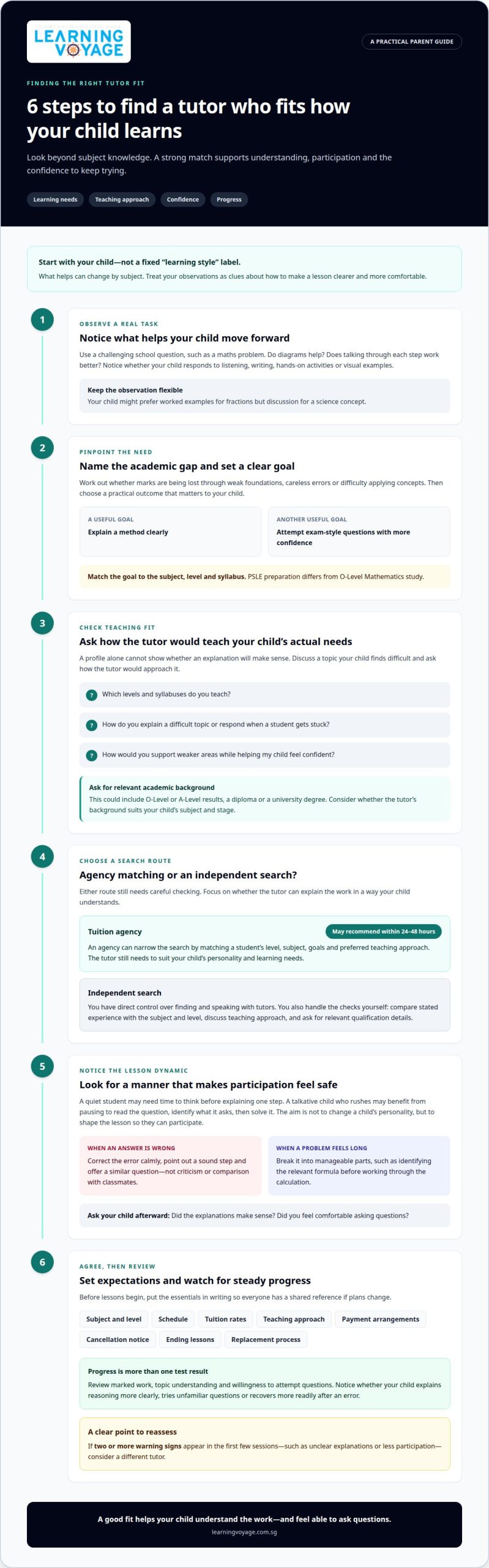
Start by observing how your child approaches a real task, such as a challenging maths question. Do diagrams help, or does talking through each step work better? Children may respond to listening, writing, hands-on activities or visual examples. Treat these as clues, not fixed labels: your child might prefer worked examples for fractions but discussion for a science concept. When finding a tutor that matches my child’s learning style, I start by noticing what helps them understand.
Next, identify the academic gap and set a clear goal. Is your child losing marks because of weak foundations, careless errors or difficulty applying concepts? Choose a practical outcome, such as explaining a method clearly or attempting exam-style questions with more confidence. Match the goal to the subject, level and syllabus. PSLE preparation differs from O-Level Mathematics study.
Before lessons begin, ask which levels and syllabuses the tutor teaches, how they explain difficult topics, and what they do when a student gets stuck. Ask how they would address your child’s weaker areas while supporting their confidence. Request details of relevant academic qualifications, such as O-Level or A-Level results, a diploma or a university degree. Consider whether the tutor’s background suits your child’s subject and stage.
2. Adapting to a child’s personality and confidence level
A child’s response to correction can show whether a tutor’s manner feels supportive. A quiet secondary student might understand a Mathematics method but hesitate to answer aloud. A patient tutor can allow time to think, then invite the student to explain one step. For a talkative child who rushes, the tutor can introduce a structured pause: read the question, identify what it asks, then solve it. The goal isn’t to change a child’s personality, but to shape the lesson so they can participate and learn.
Confidence often grows through small, specific successes. If a student freezes after a wrong answer, criticism can make them even more afraid to try. A tutor can instead point out which step was sound, correct the error calmly and offer a similar question. Manageable tasks help too. Faced with a long problem, a student might first identify the relevant formula, then work through the calculation. This steady approach helps families distinguish genuine understanding from copying a demonstrated solution.
Communication matters beyond the lesson. Ask your child whether they felt comfortable asking questions and whether explanations made sense. A tutor should welcome questions without pressure and use reassurance rather than comparison with classmates. For Singapore families balancing school demands, agree on a realistic schedule and discuss the teaching approach and tuition rates before lessons begin. If your child learns best through English explanations, confirm that instructions and discussion are clear to them. A good fit should leave room for effort and occasional struggle, while helping your child feel safe enough to keep going.
To check whether the tutoring is helping, look for changes over time: does your child explain their reasoning more clearly, attempt unfamiliar questions, or recover more readily after an error? These signs can help you and the tutor decide whether to adjust the pace or teaching approach, rather than judging progress by marks alone.
3. Agency screening compared with independent tutor searches
A tuition agency can narrow the search by matching a student’s level, subject, goals and preferred teaching approach. In Singapore, an agency may also recommend a tutor within 24-48 hours. This can save families time, especially when preparing for a major examination, but the match still needs to suit the child’s personality and learning needs.
When choosing a tutor, ask about their subject knowledge, teaching experience and approach to your child’s specific learning needs. Discuss how they respond when a student gets stuck, explain a concept in a different way or need more time to think. A tutor’s profile can offer useful background, but a conversation about a real topic your child finds difficult can show how clearly they teach.
Searching independently gives parents direct control over finding and speaking with tutors. It also means handling the practical checks yourself: compare the tutor’s stated experience with the subject and academic level, discuss their teaching approach, and ask for relevant qualification details. Clear communication matters. A polished profile alone cannot show whether a tutor can explain a difficult topic in a way your child understands.
Before lessons begin, agree on the essentials in writing. Include the subject and level, schedule, tuition rates, teaching approach, payment arrangements, cancellation notice and what happens if either side needs to end lessons. State whether a replacement is possible and how that process works; don’t assume every agency or independent tutor uses the same terms. This gives families a shared reference if plans change, while leaving the central decision clear: does the teaching help the student learn?
4. Matching a tutor to a child’s learning style and personality
Start with a real school task, then notice what helps your child move forward. A student who responds to visual examples might benefit from a tutor drawing particle diagrams before introducing Chemistry equations. A student who prefers discussion may grasp the same idea by explaining it aloud. These are useful clues, not permanent labels. A good tutor adjusts explanations when one method isn’t working.
Assess the approach through a trial session or an early lesson. Notice whether your child follows the explanation, attempts a question independently and feels comfortable asking for help. You can also ask them to explain one idea afterwards in their own words. A good fit should show through clearer understanding, better focus and growing confidence. Parents may notice these signs within 4-6 weeks.
A claimed match with a learning style isn’t enough on its own. Relying too heavily on labels can limit how a child explores new ways to understand a concept, and repeating one preferred method may not suit every topic. Look for responsiveness: does the tutor switch from a verbal explanation to a worked example when your child gets stuck? Choose for subject expertise, adaptable teaching and a respectful connection, then judge the fit by what your child can understand and do.
Learning Voyage Education Centre
Learning Voyage Education Centre is a next step for families seeking structured Mathematics support for a Secondary 3 or Secondary 4 student. If school lessons move quickly, or exam practice keeps exposing the same gaps, focused tuition can help the student revisit the concepts behind those errors. The aim is to build understanding and confidence alongside academic progress, rather than simply add more questions to complete.
For these levels, the centre offers Secondary 3 E-Mathematics Tuition, Secondary 3 A-Mathematics Tuition, Secondary 4 E-Mathematics Tuition and Secondary 4 A-Mathematics Tuition. The right subject depends on what your child studies and where they need support. For example, a student who understands a method in class but struggles to apply it to unfamiliar questions may need to strengthen the concepts behind each step.
Learning Voyage’s small-group coaching is tailored to the relevant syllabus, allowing for individual attention and interaction. Its Plug-the-Gaps technique is designed to identify and address specific learning hurdles. This can be relevant when a student’s difficulty is not simply completing enough practice, but understanding why a method works or where a solution went off course. Targeted support can make the route through a challenging topic feel more manageable.
Consider this option when your child needs help in one of the Secondary 3 or Secondary 4 Mathematics subjects listed above, especially if recurring gaps are affecting confidence or exam preparation. Share the subject, current challenges and learning goals so the support can relate to the student’s needs. Progress still depends on the student’s effort and the learning process, but clear explanations and attention to weak areas can provide a more purposeful way forward.
Please contact Learning Voyage Education Centre to discuss your child’s Mathematics tuition needs.
Frequently Asked Questions
What Actually Makes a Great Home Tutor?
A good tutor combines strong subject knowledge with clear explanations, patience and reliable communication. They should be able to show how they would teach a specific topic, such as guiding a student through a difficult algebra question without simply giving the answer. A good tutor also respects the child’s pace and keeps parents informed about lesson focus, effort and recurring obstacles.
What Makes a Good Home Tuition Agency?
A good tuition agency takes time to understand the student’s subject, academic level, goals and preferred learning environment before recommending a tutor. Ask how it screens tutors, what information supports its recommendations, and how it handles communication if a match is unsuitable. Clear terms for scheduling, cancellations and replacements also help families know what to expect before lessons begin.
What are common learning styles and how can I identify my child’s learning preferences?
Where can I find qualified tutors in Singapore, and how do I verify their credentials?
In Singapore, families can explore tuition centres, tutor-matching agencies and independent tutor listings. To assess a tutor’s credentials, ask for relevant academic certificates and details of experience teaching the child’s subject and level. Then discuss a specific syllabus topic and invite the tutor to explain how they would teach it. Clear answers help you judge both subject knowledge and teaching ability.