
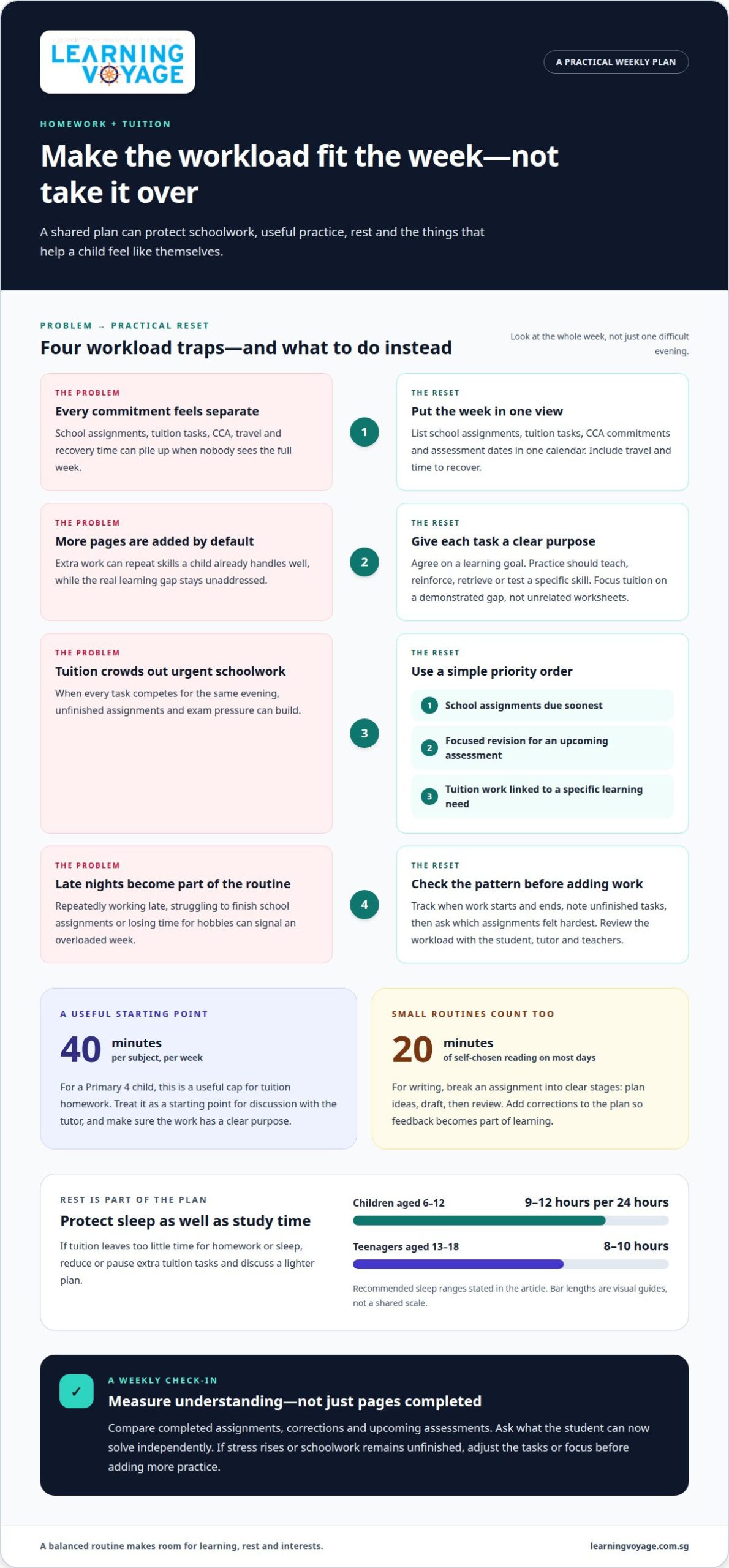
What if the answer isn’t more practice, but a better limit? A practical way to balance homework and tuition work is to plan the full week around school assignments, tuition tasks, CCA and rest. For a Primary 4 child, a useful cap is forty minutes per subject per week for tuition homework. Treat it as a starting point for discussion, and make sure the work has a clear purpose.
It’s understandable to worry that cutting extra work could slow progress, especially as exams approach. But a packed timetable can leave a child tired, frustrated and less able to learn confidently. This guide explains how parents and tutors can set shared goals, organise school and tuition workloads, and spot signs that a routine is too demanding. It also shows how to agree on a reasonable cap for tuition homework, so practice supports learning without taking over the student’s week.
Key Takeaways
- Keep school assignments visible and prioritise them before tuition tasks, while giving corrections a place in the weekly plan.
- Share progress between parents, teachers and tutors so support reflects the student’s strengths, learning gaps and full schedule.
- Watch for signs that study is crowding out rest, hobbies or confidence, and adjust the routine before fatigue builds.
- Agree with the tutor on what each task should teach and when extra Mathematics support or an Intensive Revision Workshop may help.
Parent-tutor communication and workload planning
In Singapore, start with a shared view of the week. Parents can list school assignments, tuition tasks, CCA commitments and assessment dates in one calendar. A student with CCA twice a week and two tuition classes may need a different plan from a peer with fewer commitments. Compare actual workload across the week, rather than judging it from one demanding evening. To understand how to balance homework and tuition work, include travel and recovery time too.
Agree on realistic academic goals with the student, taking strengths and learning gaps into account. Then share those expectations with teachers and tutors. For example, if a Mathematics assessment reveals difficulty with one topic, ask the tutor to focus practice there rather than add unrelated worksheets. Review the quality of existing homework before increasing its quantity. Useful work should teach, reinforce, retrieve or test a specific skill.
For support at school without arranging extra tuition, start with the child’s teachers. Opera Estate Primary School advises pupils to ask teachers for help when homework is difficult and parents to consult teachers about progress. Bring a specific example, such as a question the student could not complete. This gives the teacher a clearer picture of the learning gap and helps parents avoid guessing what support is needed.
Set a regular check-in with the tutor and compare completed assignments, corrections and upcoming assessments. Ask what the student can now solve independently, not only how many pages are finished. Some students may benefit from one or two targeted tutoring sessions per week, depending on their needs. Parents can revisit how to balance homework and tuition work if stress rises or schoolwork remains unfinished. Adjust tasks or focus before adding practice, so support stays manageable and purposeful.
Parents’ role in managing homework and tuition
A calm routine gives schoolwork a clear place without making every evening feel like a test. Opera Estate Primary School advises parents to check the Pupil’s Handbook daily and provide a well-lit, quiet study area. Let your child complete work independently where possible; offer help with understanding the task, rather than supplying answers. This builds ownership and helps parents see where support is genuinely needed.
To prioritise school homework, tuition assignments and tests, list the deadlines together and start with school assignments due soonest. Next, set aside focused revision for an upcoming assessment, then schedule tuition work that addresses a specific learning need. If a worksheet repeats a skill your child already handles well, consider whether a shorter, more purposeful task would be enough. Keep the plan manageable, not packed.
Reading and writing do not need to become long extra lessons. Set aside twenty minutes for self-chosen reading on most days, and break a writing assignment into clear steps: plan ideas, draft, then review. Short stages make progress easier to see. Include corrections in the plan so feedback becomes a chance to improve, not another pile of worksheets.
During exam preparation, adjust the routine around actual school deadlines and the child’s energy. Keep breaks and relaxing activities, such as reading or art, in the week. If tuition leaves too little time for homework or sleep, reduce or pause extra tuition tasks and discuss a lighter plan with the tutor. Children aged 6 to 12 are recommended to get 9 to 12 hours of sleep per 24 hours; teenagers aged 13 to 18, 8 to 10 hours. Protecting rest supports steady effort, not just last-minute revision.
Recognising when a student’s routine is unhealthy
A single late study session may happen, but repeated late nights deserve attention. In one Singapore example, a junior college student revises Chemistry until 1am. If your child regularly works that late, struggles to finish school assignments, or loses time for hobbies, review the actual weekly workload. Tuition should support preparation, not crowd out schoolwork, rest and personal interests.
Look for changes over several days, not just one difficult exercise. A student who delays starting, makes avoidable errors or becomes unusually upset over routine tasks may be tired or overwhelmed. Try this three-step check: note when work begins and ends, record unfinished tasks, then ask your child which assignments felt hardest. Compare the workload with assessment demands before adding practice.
Stanford education researchers found that, for high-achieving students, more than roughly two hours of total daily homework, including school and tuition work, was associated with more stress and health costs without achievement gains. Treat that finding as a reason to examine the schedule, not a target for every student. If preparation runs late or schoolwork spills into the next day, adjust the plan with the tutor.
Review whether tuition is helping the student learn without crowding out essential parts of daily life. Tuition can become counterproductive if it displaces homework, revision or rest, while homework and tuition can limit time for hobbies and interests, potentially affecting children’s creative and social development. If the routine causes stress or leaves little room for school assignments, rest or interests, discuss what to shorten or remove before adding more work. Review the arrangement after making changes, and involve the student in deciding which practice is useful.
Negotiating homework time caps with tuition providers
Begin with a seven-day timetable showing school assignments, tuition, CCA, meals and rest. Add each subject’s homework separately, including English, so one worksheet doesn’t hide the full workload. For a Primary 4 child, a practical starting cap is forty minutes per subject per week for tuition homework. Parents deciding how to balance homework and tuition work can use this cap to start a focused discussion, not fill every available evening.
There is no single daily total that suits every student. Plan around actual schoolwork, upcoming tests, CCA and the time needed to finish essential assignments without sacrificing rest. During exam preparation, schedule revision separately from new tuition tasks: both draw on the same limited time. A realistic routine leaves room for school responsibilities and recovery.
Bring the tutor one specific example: “English writing and school Mathematics are both due this week. Which tuition task best supports progress, and what can we pause?” Ask what each assignment is meant to teach, how progress will be assessed, and whether repeated exercises can be replaced with targeted practice. Agree on a weekly time cap, then review it against completed work and the student’s energy.
If the schedule still feels too heavy, identify the main source of pressure before cutting commitments. If tuition homework repeatedly delays school assignments, reduce or reshape that homework first. If CCA and tuition leave little room for rest, discuss which activity best supports the student’s academic goals, confidence and wellbeing. Cutting back is not automatic. Use the timetable and the child’s experience to choose a manageable adjustment, then see whether the new routine helps the student finish essential work with less stress.
Learning Voyage Education Centre: Intensive Revision Workshops
Learning Voyage Education Centre can help when exam preparation reveals gaps that regular practice has not resolved. Its Intensive Revision Workshops provide a focused revision option, while the centre’s Plug-the-Gaps technique is designed to identify and address specific learning hurdles. The aim is purposeful support, not simply adding more tasks to an already full week.
A workshop may suit a student who needs concentrated revision on challenging material or wants to strengthen understanding before an assessment. It works best within a realistic plan: set aside time for school assignments, agree on a tuition homework cap and protect time for rest. This gives revision a clear place in the timetable without displacing essential responsibilities.
For secondary students, the right Mathematics support depends on the subject and level of need. Learning Voyage Education Centre offers Secondary 3 A-Mathematics Tuition and Secondary 4 E-Mathematics Tuition or Secondary 4 A-Mathematics Tuition. These options may be relevant when a student needs ongoing help with a specific Mathematics syllabus, rather than a short period of broader revision. Parents can use recent assessments and difficult topics to clarify the learning priorities.
Before choosing between ongoing tuition and an Intensive Revision Workshop, consider what the student needs next: targeted help with a subject or focused revision for upcoming exams. Share the current workload and learning goals so the support fits the student’s routine. A steady plan can help students approach demanding material with greater confidence, without treating longer study hours as the only measure of progress.
For a conversation about suitable Mathematics support, contact Learning Voyage Education Centre.
Frequently Asked Questions
How to make a weekly study timetable for homework and tuition in Singapore?
Start with fixed commitments, such as school hours, CCA and tuition, then add assignment deadlines and test dates. Mark heavier school days first and schedule demanding revision on a less crowded day. Leave some open space for unexpected assignments or corrections. At the end of the week, review what was completed and reschedule unfinished tasks thoughtfully, rather than filling every free slot.
How can students use short breaks and study techniques to finish homework more efficiently?
Take a short break between focused work periods, then return to one clear task. For example, after solving a set of Mathematics questions, pause briefly before checking errors and noting the step that caused difficulty. For content-heavy subjects, try recalling key ideas without looking at notes, then use the notes to fill the gaps. This makes study active and helps students identify what still needs attention.