
A revision timetable can either steady you or make exam stress worse. If you’re wondering how to not get stressed for A levels, start with a plan that fits your actual week: include the papers you’re preparing for, focused revision blocks, other commitments and proper breaks. Feeling unprepared, worrying about results and trying to meet high expectations can all add pressure, so a packed schedule is rarely the answer. In Singapore, fitting revision around school and CCA commitments is a familiar source of student stress (The Straits Times).
It’s understandable to feel that every spare hour should go towards studying, especially when exams seem to shape what comes next. But sustainable revision is more useful than a punishing timetable. This article shares four practical ways to feel less stressed during A levels, from building a realistic schedule to taking outdoor breaks and dividing demanding topics into manageable tasks. You’ll also see how short study sessions, time to relax and room for hobbies can help revision feel more achievable. A timetable should leave space to adjust when a topic takes longer than expected, rather than turning one delay into a crisis. Think of the plan as a steady route through exam season, not another test you have to pass.
Key Takeaways
- Build a study schedule around exam dates and real commitments, with room for breaks, exercise and time off.
- Use outdoor walks, gentle movement or a simple breathing exercise to reset when revision feels intense.
- Break difficult topics into smaller tasks, then use timed practice to spot gaps and build exam confidence.
- If Mathematics revision feels hard to manage alone, targeted tuition can provide structured support with specific topics.
Creating a realistic study schedule
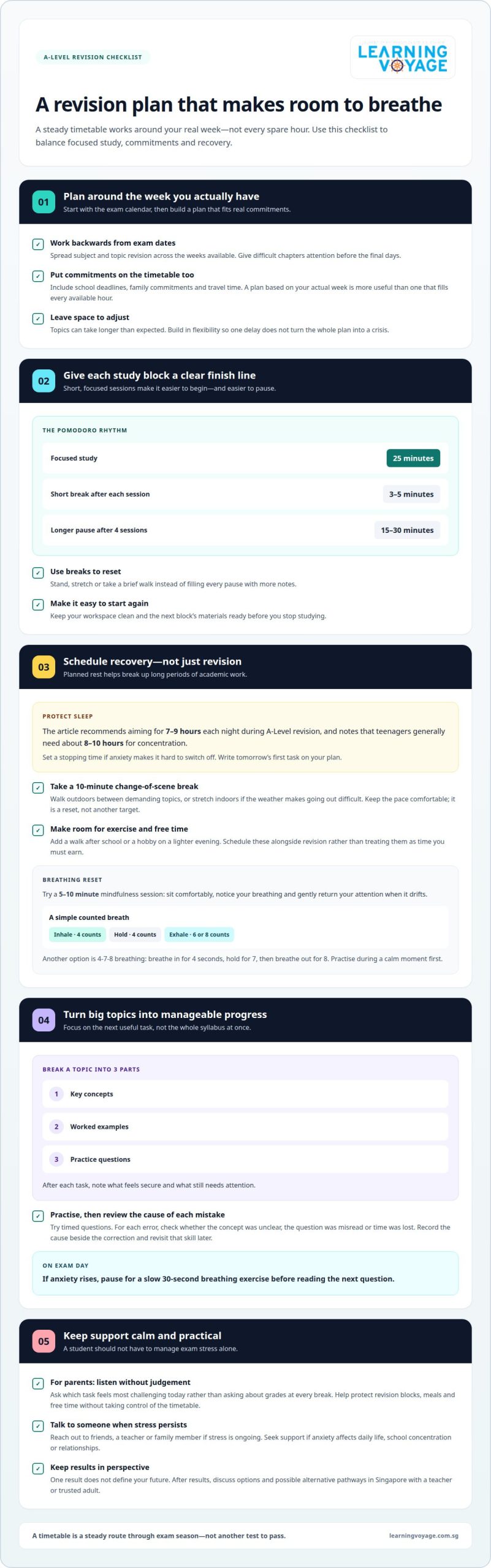
Learning how to not get stressed for A levels starts with a plan that fits your actual week. Begin with the exam calendar, then work backwards to assign revision blocks to each subject and topic. Spread preparation over the weeks available instead of leaving difficult chapters until the final days. Include school deadlines and family commitments, too. A timetable based on your real week is more useful than one that fills every available hour.
Protect sleep as part of the schedule, not as time left over. During A-level revision, aim for seven to nine hours each night; teenagers generally need about 8 to 10 hours per night for concentration. If anxiety makes it hard to switch off, set a stopping time and write tomorrow’s first task on your plan. Keep your workspace clean before and after studying, with the next block’s materials ready.
Parents can ease exam pressure by listening without judgement and making home a safe place to share worries. Instead of asking about grades at every break, ask which task feels most challenging today. Help protect planned revision blocks, meals and free time without taking control of the timetable. This support shows care while helping students keep academic goals in view and make room for rest.
Exercise and spending time outdoors
A short change of scene can interrupt the cycle of rereading notes while your concentration fades. Take a 10-minute walk between demanding topics, or stretch outside before returning to a difficult question. Light physical exercise gives your mind a pause from academic work and helps break up long periods of sitting. It doesn’t need to become another target to meet; a comfortable pace is enough to make movement part of a balanced revision day.
In Singapore, choose an outdoor break that feels practical for your day, such as walking near home or taking a quiet route after school. If the weather makes that difficult, stretch indoors or walk around your home instead. Add the activity to your timetable as a reset, not a reward you must earn by finishing every task. The point is to step away briefly, notice your surroundings and return with more attention for the next study block.
Try a 5-10 minute mindfulness session when worry is pulling your thoughts towards exam results. Sit comfortably, notice your breathing, and gently bring your attention back whenever it drifts. For controlled breathing, inhale for four counts, hold for four, then exhale for six or eight counts. Repeat at a comfortable pace. This simple sequence gives your attention a clear physical rhythm to follow.
You can also practise the 4-7-8 breathing technique: breathe in for four seconds, hold for seven, then breathe out for eight. Use it during a calm moment first, so the steps feel familiar if anxiety rises later. Pair the exercise with a small relaxation ritual, such as lowering your shoulders and unclenching your hands. These techniques offer a brief pause when revision feels intense, helping you return to the task more steadily.
Planning and breaking revision into manageable sections
Students wondering how to not get stressed for A levels can begin by turning broad subjects into smaller, clear tasks. For example, divide a Singapore-Cambridge A-Level topic into key concepts, worked examples and practice questions. After each task, note what feels secure and what still needs attention. This gives revision a clear direction when exam stress makes it difficult to decide where to start. Focus on one manageable step rather than judging your progress by the whole syllabus. The Straits Times has also covered exam stress among Singapore students, showing why manageable revision plans matter.
Use practice papers and exam questions to learn actively. Try a timed question, then review each mistake: Was the concept unclear, did you misread the question, or did you lose track of time? Record the cause beside the correction, then revisit that skill later. When brain fog makes familiar questions feel difficult, timed practice helps you rehearse starting, thinking and moving on. Treat errors as information for your next attempt, not a verdict on your ability.
If anxiety rises on exam day, pause and take a slow breath. A quick 30-second breathing exercise can help you refocus before reading the next question. For ongoing stress, talk with friends, a teacher or family member. Seek support if anxiety affects daily life, school concentration or relationships, rather than waiting until it becomes harder to manage.
Results anxiety may feel tied to a hoped-for university course, but one result doesn’t define your future. After results, discuss options and possible alternative pathways in Singapore with a teacher or trusted adult. Effective revision combines topic review, practice questions, careful correction and timed attempts. If you feel stuck, an Intensive Revision Workshop may offer focused practice. This can help you approach exam preparation with a clearer sense of direction.
Creating a realistic revision timetable
Start with the Singapore-Cambridge A-Level exam dates, then work backwards across the weeks available. Write each subject and its topics into a weekly plan, giving challenging areas attention before the final stretch. Add school deadlines, family commitments and travel time so revision fits around real life. The Straits Times has covered the pressure students face during exam periods, underscoring why a workable plan matters. A timetable should help you prepare steadily, not create pressure to fill every hour.
Give each study block a clear outcome, such as reviewing one concept or completing a set of practice questions. Schedule demanding topics for when you’re most alert, and alternate them with more familiar tasks. For example, follow a challenging Chemistry topic with correcting Maths questions. This change of pace can help you stay motivated while keeping your progress visible.
Review your timetable at the end of each week. If a topic took longer than expected, move a lower-priority task instead of extending every study day. Mark completed tasks, and choose the next week’s priorities based on the questions you found hardest. A helpful plan shows what you’ve achieved as well as what remains. It should guide your revision through a demanding period, not become another test to pass.
If you’re preparing for both the UCAT and A-Levels, schedule UCAT revision in July/August, then refocus on A-Levels in autumn. Keeping these phases distinct can make it easier to decide what belongs in each week’s plan and where to direct your attention next.
Learning Voyage Education Centre
Learning Voyage Education Centre can help when exam pressure is tied to unresolved Mathematics gaps. A study plan helps organise revision, but it may not explain why a concept still feels difficult or how to correct a repeated mistake. Learning Voyage’s small-group Mathematics tuition uses the Plug-the-Gaps approach to identify learning hurdles and guide students through challenging material alongside their own revision routine.
For students who feel anxious about keeping up with Mathematics, support is most useful when it targets the exact topics causing difficulty. Learning Voyage Education Centre’s small-group coaching encourages interaction and personalised attention, while its Plug-the-Gaps technique is designed to identify and address specific learning hurdles. This can give students a clearer route through a topic instead of leaving them to repeat questions without understanding where their reasoning went off track.
The suitable class depends on the student’s level and subject. Secondary 3 E-Mathematics Tuition or Secondary 3 A-Mathematics Tuition may help when a student needs support with those subjects. For Secondary 4 students, Secondary 4 E-Mathematics Tuition or Secondary 4 A-Mathematics Tuition may be relevant when difficult concepts or recurring errors are adding strain to exam preparation. These offerings focus on Mathematics learning, so they are not a replacement for support with anxiety that is affecting everyday wellbeing.
Parents can help by discussing the specific topics their child finds stressful, rather than treating every missed question as a lack of effort. A clearer understanding of the learning gap can make the next study step more manageable and help rebuild confidence gradually. Tuition can sit alongside a realistic timetable, rest and open conversations at home. If you’d like to discuss support, contact Learning Voyage Education Centre.
Frequently Asked Questions
Why do you get stressed in exam season?
Exam season can feel stressful when students worry about being underprepared, future choices, family expectations or personal goals. These pressures can build together, especially when a difficult subject seems tied to university plans. Stress may show up as irritability, frequent worry or trouble enjoying usual activities. Naming the main concern, such as fear of a particular paper, can help a student explain what support would be useful.
What study timetable works best for Singapore A-Level students?
The most useful timetable fits the student’s energy, school commitments and exam priorities, rather than copying a classmate’s routine. Choose one main academic priority for each study day, then rotate subjects across the week so none disappear from view. Keep a catch-up space for unfinished work. If a task slips, move it into that space instead of letting one delay overturn the whole plan.
What are signs that A-Level stress needs professional help?
Seek support when stress is persistent, feels unmanageable or disrupts daily life. Warning signs can include ongoing sleep problems, difficulty concentrating at school, frequent anxiety, low confidence or withdrawing from friends and family. Start by telling a trusted adult, teacher or family member what has changed, and ask for help finding appropriate professional support. Students don’t need to wait until exams are close to speak up.