
Strong A-Math results come from understanding what a calculus question asks, not just memorising rules. Mastering differentiation and integration in A-Math means recognising when to find a gradient or stationary point, when to reverse differentiation, and how to show each step clearly.
It is understandable if the rules feel like a lot at first. Differentiation questions may call for different methods, while integration involves decisions about constants and limits. With focused practice, these ideas become easier to distinguish and apply.
This guide explains how differentiation and integration are used in Singapore A-Maths, how to choose between the chain, product and quotient rules, and how to find and classify stationary points. It also covers essential integration methods and a practical way to revise with worked examples and practice, helping you approach exam questions with greater clarity and confidence.
Key Takeaways
- Choose the power, chain, product or quotient rule by looking at how the function is structured.
- Use the derivative to locate stationary points, then examine how the gradient changes to classify them.
- Connect calculus to curve sketching, area, trigonometry and motion to make sense of its A-Math applications.
- Build confidence through worked examples and focused practice, with tuition support available for Secondary 3 and Secondary 4 A-Mathematics.
When should I use the chain rule vs product rule vs quotient rule?
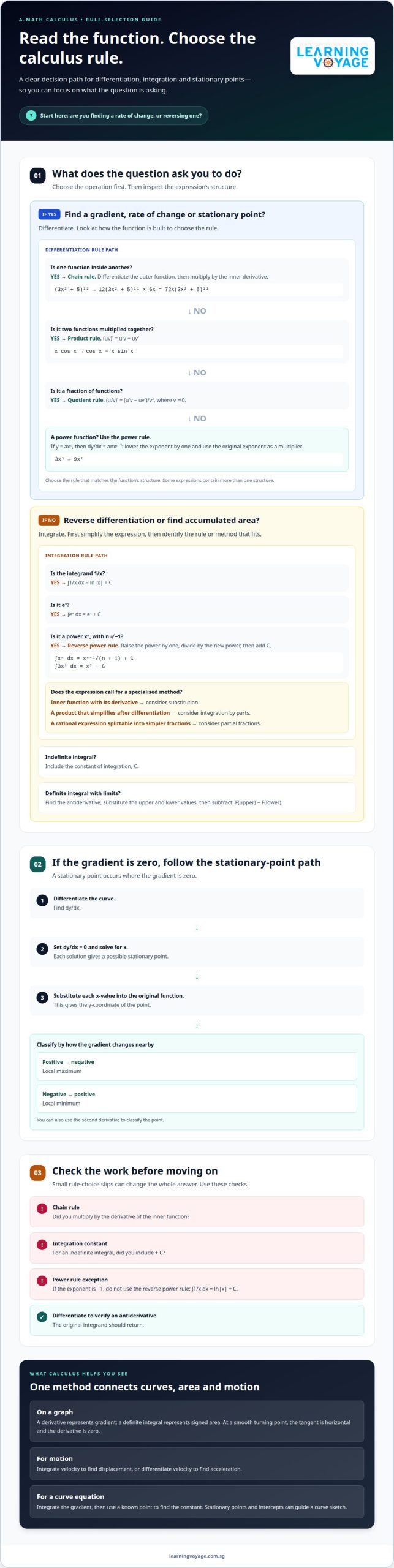
Start with the function’s structure. For a power function, use the power rule: if y = axⁿ, then dy/dx = anxⁿ⁻¹. For example, differentiating 3x³ gives 9x². The exponent decreases by one, while the original exponent becomes a multiplier. This rule helps students find rates of change used in curve geometry applications.
Use the chain rule when one function sits inside another. For (3x² + 5)¹², differentiate the outer power, then multiply by the inner derivative: 12(3x² + 5)¹¹ × 6x = 72x(3x² + 5)¹¹. Use the product rule for two multiplied functions: (uv)’ = u’v + uv’. For x cos x, the derivative becomes cos x − x sin x. The quotient rule handles a fraction: (u/v)’ = (u’v − uv’)/v², where v ≠ 0.
The main integration rules reverse differentiation. For n ≠ −1, the reverse power rule gives ∫xⁿ dx = xⁿ⁺¹/(n + 1) + C; for example, ∫3x² dx = x³ + C. Also, ∫eˣ dx = eˣ + C and ∫1/x dx = ln|x| + C.
For integration problems, first simplify the expression and identify the relevant rule. Integrate each term by raising its power by one and dividing by the new power, then add C for an indefinite integral. For definite limits, substitute the upper and lower values into the antiderivative and subtract.
A common differentiation mistake is forgetting the inner derivative in the chain rule. In integration, students may omit C or use the power rule when the exponent is −1. Check by differentiating the antiderivative: the original integrand should return.
How do I find stationary points using differentiation?
A stationary point occurs where the gradient is zero. Differentiate the curve, set dy/dx = 0, then solve for x. Substitute each solution into the original function to find its y-coordinate. To classify each point, check how the gradient changes nearby, or use the second derivative. A change from positive to negative indicates a local maximum; negative to positive indicates a local minimum.
For curve equations, reverse differentiation by integrating the gradient, then find the constant using a known point. For example, if dy/dx = 4x and the curve passes through (2, 10), integration gives y = 2x² + C. Substitution gives C = 2, so the equation is y = 2x² + 2. Plot intercepts and stationary points to guide a curve sketch.
Integration also connects curves with area. The area under y = x from x = 0 to x = 3 is 9/2 square units. For the region between y = x² and the line y = 4, the intersections are x = −2 and x = 2; integrate 4 − x² between these limits. Singapore 4049 and SEC K341 exclude finding area between two curves, so distinguish this concept from assessed requirements.
In kinematics, integrate velocity to find displacement, or differentiate velocity to find acceleration. Choose substitution when an inner function appears alongside its derivative; use integration by parts for a product that simplifies after differentiation. Partial fractions suit rational expressions that can be split into simpler fractions.
These concepts connect gradients, equations and motion through one method: identify what the question asks, then select the operation. For continued mathematics learning, explore guided maths support.
How Is Differentiation Applied in A-Maths?
Calculus links algebraic expressions to gradients, changing quantities and accumulated area. In Singapore, students meet these ideas in A-Mathematics and later develop them further in H2 Mathematics.
Calculus with Trigonometry and Coordinate Geometry
Calculus with trigonometry and coordinate geometry uses derivatives and integrals to analyse curves and changing values. For example, differentiating sin x gives cos x, the gradient at each point. In coordinate geometry, that gradient determines a tangent’s direction. Combining these topics helps students turn a graph or equation into a useful mathematical expression, rather than treating each technique as an isolated rule.
Visualizing Calculus with Graphs
A graph makes calculus visible: its gradient represents a derivative, while signed area represents a definite integral. At a turning point, a smooth curve has a horizontal tangent, so its derivative is zero. The fundamental theorem of calculus connects these ideas: if F′(x) = f(x), then the integral of f(x) from a to b is F(b) − F(a). This connection helps with interpretation and checking.
For Singapore’s A-Math pathway, SEAB’s syllabus documents state that syllabus 4049 runs through 2026 and SEC K341 applies from 2027. At A-Level, SEAB’s H2 Mathematics syllabus includes calculus. The 25-35% estimate for differentiation and integration in the 4049 papers is based on the combined 180 marks. For K341, SEAB’s syllabus assigns 35% to AO1, 50% to AO2 and 15% to AO3; Paper 1 is worth 90 marks and 50% of the assessment.
Build a six-week revision route: spend weeks 1-2 learning rules and practising basic differentiation and integration, including 20-30 differentiation questions. Use weeks 3-4 for basic applications, then weeks 5-6 for combined calculus applications. In each practice session, identify the topic, choose a strategy, solve, and review the working. These steps strengthen mathematics fluency and exam readiness.
A-Math exam revision and practice
Try a tangent-line problem with y = x³ − 3x at x = 2. The derivative is 3x² − 3, giving gradient 9; the point on the curve is (2, 2). Use y − 2 = 9(x − 2) to form the tangent equation. This tests differentiation, substitution and coordinate geometry in one question.
For integration practice, evaluate ∫(2x + 1)³ dx. Set u = 2x + 1, so dx = du/2. Integrating gives (2x + 1)⁴/8 + C. Differentiate your result to confirm it returns the integrand. Writing the substitution clearly helps prevent losing the factor from the inner expression.
Once individual methods feel secure, mix question types instead of practising the same rule repeatedly. Before solving each question, note the task in a few words, such as “find tangent” or “integrate composite expression.” Afterwards, identify the step where your approach succeeded or went wrong. Mastering A-Math differentiation and integration becomes more purposeful when practice addresses specific errors.
For focused revision support, explore an intensive revision workshop.
Learning Voyage Education Centre
Learning Voyage Education Centre offers mathematics tuition for students who need structured support with A-Math concepts and practice. This can be useful when differentiation rules feel disconnected, integration steps are difficult to choose, or exam questions combine several ideas. Small-group coaching is tailored to the syllabus, with opportunities for personalised attention and interaction as students work through challenging topics.
The centre’s Plug-the-Gaps method identifies learning gaps, explains the concepts clearly, and uses targeted practice and review to address them. For example, a student may know how to differentiate a power function but struggle to apply the result to a stationary-point question. Working through that missing link can make the next step clearer. Focused support can also help families respond constructively when repeated revision leaves a student frustrated or unsure where to begin.
For students strengthening their secondary mathematics foundation, Learning Voyage offers:
- Secondary 3 A-Mathematics Tuition
- Secondary 4 A-Mathematics Tuition
- Secondary 3 E-Mathematics Tuition
- Secondary 4 E-Mathematics Tuition
A-Mathematics tuition is the closest fit for students revising differentiation and integration. E-Mathematics tuition supports students studying that separate subject. The right level keeps tuition relevant to the student’s current studies, while clear explanations and guided practice help build confidence with questions.
If your child finds A-Math calculus difficult, contact Learning Voyage Education Centre to discuss small-group tuition and the next steps.
Keep building confidence beyond the next question
Progress in calculus comes from learning to make sound choices independently. As you practise, pause before each problem: what is changing, what must be found, and which relationship connects the information? This habit turns exam pressure into a sequence of manageable decisions and helps you recognise where another explanation or guided practice could help.
For students who would benefit from continued support with Singapore secondary mathematics, Learning Voyage Education Centre offers A-Mathematics tuition alongside E-Mathematics tuition. Its Secondary 3 and Secondary 4 A-Mathematics classes can support students as they strengthen their understanding and prepare for examinations. Mastering A-Math differentiation and integration is a process, and steady guidance can help students take the next step with greater confidence.
Contact Learning Voyage Education Centre to discuss the available tuition options. Each question you learn to approach with care is progress worth carrying forward.
Frequently Asked Questions
How many marks does calculus carry in O-Level / SEC A-Maths?
For Singapore’s O-Level Additional Mathematics syllabus 4049, differentiation and integration are estimated to account for 25-35% of the combined 180 marks, or about 45-63 marks. This is an estimate, not a fixed allocation for each paper. Syllabus 4049 runs through 2026, while SEC K341 applies from 2027. For K341, SEAB states that Paper 1 is worth 90 marks and contributes 50% of the assessment; that is the paper’s weighting, not calculus’s specific share.
What Differentiation Rules Must Students Know?
Students should know the power, chain, product and quotient rules, plus derivatives of standard trigonometric functions. These cover common forms such as powers, nested expressions, products and fractions. They should also practise implicit differentiation when an equation contains both x and y; for example, differentiating x² + y² = 25 gives dy/dx = −x/y. Match the rule to the expression’s structure before calculating.
What are the core rules of differentiation, with examples?
The power rule handles individual powers: the derivative of 5x⁴ is 20x³. For a product such as x²eˣ, differentiate one factor at a time and add the two resulting terms: 2xeˣ + x²eˣ. For a quotient, use the denominator squared and subtract the cross-products in the correct order. These examples help distinguish the rules before a question combines them.
How are differentiation and integration related by the Fundamental Theorem of Calculus?
Differentiation finds how a quantity changes, while integration accumulates that change over an interval. The Fundamental Theorem of Calculus links them: an antiderivative can evaluate a definite integral at its endpoints. For example, integrating 2x from 0 to 1 gives [x²]₀¹ = 1. This result represents signed accumulation, so a graph below the horizontal axis contributes negatively.
What are the best step-by-step methods for solving differentiation problems?
First, rewrite negative or fractional powers clearly, then identify whether the expression is a power, composite, product or quotient. Apply the matching rule and show the intermediate line before simplifying. If the question asks for a gradient at a point, differentiate first, then substitute the point’s coordinates. For an implicit curve, differentiate both sides with respect to x, treating y as a function of x.
What practice problems and solutions help master differentiation and integration?
Use varied questions that test both rule selection and checking. For instance, differentiate (2x − 1)⁵ to get 10(2x − 1)⁴. Then integrate e³ˣ to get e³ˣ/3 + C. Check the first answer by differentiating it again; check the second by differentiating the antiderivative. Keep an error log noting the rule or algebra step that needs more practice.