
The right chemistry tutor may not be the one promising the biggest grade jump. A better fit is a teaching format that helps a student ask questions, practise difficult concepts and build confidence steadily. For families weighing small-group chemistry tuition against one-to-one lessons, the choice depends on how the student learns, where they are getting stuck and how much guidance they need.
It’s understandable to want clear proof that tuition will help, especially when exam stress is rising. This guide explains how to assess tutor qualifications, read grade guarantees carefully, compare class sizes and decide whether individual attention should be a priority. You’ll also see how shared discussion differs from a lesson focused on one student, so you can choose support that fits your child’s needs rather than relying on a bold promise alone.
Key Takeaways
- Look beyond a tutor’s stated qualifications: consider how clearly they explain chemistry concepts and help students tackle challenging questions.
- Read grade guarantees carefully and focus on the teaching support behind any promised result.
- Choose small-group learning for peer discussion, or consider one-to-one tuition when focused individual attention is the priority.
- Match tuition to the student’s current level and exam needs so support can address learning gaps and build confidence.
Tutor qualifications and grade guarantees
A chemistry tutor’s academic record, teaching experience and grade promise answer different questions. Families weighing the options at Learning Voyage Education Centre can compare evidence of subject knowledge, familiarity with Singapore examinations and a clear plan for helping students improve.
Tutor Qualifications
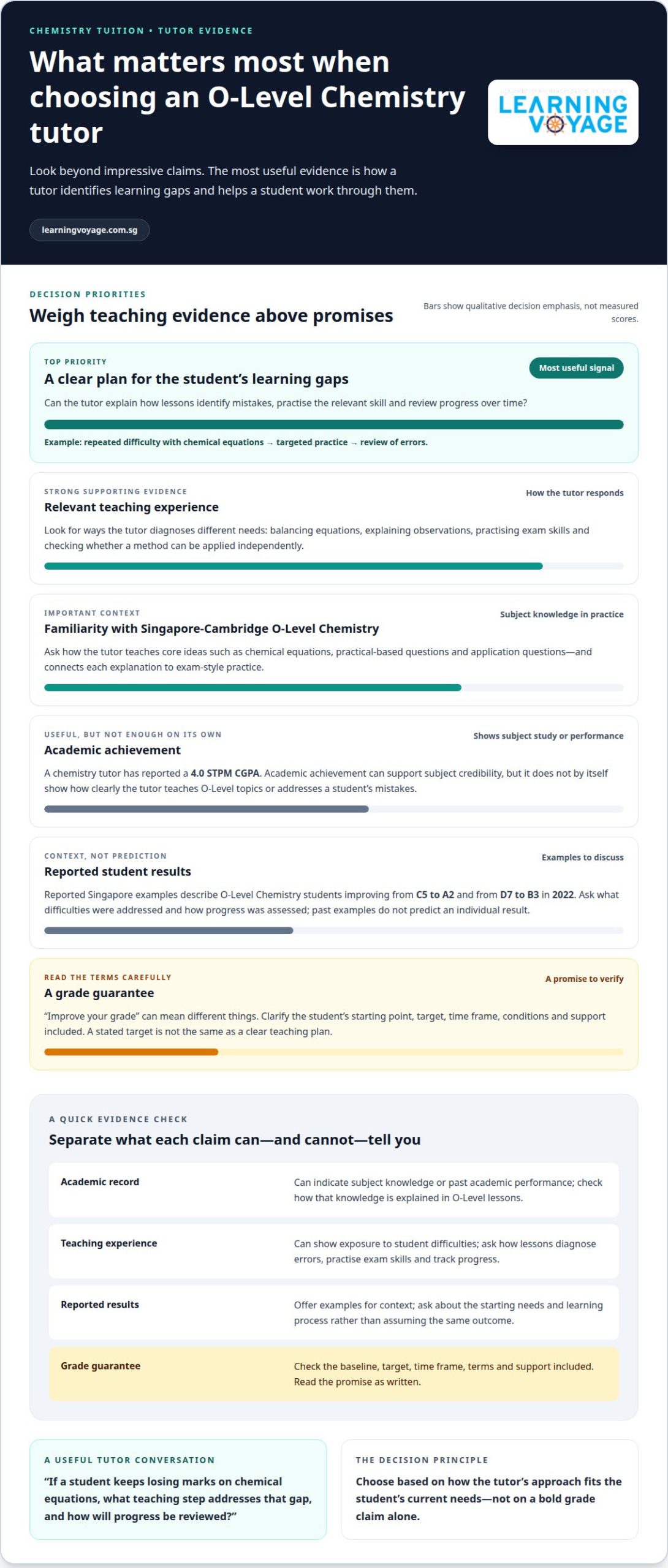
A qualification can show that a tutor has studied chemistry or achieved strongly in an academic programme. For example, a chemistry tutor has reported a 4.0 STPM CGPA. That result indicates academic achievement, but it does not by itself show how well the tutor teaches Singapore-Cambridge O-Level Chemistry or explains a student’s specific mistakes.
For an O-Level student, familiarity with the syllabus matters alongside subject knowledge. A tutor should be able to explain how they teach core ideas such as chemical equations, practical-based questions and application questions, then connect each explanation to exam-style practice. This shows how subject knowledge translates into useful learning support.
Tutor Experience
Experience is most useful when it shows how a tutor responds to different learning needs. One student may need help balancing equations, while another understands the method but loses marks when explaining observations. Ask how lessons identify these gaps, practise the relevant skills and review errors over time.
Reported Singapore examples describe O-Level Chemistry students improving from C5 to A2 and from D7 to B3 in 2022. These outcomes offer context, not a prediction for every student. Their value lies in prompting a more useful discussion: what starting difficulties did the tutor address, what learning process supported progress, and how was improvement assessed?
Be cautious about grade guarantees. “Improve your grade” can mean different things unless the starting point, target, time frame and conditions are clear. Instead of relying on a promise, ask how lessons identify learning gaps, monitor progress and support a student who is struggling with a topic. A clear teaching approach is more useful when comparing tutors.
Use this comparison to separate academic evidence from teaching evidence and outcome promises:
| Option | What it can show | What to assess | How it relates to a grade promise |
|---|---|---|---|
| Chemistry academic achievement | Subject knowledge or past academic performance | How the tutor explains Singapore O-Level topics | It supports credibility, but does not explain the improvement plan |
| Relevant teaching experience | Exposure to student questions and learning difficulties | How lessons diagnose errors and practise exam skills | Ask how progress is tracked against the stated target |
| Reported student results | Examples such as C5 to A2 or D7 to B3 in 2022 | The student’s starting needs and learning process | Past examples provide context, not an individual outcome |
| Grade guarantee | A stated target or condition | The baseline, time frame, terms and support included | Read the promise as written, not as a general assurance |
For example, if a student repeatedly loses marks on chemical equations, choose a tutor who can describe a teaching step for that gap and a way to review progress. This makes the decision more practical than comparing credentials or grade claims alone. The ideal chemistry tutor for a particular student at Learning Voyage Education Centre is one whose teaching approach addresses that learner’s needs. Families can use these criteria to consider how chemistry learning support fits a student’s current goals.
Class sizes and one-to-one options
Class format affects how a student asks questions, receives feedback and practises chemistry. Small-group lessons allow shared discussion, while one-to-one tuition focuses on one learner. Neither format suits every student. Consider the support needed, the student’s confidence speaking up and how lessons fit around school and revision.
In a small group, students can hear different explanations of the same concept. For example, one learner’s question about balancing a chemical equation may clarify a step another student missed. Explaining their reasoning also gives students practice beyond copying a worked solution. This format can suit a student who benefits from peer ideas and structured practice.
The trade-off is shared lesson time. A student who is unsure about a foundational idea needs to raise that difficulty before the group moves on. A quieter learner might understand the worksheet but hesitate to ask about a confusing step. Attentive guidance and opportunities to ask questions matter as much as the class format.
Individual attention also has limits. A student may have fewer chances to hear classmates’ approaches or compare explanations. The tutor also needs to notice when the student understands a method but cannot apply it independently. A useful session should include explaining a step, attempting a fresh question and reviewing errors, not just watching the tutor solve problems.
Use these signs to compare the formats with a student’s learning habits:
- Choose group discussion when the student is comfortable asking questions and can learn from classmates’ explanations.
- Prioritise focused attention when a student needs repeated guidance through a specific chemistry skill or has trouble speaking up.
- Consider lesson pace when the student needs time to explain working, correct errors and try a similar question independently.
- Factor in travel when a lesson’s journey would take substantial time away from revision or recovery.
For example, a student who can balance equations but struggles to explain reaction observations may benefit from practice focused on written reasoning. A student who is unsure how to start equations may need step-by-step explanations and feedback. These examples reflect different needs, not a rule that one format is always better.
Before settling on a format, map the student’s needs through three practical steps: identify the topics causing difficulty, note whether the student asks questions comfortably, and consider how travel affects the weekly routine. Then match the format to those needs. Families planning around school commitments can use the class schedules as part of that decision.
Consider learning gaps, confidence and need for feedback rather than treating either format as the default. A trial lesson can show whether the student has enough opportunity to ask questions, explain a method and practise independently. Afterward, consider whether the pace felt manageable and whether the tutor addressed confusion without taking over the work.
When searching for the best chemistry tutor hougang, experience and track record provide helpful context, but they cannot establish whether a particular class or tutor is right for one learner. Ask what the sessions involve, how progress is reviewed and how the student can raise a difficulty. The strongest choice is one that supports regular, active practice while fitting the student’s needs and schedule.
Learning Voyage Education Centre
Learning Voyage Education Centre offers Secondary 3 and Secondary 4 Pure Chemistry Tuition for students who need structured support with chemistry concepts and exam preparation. Its small-group coaching and Plug-the-Gaps technique focus on identifying learning hurdles and addressing them, helping students build understanding step by step. This can suit families seeking guided learning in Hougang, especially when a student needs help strengthening foundations or approaching O-Level questions with greater confidence. Explore the chemistry tuition in Hougang to see how this support aligns with your child’s learning needs. For a straightforward next step, contact Learning Voyage Education Centre.
Set a Steady Course for Chemistry Progress
Turn uncertainty into a clear learning plan. Before exam pressure builds, note which chemistry topics feel secure, which cause frustration and what kind of class setting helps the student speak up. These details provide a useful starting point for discussing learning support, rather than focusing only on a hoped-for grade.
Choosing the best chemistry tutor in Hougang means finding guidance that fits the student’s needs and helps them keep moving forward. Learning Voyage Education Centre can help families consider suitable chemistry support as students work towards their academic goals. A thoughtful decision can make revision feel more manageable and help a student approach challenging topics with greater confidence.
Contact Learning Voyage Education Centre to discuss the next step. Each student can build understanding at their own pace, one concept at a time.
Frequently Asked Questions
Do Hougang chemistry tutors offer trial lessons, group classes, or one-to-one tuition?
Options depend on the tutor or centre. Learning Voyage Education Centre offers trial lessons arranged in a suitable class, and its chemistry tuition is delivered in small groups. The centre’s format is group-based rather than private one-to-one tuition. A trial lesson can help a student experience the teaching approach and class environment before deciding whether the learning setting feels comfortable.