
A lesson package is only useful when its pace matches the student’s learning needs. Tuition centres and lesson structures vary, and many Secondary Chemistry programmes are conveniently located within a short walk of an MRT station, including options accessible for families searching for a secondary 4 chemistry tutor kovan. A dedicated Secondary 4 Chemistry tutor can help a student build understanding through concept review, question practice, and focused revision.
It’s understandable to want clear answers before committing: how long lessons run, what a package covers, and whether the support addresses the topics causing stress. At Learning Voyage Education Centre, this guide explains how to assess those details, compare teaching approaches, and understand revision support, so you can choose a learning routine that helps your child feel more prepared and confident for exams.
Key Takeaways
- Compare lesson length and package structure against your child’s focus, learning pace and revision needs.
- Look for teaching that connects chemistry concepts to worked examples and exam-style practice.
- Use revision support to identify topics that need attention and turn practice into a clear study plan.
- Consider travel convenience alongside teaching approach when choosing a Kovan tuition option.
Lesson duration and session packages
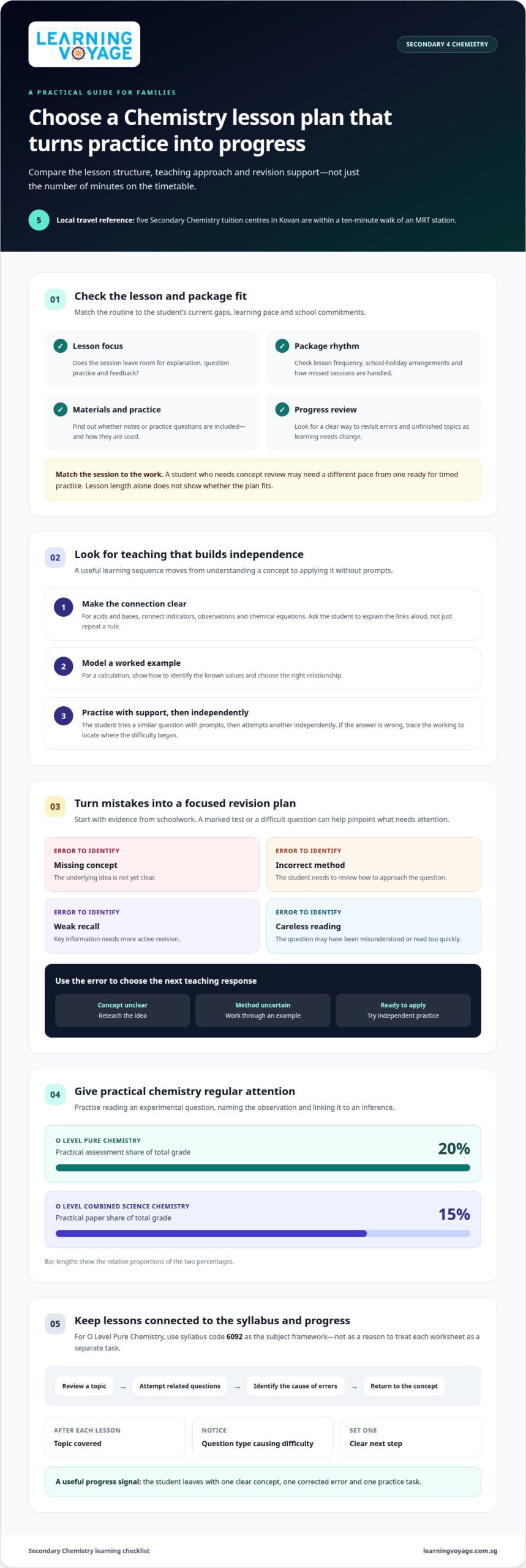
Lesson length matters because Secondary 4 Chemistry combines concepts, calculations and practical skills. A short session may suit targeted revision, while a longer lesson can leave room for explanation, guided practice and correction. There is no single duration that suits every student. Match the session to the work planned, not simply the number of minutes on a timetable.
In Kovan, five Secondary Chemistry tuition centres are within a ten-minute walk of an MRT station. That gives parents a practical way to compare travel time alongside teaching arrangements. A nearby lesson can make regular attendance easier during a demanding school term. Still, convenience should support learning, not replace a clear plan for each session.
Before choosing a package, identify the student’s immediate needs. For example, a student who understands chemical equations but struggles with calculations may benefit from lessons that set aside time for worked problems and correcting errors. Someone who has missed key ideas may need a concept review before timed practice. This simple assessment helps parents judge whether the pace is realistic.
Packages can differ in how lessons are scheduled and learning is organised. Read the terms as a whole: note lesson frequency, what happens during school holidays and how missed sessions are handled. Check whether lesson materials and revision activities are included. These details affect how consistently a student can follow the course, even when the timetable changes.
Use a short comparison checklist before committing:
- Lesson focus: Does each session balance explanation, practice and feedback?
- Package rhythm: Can the student attend consistently around school commitments?
- Learning materials: Are notes or practice questions included, and how are they used?
- Progress review: Is there a clear way to revisit errors and unfinished topics?
For O Level Pure Chemistry, syllabus code 6092 gives students a defined subject framework. A package should connect lessons to that framework rather than treat each worksheet as an isolated task. For instance, after reviewing a topic, a student can attempt related questions, mark each error by cause, then return to the concept behind the mistake. That sequence turns practice into learning.
When comparing a secondary 4 chemistry tutor in Kovan, focus on whether the lesson plan responds to evidence of progress. A student who repeatedly makes the same calculation error needs a different response from one who has forgotten definitions. Parents can keep a simple record after each lesson: topic covered, question type that caused difficulty, and one next step. WhatsApp notes can make that record easy to share at home.
Finally, judge a package by its continuity. Lessons should build from understanding towards independent exam practice, with time to revisit weak areas before they become larger gaps. If the student leaves each session with one clear concept, one corrected error and one practice task, parents can see how learning is progressing. That is more useful than session length alone.
Price can help narrow the options, but it does not show how much teaching time, practice or feedback a package provides. Compare the lesson rate with the schedule and included materials, and ask how the tutor responds when a student needs more time on a topic. A lower rate may suit a family’s budget, but the course still needs to match the student’s learning needs and school commitments. Check whether the stated rate applies to the lesson format you are considering, and clarify package terms before deciding. This keeps the comparison focused on what the student will receive, rather than on a single figure.
These figures provide a local reference point, not a measure of teaching quality or suitability. Use them to begin a comparison, then ask what each lesson covers, how practice is reviewed and whether the schedule can accommodate school demands. Consider whether the student benefits from a steady routine or needs a more flexible arrangement. The right package is one the student can attend consistently, with enough time to address current gaps, practise relevant questions and review mistakes. A clear explanation of the lesson plan and package terms can make the choice easier. Regular progress checks can also show whether the arrangement remains appropriate as the student’s needs change. Choose a package that supports learning over time, rather than deciding on price alone.
Teaching methods and revision support
Effective chemistry tuition makes difficult ideas clear, then helps students apply them. In a lesson on acids and bases, for example, a teacher might connect indicators, observations and chemical equations. The student can then explain each step aloud and attempt a related question. This reveals whether they understand the connections or have only memorised a rule.
For a Secondary 4 student, school notes and tuition should work together. Bring a marked test or a question that caused difficulty. Sort each error into a useful category: missing concept, incorrect method, weak recall or careless reading. That first step helps the teacher choose between reteaching, a worked example or independent practice.
Teaching should move from demonstration to independence. A tutor can first model a calculation, showing how to identify the known values and select the right relationship. The student then solves a similar question with prompts before trying another independently. If the final answer is wrong, tracing the working shows whether the problem began with the concept or the arithmetic.
Practical chemistry also needs deliberate revision. A student can practise reading an experimental question, naming the observation and linking it to an inference. For O Level Pure Chemistry, practical assessment accounts for 20% of the total grade. For O Level Combined Science Chemistry, the practical paper accounts for 15%. These parts merit regular attention, not a last-minute review.
A useful revision cycle can turn a mistake into a specific next action:
- Recall: Close the notes and explain the concept in the student’s own words.
- Apply: Attempt a question that uses the concept in a new way.
- Review: Mark the response and identify the exact point of confusion.
- Return: Revisit the error later, then try a fresh question without prompts.
For example, if a student confuses an observation with an inference, record both terms in a revision log. Write one experimental example under each, then practise separating what is observed from what it suggests. This targeted approach is more useful than copying an entire chapter again. It also gives parents a clear view of what the student is working to improve.
Choose a centre by examining how it responds to questions, mistakes and varied starting points. A trial lesson can help a student experience the pace and ask about an unfamiliar topic. Four of the five Secondary Chemistry tuition centres in Kovan offer a free trial lesson. During one, notice whether the student gets time to explain their thinking, rather than only copy solutions.
A secondary 4 chemistry tutor in Kovan should help students build a repeatable method: understand the idea, practise applying it, then review errors. Parents can support that method at home by asking the student to teach one concept back after each lesson. A calm explanation often exposes gaps that silent rereading can miss. For a structured route through Secondary Chemistry tuition, connect concept learning with revision and exam practice.
The student can describe what felt clear, where the pace became difficult, and which question still needs another explanation. Ask the tutor to show how a lesson would move from the student’s current understanding to a next step, rather than relying only on broad promises about results. At Learning Voyage Education Centre, the lead Chemistry tutor is described as having 8+ years of full-time Chemistry teaching experience. Consider that information alongside the student’s experience of the lesson: invite them to explain a method in their own words, and notice whether the tutor’s prompts help them reason rather than simply supply an answer.
Before choosing ongoing support, ask how progress will be discussed, what work the student should bring and how revision tasks can be adjusted when a concept remains uncertain. A useful arrangement should leave the student with a manageable task after each lesson, such as correcting a particular error or practising a type of question. Parents can also ask how the tutor distinguishes a gap in understanding from difficulty reading the question or showing working. This makes it easier to judge whether the support addresses the student’s actual needs. After the trial, the student can note what they understand better and what still feels difficult. Use those observations to discuss a suitable pace and focus, so tuition complements school learning and revision targets specific areas for improvement.
Learning Voyage Education Centre: Secondary 4 E-Mathematics Tuition
Learning Voyage Education Centre offers Secondary 4 E-Mathematics Tuition for students who need structured support with mathematical concepts and problem-solving. If algebraic manipulation or interpreting graphs is slowing a student’s progress in other subjects, strengthening those maths foundations can support more confident working across school tasks. For students taking Additional Mathematics, Secondary 4 A-Mathematics Tuition offers subject-specific support.
The right next step depends on the student’s learning needs: E-Mathematics tuition is relevant for core secondary maths, while A-Mathematics tuition suits students studying that subject. For a clearer picture of the available support, contact Learning Voyage Education Centre.
Take the Next Step with Confidence
Choosing a secondary 4 chemistry tutor in Kovan is one part of supporting a student through a demanding school year. The lasting goal is for your child to approach unfamiliar questions with a steadier mind, recognise where they need help, and keep building on each new understanding. Small, consistent steps can help exam preparation feel more manageable.
Learning Voyage Education Centre offers Secondary 4 E-Mathematics Tuition, Secondary 4 A-Mathematics Tuition and Secondary 3 A-Mathematics Tuition. These options may suit families seeking additional mathematics support alongside their child’s wider academic priorities. Take time to consider which subject needs attention now, and what kind of guidance will help your child move forward.
Contact Learning Voyage Education Centre to explore the next step. With patient effort and a clear course, your child can keep growing in confidence and capability.
Frequently Asked Questions
How should I choose a Chemistry tutor for a Secondary 4 student in Singapore?
Choose a Chemistry tutor who understands the student’s syllabus, identifies topic gaps and teaches them to apply concepts to unfamiliar questions. Ask how lessons tackle weak areas such as chemical equations or experimental questions, and whether the student can get help when confused. Learning Voyage’s Secondary 4 Pure Chemistry Tuition uses small-group coaching with 6 to 9 students per class. Trial classes are available for both maths and science, so the student can assess the teaching fit.