
A capable student who avoids studying isn’t necessarily lazy. The difficulty may stem from low confidence, work that feels too easy or too hard, stress, or trouble planning study time. If you feel your child is smart but lazy in studying, look beyond the label to understand what is getting in the way and what support could help.
It’s frustrating to see your child grasp ideas quickly but put off revision, especially when exams are approaching. Four possible reasons for this gap between ability and study habits are low confidence, a lack of meaningful challenge, wellbeing concerns, and difficulty planning. Practical responses include recognising progress, finding appropriately challenging work, checking in on how your child is feeling, and making study time easier to organise. Small, steady changes can help your child approach learning with greater confidence and independence.
Key Takeaways
- Replace labels like “lazy” with calm conversations about what feels difficult, then notice effort and progress as well as grades.
- Use your child’s interests and strengths to make learning feel more engaging, while offering a suitable level of challenge.
- Look for signs that worry, sadness, stress, or exhaustion may be affecting concentration, and respond with support rather than blame.
- Help your child break revision into manageable tasks and shape a realistic routine that includes time to rest.
1. Building a growth mindset and confidence
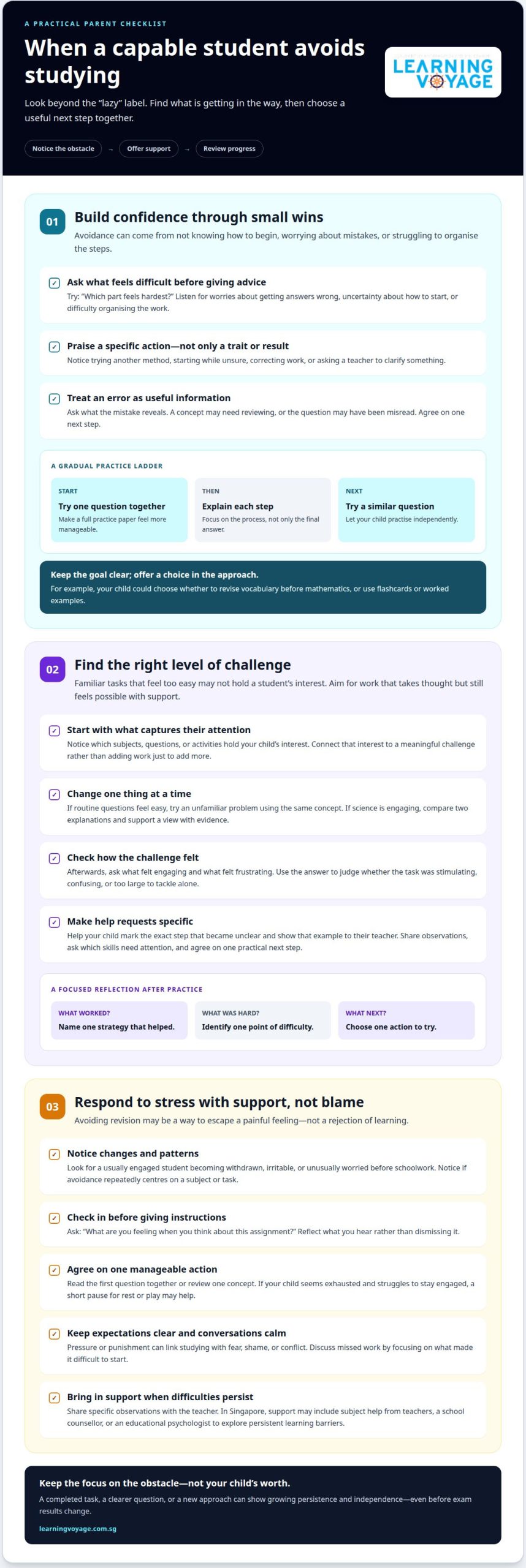
If you feel your child is smart but lazy in studying, pause before treating “lazy” as the explanation. A student who avoids a worksheet may worry about getting answers wrong, feel unsure how to begin, or struggle to organise the steps. Ask, “Which part feels hardest?” and listen before offering advice. Identifying the obstacle gives you and your child a problem to solve, rather than a label to carry.
Build persistence by praising a specific action, not a fixed trait or result. You might say, “You tried a second method after the first one didn’t work,” or, “You started revising even though you felt unsure.” This shows that progress comes from choices your child can repeat. When a mistake appears, ask what it reveals: perhaps a maths concept needs reviewing, or the question was misread. Treat the error as useful information, then agree on one next step.
Confidence grows through mastery: the work should require effort but remain manageable with support. If your child freezes at a full practice paper, start with one question together. Ask them to explain each step, then let them try a similar question independently. Recognise the process, such as showing working clearly, rather than praising only a correct answer. Small successes give your child evidence of what they can do.
Offer choices to strengthen your child’s sense of control. They might choose whether to revise vocabulary before mathematics, or whether to use flashcards or worked examples. Keep the learning goal clear while allowing the approach to vary. Notice effort in schoolwork, including starting promptly, correcting work, or asking a teacher for clarification. Reviewing one completed task calmly can help your child see persistence as a skill they can practise, not a quality they either have or lack.
2. Providing more challenging work in areas of strength
A student who finishes familiar tasks quickly may disengage when the work no longer sparks curiosity. Notice which subjects, questions, or activities hold your child’s attention, then connect that interest to a meaningful challenge. For example, a child who enjoys patterns might explore a harder mathematics problem and explain why each step works. The aim isn’t to add work for its own sake, but to find a level of difficulty that calls for thought without making progress feel out of reach.
Try one adjustment at a time. If your child finds routine questions easy, introduce an unfamiliar problem using the same concept. If they enjoy science, ask them to compare two explanations and support their view with evidence. Afterwards, ask what felt engaging and what felt frustrating. Their answers can help you judge whether the challenge is stimulating, confusing, or simply too large to tackle alone.
When difficulties persist, help your child ask for support with a specific question rather than saying only, “I don’t understand.” They could mark the exact step that became unclear and show that example to their teacher. Share your observations with the teacher, ask which skills need attention, and agree on one practical next step. A brief follow-up on that action helps connect support at home and school.
In Singapore, support may include subject help from teachers and conversations with school counsellors. Educational psychologists may help explore persistent learning barriers. Costs vary according to the type and format of support, such as subject coaching, counselling, or an assessment, as well as the time and scope involved.
Reflection turns a difficult task into useful information. After a practice question, invite your child to name one strategy that worked, one point that caused difficulty, and one action to try next. Keep the review focused on the work, not personal worth. If your child can explain a new approach or identify a precise question for the teacher, that shows growing independence, even before exam results change.
Anxiety, sadness, and stress affecting motivation
A student who avoids revision may be protecting themselves from a painful feeling, rather than rejecting learning. For example, a child who fears looking unintelligent might delay opening a mathematics paper, even when they understand the topic. Stress, sadness, grief, or anxiety can make concentration and enjoyment harder. Watch for changes in behaviour, such as a usually engaged student becoming withdrawn, irritable, or unusually worried before schoolwork.
Punishment or excessive pressure can deepen avoidance by linking study with fear, shame, or conflict. A threat over a test mark might lead a child to hide unfinished work instead of asking for help. It can also make grades feel like a measure of personal worth. Set clear expectations, but discuss missed work calmly and focus on what made it difficult to start.
Try a brief check-in before giving instructions. Ask, “What are you feeling when you think about this assignment?” Then reflect their answer without dismissing it: “It sounds like the test feels overwhelming.” Agree on one manageable action, such as reading the first question together or reviewing one concept. A short pause for rest or play may also help when your child seems exhausted and struggles to stay engaged.
Look for patterns rather than judging one difficult evening. If your child repeatedly avoids a particular subject, ask whether the work feels confusing, high-stakes, or connected to a recent setback. Share specific observations with the teacher, such as when the avoidance began or which tasks trigger worry. A school counsellor can help your child discuss emotional barriers. Persistent difficulty studying independently may also call for guidance from an educational psychologist. Needs can change as school demands and circumstances change, so revisit the plan if the same obstacles return.
4. Helping children budget study time
A study plan turns “revise more” into clear actions your child can start. Ask them to list assignments, upcoming tests, and topics to review. Then break a large task, such as revising algebra, into smaller steps: review a worked example, attempt practice questions, and mark difficult parts. Set a deadline for each task so your child can see what comes next instead of facing one overwhelming list.
Build the plan with your child, not for them. They might choose whether to tackle mathematics or science first, while you help decide which tasks need attention sooner. A planner or calendar can show school deadlines alongside family activities. When a teacher sets an assignment, record its instructions and due date straight away. This reduces last-minute surprises and gives your child practice taking responsibility for their own revision.
Consistent routines, a prepared study space, manageable tasks, and planned breaks can support motivation and focus. Clear away distracting clutter, keep needed books nearby, and let your child choose a realistic order for their work. Include rest and enjoyable activities so revision doesn’t take over the day. A routine should suit your child’s needs, rather than copy another student’s schedule.
Make checking schoolwork part of the routine: review the class website weekly or even daily, depending on what helps your family catch assignments. If homework repeatedly gets pushed late, set it as a priority before evening activities, rather than squeezing it in at 11 at night. When a task takes longer than expected, ask what interrupted progress and adjust the next plan. The aim is to learn from the schedule, not turn it into another source of blame.
At the end of a study session, ask your child what they completed and what remains. Add unfinished work to the planner and decide when to return to it. This simple review gives you both a clearer picture of progress while leaving room for sleep, play, and changing school demands.
Learning Voyage Education Centre: Secondary 4 E-Mathematics Tuition
Learning Voyage Education Centre can support a Secondary 4 student whose E-Mathematics study is being held back by gaps in understanding or difficulty applying concepts. Its Secondary 4 E-Mathematics Tuition uses small-group coaching and the “Plug-the-Gaps” technique to identify specific learning hurdles and work through them. This focused subject support can help when a student understands ideas in class but struggles to revise independently, tackle exam-style questions, or know where errors begin. Families can also explore Secondary 4 A-Mathematics Tuition, Secondary 3 A-Mathematics Tuition, and Secondary 3 E-Mathematics Tuition where those subjects match the student’s needs. A clearer grasp of the material can give revision a more manageable starting point, while consistent practice helps students build confidence in their own methods.
For details, contact Learning Voyage Education Centre.
Choose a next step that fits your child
Progress can start with a small shift: treat difficulty with studying as a signal to understand, not a verdict on your child’s ability. If you’re asking, “Is my child smart but lazy in studying?”, focus on what is making the next task hard to start, then choose support that matches the need.
For a Secondary 4 student struggling with Mathematics concepts or practice, Learning Voyage Education Centre offers Secondary 4 E-Mathematics Tuition and Secondary 4 A-Mathematics Tuition. Its Secondary 3 A-Mathematics Tuition may also suit a student whose current subject needs targeted support. These options can provide a more focused route through subject difficulties, while families continue building routines and confidence at home.
Exam pressure can make every setback feel larger, but a clear next step helps restore direction. If subject support feels like the right fit for your child, contact Learning Voyage Education Centre to explore the available Mathematics tuition. With patient guidance and steady effort, your child can keep moving forward at a pace that supports both learning and confidence.
Frequently Asked Questions
What is going on, if not laziness?
A child may be facing a barrier that makes studying hard to start or complete. They might lose track of materials, forget a teacher’s instructions, or feel unsure about a task with several steps. Notice what happens before they stop. For example, does your child begin a Secondary 3 worksheet but stall when questions require several lines of working? That detail can guide your next conversation.
Why might a smart child avoid studying?
A capable student may avoid revision when the work feels repetitive, confusing, or emotionally demanding. For example, a student preparing for an O-Level subject may understand class examples but dread unfamiliar practice questions. Ask what part they expect to find difficult, then listen for clues about boredom, uncertainty, or fear of making mistakes. Their answer can help you choose a more useful response than simply asking them to study longer.
How can parents tell whether a child is lazy or struggling with motivation, attention, or learning?
Look for patterns across subjects and settings instead of judging one unfinished task. Does your child lose track of instructions in several classes, or struggle mainly with one topic, such as algebra? Notice whether a clear first step helps them begin, and whether they can focus on an activity they chose. Share these observations with the teacher so the discussion starts with examples, not labels.
How can parents set a realistic study routine without nagging?
Agree on a simple routine and give your child a visible way to track it. For example, after unpacking their school bag, they can check the assignment list and choose a task to begin. Set a shared time to review what is done, rather than prompting after every step. This keeps expectations clear while giving your child a role in managing their own schoolwork.
When should parents seek help from a teacher, school counsellor, or educational psychologist in Singapore?
Seek support when difficulties keep affecting learning, daily routines, or your child’s wellbeing despite reasonable changes at home. For example, if your Secondary 4 student repeatedly avoids E-Mathematics practice, ask the subject teacher which skills or classroom tasks seem to be causing difficulty. A school counsellor can discuss emotional concerns, while an educational psychologist may help explore persistent learning barriers.
How can parents praise effort and build a growth mindset in children?
Describe a specific action your child took, such as checking a difficult answer or returning to a question after a break. Then ask what they learnt from the attempt. This connects progress to choices they can repeat, rather than suggesting ability is fixed. For instance, praise your child for showing their working clearly, even if the final answer still needs correcting.