
What if the key to solving a difficult Physics question isn’t memorising another formula, but understanding why it works? A parent searching for an upper secondary physics tutor may be looking for help that goes beyond extra worksheets. When concepts feel disconnected, students can struggle to apply them to unfamiliar problems, and exam pressure can make it harder to explain each step clearly.
Purposeful upper-secondary Physics tuition at Learning Voyage Education Centre should help students connect ideas, choose suitable methods and show their reasoning with greater confidence. This guide explains why Physics can feel challenging, how to identify a student’s learning needs and what useful practice can involve. It also covers how structured teaching and targeted support can help students build understanding at a pace that suits them.
With a clear approach, Physics can become more than a list of formulas to remember. Students can learn to move from the question to the reasoning behind an answer, one step at a time.
Key Takeaways
- Knowing Physics formulas isn’t always enough. Gaps in concepts, prerequisites and written working can all affect problem-solving.
- Build a clear route from the physical situation to the relevant principle, calculations and final explanation.
- Compare Pure Physics and Combined Science by their structure and learning priorities, while keeping the student’s current school syllabus in view.
- Use a repeatable study cycle: recall a concept, attempt a question, check the reasoning and revisit errors.
- Look for upper-secondary Physics support that responds to learning gaps and helps students practise with purpose.
Why Upper Secondary Physics Can Feel Difficult Even When Students Study Hard
A student can revise diligently, remember formulas and still freeze when an examination question is worded differently from the examples in class. That disconnect can frustrate the student and worry parents, especially when more practice seems to produce the same mistakes. The difficulty isn’t always a lack of effort. A student may be unsure which principle applies, how it connects to the situation, or how to show each step clearly.
Physics asks students to make these connections. The subject explores matter, motion, energy and forces; Physics is the natural science that studies matter, its motion and behavior through space and time, and the related entities of energy and force. In Singapore secondary Physics and GCE O-Level questions, students may need to interpret information, use relevant concepts and explain their reasoning. If an earlier idea is shaky, it can affect several steps in a later problem.
A learning gap is a specific missing link in understanding that stops a student from connecting a concept to the correct method or explanation. For example, a student might remember an equation but be unsure what its quantities represent. The calculation then becomes guesswork instead of reasoned problem-solving.
How to spot a Physics understanding gap
Look for patterns in marked work, not just the final score. Repeated errors in diagrams, explanations, units or choosing relevant details may point to a deeper issue. A forgotten fact may be addressed by reviewing it, but a misconception needs a different response. If a student repeatedly misunderstands what a force or description of motion means, that mistaken idea may affect several kinds of questions.
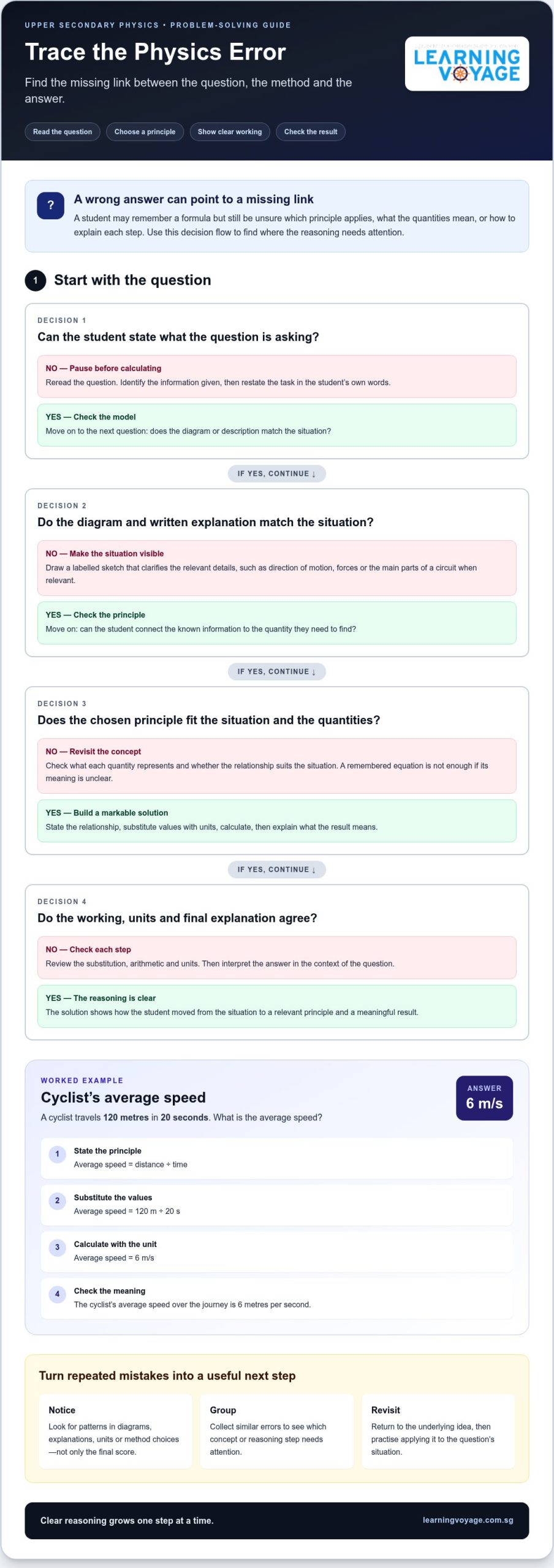
- Notice whether the student identifies what the question asks before choosing a method.
- Check whether diagrams and written explanations match the situation described.
- Group similar errors, then revisit the concept behind them.
This review helps students and parents move from “I got it wrong” to “I can see where my reasoning went off course.” That is a more useful starting point for targeted practice.
Why exam stress can make familiar questions feel unfamiliar
Examination questions may describe a familiar idea in an unfamiliar way. Students need to apply what they know, not just recognise a memorised example. Under pressure, rushed reading can hide an important condition or the quantity they need to find. A student may start calculating before deciding what the question is really asking.
Encourage a brief pause: reread the question, identify the information given, and state the task in the student’s own words before choosing a method. Confidence grows through small, observable gains, such as clearer diagrams, more complete working or fewer repeated errors. When considering Physics tuition, look for support that addresses the reasoning behind mistakes, not only the number of questions completed. Progress is built one clear step at a time.
How Upper Secondary Physics Reasoning Connects Concepts, Equations, and Answers
A strong Physics answer is more than a correct number. It shows how the student moved from the situation in the question to a relevant principle, applied that principle carefully and interpreted the result. This chain of reasoning makes problem-solving clearer and helps students pinpoint where an error has occurred.
A formula is useful only when its conditions and quantities are understood. Students need to know what each symbol represents, which measurements belong in the equation, and whether the relationship fits the situation. The Singapore-Cambridge O-Level Physics syllabus sets out a coherent understanding of energy, matter and their relationships, giving students a framework for connecting concepts to observations and calculations.
Move from a question’s wording to a suitable Physics model
Before calculating, identify what the question describes and what needs to be found. Separate the known values from the unknown quantity, then choose a concept that explains their relationship. A labelled sketch can clarify the situation. Depending on the question and the student’s syllabus, it might show the direction of motion, relevant forces or the main parts of an electrical circuit.
For example, a question states that a cyclist travels 120 metres in 20 seconds and asks for the average speed. The relevant relationship is average speed = distance ÷ time. Label the distance as 120 m and the time as 20 s before substituting. This helps students use the information for a reason, rather than treating the numbers as a cue to select any formula they remember.
Turn calculations into clear, markable explanations
Clear working gives each part of a solution a purpose. Students can state the relationship, substitute values with their units, calculate, and interpret the result in the context of the question. The reader can then follow the reasoning instead of having to guess how the answer was reached.
- State the principle: average speed = distance ÷ time.
- Substitute the values: average speed = 120 m ÷ 20 s.
- Calculate and include the unit: average speed = 6 m/s.
- Check the meaning: the cyclist’s average speed over the journey is 6 metres per second.
The final check matters. Speed is expressed as distance per unit of time, so m/s fits the quantities used. If the answer were written as 6 seconds, the units would reveal that something had gone wrong, even if the arithmetic looked neat.
Students can use this sequence for other suitable problems: identify the physical situation, select the principle, show the working and check the answer against the question. Guided practice can help them build these links and explain why a method fits, rather than relying on formula recall alone.
Pure Physics and Combined Science: What Students and Parents Should Understand
Two students can both be studying Physics and still have different course expectations. One may take Pure Physics as a standalone subject; another may study Physics as part of Combined Science alongside another science. The content, depth and assessment coverage may differ, so a practice question or revision plan that suits one student may not match the other’s course.
Tuition should match the Physics pathway a student is enrolled in, not just the subject name on a worksheet. This comparison offers general guidance, not a substitute for the student’s current school syllabus or examination requirements. Learning Voyage Education Centre provides Secondary 4 Pure Physics tuition, so the first step for any family is to identify the student’s course and learning needs.
How a student’s pathway shapes Physics study
A Pure Physics student studies Physics as a dedicated subject, while a Combined Science student studies it as part of a combined science course. This affects how students organise revision and which course materials guide their preparation. Don’t assume that the same worksheets, topic coverage or assessment expectations apply to both pathways.
Use the student’s school notes, course outline and current examination information as the reference point. If using a past paper or online resource, check that it aligns with the student’s subject and level. This simple step can prevent unnecessary confusion, especially when a student encounters a question that they haven’t been taught to answer in the same way.
Questions to use when assessing tuition fit
Parents don’t need to compare every detail of two courses to work out what support may help. Start with the student’s actual learning needs, then consider whether explanations and practice fit their enrolled pathway. Ask:
- Which Physics ideas or question types are difficult for the student in their current course?
- Are mistakes linked to a specific misconception, unclear working or uncertainty about what a question asks?
- Do the examples and practice materials align with the student’s school syllabus and level?
- Can the student explain why a method applies, rather than only recall a formula?
These questions turn a broad concern such as “Physics is hard” into a clearer picture of what needs attention. A student who understands the concept but struggles to explain their working may need different practice from one who is unsure of the concept itself. Matching support to that difference makes study more purposeful and gives families a clearer way to discuss progress.
Learning Voyage Education Centre’s Secondary 4 Pure Physics tuition is for students taking that pathway. When looking for an upper secondary physics tutor punggol families trust, use the student’s school course as the guide to ensure the learning focus is relevant. Suitable support should help the student build understanding in line with their enrolled pathway, without adding pressure to follow a course that isn’t theirs.
A Practical Physics Study Routine for More Confident Problem-Solving
Revision is more useful when each question has a purpose. Instead of rushing through a stack of problems, students can use a steady cycle: recall the idea, attempt a suitable question, check the reasoning, then revisit any error. The aim isn’t to prescribe a number of study hours or promise a particular grade. It’s to make practice regular and learn something from it.
Start by reviewing the relevant class notes, then try to recall the key concept without looking. Attempt a question that uses it. After checking the answer, consider the method as well as the result: did the chosen idea fit the question, and does the working make sense? If not, identify where the reasoning went off track. Keep a brief record so recurring difficulties don’t get lost among completed worksheets.
Review mistakes so each practice question teaches something
An error log turns marked work into a guide for what to practise next. For each question, note the concept tested, where the reasoning broke down and what to try differently. Avoid writing only “careless mistake”; name the step that needs attention. This makes it easier to choose useful follow-up practice.
- Knowledge gap: the student couldn’t recall or explain the relevant idea.
- Misread instruction: a condition or requested quantity was missed.
- Calculation slip: the method was suitable, but the arithmetic or unit was incorrect.
- Incomplete explanation: the answer lacked a clear reason or final interpretation.
After correcting an error, try a similar question later without copying the earlier solution. Being able to explain the approach and apply it again is stronger evidence of understanding than simply remembering the answer.
Build a steady revision rhythm around school learning
Use class learning as the anchor. Review notes after a lesson, practise questions on the topic and return to earlier ideas as they reappear in schoolwork. Include both focused topic practice and mixed questions. The first builds familiarity; the second asks students to decide which approach fits. Adjust the routine to the student’s school workload so revision remains manageable and consistent.
Learning Voyage’s Plug-the-Gaps approach focuses on identifying and addressing learning hurdles in Maths and Science tuition. Families can explore its targeted learning-gap support to see how identifying specific gaps can guide more purposeful practice.
Before handing in a Physics answer, pause for a quick check:
- Have I identified what the question asks me to find?
- Does my chosen concept or method fit the situation?
- Are my working, labels and units clear?
- Have I answered in context and checked whether the result makes sense?
Small habits like these give students a calmer way to approach practice. They also help parents notice more than a mark: clearer working, better explanations and a more deliberate method.
How Learning Voyage Supports Upper Secondary Physics Students
When a student studies hard but still feels uncertain, the next step isn’t always more questions. The student may need help identifying what is getting in the way, followed by a clear route to practise and ask questions. Learning Voyage provides Secondary 4 Pure Physics tuition as part of its Maths and Science support, with teaching aligned to the relevant syllabus.
Classes have 6 to 9 students. In this small-group setting, students can hear different questions and explanations, compare approaches and take part in discussion. These interactions can help bring unclear concepts to light, while each student continues to build their own understanding through practice. Small-group coaching supports active learning, but it does not guarantee a particular grade.
Customised teaching and in-house practice questions give students opportunities to work on relevant concepts and apply their understanding. A student who is unsure about a basic idea may need to revisit it; another may be ready to practise explaining answers or applying concepts to questions. A suitable pace helps students build confidence without treating every learner’s needs as identical.
What the Plug-the-Gaps approach means for Physics learning
In Learning Voyage’s Maths and Science tuition, the Plug-the-Gaps approach identifies and addresses specific learning hurdles. For a Physics student, a gap might involve an unclear concept or a mistaken understanding that affects later work. Identifying the hurdle gives practice a clearer purpose: students can return to the idea causing difficulty before it creates further confusion across related concepts.
Families can learn about the Plug-the-Gaps teaching approach and how targeted gap identification supports Maths and Science learning. It helps make practice more focused, but it is not a promise of a particular examination result.
What families can do next
Start with the student’s current needs: which ideas feel secure, where does their reasoning become uncertain, and what kind of practice might help them take the next step? Then consider whether the learning approach and subject pathway fit the student’s school course. Learning Voyage’s Secondary 4 Pure Physics tuition provides structured support for students taking that pathway.
Trial classes are available for both Maths and Science. A student seeking Physics support can experience a science trial class, while the family considers how the teaching and practice feel. A trial is a chance to explore the learning approach, not a prediction of future grades. If structured Physics learning feels like the right next step, arrange a science trial class and begin with the student’s current learning needs.
Take the Next Step with a Clear Purpose
A student’s next step doesn’t need to be dramatic. It can begin with noticing what feels uncertain, choosing one question to work through carefully and making space to ask for help. That shift matters: instead of treating a difficult result as proof that Physics is beyond reach, students can use it to decide what to practise next.
When searching for an upper secondary physics tutor punggol, focus on the kind of learning environment that helps your child engage with Physics and build confidence at their own pace. Look for support that makes room for questions, explains the reasoning behind methods and helps students work through specific learning hurdles.
If you’re ready to explore a supportive next step for your child, arrange a trial class. Learning Voyage offers trial classes for both Maths and Science, giving students and families a chance to experience the learning approach and consider whether it suits their needs.
Frequently Asked Questions
Is upper secondary Physics difficult for students who did well in lower secondary science?
It can feel like a big adjustment, even for a student who previously did well. Upper secondary questions may ask students to connect ideas and explain how they reached an answer, not just remember facts. A student might understand a class demonstration but feel unsure how to use the same idea in a written problem. That uncertainty is a reason to identify what needs practice, not proof that the student can’t learn Physics.
Can Physics tuition help if a student has already fallen behind?
Structured support can help a student work out which parts of the subject need attention first. Recent marked work can provide a useful starting point: choose a question where the student lost confidence and unpack it step by step. Rather than trying to revisit everything at once, focus on the specific hurdle and connect practice to current school learning. Progress depends on the student’s needs and continued effort; no grade can be guaranteed.
How can parents tell whether a Physics mistake is a concept gap or a careless error?
Ask the student to explain their approach, then offer a similar question to try without prompting. If the same mistaken idea shapes both attempts, they may need to revisit the concept or how it applies. If they can explain the method but copy a value incorrectly, the issue may be an execution slip. Look for patterns across work, since one error alone may not show the cause.
What should a student bring to a first Physics tuition class?
Bring recent school notes, assignments, test questions and marked work that show what the student is studying. Choose a few questions they found confusing and identify the exact step where they became unsure. Include questions answered correctly too, especially if the student can’t explain why the method worked. This gives the discussion a practical focus and helps the student describe their experience in their own words.
Should students memorise Physics formulas before attempting practice questions?
Students should learn the relevant formulas, but memorising them alone won’t show which one fits a question. A useful revision method is to write down what each quantity means and its unit, then consider what the question describes before choosing a relationship. After working through a problem, check whether the answer and unit make sense in context. This builds more flexible use of formulas than copying them repeatedly.
Are trial classes available for Physics students?
Learning Voyage offers trial classes for both Maths and Science. A student seeking Physics support can attend a science trial class to experience the learning environment and discuss areas where support may help. Enrolment can be started by calling, messaging or completing the online form. A trial is a practical first step, not a promise of a particular examination result.