
If you searched for upper secondary chemistry support, you may be trying to find help that aids your child in understanding where Chemistry gets difficult. Secondary 3 Chemistry can feel like a sharp step up, especially when topics such as the mole concept and stoichiometry ask students to connect ideas, show each step and explain their reasoning. When answers keep going wrong, it can be hard to tell whether your child needs tuition or a clearer plan for independent revision.
That uncertainty is understandable. More practice alone may not help if a student is unsure which concept they’ve misunderstood, and repeated mistakes can quickly shake their confidence. Useful support should make the thinking behind each answer clearer, not just add more questions to complete.
This guide will help you assess a tutor’s teaching approach, classroom interaction and preparation for school assessments, so you can make a choice based on fit rather than big promises. Learning Voyage Education Centre provides Secondary 3 Pure Chemistry tuition using its Plug-the-Gaps technique to identify and address learning hurdles in Science. Classes have 6 to 9 students, and a Science trial class offers a low-pressure way to experience the teaching. The aim is a steadier course towards understanding, confidence and your child’s next academic steps.
Key Takeaways
- Look for teaching that helps your child explain their reasoning, not just complete more Chemistry questions.
- Compare tuition by the clarity of explanations, useful feedback and opportunities for students to take part.
- Choose a Sec 3 Pure Chemistry tutor based on how well the teaching suits your child’s learning needs.
- Review progress by noticing a difficulty, practising a related task and listening to how your child explains their thinking.
- Explore how Learning Voyage’s Secondary 3 Pure Chemistry tuition and small-group setting could fit your child’s next steps.
Why Secondary 3 Pure Chemistry can feel like a step up
Your child may follow the teacher’s notes, then freeze when asked to explain the same idea without them. That can be frustrating for both of you, especially when a test is approaching and revision seems to be happening. It doesn’t automatically mean your child needs tuition. It may mean there’s a particular concept or skill that hasn’t settled yet.
Secondary 3 Pure Chemistry asks students to do more than remember terms. They need to connect ideas, use them in unfamiliar questions and express their reasoning clearly. Topics such as stoichiometry and experimental chemistry call for careful thought: a student may need to interpret information, choose a suitable method and show how the answer follows. The steps can feel unfamiliar at first, even for a student who has been attentive in class.
A learning gap is a specific missing concept or skill that prevents a student from making progress with the next step. Naming the difficulty this way is more useful than deciding that a student is “bad at Chemistry”. It gives parents and students a clearer point to work on.
How Pure Chemistry asks students to connect ideas
In earlier science learning, recalling a definition may sometimes be enough to answer a question. Pure Chemistry increasingly asks students to use concepts as part of an explanation. They might need to connect a calculation to the information given, or explain what an observation suggests rather than simply record what they saw. These demands reflect broader Chemistry education principles, which include helping learners understand how to apply ideas, not only remember them.
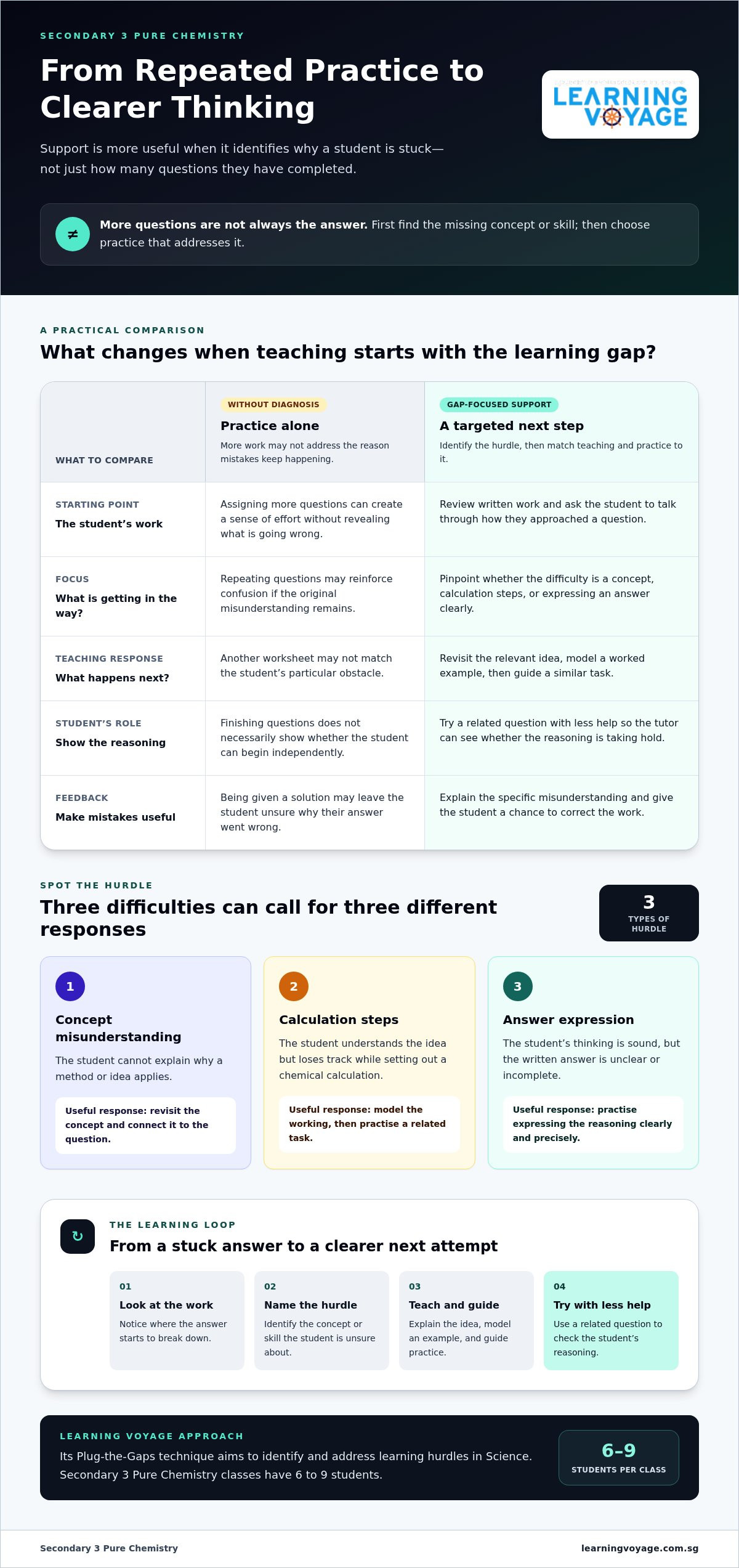
It helps to identify what kind of difficulty is getting in the way. If a student can’t explain why a method applies, the issue may be a concept misunderstanding. If they understand the idea but make errors while setting out a chemical calculation, they may need practice with the steps. If their thinking is sound but their written answer is unclear or incomplete, the challenge may be answer expression. Each calls for a different response, so simply assigning more worksheets may not address the real obstacle.
Signs a student may need more structured support
Look for patterns across marked work rather than reacting to one disappointing test. Does your child repeatedly struggle to explain an answer, connect related ideas or use feedback to correct a similar mistake? Do they understand a solution after it’s explained but find it hard to begin the next question independently? These observations can point to where more guided practice may help, without labelling the student or assuming tuition is necessary for everyone.
Try reviewing a few pieces of marked work together. Ask your child to talk through one answer: What was the question asking? Which idea did they use? Where did they become unsure? Listen without turning the conversation into another test. If they can explain the reasoning aloud but struggle to write it, that’s useful information. If the explanation itself breaks down, you may have found a concept to revisit. This gives you a calmer basis for deciding whether independent revision is enough or whether more structured support could help.
What effective Sec 3 Pure Chemistry teaching should help students practise
More worksheets can create the feeling of hard work without fixing the reason a student keeps getting stuck. Effective Chemistry support should make the student’s thinking clearer: what they understand, where their reasoning slips and what to practise next. That distinction matters when exam pressure is building. Repeating questions without understanding a mistake can reinforce confusion instead of building confidence.
A useful lesson starts with evidence. The tutor can look at a student’s written work and ask them to explain how they approached a question. Perhaps they recognise a key term but can’t connect it to the question. Perhaps they understand the concept but lose track of a calculation step, or know what they mean but struggle to express it precisely. These are different hurdles, and each points to a different next step.
From identifying a gap to practising a stronger explanation
Once the sticking point is clearer, a tutor can reteach the relevant idea, model a worked example and guide the student through a similar task. The student then tries a related question with less help, so the tutor can see whether the reasoning is taking hold. Feedback should identify the specific misunderstanding, explain why it affects the answer and give the student a chance to correct their work, not simply supply the solution.
Learning Voyage uses its Plug-the-Gaps technique in its Maths and Science tuition to identify and address learning hurdles. The principle is practical: pinpoint what is missing, then focus practice on that need. Learning Voyage’s Plug-the-Gaps approach reflects why clear diagnosis matters in learning, while Singapore’s Chemistry education initiatives highlight the value of strong teaching knowledge and collaboration in Chemistry education.
Why Chemistry answers need clear reasoning
A sound answer does more than include scientific vocabulary. The terms need to be accurate and connected to the question, so the reader can follow the explanation. In a calculation, showing the working makes the method visible and easier to check. In practical questions, students may need to distinguish what they observed from what they infer, then explain how the evidence supports their conclusion. These habits help turn remembered facts into usable understanding.
Strong Chemistry answers combine sound concepts, accurate working and clear written explanations. Practising all three gives students a way to check their own thinking, rather than relying on whether an answer simply looks familiar. Parents can listen for that progress too: can the student describe why a method fits, spot an error and explain how they would correct it?
If your child would benefit from guided Chemistry practice, you can explore Secondary Science tuition. The aim is not to promise a particular grade, but to help the student build understanding and confidence through more purposeful practice.
How parents can compare Pure Chemistry tuition options
A confident choice starts with your child’s actual learning needs, not with promises about grades. Compare how a class explains ideas, responds to mistakes, encourages student participation and fits the difficulty your child is facing. A useful clue comes after the lesson: can your child explain the key idea more clearly, or describe what they’ll try differently next time?
For parents searching “sec 3 pure chemistry tutor serangoon,” the same practical criteria apply: look for clear explanations, specific feedback and opportunities for your child to participate. The Singapore Upper Secondary Chemistry Syllabus can also help families understand the subject’s scope and learning aims. Use it as context when considering whether tuition supports Chemistry learning, rather than as a checklist for judging a tutor from one lesson.
| What to compare | What to look for | Why it matters |
|---|---|---|
| Explanation | Ideas are broken into steps, with links between concepts made clear. | A student can understand why a method works, not just copy it. |
| Feedback | Mistakes are explained, and the student gets a chance to correct them. | Feedback becomes a learning tool rather than a mark on the page. |
| Class interaction | Students have opportunities to follow explanations, attempt questions and raise doubts. | Taking part can help reveal uncertainty that may stay hidden during silent practice. |
| Fit with learning needs | The lesson approach matches the student’s current challenge, whether conceptual, calculation-based or related to exam stress. | Support is more purposeful when it addresses the right hurdle. |
Questions that reveal how a tutor teaches
Focus questions on what happens during learning: How does the tutor identify a misunderstanding? What happens after a student makes an error? Is there time for concept explanation, guided practice and student questions? These prompts help you understand the teaching process without relying on promised grades. Notice whether the answers describe a clear way to help students think through Chemistry, not simply a larger volume of practice.
Match the support to the student’s current challenge
For a concept gap, look for clear explanations and chances for your child to restate the idea. For difficulty with calculations, consider whether lessons guide students through working and respond to errors in method. If exam anxiety is the concern, calm practice and encouragement may help your child approach questions with greater confidence. None of these approaches guarantees a particular result; they help you assess whether the support feels relevant and constructive.
Class size is one part of that comparison, not a promise of individual outcomes. Learning Voyage’s Chemistry classes have 6 to 9 students per class, a small-group format that supports attention and interaction. Tuition isn’t only for students who are failing. A learner who is managing schoolwork may still benefit from structured practice that strengthens understanding and confidence. Families considering broader subject support can also explore Secondary Science tuition.
How to tell whether Chemistry tuition is helping
Progress isn’t always obvious from a single test result. A student may still find some questions difficult while becoming more able to identify what they don’t understand, organise their working or explain an idea in their own words. Look for these small signs of growing independence alongside school results, rather than expecting every new concept to feel easy straight away.
Use classwork and revision to spot understanding
A practical review follows three steps: notice the difficulty, practise a related task, then listen to the student explain their approach. For example, if they aren’t sure what a question is asking, look at a similar question and ask them to identify its key instruction before solving it. Afterwards, ask what helped and what still feels unclear. This shows whether practice is addressing the hurdle or simply repeating the task.
Across classwork and revision, look for clearer explanations, more organised working and a better ability to identify what a question requires. Encourage your child to keep track of questions they can’t yet explain independently, including the step where they become unsure. That record can make it easier to revisit a difficulty in a lesson and notice whether the explanation becomes clearer over time.
One test score is only a snapshot. Marks can provide useful information, but they don’t show every part of learning, such as whether a student can explain a method or apply feedback to a related question. Compare work from different points in time and talk about what has become easier, what still needs practice and what the next step might be. Progress may be uneven, and that doesn’t mean effort is wasted.
Keep home revision focused and manageable
Short, focused revision can feel more manageable than trying to revisit several difficult areas at once. Choose one concept or skill the student has identified, then ask them to explain it in their own words before checking their notes. If they get stuck, use the notes to fill the gap, then invite them to try the explanation again. This turns revision into an active check of understanding, rather than a quick rereading session.
Keep the conversation calm. Instead of asking, “Why did you get this wrong?”, try, “Which part felt least clear?” or “What would help you work through this next time?” A student who is worried about Chemistry may be reluctant to admit confusion; a non-judgemental question can make it easier to talk honestly about recurring difficulties and confidence.
Ask your child to bring one unresolved question to their next lesson. It gives them a concrete place to begin and helps them take part in their own learning. Learning Voyage’s Plug-the-Gaps teaching approach focuses on identifying and addressing learning gaps in its Maths and Science tuition. For families considering structured Chemistry support, explore Secondary Science tuition as a next step.
Learning Voyage Sec 3 Pure Chemistry tuition: a clear next step
Once you have identified the kind of support your child needs, the next step is to find a learning setting that feels clear, encouraging and manageable. Learning Voyage provides Secondary 3 Pure Chemistry tuition in small-group classes of 6 to 9 students per class. Students can learn alongside their peers, follow explanations and take part in class interaction, while building their understanding at their own pace. The class format supports participation, but no class size can promise a particular result for every student.
What families can expect from the teaching approach
Learning Voyage’s Plug-the-Gaps technique identifies and addresses learning gaps in its Maths and Science tuition. It helps focus attention on a student’s learning hurdles, rather than treating every mistake as the same problem. For Chemistry, support should help students make sense of concepts, work through questions and build confidence step by step. The aim is to give learners a more secure route through the subject, without promising a particular grade or outcome.
It’s reasonable to want your child to feel more settled before committing to a new routine. A Science trial class offers a low-pressure opportunity to experience the teaching approach and consider whether the class feels like a good fit. Trial classes are available for both Maths and Science. Families can also explore Secondary Science tuition to understand the wider subject support available.
Explore a trial class and enrolment
After a trial, talk with your child about what they found clear, where they still felt unsure and whether they felt comfortable taking part. Their reflections can help you judge whether this is a constructive next step. A useful decision doesn’t need to be driven by exam stress alone; it can start with a specific learning need and a setting that helps your child approach Chemistry with greater confidence.
If Learning Voyage’s approach seems suited to your family, explore Learning Voyage and take the next step towards Secondary 3 Pure Chemistry support. A clearer understanding of the teaching and class format can help you move forward with confidence, while keeping your child’s needs at the centre of the decision.
Help your child take the next step with confidence
Choosing support doesn’t have to mean reacting to every disappointing mark or making decisions under exam pressure. Use what you’ve noticed about your child’s learning to begin a calm conversation: which parts of Chemistry feel manageable, and where would clearer guidance make a difference? That reflection can help your child feel involved in the decision, rather than judged by their results.
When considering a sec 3 pure chemistry tutor serangoon search result, look beyond promises and focus on whether the teaching approach suits your child’s needs. A more confident learner develops through understanding, practice and the chance to ask questions, one step at a time.
Explore the support available at Learning Voyage and consider whether it could be a helpful next step for your family. Explore Learning Voyage and give your child room to keep growing in Chemistry with encouragement and purpose.
Frequently Asked Questions
Is Sec 3 Pure Chemistry tuition only for students who are failing?
No. Tuition can support students who are passing but want to understand difficult topics more securely, practise explaining their reasoning or feel calmer before school assessments. A student who is coping well may also benefit from having a structured place to clarify questions before they pile up. The key is to identify a useful purpose for the support, rather than treating tuition as a response to poor grades alone.
What is the difference between Pure Chemistry and Combined Science Chemistry?
Pure Chemistry is studied as a distinct science subject, while Combined Science pairs Chemistry with another science and assesses them as a combined subject. Pure Chemistry generally covers the subject in greater depth, so students should consider their interest, strengths and future study plans when making choices with their school. The exact course and assessment details depend on the syllabus and subject level the student is taking.
Can a student start Chemistry tuition in the middle of the school year?
Yes, beginning mid-year can still be useful if the student has a clear area to work on. Start by comparing recent classwork with the topics currently being taught, then note any earlier ideas that seem to be causing trouble. The practical priority is finding support that can connect current school learning with the student’s specific questions.
How can parents support Sec 3 Chemistry revision at home?
Help your child set a small, clear goal for each revision session, such as explaining one idea aloud or checking the steps in a completed answer. Ask what they found confusing before offering a correction, and encourage them to mark questions they want to revisit. A calm routine is more useful than turning every evening into a test. If revision repeatedly stalls, discuss what kind of extra guidance might help.
Does Chemistry tuition guarantee a higher grade?
No tuition can responsibly promise a particular grade. Results depend on factors such as a student’s starting point, learning needs, practice and performance in assessments. Parents can instead look for signs that support is useful: the student is more willing to ask questions, can explain their approach with greater clarity, or knows what to work on next. These are meaningful parts of learning, even before a change in marks appears.
What should a student take away from a Chemistry trial class?
A trial class should help a student and parent judge whether the lesson feels understandable and engaging. Afterward, ask the student which explanation made sense, whether they felt comfortable following along and what they would still like clarified. Learning Voyage offers trial classes for both Maths and Science. The purpose is to experience the teaching and consider fit, not to treat one lesson as proof of future grades.
How do parents enrol in Learning Voyage Chemistry tuition?
Parents can begin enrolment by calling, messaging or completing the online form. Before taking that step, it may help to write down the student’s current Chemistry concerns, such as a topic they find hard to explain or a question type that causes uncertainty. Sharing a clear starting point can make the family’s discussion about support more focused. Choose the contact method that feels most convenient for you.