
The most useful questions to ask a potential math tutor cover five areas: how they assess your child’s needs, their relevant teaching experience, their knowledge of Singapore’s mathematics curriculum, how they explain and adapt concepts, and what a trial lesson can show you. A trial is more than a preview of a lesson. It lets you see whether your child feels comfortable asking questions and can follow the tutor’s explanations.
It’s understandable to want clear answers, especially when maths has become a source of frustration or exam stress at home. The right questions help you look beyond qualifications and understand how a tutor responds when a student feels stuck, loses confidence, or needs an idea explained differently.
This guide covers five practical questions and what to listen for in each answer. You’ll learn how to discuss your child’s learning needs, check for experience with the relevant level and syllabus, and use a trial lesson to judge whether the teaching approach feels like a good fit.
Key Takeaways
- Ask how the tutor identifies your child’s specific learning gaps and adapts lessons when they feel stuck or lose confidence.
- Explore the tutor’s experience with the relevant maths level, while making space to understand how your child feels about school.
- Find out how the tutor connects teaching and progress checks to Singapore’s mathematics curriculum and assessments.
- Agree on learning goals, communication expectations and what progress should look like before lessons begin.
- Use a trial lesson to observe how the tutor explains difficult ideas, responds to questions and helps your child practise independently.
1. How Do You Assess Student Learning?
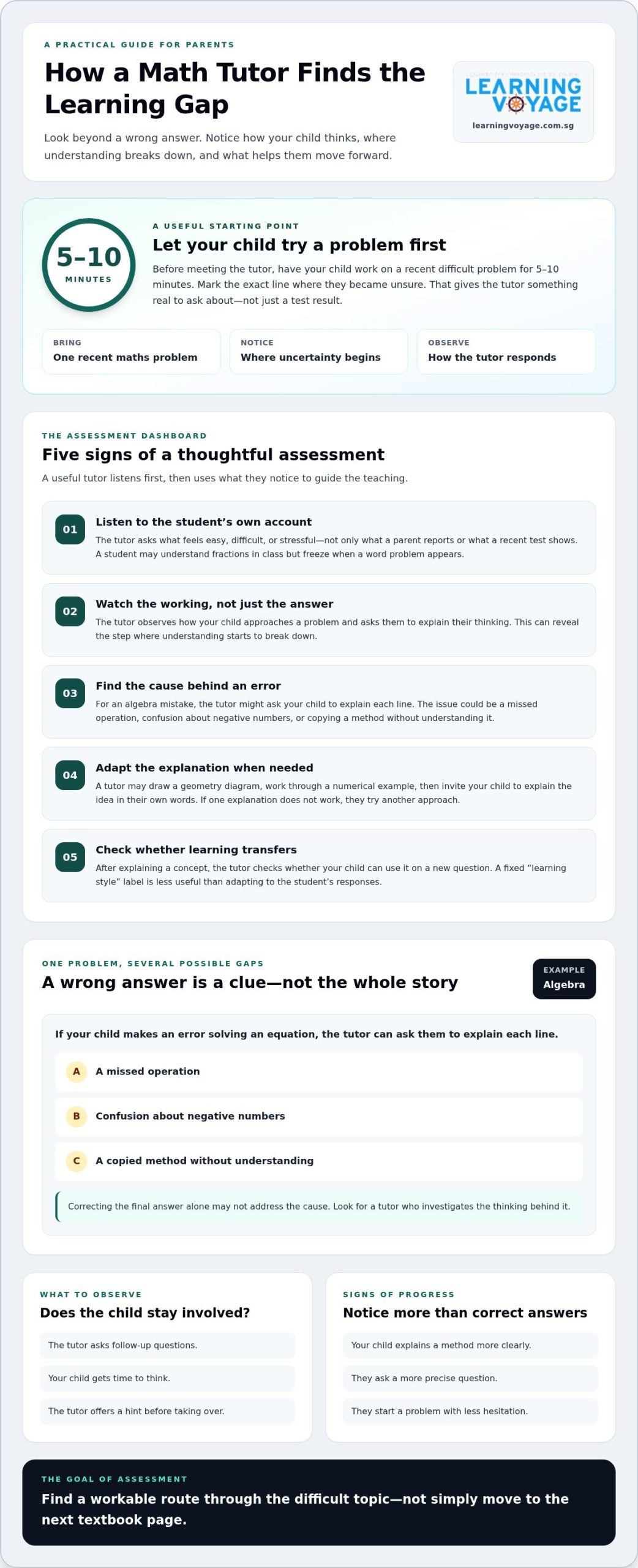
A tutor can assess a student’s strengths, gaps, and learning needs by listening first, then observing how the student approaches a maths problem. Ask what they would review, what they would ask your child, and how they would use those observations to shape their teaching. A useful assessment looks beyond a wrong answer to find the step where understanding breaks down.
Your child’s own account matters. Ask how the tutor finds out what feels easy, difficult, or stressful for the student, rather than relying only on a parent’s view or recent test results. Your child might, for example, understand fractions in class but freeze when faced with a word problem. Their interests and study habits can also help reveal when concentration slips or frustration begins.
Ask for a practical example of how the tutor investigates a learning gap. If your child makes an error solving an algebra equation, does the tutor ask them to explain each line? This can reveal whether the issue is a missed operation, confusion about negative numbers, or copying a method without understanding it. The distinction matters: correcting the answer alone may not address the cause.
A learning style shouldn’t become a fixed label. Instead, ask how the tutor adapts explanations to the student’s responses. They might draw a diagram to explain a geometry concept, work through a numerical example, then ask your child to explain the idea in their own words. If one explanation doesn’t work, a thoughtful tutor tries another approach and checks whether the student can apply the concept to a new question.
Ask how the tutor has supported students facing challenges similar to your child’s, such as weak foundations, rushing through calculations, or losing confidence after difficult questions. Request an example of how they identified the hurdle and adapted their teaching. Qualifications can show relevant study or training, but a clear account of how the tutor responds to a student’s work can tell you more about their practical approach.
Before the meeting, note a recent maths topic that caused difficulty and what your child said or did. Your child can try a problem for 5-10 minutes, then mark the exact line where they became unsure. Share that example and observe whether the tutor asks follow-up questions, gives your child time to think, and offers a hint before taking over. These small steps reveal whether learning stays active.
Look for signs of progress beyond getting an answer right: your child explains a method more clearly, asks a more precise question, or starts a problem with less hesitation. Ask how the tutor would notice these changes and use them to plan the next lesson. The aim is to find a workable route through the difficult topic, not simply move to the next textbook page.
2. What Is Your Experience In This Field?
A tutor’s experience matters most when it matches your child’s subject, level, and learning needs. In Singapore, ask about their educational background, teaching experience, and familiarity with the mathematics topics your child is studying. No single qualification guarantees a good fit; look for relevant subject knowledge and a clear account of how the tutor teaches. Among the questions to ask a potential math tutor, start with the levels and topics they know best.
Ask, “Which levels and maths topics have you taught?” A tutor may have experience with Secondary algebra but less with A-Level calculus, so broad claims about teaching mathematics aren’t enough. Ask for an example of how they explain a challenging topic, such as rearranging an equation or interpreting a graph. The explanation should be clear at your child’s level, not merely technically correct.
Experience also means understanding what school is like for the student. Ask how the tutor finds out whether maths difficulties affect your child’s confidence, workload, or willingness to participate in class. A student, for example, may understand a method at home but feel anxious when called on at school. A thoughtful discussion can reveal whether the main hurdle is a skills gap, exam pressure, or difficulty keeping up with lessons.
Invite your child to describe a typical school day, including a subject they enjoy and one they find difficult. Ask how that information could shape maths support without turning the conversation into a judgement about the student. If your child enjoys science but dreads algebra, the tutor could use a science-based example to make an abstract relationship easier to picture.
To check references, reviews, and track record, ask for references from families whose students had similar learning needs or studied a similar maths level. Read reviews for specific examples of communication, teaching clarity, and progress, rather than relying on a general star rating. Ask the tutor to explain what changed for a past student and what teaching steps contributed, without expecting another student’s private details.
Safety and privacy deserve a clear conversation before lessons begin. Agree who will be present or nearby, where lessons will take place, and how parents and tutors will communicate about the student. Keep messages focused on learning, avoid sharing unnecessary personal information, and make sure your child knows how to raise a concern with a trusted adult.
When comparing answers, look for relevant examples, honest limits, and a willingness to discuss your child’s wider school experience. Qualifications matter, as does the tutor’s ability to connect subject expertise with the pressures students face. Ask how they would respond if a capable student stopped attempting questions after repeated setbacks. Their answer can show whether they understand the connection between confidence and learning.
3. Knowledge of Singapore’s mathematics curriculum and assessments
A tutor should understand Singapore’s mathematics curriculum, its learning outcomes, and the assessments relevant to your child’s level. Ask how they connect lessons to current school topics and upcoming assessments. A student struggling with Secondary E-Math, for example, may need help applying a familiar method to unfamiliar question wording, while an A-Math student may need practice linking algebraic steps. Curriculum knowledge helps keep tuition focused on the skills the student is expected to use.
Ask how the tutor would identify your child’s needs before deciding what to focus on. A useful starting point might be a recent test, a marked worksheet, or a question the student found difficult. The tutor can look for patterns, such as errors in setting out working, choosing a method, or checking an answer. This makes the next lesson more focused than simply moving to the next textbook page.
Progress should be measured by more than test scores. Ask what the tutor will observe during lessons: can your child explain why a method works, start a similar question independently, or spot an error in their own working? A student may still make occasional calculation mistakes while showing stronger understanding of how to form an equation. That distinction helps parents see which skill is improving and what still needs attention.
Ongoing assessment can be part of everyday teaching. After reviewing a concept, the tutor might give a new question that tests the same idea in a different form, then use the student’s working to decide what comes next. Ask how feedback will explain both the mistake and a practical way to address it. “Revise algebra” offers little direction; “practise forming an equation from a word problem” gives a clear next step.
Ask how often you’ll receive progress updates and what they’ll cover. A useful update might describe the topic covered, a skill your child can now apply, and an area that remains difficult. If your child struggles with exam-style questions, the tutor could explain whether the challenge lies in understanding the concept, choosing a method, or showing the working. Clear feedback lets parents support practice without guessing.
Qualifications provide useful context, but ask how the tutor keeps their teaching aligned with curriculum expectations and assessment formats. If your child prefers worked examples before independent practice, ask how the tutor would balance that preference with building confidence on new questions. Listen for a plan that links your child’s current needs to specific learning goals. A good progress discussion should also welcome the student’s perspective, not rely only on marks or parent observations.
4. What tutoring interview questions should I ask?
Before lessons begin, agree with your child and the tutor on what the support should achieve. Share a concrete goal, such as explaining algebra steps with less prompting or feeling calmer when tackling unfamiliar questions. Ask how the tutor will work towards it and how you’ll discuss concerns. A clear plan can prevent frustration if parents expect exam practice while the student needs confidence with basic concepts.
Include your child in the conversation. Ask what they hope will feel easier and what makes maths lessons stressful. A tutor can use a simple icebreaker, such as asking about a favourite hobby, to make an initial meeting feel less formal. If your child enjoys football, for example, discussing scores or patterns can open a natural conversation before moving to schoolwork.
Ask how the tutor adapts explanations when a student doesn’t understand. They might describe showing a worked example, drawing a diagram, then asking the student to solve a similar question independently. Listen for a willingness to explain concepts another way, rather than repeating the same words or immediately giving the answer. This helps you judge whether the tutor can build understanding at your child’s pace.
Resistance can have different causes. A student may be tired after school, embarrassed by repeated mistakes, or unsure where to start. Ask how the tutor responds if your child refuses to attempt a question or goes quiet. Look for an approach that pauses, asks what feels difficult, and adjusts the task while still helping the student return to learning.
Discuss practical arrangements before lessons start. Decide whether lessons will be online or in person, where they will take place, and which schedule suits the student’s school commitments. For online lessons, ask what technology the student needs and how questions will be handled during the session. Clear details about availability can help prevent clashes with school activities or exam preparation.
Agree on cancellation, make-up lesson, and refund terms before committing. Ask what notice is expected for a cancellation, how a missed lesson is handled, and whether any refund conditions apply. Put the agreed policy in writing so parents and tutors share the same understanding. This conversation is easier before an unexpected absence creates pressure.
Finally, ask how the tutor will communicate with parents and involve the student in reviewing progress. You might agree on brief updates about completed topics, ongoing difficulties, and practice priorities. A respectful relationship works best when everyone understands their role: parents share observations, tutors guide teaching, and students explain what helps them learn. That shared understanding gives confidence room to grow alongside maths skills.
5. Trial lessons and questions to ask an H2 Math tutor
A trial lesson should reveal more than whether an H2 Mathematics explanation sounds clear. Use it to observe how the tutor diagnoses a gap, explains a concept, responds to mistakes, and supports practice. Agree on one topic beforehand, such as a question your student finds difficult. That gives the session a useful focus and makes the teaching approach easier to assess.
Ask the tutor to explain the plan for a trial session. Will they first review your child’s working, identify where their reasoning falters, then decide whether to offer a hint or a fuller explanation? A good trial gives the student time to attempt the problem. Notice whether the tutor breaks a complex question into manageable steps and checks understanding before moving on.
Students can make the conversation more specific by bringing a question and explaining what they’ve tried. For example: “I worked on this for 20 minutes, but I don’t understand this step.” They can also ask for a hint first, request a full explanation, or show a short solution and ask whether a standard method could make it clearer. These prompts reveal how the tutor responds to different needs.
During an H2 Math trial, look for feedback that helps the student improve their next attempt. If an error appears, does the tutor explain why that step doesn’t work, then invite the student to try again? Ask how they’ll support practice after introducing a concept. You want to see the student applying the idea, not only copying a worked solution.
A trial can also show whether the class feels like a suitable learning environment. Ask how sessions balance new concepts, focused practice, and questions from schoolwork. If a topic feels impossible, notice whether the tutor explores what is causing that reaction or simply pushes ahead. A calm exchange can help a student speak openly, especially when exam stress makes asking for help difficult.
After the session, ask your student which explanation helped and where they still felt unsure. Then ask the tutor what they observed, what they would focus on next, and how they would respond if there were no change after eight weeks. A few sessions can provide a fuller picture before deciding to change tutors, if circumstances allow. Compare the student’s ability to explain and apply ideas, alongside their comfort asking questions.
Learning Voyage Education Centre: Secondary 4 E-Mathematics Tuition
Learning Voyage Education Centre supports Secondary 4 students with E-Mathematics tuition focused on the Singapore syllabus. Its small-group coaching and “Plug-the-Gaps” technique help identify specific learning hurdles and address them through focused support. This can suit students who need clearer explanations, targeted practice, or steadier confidence as exam pressure builds.
Students taking A-Mathematics can also explore Secondary 4 A-Mathematics Tuition, while Secondary 3 students can choose E-Mathematics or A-Mathematics tuition. The right option depends on the subject and level your child is studying. Contact Learning Voyage Education Centre to discuss the relevant tuition option, or visit learningvoyage.com.sg.
Give your child a voice in the next step
The best learning plan is one your child can take part in, not simply receive. After speaking with a tutor, invite your child to describe what helps them feel ready to try a difficult question. Their perspective can guide how support begins and help them take ownership of steady progress.
Keep one simple goal in view, such as approaching unfamiliar problems with greater confidence. The questions to ask a potential math tutor can help you make a thoughtful choice, but your child’s comfort and willingness to engage matter too. A supportive learning relationship can turn frustration into curiosity, one concept at a time.
For families considering maths support in Singapore, explore how Learning Voyage Education Centre approaches students’ learning needs and next steps. Explore Learning Voyage Education Centre and find a supportive path forward for your child’s maths learning.
Frequently Asked Questions
What tutoring interview questions should I ask?
Ask how the tutor handles practical situations that may arise during tuition. For instance, “What would you do if school homework covered a topic we haven’t studied together?” or “How do you decide whether to follow the school’s method or introduce another one?” You could also ask what your child should bring to lessons. The answers can clarify how tuition will fit around schoolwork and what preparation is expected.
How Do You Assess Student Learning?
Ask how the tutor would distinguish a missing prerequisite from a new topic that simply needs more practice. You can also ask how they would identify a starting point if your child has no recent test results. A useful discussion should identify what evidence could help set an appropriate learning level, such as the current school chapter or a short task completed without prompts.
How Do You Explain Difficult Math Concepts To Students?
Ask how the tutor helps students make sense of unfamiliar terms and symbols, especially when a question combines ideas from different topics. For example, an H2 student might know a formula but struggle to interpret the notation in a question. Ask how the tutor connects the language of the problem to the mathematical idea, and how they check that the student can explain the link clearly.
How Do You Help Students Who Are Struggling With Math?
Ask how the tutor keeps support manageable when a student feels overwhelmed by schoolwork. Would they help the student choose which questions to attempt first, or plan how to revisit a difficult topic alongside current homework? A useful answer should respect the student’s workload and avoid treating every setback as a lack of effort. Ask how they encourage persistence without adding unnecessary pressure.
How Do You Use Data To Inform Your Instructional Decisions?
Ask whether the tutor looks for recurring patterns across different types of work, rather than drawing conclusions from a single result. Repeated sign errors in algebra questions, for example, may point to a different practice need than mistakes limited to word problems. Ask how they track such patterns and decide when to change lesson priorities. The goal is to use evidence to guide planning, not collect marks without context.
How Will The Tutor Find Out Where Your Child Actually Is?
Ask whether your child will be invited to work independently before the tutor offers help. This can show what the student can do without prompts, which steps need support, and whether they can explain their choices. You might also ask how the tutor will account for topics your child has not yet covered at school. This helps avoid mistaking unfamiliar material for a weakness.
How Will You Know If The Tutoring Is Working?
Agree on a practical sign of change that matters at home, such as your child starting maths homework with less resistance or being more willing to show their working. Ask what feels different to your child after lessons, then compare their comments with examples from schoolwork. These observations add context to marks and help the family decide whether support is making daily learning more manageable.
What Are The Red Flags When Hiring A Math Tutor?
Be wary of a tutor who guarantees a grade, blames a student for every mistake, or discourages questions about lesson plans. Pressure to decide quickly can also stop families from discussing expectations carefully. Notice whether the tutor speaks respectfully about schoolteachers and previous support, even when describing a difficulty. A professional conversation should leave room for questions, clear boundaries, and an honest discussion of learning goals.