
Knowing more Science facts isn’t always enough to earn marks on a challenging question. Tackling difficult PSLE Science questions means showing how evidence leads to an answer: identify the cause, explain the process and state the result. Naming an outcome without explaining why it happened can leave the reasoning incomplete.
Unfamiliar diagrams, experiments or open-ended questions can leave your child unsure where to begin, especially when exam pressure makes clear thinking harder. This guide offers a practical approach: spot command words, break multi-step problems into smaller parts, identify what an experiment changes and measures, and connect diagram details to the relevant Science concept. Worked examples show how to build precise explanations, use scientific terms and check that an answer addresses the full question. With a method to follow, difficult questions become manageable opportunities to show understanding.
Key Takeaways
- Build explanation answers by linking the cause to the process and then to the result, using precise scientific terms.
- For unfamiliar scenarios, identify the concept being tested instead of relying on memorised facts alone.
- In experiment questions, distinguish what changes from what is measured, then use the results to support a conclusion.
- Read diagrams and command words carefully so your response addresses the exact task, not just the topic.
- Break open-ended problems into manageable steps, write complete answers and review them for clarity before moving on.
Explanation questions and cause-and-effect answers
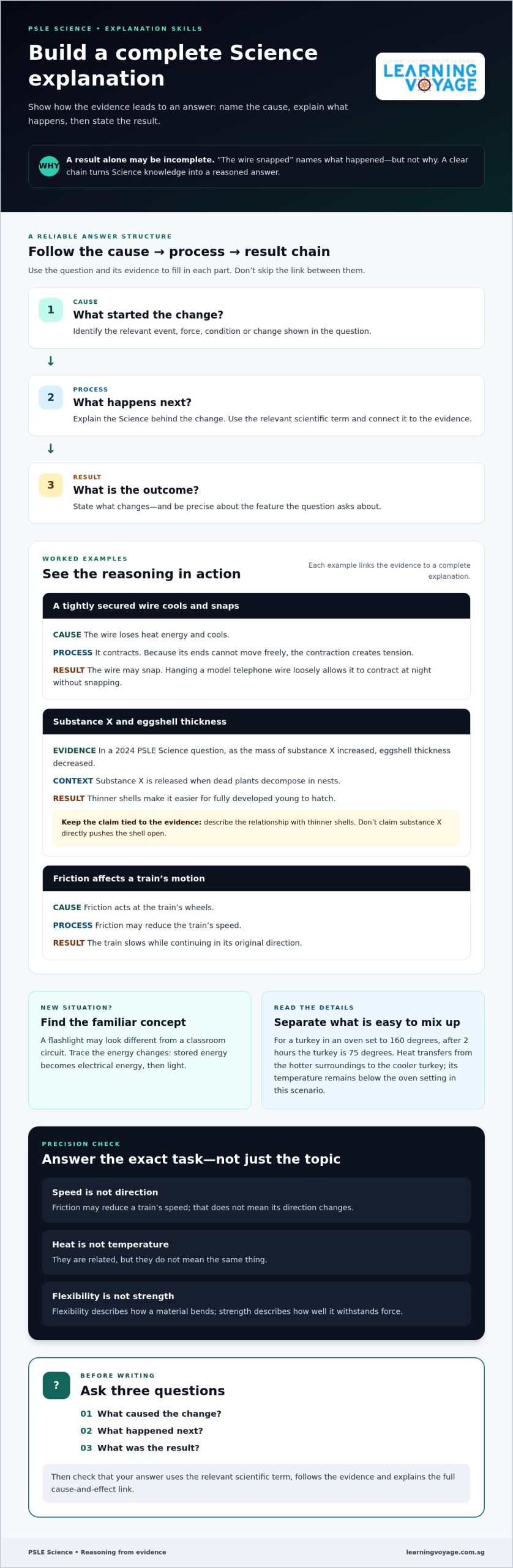
A strong explanation connects an event to the science behind it, then states the result. In a challenging examination question, avoid giving only an outcome, such as “the wire snapped.” Name the cause, describe the process and explain what happened. This sequence turns syllabus knowledge into a complete explanation rather than a guess.
Case: A wire cools and snaps
Situation: A tightly secured wire is exposed to changing temperatures. Action: Trace the effect of cooling: the wire loses heat energy, cools and contracts. Because its ends cannot move freely, the contraction creates tension. Result: The wire may snap. Saying only that it “became shorter” misses the link between restricted movement and snapping. In a model telephone line, hanging the wire loosely allows it to contract at night without snapping. That detail completes the cause-and-effect chain.
Case: Eggshell thickness and environmental effects
Situation: A 2024 PSLE Science question explored animal life cycles and eggshell thickness. As the mass of substance X increased, eggshell thickness decreased. Action: Read the relationship accurately, then connect it to the young inside the egg. Substance X is released when dead plants decompose in nests. Result: Thinner shells make it easier for fully developed young to hatch. An answer should describe the environmental change, its effect on shell thickness and the advantage for hatching. Avoid claiming that the young hatch because substance X directly pushes the shell open. The evidence shows a relationship involving thinner shells.
Case: Friction changes a train’s motion
Situation: A train question asks how friction at the wheels affects movement. Action: Distinguish speed from direction. Friction at the wheels may reduce the train’s speed, but it does not change its direction of motion. Result: A precise answer says the train slows while continuing in its original direction. Use this distinction whenever a force question asks what changes. Naming “friction” alone is not enough; explain its effect on the specific feature in the question.
Before writing, use three prompts: What caused the change? What happened next? What was the result? For a cooling wire, the answers lead from heat loss, to contraction, to snapping when movement is restricted. For the train, they lead from friction, to reduced speed, to continued travel in the same direction. This method also helps parents guide practice without giving away the answer. Ask your child to point out the cause, process and result in the question or diagram. Then check that the explanation uses the relevant scientific term and answers the exact task. A clear chain is a reliable way to approach difficult explanations.
What Are PSLE Science Question Types?
The PSLE Science paper asks students to apply concepts, interpret information and explain scientific processes. It includes multiple-choice and open-ended questions, so preparation needs both careful selection and clear written reasoning.
What are the latest PSLE Science assessment rules and format in Singapore? Students encounter questions that test understanding, application and scientific explanation, including interpreting experimental results. Practising both multiple-choice and open-ended responses helps them prepare for these different tasks.
What topics are covered in the Singapore PSLE Science syllabus? Examples include energy, heat, forces, magnetism, plant processes and animal life cycles. Students should understand how these topics connect, rather than memorising isolated definitions.
Apply familiar concepts to new situations
An unfamiliar setting does not always require unfamiliar science. Start by identifying the clues, then ask which concept explains them. For example, a flashlight may look different from a classroom circuit, but students can trace how stored energy changes into electrical energy and then light. The situation provides the context; the concept provides the reasoning.
Situation: A question describes a turkey inside an oven set to 160 degrees. After 2 hours, the turkey’s temperature is 75 degrees. Action: Students should distinguish the oven’s temperature from the turkey’s temperature, then explain that heat transfers from the hotter surroundings to the cooler turkey. Result: The turkey warms, but its temperature remains below the oven setting in the stated scenario. This example tests heat transfer and the difference between an object’s temperature and its surroundings.
Connect concepts and separate confusing terms
Some challenging questions combine ideas. A plant experiment might connect light intensity, photosynthesis and oxygen production. If oxygen volume indicates the rate of photosynthesis, students can interpret a greater volume as evidence of a higher rate. Follow the evidence rather than assuming that every change in a set-up has the same effect.
Common mix-ups can derail otherwise sound answers. Heat and temperature are related, but they do not mean the same thing. Magnetism describes magnetic effects, while electromagnetism involves magnetism produced by an electric current. Flexibility describes how a material bends; strength describes how well it withstands force. In each case, students can write a short contrast and test it against an example. A flexible object may bend without breaking, while a strong object resists damage under force.
What strategies help manage time in the PSLE Science exam? Practise under timed conditions, answer the clearest questions first and leave a marked question to revisit if reasoning stalls. How can students use past-year PSLE Science papers effectively? Attempt each paper under timed conditions, then review errors by topic and identify whether the gap involved knowledge, interpretation or wording. Targeted Primary 6 Science tuition can support students who need structured practice applying concepts to unfamiliar examples.
Experimental analysis and identifying variables
How to solve PSLE Science experimental and data interpretation questions? Identify the experiment’s aim, compare what changes with what is measured, then use the results to form a conclusion. Check every diagram, label and unit before deciding what the data shows.
Read the experiment as a set of decisions
Start by asking what the experiment is testing. The factor deliberately changed is the independent variable; the result measured is the dependent variable. Conditions kept the same help make the comparison fair. Then state what the results show without claiming more than the evidence supports.
- Aim: What relationship or effect is being investigated?
- Changed factor: What differs between the set-ups?
- Measured result: What observation or quantity is recorded?
- Controlled conditions: What should stay alike for a fair comparison?
- Conclusion: What pattern in the results answers the aim?
For example, a water-plant experiment compares light intensity by changing the number of batteries and bulbs. In the 2024 Singapore PSLE Science example, Set-up 1 used 1 battery and 1 bulb; Set-up 3 used 3 batteries and 3 bulbs. Oxygen volume indicates the rate of photosynthesis. If the set-up with greater light intensity produces more oxygen, the results support the conclusion that increased light intensity increases photosynthesis. Students should describe that measured relationship, not simply write “the plant grew better.”
Case: Mosquito landings and shirt colour
Situation: A 2020 PSLE Science question involved mosquito life cycles and malaria. In Joel’s experiment, box P contained 20 mosquitoes of type A, and he counted landings on a shirt for three minutes. Action: To investigate shirt colour, compare the number of landings on each colour while keeping the observation period and mosquito type consistent. Identify shirt colour as the changed factor and landings counted as the measured result. Result: White shirts provide better contrast, making mosquitoes easier to see and count than on black shirts. That affects observation accuracy; it does not by itself show that mosquitoes prefer white.
When data appears in a table or diagram, compare the relevant values before writing. Note the units, identify which set-up matches each value, and describe the pattern in the results. If the experiment changes more than one factor, avoid claiming which factor caused the outcome unless the comparison supports that conclusion. This disciplined approach helps students master experiment questions on the PSLE Science paper: evidence first, conclusion second. It builds the ability to reason calmly, even when an unfamiliar diagram makes the task feel challenging.
Reasoning from diagrams and question wording
A diagram can contain clues to the answer, but students need to inspect it systematically. First identify what the picture represents. Next, locate labels, arrows, switches, measurements and any changes between stages. Then connect the visible evidence to a scientific concept. This routine helps prevent mistakes such as overlooking a closed switch or confusing an object’s position with its direction of movement.
Read the question before interpreting the visual
Command words tell students what to do with the diagram. “Describe” asks for an observation; “explain” requires a reason; “compare” needs a similarity or difference; “predict” asks what is likely to happen next. Underline the command word, then identify the exact feature it asks about. A question about magnetic strength does not necessarily ask about direction of movement. Answering the broader topic instead can leave the specific task unresolved.
Situation: In PSLE Science 2024 question 36, students had to read a graph about a wire’s length at different temperatures. The wire measured 50 mm at 0 °C, and its length increased by 6 mm when heated from 0 °C to 80°C. Action: Read the graph’s axes and units, find the value at 0 °C, then distinguish the length shown from the increase requested. Result: The graph gives the starting length as 50 mm and the increase as 6 mm. A common error is to report a graph reading when the question asks for a change.
Tables need the same careful comparison. Follow each row and column heading before matching values. For example, the 2019 PSLE Science question described a 50 CM³ container. A pump added 5 CM³ of water and 10 CM³ of air, and the final amount of air was 30 CM³. Students should track what each figure describes instead of treating every volume as air. Units and labels guide the correct interpretation.
Case: A toy boat’s magnetic mechanism
Situation: PSLE Science 2024 question 38 showed a toy boat’s captain and an electromagnet. Action: Trace the diagram’s circuit: closing the switch allows current to flow and magnetises the iron cylinder. When the magnet and metal contact separate, the circuit breaks and the captain falls. Result: After the batteries discharge, the electromagnet weakens. The reduced repelling force makes the captain move more slowly and reach a lower height. Each detail links a diagram feature to a change in motion.
Before submitting, check that the response matches the command word, uses the correct unit and names the feature shown. For graph questions, reread whether the task asks for a value, a difference or a trend. For circuit diagrams, trace the path of current before describing an effect. This final review helps students turn visual clues into precise answers under examination pressure.
PSLE Science open-ended question techniques
Open-ended answers are stronger when each sentence has a clear purpose. State the scientific idea, support it with a detail from the question, then explain why that detail matters. This keeps the response focused without turning it into a list of memorised terms. It also helps when a child understands the topic but struggles to express that knowledge under exam pressure. With practice, tackling difficult PSLE Science questions becomes a writing skill as well as a test of understanding.
Make every sentence earn its place
After drafting, check that the answer names the subject clearly. A sentence such as “It helps it” leaves the reader guessing what “it” means. Replace vague pronouns with the organism, material or process named in the question. Then check that the explanation does not claim more than the evidence supports. Words such as “always” and “only” can make an answer inaccurate when the question provides no basis for them.
- State the idea: Use the scientific term that fits the situation.
- Point to evidence: Include a relevant feature or observation from the prompt.
- Explain its meaning: Show how that evidence supports the answer.
- Trim unsupported claims: Remove details that the question or Science concept does not justify.
Situation: A question describes an animal with webbed feet and asks how this feature helps. Action: The student names the feature, links it to pushing against water, and explains how that movement helps the animal swim. Result: The response connects a visible body feature to its function instead of simply stating, “It is adapted to water.” Practising precise wording helps students turn a broad idea into a clear explanation.
During revision, compare two versions of the same answer. In the first, underline every scientific term; in the second, underline the evidence from the prompt. If either set of underlines is missing, the response may need more precise knowledge or closer attention to the question. This review gives students a specific way to improve, rather than rewriting an answer without knowing what changed. It can also make feedback feel more manageable for a child who is worried about the examination.
Keep a small collection of corrected responses, each labelled with the Science idea it tested. Before a practice session, choose one and explain why its wording is clear. Recalling what made an answer effective helps build confidence for new prompts. For guided practice expressing Science ideas accurately, families can explore Primary 6 Science tuition. With patient review and deliberate practice, tackling difficult PSLE Science questions can become a more confident part of a student’s preparation.
Learning Voyage Education Centre: Secondary 4 E-Mathematics Tuition
Learning Voyage Education Centre supports students who need focused guidance in secondary mathematics. If your child is preparing for the move from primary school or finding secondary-level problem-solving challenging, its Secondary 4 E-Mathematics Tuition may be relevant when they reach that level. The centre also offers Secondary 4 A-Mathematics Tuition, Secondary 3 A-Mathematics Tuition and Secondary 3 E-Mathematics Tuition.
PSLE Science and secondary mathematics call for different learning support, but both reward clear reasoning and steady practice. For mathematics, structured tuition can help students identify gaps, work through challenging questions and build confidence at a manageable pace.
Contact Learning Voyage Education Centre to discuss its secondary mathematics tuition.
Keep Building Confidence Beyond the Examination
Each practice question gives your child a chance to strengthen independent thinking, not just prepare for one paper. As they keep tackling difficult PSLE Science questions, encourage them to notice their progress: a clearer explanation, more careful reading of evidence or the confidence to begin an unfamiliar problem. These steps can make exam pressure feel more manageable and build habits that support learning beyond primary school.
Learning Voyage Education Centre also supports students as they progress through secondary mathematics, with Secondary 4 E-Mathematics Tuition, Secondary 4 A-Mathematics Tuition and Secondary 3 A-Mathematics Tuition. If that is a useful next step for your family, contact Learning Voyage Education Centre to learn more.
Keep practising with patience. A child who learns to approach each question thoughtfully is building confidence for the challenges ahead.
Frequently Asked Questions
How Can Students Solve These Questions?
Students can start by turning the question into a short task list. Circle the command word, box the information provided and note what the answer must include. For a question with several parts, label each part in the margin and answer them separately. After drafting, compare the response with those labels. This simple check helps prevent a complete explanation for one part from leaving another unanswered.
What Made This Question Challenging?
A question often feels challenging because it combines familiar Science ideas in an unfamiliar setting. Students may understand each idea separately but be unsure which details matter together. To find the sticking point, ask your child to explain the question aloud without solving it. If they can summarise the situation but cannot name the concept, revise that topic. If the concept is clear, practise interpreting the wording or visual clues.
What makes PSLE Science questions difficult?
PSLE Science questions can be difficult when students must select relevant knowledge rather than recall a definition directly. A prompt may include extra details, several stages or answer choices that sound plausible. Practise explaining why one detail matters and another does not. If a wrong answer comes from misunderstanding a term, review the concept; if it comes from overlooking a clue, practise reading more carefully.
What question types commonly appear in PSLE Science papers?
PSLE Science papers include multiple-choice and open-ended questions. Students may also encounter application problems, experiment-based questions and items that require reading diagrams, tables or graphs. Each format calls for a different response: select the best-supported option, write a reasoned explanation or interpret the information shown. During practice, label each question by type. This helps students identify which skills need more attention across different Science topics.
How to answer PSLE Science open-ended questions using keywords and evidence?
Use a scientific keyword only when it accurately describes the evidence in the question. For instance, if a prompt shows a shadow changing as a light source moves, refer to the positions shown rather than adding unsupported details about the object. Make the reasoning explicit: state the relevant observation and explain what it indicates. Reread the response, checking that every claim is supported by a clue or concept.
How to tackle application questions involving unfamiliar situations?
Translate the unfamiliar story into simple Science terms. Identify the object, what happens to it and the change the question asks about. Then connect those details to a concept studied in class. A story about a new device, for example, may still test a familiar idea such as energy transfer or material properties. Ignore names or decorative details unless they affect the scientific situation.
What are common mistakes students make in PSLE Science answers?
Students may add assumptions the question never gives, answer only one part of a multi-part prompt or use a Science term loosely. Another mistake is treating two events that occur together as proof that one caused the other. To catch these errors, ask: “Which words in the question support this sentence?” If the answer has no clear evidence, revise it or remove the unsupported claim.