
PSLE Science tuition is most valuable when it turns uncertain answers into clear, well-reasoned ones. In the 2026 Singapore PSLE Science examination, Booklet A has 30 multiple-choice questions, while Booklet B has 10-11 structured questions. Through expert support from Learning Voyage Education Centre, a skilled Science tutor can help students identify knowledge gaps and practise explaining ideas with accurate, relevant scientific terms.
It’s understandable to feel concerned when revision leads to repeated mistakes or exam stress, especially if your child knows the topic but struggles to express it in an answer. Personalised guidance from Learning Voyage Education Centre can help students strengthen concepts, interpret questions and build confidence at a pace that suits their learning needs. This article explains what effective PSLE Science preparation involves, how support can help struggling and confident learners, and what to consider when choosing the best psle science tutor punggol.
Key Takeaways
- Practise choosing precise scientific terms and linking each answer directly to the question, not just recalling facts.
- Identify whether mistakes come from topic knowledge, question interpretation, diagrams, data or exam nerves so revision targets the real gap.
- Look for teaching that develops both foundational understanding and deeper reasoning, with guidance adapted to the student’s needs.
- Assess how class size and teacher feedback can shape opportunities to ask questions, correct misconceptions and build confidence.
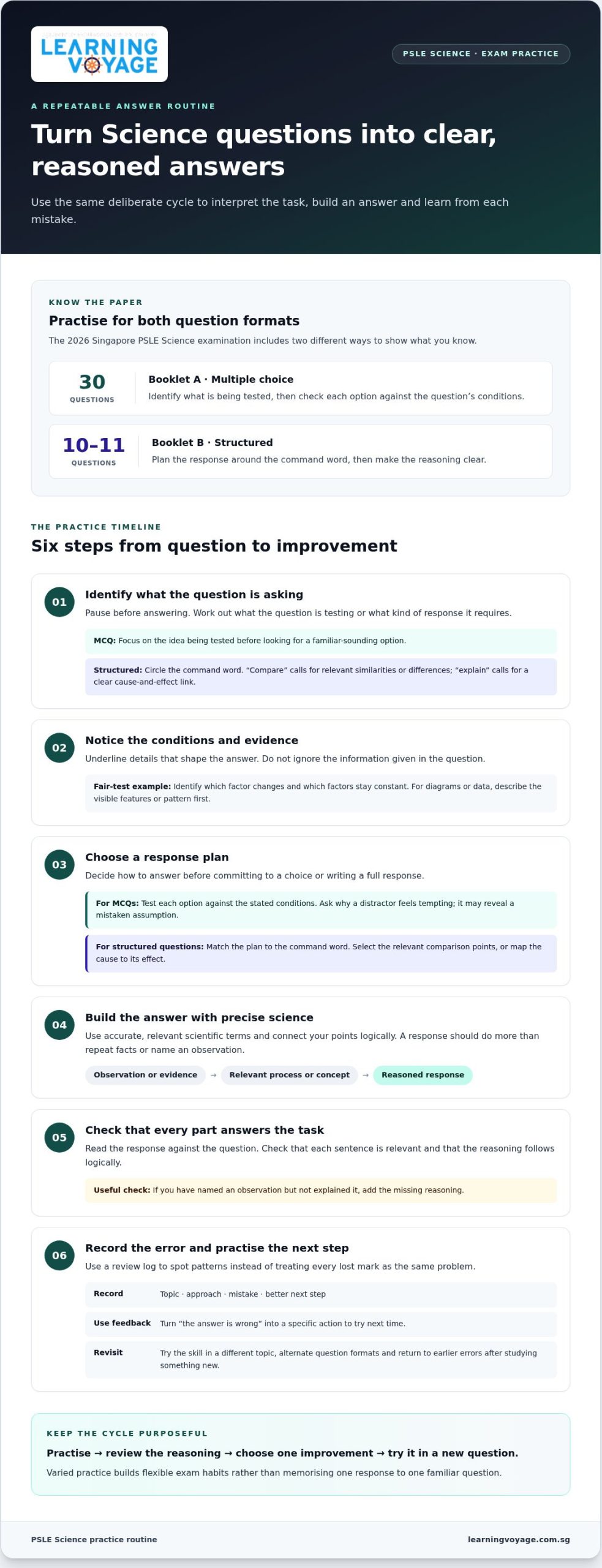
MCQ and structured-question preparation
Effective practice is more than completing worksheet after worksheet. Students need a repeatable way to make decisions under exam conditions, then learn from those choices. A review log can record the topic, the student’s approach, the mistake and a better next step. This helps families spot patterns instead of treating every lost mark as the same problem.
For multiple-choice practice, students can pause before selecting an option and identify what the question is testing. They can then check whether each option fits the stated conditions, rather than choosing an answer that merely sounds familiar. If a question describes a fair test, for example, the student should notice which factor changes and which factors stay constant. Reviewing why a distractor seems tempting can reveal a mistaken assumption.
Structured responses benefit from planning before writing. Students can circle the command word, such as “compare” or “explain”, and decide what kind of response it requires. A comparison needs relevant similarities or differences; an explanation needs a clear link between cause and effect. After drafting, they can check that each sentence answers the task and the reasoning follows logically.
A tutor’s feedback is most useful when it shows the next action, not just the correct answer. If a response names an observation but does not explain it, for instance, the student can practise adding the missing reasoning. Revisit that skill in a different topic to see whether it transfers. This deliberate practice can focus revision and help students approach unfamiliar questions more calmly.
- Before answering: identify the task and underline conditions that shape the response.
- After answering: note the error pattern and write one specific improvement for the next attempt.
Keep practice varied: alternate question formats and revisit earlier errors after studying a new topic. This builds flexible exam habits instead of memorising one response to one familiar question.
Support for struggling and advanced students
A disappointing Science result can reflect different learning gaps. One student may have forgotten how a concept works; another may understand it but misread the question. Start by reviewing recent work and sorting mistakes by cause: content knowledge, question interpretation, missing keywords, process explanations, diagrams, data interpretation or exam anxiety. This gives revision a clear starting point instead of asking a worried child to redo everything.
For a student who feels stuck, begin with one topic and trace the idea through an example. If a question asks why an observation occurred, check whether the student can describe the process, identify relevant evidence and connect it to the science concept. Practise a similar question with guidance, then let the student try one independently. Early support can help identify and address gaps, while small, specific goals make progress easier to recognise.
Confident students need opportunities to deepen their reasoning, not simply more questions. Ask them to compare possible explanations, interpret unfamiliar data or explain why a tempting answer is incorrect. After reading a results table, for example, they can describe its pattern and support a conclusion with the observations shown. This stretches scientific thinking and reveals whether strong recall transfers to new question contexts.
- If concepts are unclear: revisit the underlying idea, explain it aloud, then apply it to a fresh example.
- If answers miss marks: identify the question’s demand and check for relevant evidence, process links and precise vocabulary.
- If diagrams or data cause difficulty: describe visible features first, then connect them to the question’s focus.
- If exam anxiety disrupts recall: practise one question calmly, review the approach and build towards mixed-topic practice.
For parents, the key is matching support to the reason behind the difficulty. A student who hesitates over scientific terms needs different guidance from one who understands concepts but struggles to interpret diagrams. Reviewing corrected work regularly helps families spot patterns, recognise growing independence and choose the next learning step with confidence.
Choosing a PSLE Science tutor
Compare teaching quality, lesson format and practical arrangements before deciding. The right fit should help your child learn with purpose and work with your family’s routine.
Tutor Reviews and Results
The most useful reviews describe specific teaching, such as how a tutor explains a difficult idea or helps a student become more independent. Look for feedback relevant to PSLE Science that describes the learner’s progress, rather than relying on praise alone. Comments are more informative when they also explain the student’s starting point, study habits or changes in confidence.
In-Person and Online Tuition Options
In-person lessons allow direct discussion with a tutor and classmates, while online tuition can make lessons easier to fit around travel and home routines. Compare how each format handles questions, shared diagrams and written feedback. A student who loses focus on screen may prefer a classroom, while one comfortable with digital tools may find remote discussion effective.
Available Tutors and Tuition Centres
Families can consider private tutors, tuition centres and online classes. Compare their PSLE Science focus, lesson structure and how they help students stay on track between sessions. Some offer trial lessons or placement assessments; others use a different introduction process. A trial lets a student experience the teaching style, while an assessment can help identify suitable starting topics and areas to work on.
Access by MRT or Bus
For centre-based lessons, consider the full journey from home or school, including walking time, transfers and the route after class. Singapore’s MRT and bus connections can make a venue reachable, but convenience depends on the family’s starting point and lesson schedule. Factor in how travel fits alongside schoolwork, meals and rest. Online tuition avoids commuting, which may suit a busy household.
Class size and personalised guidance
Class size affects how easily a student can ask questions and receive feedback during a Science lesson. Rather than choosing by headcount alone, consider how the tutor notices individual needs, responds to mistakes and adjusts explanations. A quiet student who avoids speaking up may need deliberate prompts, while a confident learner may benefit from challenging follow-up questions.
In a small-group setting, every student still needs a clear opportunity to contribute. After studying a plant diagram, for example, the tutor might ask one student to identify a feature and another to explain its function, correcting misunderstandings as they arise. Look for lessons where participation is shared, questions are welcomed and feedback shows each child what to practise next.
Personalised support also depends on accurate diagnosis. A tutor can compare a student’s written answer with their verbal explanation. If the student understands a process aloud but omits key details on paper, practise answer structure. If both explanations show confusion, revisit the concept first. This distinction helps ensure focused teaching, rather than repeated worksheets, addresses the difficulty.
- Notice participation: Does the student get chances to explain, ask and respond?
- Look for targeted feedback: Does correction identify the exact misconception or missing step?
- Check the follow-through: Does the next task build on the student’s current understanding?
Small-group coaching can combine peer discussion with guidance tailored to each learner. The balance matters: students should hear different explanations without feeling lost in the group. After a lesson, ask your child to describe one idea they understand better and one question they still have. This simple check helps parents see whether the teaching connected and gives the next lesson a useful starting point.
Explore structured Science learning support when your child would benefit from guided practice and individual feedback within a learning group.
Learning Voyage Education Centre: Secondary 4 E-Mathematics Tuition
Learning Voyage Education Centre supports students who need a clear path through secondary Mathematics, including Secondary 4 E-Mathematics Tuition. After PSLE, some families begin planning for the demands of secondary school; this offering is relevant when a student reaches Secondary 4 and wants structured help with E-Maths concepts and exam preparation.
Learning Voyage’s small-group coaching and Plug-the-Gaps technique focus on identifying specific learning hurdles and addressing them through targeted guidance. The centre also offers Secondary 4 A-Mathematics Tuition, Secondary 3 A-Mathematics Tuition and Secondary 3 E-Mathematics Tuition. These are Mathematics programmes, so they serve a different learning need from PSLE Science preparation.
If you’re considering Secondary 4 E-Mathematics support, contact Learning Voyage Education Centre to discuss the next step.
Set a steady course for the next step
Exam preparation can feel overwhelming when every missed mark seems to call for another worksheet. A more useful next step is to notice what helps your child learn: clear explanations, thoughtful feedback, regular practice or room to ask questions. That insight can guide decisions beyond the PSLE, too, as students take on new subjects and greater independence.
For families considering Mathematics support at secondary level, Learning Voyage Education Centre offers Secondary 4 E-Mathematics Tuition, Secondary 4 A-Mathematics Tuition and Secondary 3 A-Mathematics Tuition. These programmes address a different stage of learning from PSLE Science preparation, but may be relevant as your child progresses through school. Choosing the best PSLE Science tutor in Punggol starts with finding guidance that fits the learner, not simply adding more pressure.
To explore Learning Voyage Education Centre’s tuition options, contact the centre. With a clear next step and supportive guidance, your child can keep learning with greater confidence.
Frequently Asked Questions
Why Have PSLE Science Tuition?
PSLE Science tuition can provide focused support when home revision feels repetitive or a child struggles to explain what they have learned. It can also help families build a manageable study routine alongside schoolwork. A student might review a challenging topic after a school test, then track whether they can explain it more clearly in the next revision session.
Do Punggol tutors offer PSLE Science group classes or one-to-one lessons?
Lesson formats vary, so the right choice depends on how your child learns and participates. Learning Voyage Education Centre provides small-group coaching, with 6 to 9 students per class. Group learning offers opportunities to hear classmates’ reasoning, while individual support may suit a learner who needs a quieter setting. Consider whether your child asks questions comfortably and benefits from shared discussion.
What PSLE Science topics and exam skills do Punggol tutors cover?
Lessons can cover Science concepts, vocabulary, diagrams, experiments and data interpretation. Ask how the teaching connects these skills to unfamiliar questions, not just familiar revision exercises. For instance, a student working with experiment results should practise describing what the data shows and explaining which conclusion it supports. This links topic knowledge with evidence-based reasoning in exam responses.
What class sizes and lesson schedules do Punggol PSLE Science tutors offer?
Class sizes and schedules vary, so compare the learning format with your family’s weekly routine. Consider school dismissal times, travel, rest and other commitments before choosing a lesson slot. Learning Voyage Education Centre offers trial classes in both Science and Mathematics, so students can experience the teaching approach before deciding.
What qualifications and teaching experience should I look for in a PSLE Science tutor?
Look for clear evidence that a tutor understands primary Science and can explain ideas in language your child follows. Ask how they would teach a difficult concept, respond to a wrong answer and adapt an explanation if a student remains unsure. Making scientific reasoning understandable matters alongside subject knowledge and familiarity with PSLE preparation.
What should parents check before enrolling in PSLE Science tuition in Singapore?
Before enrolling, clarify the lesson format, topics covered, learning materials, schedule and how progress is shared with families. Ask your child what they find difficult and use that as a starting point for discussing support. Then consider whether the planned lessons fit with schoolwork and rest time. A practical arrangement should support steady learning without making the week feel unmanageable.