
What if a failing grade in Mathematics isn’t a reflection of your child’s intelligence, but rather a navigational error caused by hidden conceptual gaps that act as anchors, dragging their confidence underwater? It’s exhausting to watch your child lose their spark and give up on Math while the high-pressure Singapore education system creates daily friction at home. You’re likely worried that poor O-Level or N-Level results will limit their future academic pathways. Finding a math tuition for failing students sengkang that truly understands these specific anxieties is the first step toward steadying the ship and charting a new course.
We agree that every student deserves high-quality support and the chance to succeed at their own pace, regardless of their starting point. This guide promises to show you how to transform your child’s results from failure to confidence through a systematic, gap-plugging approach that rebuilds their self-esteem from the ground up. We’ll provide a clear roadmap to passing grades and mastery of the MOE Math syllabus, moving from emotional frustration to the logical conviction that academic success is within reach.
Key Takeaways
- Reframe a failing Math grade as a temporary navigational error rather than a lack of ability, helping to reduce family friction and student anxiety.
- Identify how cumulative learning gaps from previous years can sabotage current results, acting as hidden anchors that prevent steady academic progress.
- Explore the “Plug-the-Gaps” methodology used by a math tuition for failing students sengkang to find and fix foundational weaknesses with surgical precision.
- Use a targeted checklist to select a tuition partner who prioritizes holistic mentorship and character growth alongside the rigors of the MOE syllabus.
- Transition from a state of academic distress to a path of self-esteem and mastery, ensuring your child is prepared for the challenges of national examinations.
The Emotional and Academic Reality of Failing Math in Singapore
An “F9” or “U” grade on a mid-year report card feels like a heavy anchor dragging down a child’s entire academic future. In the context of the rigorous MOE Secondary syllabus, Math failure is rarely a sign of low intelligence. Instead, it represents a total breakdown in communication between the student and the curriculum. When a student fails to meet the basic competency thresholds, it’s often because they’ve lost their bearings in a sea of increasingly complex abstract concepts. For many families, this academic distress manifests as tense dinner table conversations and a palpable sense of defeat that permeates the household. If your child is currently struggling, finding a math tuition for failing students sengkang that prioritizes emotional recovery is just as vital as finding one that teaches algebra.
A failing grade is essentially a cry for a different pedagogical approach. Traditional methods often prioritize speed and rote memorization, which can leave struggling students stranded. We view this not as a permanent failure, but as a navigational error that requires a specialized set of tools to correct. Our goal is to guide your child away from these stormy academic waters and toward a safe harbour of passing grades and renewed self-belief. By shifting the focus from the “F” to the underlying gaps, we can begin the transformative process of personal growth.
The Psychological Impact of Consistent Failure
Repeated exposure to “red marks” on exam papers often leads to a phenomenon known as learned helplessness. When a teenager believes that failure is inevitable regardless of their effort, they stop trying altogether to protect their ego. This Math anxiety doesn’t stay confined to one period; it often spills over into Science or even Humanities, as the student begins to doubt their overall intellectual capacity. Modern research into mathematics education suggests that a student’s emotional state is inextricably linked to their ability to process logical information. Parents can support their child’s mental health by framing these results as temporary setbacks and seeking a mentorship-based environment where the student feels safe to make mistakes.
Why Traditional Classroom Settings May Fail Your Child
The standard Singaporean classroom, while high-performing, often moves at a relentless pace that caters to the middle and top of the cohort. In a class of 30 or 40 students, a teacher simply cannot pause the entire lesson to address one student’s confusion regarding a concept from two years ago. This problem is exacerbated by the 2026 O-Level syllabus, which places an even greater emphasis on higher-order thinking and real-world application over simple calculation. For a student with a shaky foundation, these “application questions” feel like an impossible mountain to climb. To bridge this gap, a student needs more than just a tutor; they need a dedicated partner who understands the nuances of the national examination system. You can learn more about our philosophy on our About Us page, where we explain how we move beyond functional instruction to provide holistic mentorship.
Why Students Sink: Identifying the Hidden Gaps in Math Mastery
Imagine a vessel that sails smoothly in calm coastal waters, only to begin taking on water the moment it hits the open sea. Mathematics is a uniquely cumulative discipline; it’s a vertical climb where every new concept rests heavily on the one below it. If a student misses a fundamental rule in Secondary 1, they aren’t just missing one lesson. They’re carrying a hidden “leak” in their academic hull that will inevitably cause them to sink as the curriculum grows more turbulent. This is why a student might appear to be treading water successfully in Lower Secondary, only to face a total failure when they reach the “steep learning curve” of the Upper Secondary years, a challenge frequently highlighted in Singapore educational reviews by The Straits Times.
Identifying these gaps is the first step toward recovery. When you seek out a math tuition for failing students sengkang, the focus shouldn’t just be on the current week’s homework. It must be on a diagnostic journey back to where the initial leak occurred. Without addressing these foundational cracks, even the most intensive revision for the O-Levels will feel like trying to bail out a sinking ship with a teaspoon. We believe that every student has the potential to navigate these waters if their vessel is properly repaired.
The Secondary 3 and 4 “Breaking Point”
Many parents are blindsided when a child who consistently scored “C” grades suddenly drops to an “F9” in Secondary 3. This jump isn’t just about harder numbers. It’s a shift from basic arithmetic and linear algebra to the abstract complexities of Trigonometry, Calculus, and circular measure. The cognitive load increases significantly. If a student’s mental “navigation system” is already strained by weak basics, the added pressure of timed school assessments and the looming national exams can cause a complete academic shutdown.
Common “Anchors” That Drag Down Grades
The most persistent “anchor” dragging down grades is a lack of fluency in algebraic manipulation. If a student struggles to move terms across an equal sign, they’ll never reach the stage of solving complex problems. Additionally, the modern MOE syllabus emphasizes “Real-World Context” questions. These require students to decode long paragraphs of text before they even begin the Math. Many failing students have the raw calculation skills but lack the conceptual depth to apply them. Research suggests that implementing evidence-based intervention strategies, such as systematic instruction and visual modeling, is essential for these learners. If your child is struggling to keep their head above water, consider how our Secondary E-Math tuition can provide the specialized support they need to navigate these challenges.
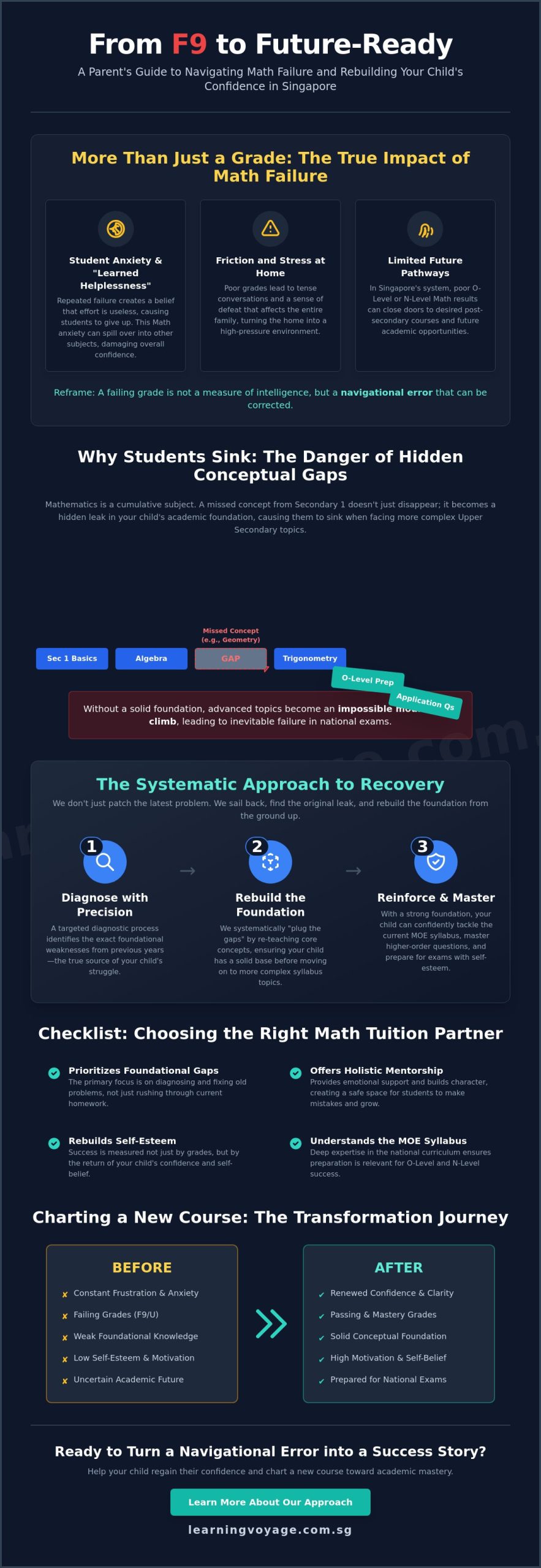
The “Plug-the-Gaps” Technique: A Systematic Approach to Recovery
Stopping the intake of water is the first priority for any vessel in distress, and the same logic applies to a student drowning in mathematical concepts. Most traditional centers attempt to pile new information on top of a shaky foundation, but this only adds weight to a sinking ship. At Learning Voyage, we utilize our proprietary Plug-the-Gaps technique to identify and seal the specific conceptual “leaks” that prevent academic progress. This methodology wasn’t born in a boardroom; it was meticulously developed by our Principal Tutor, Andy Woo, who recognized that failing students don’t need more homework. They need a surgical intervention that addresses the root cause of their misunderstanding. When parents search for a math tuition for failing students sengkang, they aren’t just looking for a teacher; they’re looking for a specialist who can navigate the complexities of the MOE syllabus with a steady, expert hand.
Our small-group coaching dynamic is essential to this recovery process. Unlike large classroom settings where a struggling student might hide in the shadows, our environment ensures every individual receives the mentorship they deserve. This personal touch allows Andy Woo and our team to act as navigators, adjusting the speed and direction of the lesson based on real-time feedback from the student. It’s a transformative process where education shifts from a functional necessity to a journey of personal growth and achievement.
Diagnostic Assessment vs. Standard Testing
Standard school tests tell you that a student is failing, but they rarely explain why. Our diagnostic phase looks beyond the “wrong answer” to uncover the “wrong logic” hiding beneath the surface. We often find that a student is suffering from “unconscious incompetence,” where they don’t even realize which specific rules they are misapplying. By pinpointing these exact moments of confusion, we create a bespoke recovery plan. This isn’t a one-size-fits-all worksheet; it’s a strategic map designed to guide that specific student back to competency. We’ve seen that once these foundational leaks are plugged, the student’s ability to grasp new Upper Secondary topics improves exponentially.
Incremental Success: Building Momentum
Confidence is the fuel that keeps a student moving forward. We don’t expect a jump from an F9 to an A1 overnight. Instead, we focus on “small wins” that prove to the student they are capable of mastery. This might mean finally perfecting algebraic expansion or correctly identifying a trigonometric ratio for the first time. As these wins accumulate, the student’s self-esteem begins to rebuild. The transition from a failing grade to a “C6” is often the hardest part of the journey; once they reach that safe harbour, the path toward a distinction becomes a matter of refined technique and practice. You can read more about our nurturing philosophy on our about us page, where we detail our commitment to building character alongside academic results.
How to Choose the Right Math Tuition for a Struggling Student
Selecting the right educational partner is a critical decision that can determine whether your child continues to drift or finds their way back to shore. When a student is already facing the weight of a failing grade, the last thing they need is another high-pressure environment that mirrors the classroom where they first lost their way. Instead, parents should look for a sanctuary where academic authority meets nurturing mentorship. If you are currently vetting a math tuition for failing students sengkang, your focus must shift from mere academic credentials to the quality of the mentorship provided. A specialist tutor doesn’t just deliver content; they provide the emotional buoyancy a student needs to keep trying when the numbers don’t seem to make sense.
This is particularly true for Secondary 4 E-Math tuition, where the syllabus reaches its peak complexity. At this stage, a student isn’t just learning new topics; they’re preparing for a national examination that will dictate their future academic pathways. A specialist approach is required to help them navigate the specific traps set by examiners while simultaneously repairing any lingering foundational cracks. You want a partner who views your child’s success as a shared mission of personal growth.
Questions Every Parent Should Ask a Tutor
To ensure you’re choosing a tutor who can actually facilitate a turnaround, consider these specific inquiries during your initial conversation:
- “How do you handle a student who has lost all interest in Math?” Look for an answer that emphasizes rebuilding confidence and character, not just drilling worksheets.
- “What is your specific process for identifying Lower Secondary gaps?” An expert should mention a diagnostic approach similar to our Plug-the-Gaps technique.
- “Can you provide examples of students who moved from F9 to a pass?” Real-world transformation stories are the best evidence of a tutor’s ability to navigate academic distress.
Small Group vs. Large Lecture Styles
Struggling students often become masters of “hiding” in large tuition classes. They sit in the back, avoid eye contact, and never raise their hand for fear of asking a “silly” question. This invisibility is a significant barrier to progress. In a small, supportive group, this stigma is replaced by peer encouragement and immediate feedback. When a student realizes they aren’t the only one finding a topic difficult, their anxiety levels drop. This safe environment allows for the “silly” questions that are actually the keys to unlocking complex concepts. Our small-group dynamic ensures that every student is seen, heard, and guided with a methodical hand. If you’re ready to see your child regain their spark, contact us today to find the right class schedule for their recovery.
Charting a New Course: From Failure to O-Level Success
The journey from academic distress to a safe harbour is not merely about changing a letter on a report card. It’s a profound transformation that involves shedding the weight of past failures and embracing a new identity as a capable, confident learner. We’ve seen many students arrive at our doors feeling defeated by the relentless pace of the Singapore education system, their self-esteem battered by years of “U” or “F9” grades. However, it’s vital to remember that failing is a temporary state of being, not a permanent identity. With the right navigator and a methodical approach to plugging conceptual leaks, every student can find their way back to a path of achievement. Choosing a math tuition for failing students sengkang that understands this emotional journey is the first step toward reclaiming your child’s future.
As we’ve discussed in previous sections, the “Plug-the-Gaps” technique provides the necessary repairs to a student’s foundational knowledge. Once the hull is secure, the student can begin to sail with purpose again. This evolution from a struggling learner to a prepared candidate is what we strive for in every lesson. Education, when done correctly, is a transformative process of personal growth that extends far beyond the walls of a classroom. It’s about giving a child the tools to navigate high-pressure environments with a calm and steady hand.
Success Stories of Transformation
We recall a student who joined us after failing Math consistently for two years. They were convinced they simply didn’t have a “Math brain.” Through our systematic approach and attendance in our Intensive Revision Workshops, they didn’t just pass; they achieved a grade that opened doors to their first-choice Polytechnic course. These rapid jumps in performance are possible when we stop drilling the same mistakes and start fixing the root causes. A pass in O-Level Math is a critical milestone in Singapore, acting as a prerequisite for most courses in Polytechnics and Junior Colleges. Reaching this destination provides a student with more than just academic options; it gives them the confidence to face any challenge that lies ahead.
Take Action Before the Next Exam
The most dangerous thing a parent can do is wait for the next mid-year or preliminary exam to see if things “get better” on their own. In a cumulative subject like Mathematics, gaps in knowledge don’t just stay the same; they widen over time as the curriculum introduces more complex variables. The longer a leak is left unaddressed, the more likely the vessel is to sink under the pressure of national examinations. We invite you to book a diagnostic session to assess the current state of your child’s Math knowledge. This is the moment to stop the drift and start the voyage toward success. Your child’s potential is waiting to be unlocked. Contact us today to start your child’s voyage to success and ensure they have the specialized support needed to reach their academic destination.
Empowering Your Child to Navigate Beyond Academic Distress
The weight of a failing grade doesn’t have to define your child’s entire educational voyage. We’ve explored how hidden conceptual anchors can drag down even the most hardworking students, but these leaks are entirely repairable with the right intervention. By identifying specific gaps from previous years and addressing them through a systematic framework, we transform academic distress into a path of personal growth and achievement.
Finding a math tuition for failing students sengkang that prioritizes this holistic development is the first step toward a successful O-Level or N-Level outcome. Led by Principal Tutor Andy Woo, our small group coaching sessions provide the personalized navigation and empathetic guidance your child needs to regain their self-esteem. Our proprietary “Plug-the-Gaps” technique ensures that every foundational weakness is sealed; this allows your child to sail confidently toward their academic destination. It’s time to stop the drift and begin a new chapter of mastery. Secure your child’s academic future—Book a diagnostic session at Learning Voyage. Every student deserves the opportunity to succeed at their own pace, and with the right navigator, the horizon of success is closer than you think.
Frequently Asked Questions
Is it too late for my child to pass Math if they are already in Secondary 4?
It’s never too late to steady the ship, even in the final year of Secondary school. Many students who join our intensive revision workshops in Secondary 4 see rapid improvements by focusing on high-weightage topics and examination techniques. By plugging foundational gaps quickly, we can help a student move from a failing grade to a pass before the national examinations begin.
How is Learning Voyage different from other tuition centres for failing students?
Learning Voyage distinguishes itself through a dedicated focus on emotional recovery alongside academic mastery. We don’t just provide worksheets; we offer a math tuition for failing students sengkang that utilizes a proprietary Plug-the-Gaps technique. This methodical approach, led by Principal Tutor Andy Woo, ensures that we address the root cause of academic distress rather than just treating the symptoms of failure.
How long does it typically take to see an improvement in grades?
Improvement timelines vary based on the depth of the conceptual leaks, but most parents notice a boost in their child’s confidence within the first few weeks. Actual grade transformations usually manifest within one full school assessment cycle. As the student begins to grasp previously daunting concepts, their momentum builds, leading to more consistent results in school weighted assessments and preliminary exams.
Does your Math tuition cover both E-Math and A-Math for failing students?
Yes, we provide specialized support for both Secondary E-Mathematics and A-Mathematics across all Upper Secondary levels. Each subject requires a distinct navigational strategy to master. Our tutors are experts in the specific demands of the MOE syllabus for both tracks, ensuring that failing students receive targeted help to clear their specific academic hurdles and regain their footing.
What if my child has a very poor foundation from Lower Secondary?
A poor foundation from Lower Secondary is exactly what our diagnostic process is designed to fix. We treat these early misunderstandings as the primary anchors dragging down current performance. By going back to basics in a targeted way, we ensure the student’s vessel is seaworthy before tackling the more complex Trigonometry or Calculus found in the Upper Secondary curriculum.
Do you provide materials for students to practice at home?
We provide all our students with proprietary learning materials and curated practice sets designed to reinforce our in-class discovery sessions. These resources are specifically crafted to mirror the types of questions seen in national examinations. Having these tools at home allows students to maintain their progress and build the muscle memory required for mathematical fluency outside of our coaching environment.
How do small group sessions help a student who is shy about failing?
Small group environments remove the fear of being judged for failing, which is a common barrier for many shy students. In a setting with fewer peers, students feel safer asking the “silly” questions that are actually crucial for their personal growth. This intimacy allows the tutor to provide immediate feedback, ensuring no student is left behind in the wake of the lesson.
Can I speak with the tutor before enrolling my child?
We encourage parents to engage in a diagnostic session to assess their child’s current academic standing before enrollment. This allows you to understand our nurturing mentorship philosophy and see how we plan to navigate your child’s specific challenges. It’s a vital step in building the trust necessary for a successful educational partnership and ensuring our methodical approach aligns with your child’s needs.