
Learning Voyage – Math and Science Specialist


By Andy Woo April 30, 2026
Singapore School Holidays 2026: The Ultimate Strategic Guide for Parents and Students
Navigating the Singapore academic year can often feel like steering a ship through a demanding voyage. For parents and students, the school holidays are not merely breaks; they are strategic ports of call—opportunities to rest, refuel, and recalibrate before the next leg of the journey. The key is to transform these term breaks from periods of unstructured downtime into a launchpad for academic excellence and mental well-being.
This guide provides the complete, strategic overview of the Singapore school holidays in 2026. We will go beyond just listing dates from the Ministry of Education (MOE). We will equip you with a concrete framework to balance essential rest with targeted revision, turning anxiety about major exams like the PSLE and O-Levels into a confident, actionable plan.
Table of Contents
-
Planning for Milestones: Primary, Secondary, and JC Holiday Schedules
-
The Psychology of Holiday Revision: Avoiding Burnout and Navigating Stress
-
Maximizing the 2026 Holidays with Learning Voyage’s Intensive Workshops
Official MOE School Terms and Holidays 2026 at a Glance
Having a clear calendar is the first step in effective planning. Below is the full breakdown of the academic year for primary and secondary schools, allowing you to map out family vacations, revision schedules, and crucial rest days well in advance.
Important Note: The following dates for 2026 are projected based on the Ministry of Education’s (MOE) typical academic calendar structure. They are pending official confirmation from MOE, which is usually released in the latter half of the preceding year. Please use these for preliminary planning and refer to the official MOE website for the finalised schedule once it is available. (Public Holidays in Singapore)
-
Start of Academic Year: Friday, 2 January 2026
-
Term 1: 2 Jan – 13 Mar
-
March Holidays: 14 Mar – 22 Mar
-
Term 2: 23 Mar – 29 May
-
June Holidays: 30 May – 28 Jun
-
Term 3: 29 Jun – 4 Sep
-
September Holidays: 5 Sep – 13 Sep
-
Term 4: 14 Sep – 20 Nov
Additionally, remember to account for other scheduled school holidays such as Youth Day, Teachers’ Day, and Children’s Day (for primary schools), the exact dates of which will be confirmed by MOE.
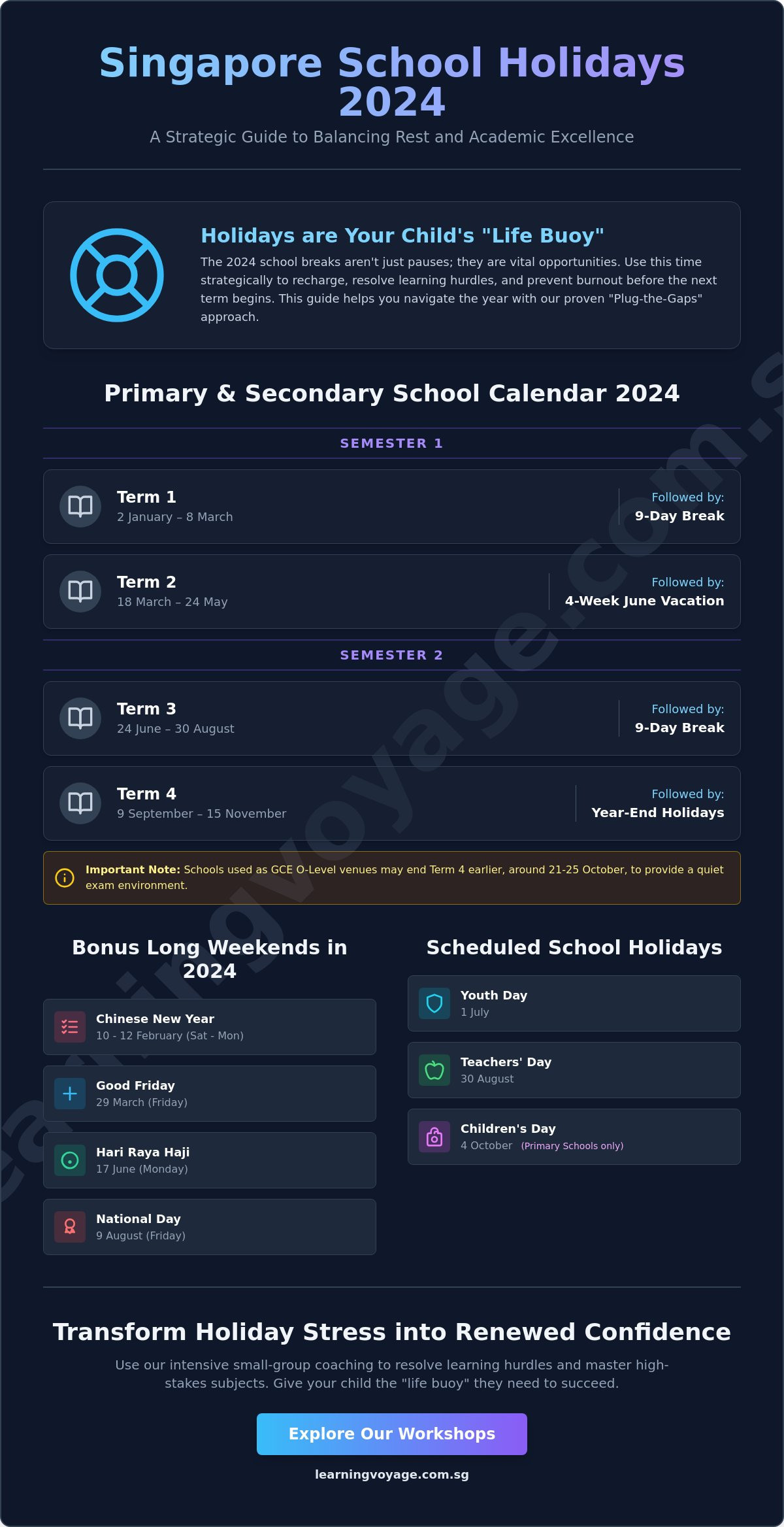
Primary and Secondary School Calendar 2026
The academic year is divided into two semesters, each comprising two terms. Understanding this rhythm is crucial for pacing your child’s learning and revision efforts.
-
Semester 1
-
Term 1: Fri, 2 Jan – Fri, 13 Mar 2026
-
Term 2: Mon, 23 Mar – Fri, 29 May 2026
-
Semester 2
-
Term 3: Mon, 29 Jun – Fri, 4 Sep 2026
-
Term 4: Mon, 14 Sep – Fri, 20 Nov 2026
Parents of graduating cohorts should also note that schools used as venues for the GCE O-Level written examinations may close earlier in late October or November. This will be communicated by the respective schools closer to the date.
2026 Public Holidays and Long Weekends
Public holidays offer fantastic "bonus" breaks for family bonding and mental recharge. In 2026, several public holidays fall on a Friday or Monday, creating valuable long weekends.
-
New Year’s Day: Thursday, 1 Jan
-
Chinese New Year: Tuesday, 17 Feb & Wednesday, 18 Feb (Potentially a 4-day break if Monday is declared a school holiday)
-
Good Friday: Friday, 3 Apr
-
Labour Day: Friday, 1 May
-
Vesak Day: Saturday, 30 May (Monday, 1 Jun will be a public holiday)
-
Hari Raya Puasa: Wednesday, 24 Jun
-
Hari Raya Haji: Friday, 31 Jul
-
National Day: Sunday, 9 Aug (Monday, 10 Aug will be a public holiday)
-
Deepavali: Saturday, 17 Oct (Monday, 19 Oct will be a public holiday)
-
Christmas Day: Friday, 25 Dec
Planning for Milestones: Primary, Secondary, and JC Holiday Schedules
Not all holidays are created equal. The significance of each break changes dramatically depending on whether a student is in a graduating cohort. For those facing the PSLE, O-Levels, or A-Levels, the June and September holidays are less of a vacation and more of a critical preparation window.
The anxiety surrounding the June holidays, in particular, is palpable for many families. It represents the last substantial break before the preliminary exams begin, making it a pivotal moment to either catch up or pull ahead. This requires a delicate balance between aligning family plans and respecting the rigorous demands of the national exam schedule. (Official MOE School Calendar 2026)
PSLE and O-Level Preparation Windows
For students in Primary 6 and Secondary 4/5, the holidays serve as strategic checkpoints in their marathon toward the national exams.
-
The June Holidays: This four-week period is the most critical ‘recovery and catch-up’ phase. It’s the ideal time to solidify concepts from the first semester and address any lingering weaknesses before new topics are introduced in Term 3.
-
The September Holidays: This one-week break is the final ‘sprint’ before the written papers. Revision during this week should be highly focused on timed practices, reviewing mistakes, and fine-tuning exam strategies.
-
Setting Clear Goals: To keep motivation high, it’s essential to have a clear goal in sight. Help your child understand the path ahead by reviewing resources like the JC Cut Off Points to set realistic and aspirational targets for their post-secondary journey.
Junior College and Millennia Institute Specifics
The Junior College (JC) and Millennia Institute (MI) academic calendar operates on a slightly different rhythm. Terms are often longer, and the examination stakes, particularly for H2 subjects, are incredibly high.
-
JC1 vs. JC2: The holiday expectations for a JC1 student are different from a JC2 student. While JC1 students use the breaks to consolidate a year’s worth of foundational knowledge, JC2 students are in an all-out sprint towards the A-Levels.
-
The O-Level to JC Bridge: The long year-end break after the O-Levels is a crucial transition period. For students aspiring to take on challenging subjects like H2 Mathematics, this holiday is a golden opportunity to get a head start and bridge the significant syllabus gap. Specialist programmes like IP & JC Maths Tuition can be invaluable in building this essential foundation early.
The Psychology of Holiday Revision: Avoiding Burnout and Navigating Stress
The pressure to perform in Singapore’s education system is immense, a fact often highlighted in reports by local media like The Straits Times. This pressure doesn’t disappear during the holidays; sometimes, it intensifies. Parents often feel frustrated when their children seem to ‘switch off’ completely, fearing they will fall behind. This is a classic emotional trigger that can lead to friction at home.
The solution isn’t to enforce ‘more work’. It’s to introduce ‘smarter work’. The holiday shouldn’t be a second school term at home. Instead, it should be a time for targeted, effective revision that builds confidence, not resentment. This is where we redefine the holiday by moving away from endless drills and towards a strategic method like our Plug-the-Gaps technique. By focusing on identifying and fixing specific weaknesses, students feel a sense of accomplishment and control, which is the perfect antidote to burnout.
Identifying Academic Gaps Before the Break
Effective holiday revision starts before the holiday even begins. The key is to use the term’s assessments not just as a measure of grades, but as a diagnostic tool.
-
Use Assessment Results: Go through the Term 1 and Term 2 weighted assessments and exam papers. Pinpoint the exact topics or question types where marks were lost. This is far more effective than just re-reading textbooks.
-
Avoid ‘Passive Revision’: Simply reading notes is one of the least effective ways to learn. The holidays are a time for ‘active retrieval’—practising past-year papers and forcing the brain to recall information.
-
Tackle the ‘Scary’ Topics First: Use the longer runway of the holidays to confront the topics your child finds most intimidating. Mastering a difficult chapter early in the break provides a massive confidence boost that fuels motivation for the rest of the holiday.
Managing Exam Stress as a Family
A supportive home environment is a student’s most powerful asset. During the stressful exam season, parents can transform their role from ‘supervisor’ to ‘mentor’.
-
Provide Mentorship, Not Just Supervision: Instead of asking "Have you finished your work?", try asking "What did you find challenging today, and how can we figure it out together?" This shifts the dynamic from one of compliance to one of collaboration.
-
Reward Effort, Not Just Grades: Acknowledge the hard work and persistence your child puts in, regardless of the final score. This builds resilience and a healthier relationship with learning.
-
Know When to Seek Help: If you see signs of persistent struggle or extreme anxiety, it may be time to seek professional support from a specialist tuition centre that understands how to rebuild a student’s confidence from the ground up.
How to Create an Effective Holiday Revision Schedule
A well-structured plan prevents the holidays from being wasted. It provides clarity and momentum, ensuring that both rest and revision are given their due importance. Here’s a simple, four-step process to build a schedule that works.
-
Audit and Identify: Spend the first day of the holiday auditing the past term’s performance. Create a list of 3-5 specific topics or skills that need the most attention.
-
Allocate ‘Deep Work’ Blocks: Schedule 90-minute to 2-hour blocks for cognitively demanding subjects like Additional Mathematics or Physics. These should be during times when your child is most alert, usually in the morning.
-
Build in ‘Guilt-Free Rest’: For every ‘Deep Work’ block, schedule a ‘Guilt-Free Rest’ period. This could be playing sports, watching a movie, or meeting friends. This is non-negotiable and crucial for preventing burnout.
-
Set Achievable Daily Goals: Instead of a vague goal like "study Math," set a specific target like "complete Chapter 5 of the A-Math textbook and mark the practice questions." Small wins create a powerful sense of progress.
The 3:2:1 Holiday Rule
For a balanced approach, consider the 3:2:1 Holiday Rule. For every six blocks of time, allocate them as follows:
-
3 parts Rest and Recreation: This is for genuine downtime, hobbies, and family activities.
-
2 parts Revision: This is for focused work on weak subjects using the ‘Plug-the-Gaps’ method.
-
1 part Skill-building/Exploration: This could be reading, learning a new skill, or exploring a topic outside the school syllabus. This keeps the mind engaged and curious.
This framework helps avoid the common pitfall of a rigid 8-hour study day, which often leads to diminishing returns and exhaustion, especially for secondary school students.
Subject-Specific Focus: Math and Science
Different subjects benefit from different holiday strategies. Use the extended time to tackle complex areas that are hard to master during the fast-paced school term.
-
Primary Maths: The June break is perfect for mastering challenging heuristics. Instead of rushing through assessments, students can spend time deeply understanding the models required for problem sums. A strong foundation in Primary Maths is essential for PSLE success.
-
Secondary Science & Math: Use the holidays to deep-dive into notoriously tricky topics like Organic Chemistry, Trigonometry proofs, or Electromagnetism. The absence of daily homework allows for the sustained focus needed to connect complex ideas.
-
O-Level Practical Prep: The Term 3 holidays are an excellent time to review past practical exam procedures and familiarise oneself with the format, especially for Physics and Chemistry.
Maximizing the 2026 Holidays with Learning Voyage’s Intensive Workshops
For students who need a more structured and guided approach, our intensive holiday workshops are designed to be the ‘life buoy’ they need. These high-impact programs are engineered to resolve specific learning hurdles quickly and effectively, transforming a student’s understanding and confidence in a short period.
Our small group coaching provides the personalised attention that is often missing in a large classroom setting. This allows our expert tutors to zero in on the root cause of a student’s struggle. By applying our signature ‘Plug-the-Gaps’ methodology, we don’t just teach content; we identify and fix the fundamental misunderstandings that are holding a student back.
To see how we can support your child’s journey, you can view our class schedules for upcoming holiday intensives.
Why Choose Intensive Revision Workshops?
Holiday workshops offer a powerful boost right when it’s needed most, especially for PSLE, O-Level, and A-Level candidates.
-
Rapid Content Mastery: We condense the most critical, exam-heavy topics into a structured, easy-to-digest program.
-
Focus on Exam Techniques: We go beyond theory to teach students how to tackle ‘common trap’ questions and manage their time effectively under exam conditions.
-
Proven Transformation: Our methodical, step-by-step guidance has a track record of helping students make remarkable progress, transforming grades and, more importantly, their belief in their own abilities.
Join the Journey of Excellence
At Learning Voyage, our mission extends beyond achieving high scores. We are committed to moulding students into responsible, confident young adults who are ready to navigate the challenges of the future. The testimonials from our students and parents speak to the ‘life buoy’ they found with us—a supportive environment where they could finally overcome their academic struggles.
The 2026 school holidays are a finite, precious resource. Let’s work together to make them count. Contact us today to discuss how we can tailor a plan for your child and secure a spot in our 2026 holiday workshops.


