
Pure Science isn’t automatically the better choice for every student. In Singapore, knowing how to choose between pure and combined science starts with understanding the difference: Combined Science assesses two disciplines as one subject, while Pure Science assesses each discipline separately, with its own grade.
It’s understandable to feel pressure around this decision, especially when a student’s confidence, workload and future study plans all seem to be at stake. The choice is commonly made in Secondary 2, but it doesn’t have to be a verdict on a student’s ability. The right fit depends on what they enjoy, how they’re progressing and which pathways they may want to keep open.
This guide compares the subject structures, assessment demands and possible routes to junior college or polytechnic, then explains what to consider if a student is thinking about switching. You’ll come away with a clearer way to weigh academic goals against day-to-day readiness, so the decision feels less like a leap into uncertainty and more like a course you can navigate with care.
Key Takeaways
- Choose a science combination that matches the subjects your child enjoys and can manage consistently, not simply the option that sounds more prestigious.
- Compare the Chemistry content and practical assessment demands before deciding which course structure feels like a better fit.
- Keep future study plans in view: some junior college science pathways commonly expect the corresponding Pure Science subject, while polytechnic entry can accept either route if requirements are met.
- If results and workload are causing concern, consider whether switching to Combined Science could make the study path more manageable.
Pure Science vs Combined Science: Which to Choose?
In Singapore, the key difference is how science disciplines are grouped and how deeply each is studied. To choose between the two, compare the subject structure, practical assessment and workload involved in each route.
Syllabus Depth and Subject Structure
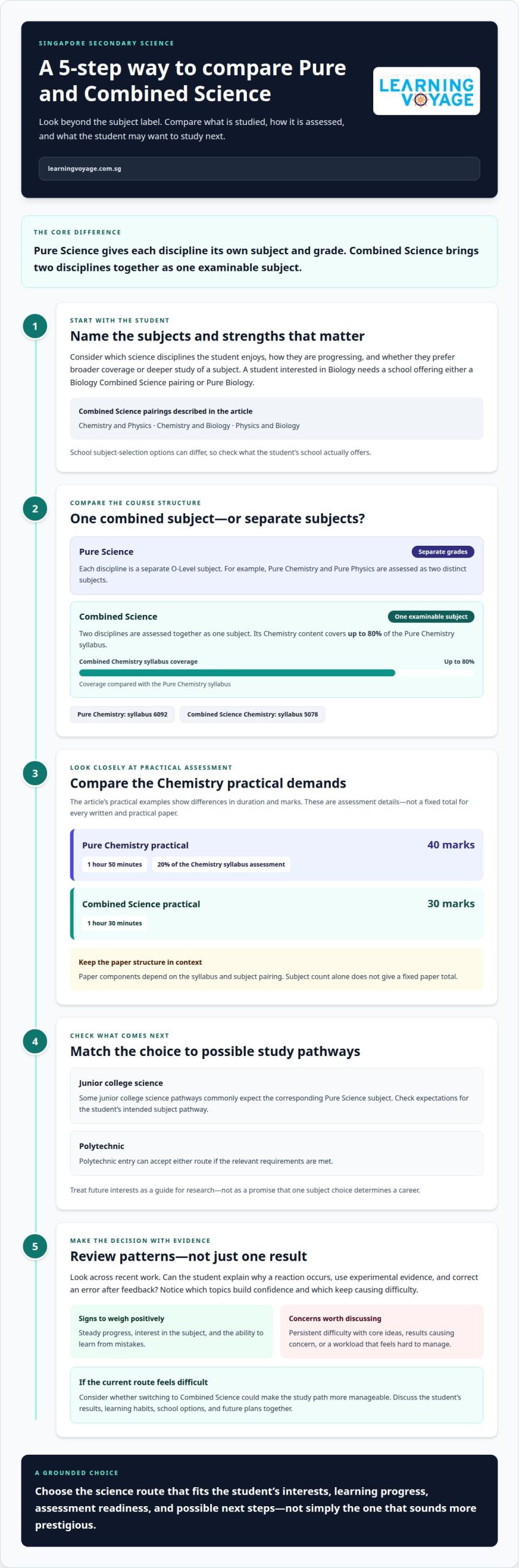
Pure Science treats each discipline as a separate O-Level subject, with its own grade. A student taking Pure Chemistry and Pure Physics, for example, studies and is assessed in two distinct subjects. Combined Science brings two disciplines together as one examinable subject, such as Chemistry and Physics. Its Chemistry content covers up to 80% of the Pure Chemistry syllabus, so the combined route has less Chemistry breadth while still developing knowledge across two disciplines. The choice changes both the depth of study and how results are recorded.
O-Level Subjects and Papers
For subject count, Combined Science is one examinable subject covering two disciplines; each Pure Science discipline counts as a separate subject with its own grade. Paper components depend on the syllabus and subject pairing, so the subject count alone does not give a fixed paper total. Practical assessment offers a concrete comparison: the Pure Chemistry practical exam lasts 1 hour and 50 minutes, is worth 40 marks and contributes 20% of the Chemistry syllabus assessment. The Combined Science practical assessment lasts 1 hour and 30 minutes and is worth 30 marks. These formats affect how students prepare for written and practical work.
School Subject Combinations and Policies
Singapore schools offer Combined Science in Chemistry and Physics, Chemistry and Biology, or Physics and Biology combinations. Pure Science keeps disciplines separate, giving students a distinct subject and grade for each one they take. The options depend on the school’s subject-selection process, so one school’s choices may differ from another’s. For example, a student interested in Biology needs a school that offers either a Biology combination in Combined Science or Pure Biology. Compare the subjects available with the student’s interests and learning strengths.
| Option | Subject structure | Assessment example |
|---|---|---|
| Pure Science | Separate subjects and grades | Pure Chemistry practical: 40 marks |
| Combined Science | Two disciplines, one examinable subject | Practical assessment: 30 marks |
Choose the route that best matches the student’s subject interests, preferred depth of study and readiness for practical and written assessments.
Pure Chemistry and Combined Science subject structure
The syllabus identifiers help families compare the Chemistry component precisely: Pure Chemistry is syllabus 6092, and Combined Science Chemistry is syllabus 5078. These codes identify distinct examination syllabuses, so use the relevant code when reviewing a student’s notes, practice papers or course expectations. The code alone doesn’t show whether the subject suits the student; their comfort with the content matters too.
Combined Science Chemistry covers up to 80% of the Chemistry syllabus. That difference in coverage can matter to a student who enjoys exploring Chemistry in depth, but breadth is only one part of readiness. Consider how the student handles explanations, chemical equations and applying ideas to unfamiliar examples. Strong interest paired with steady progress may support deeper study; repeated difficulty with core ideas may call for targeted revision first.
Use recent work to assess aptitude rather than relying on one test. Look for patterns: can the student explain why a reaction occurs, use experimental evidence and correct an error after feedback? A student who understands a concept after reviewing mistakes may be developing useful study habits, even if an early result was disappointing. Compare performance across topics and note which tasks build confidence or cause persistent stress.
Future subject plans also deserve careful attention. A student considering H2 Chemistry should think about whether the O-Level Chemistry route provides a sound foundation for that next stage. Discuss the intended subject with the school, alongside the student’s results and learning habits. This keeps the choice connected to a clear academic aim without treating one current grade as the whole story.
For students pursuing Pure Chemistry, focused support can help strengthen challenging concepts and exam preparation. Pure Chemistry tuition support can provide a structured way to work through learning gaps and build confidence.
Further study and career pathways
Science can prepare students for different kinds of further study and work, but a subject choice alone does not determine a career. Start by noticing which activities hold the student’s attention. Do they enjoy analysing evidence, explaining how a process works or testing an idea through practical investigation? These preferences can help families explore possible directions without expecting a secondary school student to settle on an occupation.
Turn those interests into practical exploration. Choose a possible area of study, look at the subjects and tasks it involves, then discuss whether they suit the student. For example, someone drawn to laboratory work may want to explore courses involving practical investigation. A student who enjoys interpreting results might be curious about programmes that use data and evidence. Treat these examples as starting points for research, not promises about future employment.
Keep the student’s learning habits in view, too. A course may sound appealing, but its day-to-day demands matter. Ask whether the student enjoys careful observation, revising explanations in light of new evidence or communicating findings clearly. These questions can help compare areas of study and identify an engaging learning environment. Parents can support the process by listening to what energises their child, not just focusing on high marks.
Career interests can change as students encounter new topics. Keep a simple record of subjects, projects and practical tasks that spark curiosity, then use it to guide later conversations about study choices. If a student is undecided, they can focus on building sound science study habits while exploring more than one direction. A thoughtful pathway develops through experience, reflection and informed choices, not from one O-Level subject decision.
Switching from pure Science to combined Science
A switch from Pure Science to Combined Science can be a practical reset, not a sign of failure. Consider it when sustained difficulty across subjects is affecting progress, confidence or time for other O-Level work. One suggested indicator is averaging 40-50% across subjects. Treat that range as a prompt to review the whole picture, rather than an automatic rule for changing courses.
Start by identifying what is driving the struggle. Is the student finding one Pure Science discipline difficult, or are Chemistry, Physics and other subjects all demanding more time than they can manage? Review recent results, incomplete assignments, revision habits and test-related stress. For example, a student who enjoys Chemistry but repeatedly falls behind across several subjects may need a different balance from one whose difficulty is limited to a single topic.
Next, consider what changes with Combined Science. It groups two science disciplines into one examinable subject, with pairings of Chemistry and Physics, Chemistry and Biology, or Physics and Biology. A switch may mean less depth in each discipline, but students still need to learn both components. Consider whether the new pairing suits the student’s interests and strengths rather than assuming it removes the science workload.
Timing matters. A change closer to O-Level examinations can mean catching up with a different syllabus and assessment approach, so discuss the proposed move with the school and clarify what material the student would need to cover. If the student is considering H2 Chemistry or H2 Physics later, remember that the corresponding Pure subject is commonly expected. Strong Combined Science results may still support some JC science-stream applications, depending on pairing and overall performance.
Make the decision collaboratively: review performance, identify the source of pressure, compare future plans, then discuss the switch with the school. If science foundations need attention before that decision, explore science learning support to help build confidence in core concepts.
Learning Voyage Education Centre
Learning Voyage Education Centre supports students in strengthening subject foundations as they plan their next academic steps. When exam stress or recurring gaps make the science decision harder, structured learning support can help students approach their studies with greater clarity and confidence. The centre’s Plug-the-Gaps technique identifies specific learning hurdles and gives students a clear starting point for improvement.
Use that support alongside discussions about subject interests, recent progress and future study plans. The aim is not to choose a pathway for the student, but to help them feel more prepared to make an informed decision.
Contact Learning Voyage Education Centre to discuss the next step in your child’s learning journey.
Make the Next Step with Confidence
This decision does not define a student’s ability or future. It is one stage in a longer learning journey, shaped by curiosity, confidence and changing goals. Choosing between pure and combined science becomes more manageable when families focus on the student’s current needs while keeping future options in view.
Before deciding, make time for an honest conversation about what feels difficult, what sparks interest and what support could help. Exam pressure can make every choice feel final, but a considered decision gives students a clearer path and room to keep growing. Parents can help by listening first, then turning concerns into practical next steps.
If you’d like support as your family considers those next steps, contact Learning Voyage Education Centre. With steady guidance and a plan that fits the student, confidence can grow alongside academic progress.
Frequently Asked Questions
What Should You Do?
Set aside time for a family discussion before making a subject choice. Ask the student to name one science topic they enjoy, one they find difficult and one question they still have about the options. Write down the answers, then use them to guide a focused conversation with the school. This gives the student a voice and helps parents turn worry into specific points to discuss.
Which Option Helps You Score Better in O-Levels?
Neither route automatically leads to a higher O-Level score. To judge readiness, review recent marked work: note whether errors come from misunderstood concepts, incomplete answers or difficulty applying knowledge. Then check whether the student can correct those errors after feedback. This is a more practical guide than choosing based on which option sounds easier or carries more status.
What is the difference between pure science and combined science in Singapore secondary schools?
The main difference is how science disciplines are organised for study and examination. On a school’s subject-choice sheet, check whether each discipline appears as a separate subject or within a Combined Science title. For example, Chemistry paired with another science appears as one Combined Science subject. This helps families understand the choices before comparing their academic fit.
How are pure and combined science graded in the Singapore-Cambridge O-Level examination?
Combined Science reports an overall grade that reflects performance across its components. For example, an A1 in Combined Science Chemistry and a C6 in the other component may combine to an overall grade of B3/4. The practical point is to prepare consistently across both components, rather than relying on strength in only one. Review feedback for each area to spot where further practice would help.
What are the subject eligibility requirements for taking pure science in Singapore schools?
Eligibility depends on the school’s subject-selection process, so options can differ between schools. Before discussing the choices, gather recent science results and note topics where the student has shown steady understanding or needs more support. Ask how the school assesses readiness for each option. This keeps the conversation specific to the student instead of relying on a general rule.
Can students switch between pure and combined science, and when can they do so?
Students may be able to switch, but timing and process depend on their school. Raise the possibility as soon as the current arrangement seems unsustainable, and ask what learning would need to be covered after a change. Include the student in the conversation so they understand the new course and can take part in the decision.