
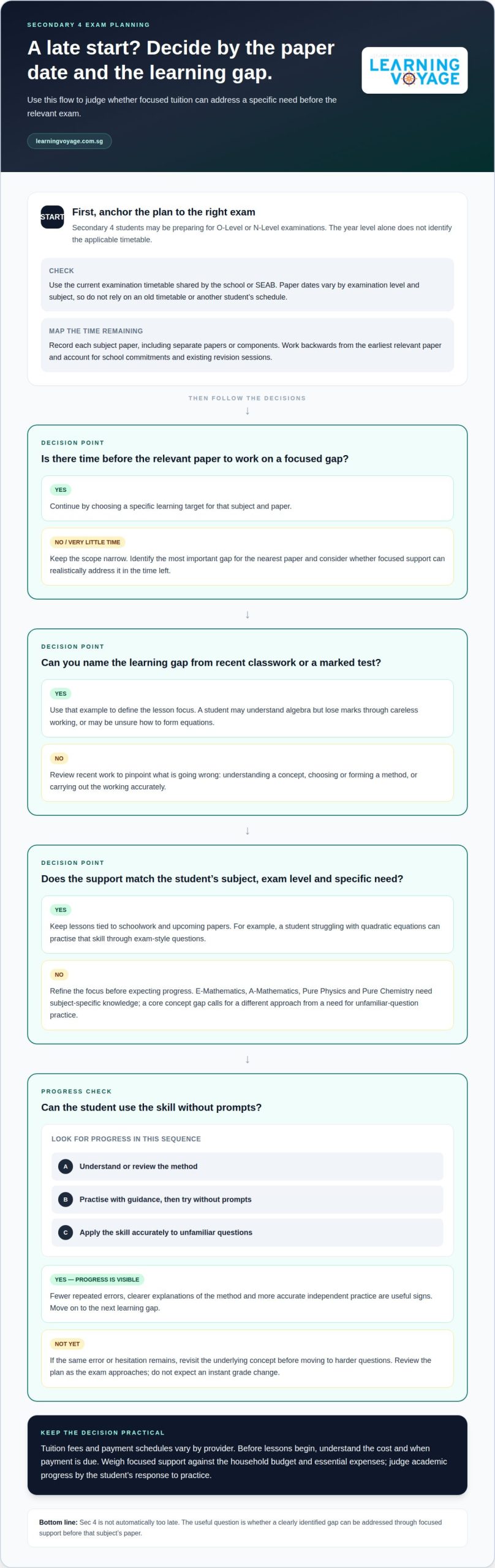
Sec 4 is not automatically too late for tuition. If you’re wondering whether it’s too late to get tuition in Sec 4, the answer depends on how much time remains, which topics are causing difficulty and what support can realistically address before the exams. Starting later may mean a tighter focus, not that there’s no point in getting help.
It’s understandable to feel pressure when your child is behind and exams are approaching. Parents may also wonder whether tuition is a sensible use of household funds. The key question is whether focused support can address specific learning gaps in the time available, and whether the cost fits your budget.
This article explains how to judge whether tuition could still help, what a late start means for exam preparation, and how to weigh the financial commitment. It also shows how to focus support on the learning gaps and exam priorities that matter most, so your next step is considered rather than rushed.
Key Takeaways
- Use your child’s exam timetable and current learning gaps to judge how much time remains for focused support.
- Consider progress through clearer understanding, fewer repeated errors and more confident practice, rather than expecting instant results.
- Match tuition to the student’s subject and exam level, and find out how lessons will target the most important gaps.
- Before using personal funds, weigh the value of focused support against your household budget and other essential expenses.
When do Singapore Secondary 4 students take O-Level or N-Level exams?
- Start by identifying the student’s examination level. Secondary 4 students may be preparing for the Singapore-Cambridge O-Level or N-Level examinations, and the year level alone doesn’t tell you which timetable applies. Use the examination details shared by the school to identify the correct route before planning revision or tuition.
- Check the current examination timetable through the Singapore Examinations and Assessment Board (SEAB) or the student’s school. Paper dates vary by examination level and subject, so an old timetable or another student’s schedule may not apply. Plan from the current information, not an assumed month or date.
- Record every subject paper on the student’s timetable. For example, an O-Level candidate taking Mathematics and Science should note the dates for both subjects, including any separate papers or components. This makes it easier to prioritise topics and see how much revision time remains.
- Work backwards from the earliest paper, not just the final examination date. If the Mathematics paper comes first, prioritise that deadline. Mark school commitments and existing revision sessions, then identify realistic periods for targeted practice before each paper.
- Keep the plan current using school notices. If the school provides an individual schedule or updates examination arrangements, use that as the working version. Discuss the dates with your child and identify whether the main concern is one subject, several topics, or a broader revision plan.
- Judge a late start against the time remaining before the relevant paper. The question “is it too late to get tuition in Sec 4?” has no single answer based on the student’s level alone. A timetable helps show whether focused support can address a particular gap before that subject’s examination.
The timing varies by examination level and subject. Check the current timetable from SEAB or the student’s school.
How long does it take for tuition to improve Secondary 4 exam results?
- Start by identifying the learning gap, because different problems call for different teaching and practice. A student who understands algebra but loses marks through careless working needs a different plan from one who is unsure how to form equations. Use recent classwork or a marked test to pinpoint the issue.
- Choose a focused first target instead of trying to repair every subject at once. For example, a Secondary 4 E-Mathematics student might work first on quadratic equations, then apply that skill to exam-style questions. A smaller target makes it easier to see whether explanations are translating into independent problem-solving.
- New learning needs time to move from explanation to independent practice. A student may first review a method, then try questions without prompts. Progress is clearer when they can apply the same skill accurately to unfamiliar questions, not just examples covered in the lesson.
- Track progress using specific evidence after each lesson. Compare errors in worked solutions, note which question types still cause hesitation, and check whether the student can explain the method. A correct answer is useful, but clear reasoning shows whether the knowledge is taking hold.
- Keep practice connected to the student’s schoolwork and upcoming papers. If a student repeatedly struggles with differentiation in A-Mathematics, targeted revision and regular question practice are more useful than rushing through unrelated topics. Families considering A-Mathematics tuition in Singapore can use that subject focus to guide support.
- Review the plan as exam pressure changes. If the student is improving on a topic, move to the next gap. If the same error persists, revisit the underlying concept before attempting harder questions. This steady cycle builds accuracy and confidence without creating an expectation of an instant grade change.
In Singapore, tuition fees and payment schedules vary by provider. Ask about the cost and when payment is due before lessons begin, then keep that budgeting decision separate from academic progress: lesson frequency and the student’s response to practice are more relevant when judging whether support is helping.
How can I find a Secondary 4 tutor for a specific subject or exam level
- Start with the student’s examination level and subject. Note whether they’re preparing for O-Level or N-Level papers, then specify the subject, such as E-Mathematics or Pure Chemistry. This keeps a broad request for “science help” from obscuring the actual learning need. Use the school’s subject information and recent work to define the focus.
- Identify the gap using a real example. A marked algebra question may show that the student understands the method but makes errors in their working. A Chemistry response may reveal difficulty explaining a concept. Pinpointing the problem helps shape tuition around what the student needs to learn, rather than repeating familiar material.
- Match the subject to the required expertise. E-Mathematics, A-Mathematics, Pure Physics, and Pure Chemistry each require different subject knowledge. Consider the student’s current understanding too: someone confused by a core concept needs guided explanation, while a student who knows the content may need practice applying it to unfamiliar questions.
- Use the student’s school assessments to define useful lesson content. For example, bring a recent test with A-Mathematics questions where the student lost marks. Focused support can address the underlying concept, practise related problems, and help the student explain each step independently. This makes progress easier to observe than simply counting completed questions.
- Choose a format that supports steady study alongside school commitments. Consider whether the student can attend regularly, complete practice between lessons and review mistakes without adding unsustainable pressure. A clear subject focus, realistic study rhythm and attention to confidence can help the student approach Secondary 4 revision with greater purpose.
For a separate education-tax consideration, distinguish tax-credit eligibility from choosing a tutor by subject or exam level. A student generally must be enrolled at least half-time in a qualifying post-secondary program for at least 1 academic period during the tax year to be eligible for the American Opportunity Tax Credit. Qualified expenses for US education tax credits generally include tuition and required enrollment or attendance fees at eligible post-secondary institutions. A student generally must receive Form 1098-T to claim a US education tax credit, subject to exceptions.
What should I ask a tutor before starting Secondary 4 tuition close to exams?
- Ask how the tutor identifies a student’s main learning gaps. For example, do they review a marked E-Mathematics paper, classwork, or a topic the student finds difficult? A clear starting point helps keep lesson time focused on areas the student has not yet mastered.
- Check that lessons match the examination level and subject. O-Level A-Mathematics, E-Mathematics, Pure Chemistry, and Pure Physics each require different subject knowledge. The plan should focus on the student’s syllabus needs rather than relying on broad revision alone.
- Ask what a typical lesson involves. Does the student revisit a concept, work through examples, attempt questions independently, and review errors? This sequence helps you judge whether tuition develops understanding and exam skills, rather than relying only on explanations or worksheets.
- Ask how progress is reviewed. For instance, does the tutor track repeated algebra mistakes or check whether the student can apply a science concept to a new question? Specific indicators show where confidence is growing and which gaps still need attention.
- Consider how tuition fits around schoolwork and the examination timetable. Set priorities by subject, account for existing commitments, and leave enough time for independent revision and rest alongside the school’s preparation.
- Ask how the tutor responds when a student remains confused about a topic. Revisiting the underlying idea, using a different example, and then guiding the student through a related question can help clarify the concept. This is particularly useful when exam pressure makes it harder to ask for help.
Have a subject priority in mind? Share your tuition enquiry and the learning support your child needs.
Learning Voyage Education Centre
Learning Voyage Education Centre can help families turn exam concerns into a focused plan for Secondary 4 Mathematics. Its small-group coaching and Plug-the-Gaps technique are designed to identify learning hurdles and address them, helping students build understanding alongside confidence.
Consider this support when a student is struggling with specific topics, losing confidence in practice, or unsure how to prepare for O-Level Mathematics. Relevant options include Secondary 4 E-Mathematics and A-Mathematics tuition, with Secondary 3 Mathematics tuition also available for students at that level. Tuition can provide structure and targeted guidance, while progress still depends on the student’s learning needs and practice.
To discuss your child’s subject and learning needs, contact Learning Voyage Education Centre.
Choose a next step that feels manageable
If you’re still weighing whether it’s too late to get tuition in Sec 4, turn that uncertainty into one practical conversation with your child. Ask what feels hardest right now, then agree on a realistic next step together. Feeling heard can ease tension at home and help your child take a more active role in preparing for exams.
If you’d like to discuss your child’s learning needs, contact Learning Voyage Education Centre. A thoughtful conversation can help your family decide how to move forward with greater clarity and confidence.
Frequently Asked Questions
Is it too late to start tuition in Secondary 4 in Singapore?
No, starting tuition in Secondary 4 isn’t automatically too late. The useful question is whether support can address a current learning need before the relevant paper. For example, a student who understands most topics but struggles to apply them may benefit from focused practice. Set a specific aim, such as improving working for one topic, rather than expecting tuition to resolve every difficulty at once.
Can students join tuition classes partway through the school year in Singapore?
Yes, students can begin tuition partway through the school year. At Learning Voyage, enrolment can be started by calling, messaging, or completing an online form. To help make the transition purposeful, identify the subject and examination level, then share a recent class exercise or a topic the student finds challenging. This gives the learning support a practical starting point without waiting for a new school year.