
A low science mark isn’t proof that a child can’t succeed. If it feels as though my child lacks confidence in science, start by noticing signs of insecurity, offering reassurance, easing the pressure around mistakes, and choosing words that recognise effort and progress.
It’s understandable to worry when your child avoids science homework, feels tense before a test, or says they’re “just not good at it”. Pushing harder may seem helpful, but calm support can make it easier for them to ask questions and try again. Learn to recognise signs of low confidence, respond to defensiveness, ease science-related stress, and encourage a more positive approach to learning. These practical steps can help your child build confidence at their own pace.
Key Takeaways
- Notice whether your child becomes defensive or avoids talking about science; a calm conversation can uncover what feels difficult.
- Help reduce stress by listening to your child’s worries and breaking challenging work into manageable steps.
- Recognise effort and progress, and discuss mistakes as chances to learn rather than reasons to feel like a failure.
- Offer reassurance when your child seems unsure, while encouraging them to ask questions and try again at their own pace.
Defensive behaviour and insecurity about school abilities
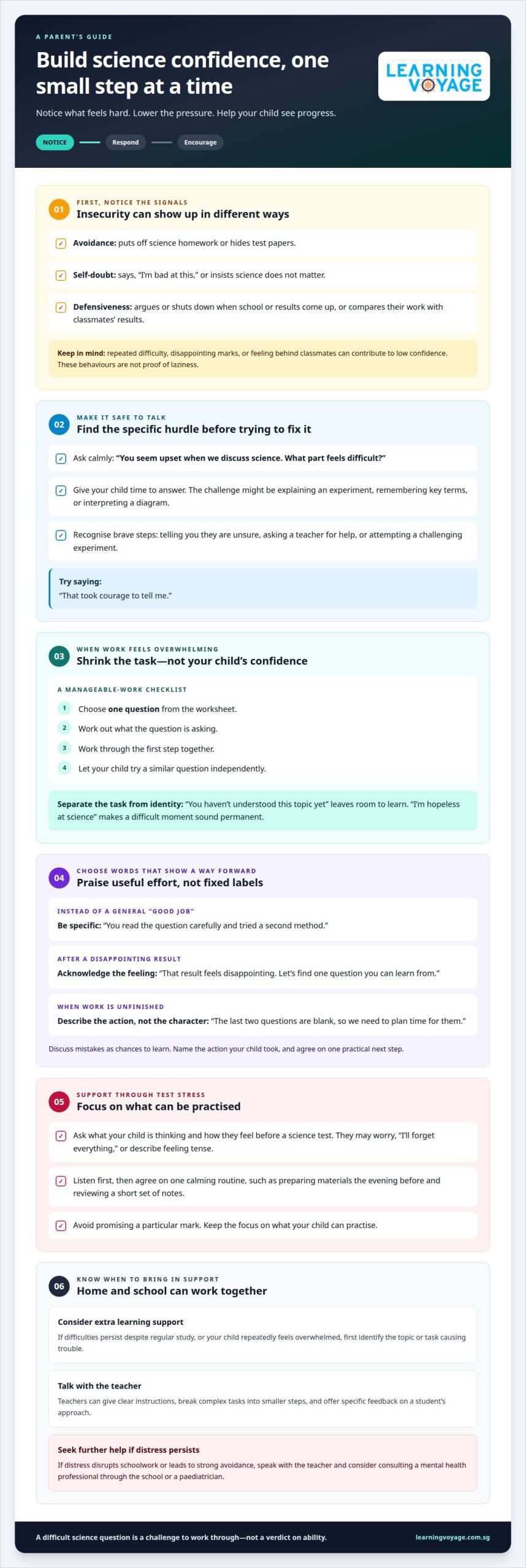
What are signs that a child lacks confidence in science? They may avoid homework, hide test papers, or say, “I’m bad at this.” They may also become defensive when you ask about school or compare their work with classmates’ results.
Why do children lose confidence in science? Repeated difficulty understanding lessons, disappointing marks, or feeling behind classmates can all contribute. A child who expects criticism may protect themselves by arguing, shutting down, or insisting that science doesn’t matter.
Respond to the behaviour without treating it as proof of laziness. Try asking, “You seem upset when we discuss science. What part feels difficult?” Give your child time to answer. This keeps the conversation focused on a specific hurdle, such as explaining an experiment or remembering key terms.
Recognise brave behaviour when it happens. If your child admits they don’t understand a question, say, “That took courage to tell me.” Notice when they ask their teacher for help or attempt a challenging experiment. A small reward can mark the effort, but be specific about what you’re praising.
Give clear feedback about positive behaviour. Instead of saying only “good job,” name the action: “You read the question carefully and tried a second method.” This helps your child see which habits were useful, even if the answer was wrong. Keep praise sincere and specific.
What is the cost of science tuition in Singapore for primary and secondary students? Fees vary with the child’s level, lesson format, and support needed. Providers set costs around these factors and share the amount after a quote request.
When should I consider science tuition for my child in Singapore? Consider extra support if difficulties persist despite regular study, or your child repeatedly feels overwhelmed by lessons. First identify the topic or task causing trouble, such as interpreting data or applying concepts.
How can I find science enrichment programmes and hands-on activities in Singapore? Review school and community programme notices, then choose activities that involve observation and simple experiments. At home, compare how much water different paper towels absorb, and invite your child to predict and explain the result.
2. Mindset, counseling, and stress management
A difficult science question can feel like proof of failure to a worried child. Help them separate the task from their identity: “You haven’t understood this topic yet” leaves room to learn, unlike “I’m hopeless at science.” Ask what feels hardest, such as interpreting a diagram, remembering terms, or explaining an experiment.
Then make the next step manageable. If a worksheet feels overwhelming, choose one question, identify what it asks, and work through the first step together. Afterward, let your child try a similar question independently. This gives them practice solving problems instead of avoiding every situation that feels uncomfortable.
Can science anxiety affect a child’s school performance, and when should I seek help? Anxiety can make it harder to focus, remember information, or ask questions in class, which may affect learning. If distress persists, disrupts schoolwork, or leads to strong avoidance, speak with the teacher and consider consulting a mental health professional through the school or a paediatrician.
Ask about your child’s thoughts and physical reactions before a science test. They might say, “I’ll forget everything,” or describe feeling tense. Listen first, then agree on one calming routine, such as preparing materials the evening before and reviewing a short set of notes. Avoid promising a particular mark; focus on what they can practise.
For Primary 5 and Primary 6 students who need guided help with science concepts, primary science tuition can provide structured learning support alongside encouragement at home.
Mindset work, counselling, and stress-management techniques can support children’s mental health. Difficulties with learning, focusing, reading, remembering, and thinking can cause ongoing stress. Learning struggles may also act like chronic stress or trauma in the brain, which can affect areas involved in memory and emotional regulation. Parents can build confidence by giving children manageable tasks to complete independently and supporting them if problems arise or they make mistakes. Children as young as preschool age who take part in school-based mindfulness meditation programmes can experience decreased stress and aggression and improved cognitive performance.
3. Parental words and attitudes
What your child hears after a difficult science test can shape their confidence. If they say, “I’m bad at science,” don’t argue or rush to correct them. Try, “That result feels disappointing. Let’s find one question you can learn from.” This acknowledges their feelings without treating one mark as a verdict.
Praise effort and choices rather than fixed labels such as “clever”. For example, say, “You reread the question and explained your answer clearly.” If the result is poor, discuss one next step, such as practising how to interpret a food chain diagram. This turns feedback into a useful way forward.
Discipline works better when you describe the action, not your child’s character. Instead of calling them “lazy” for leaving a science worksheet unfinished, explain the problem: “The last two questions are blank, so we need to plan time for them.” Agree on a practical step, such as completing one question before dinner.
Make room for different strengths. One child may enjoy drawing plant parts, while another remembers facts through discussion. Encourage your child to try different hobbies, such as nature sketching or building simple models, and notice what holds their interest. Science is one area of learning, not a measure of their overall ability.
How can parents make science fun at home with simple experiments? Ask your child to predict what will happen when a small object is placed in water, then observe whether it floats or sinks. Invite them to explain their prediction and describe what changed their thinking.
How should I respond when my child says they are bad at science? Ask which part feels hardest, then choose one example to work through together. You might say, “Let’s look at how you identified the different parts of this plant,” rather than insisting they should feel confident.
Compare your child’s progress with their own earlier work. Look at an earlier worksheet beside a recent one and identify a skill they’ve practised, such as using evidence in an answer. This helps you recognise growth without measuring your child against a classmate.
Recognising a need for reassurance
Some children ask for reassurance directly; others show their worries through changes in routine. Notice whether your child avoids opening a science workbook, repeatedly asks if an answer is correct, or becomes unusually quiet before a test. One difficult evening may reflect tiredness, but a repeated pattern deserves a calm conversation.
Choose a private moment, such as walking home from school, and ask one clear question: “Which part of science feels hardest this week?” Listen for a specific worry, such as forgetting vocabulary or giving the wrong answer in class. Reflect what you hear before offering advice: “You’re worried people will notice if you make a mistake.”
Reassurance works best when it is honest and practical. Instead of promising your child will get every question right, remind them of a skill they can use: “You can read the question again and underline what it asks.” Then encourage one manageable attempt, such as explaining a diagram aloud before writing an answer.
Watch for changes beyond homework. A child who stops discussing a favourite topic, loses interest in school plans, or regularly says they are not good at anything may be carrying worries into other parts of life. Ask about friends, teachers, and classroom activities. These details can reveal whether the concern is limited to science or affecting school more broadly.
If your child behaves very differently at home and school, speak with their teacher about what they observe. Share examples, such as answering freely at home but staying silent during class discussions. If distress continues or interferes with learning and daily routines, seek guidance from a mental health professional through the school or a paediatrician. Clear observations help adults decide what support may help.
Keep a brief record of what happens before and after science tasks: the topic, your child’s reaction, and what helped them begin. For example, note whether a short break or reading instructions together made a worksheet more manageable. These details can help you offer reassurance that fits your child, rather than repeating general encouragement.
Children who lack confidence may rely on others for validation and reassurance. Set attainable goals together to recognise their potential and build confidence in class. If school questions make them defensive, reassure them that asking for help is nothing to be ashamed of.
Learning Voyage Education Centre
Learning Voyage Education Centre provides mathematics tuition for students who need help working through subject concepts and learning gaps. If your child’s confidence concerns also affect mathematics, structured support may help them approach questions with greater clarity and independence. Available options include Primary 5 and Primary 6 Mathematics Tuition, as well as Secondary 1 and Secondary 2 Mathematics Tuition. For older students, support includes Secondary 3 and Secondary 4 E-Mathematics and A-Mathematics Tuition.
Building science confidence may call for patient conversations at home, collaboration with your child’s teacher, or guidance from a mental health professional when distress persists. If your child also needs help with mathematics, Learning Voyage provides small-group tuition using its “Plug-the-Gaps” technique to identify and address learning hurdles. Trial classes are available for both maths and science.
Give confidence room to grow
Confidence grows through repeated experiences of trying, reflecting, and discovering that a difficult idea can become clearer. If my child lacks confidence in science, I can offer a steady presence without taking over: listen to what feels hard, agree on a small next step, and notice when they attempt it. That support helps a child see learning as a path they can keep moving along, even when exam pressure makes progress feel slow.
Learning Voyage Education Centre also supports students with mathematics, including Secondary 3 A-Mathematics Tuition and Secondary 4 E-Mathematics and A-Mathematics Tuition. If your child could use guidance in these subjects alongside your support at home, contact Learning Voyage Education Centre to discuss the next step. Keep encouraging curiosity, one question and one discovery at a time.
Frequently Asked Questions
How can I help my child build confidence in science?
Help your child see science as something they can explain, not just a subject to score in. If my child lacks confidence in science, I can invite them to choose an everyday question, such as why a bathroom mirror fogs, and draw what they think happens. Find the related concept in their textbook and let them explain it in their own words. Praise clear reasoning, even when their explanation needs refining.