
A strong maths foundation grows through four connected habits: solving problems for understanding, practising regularly, mastering core arithmetic and place value, and building skills in step with Singapore’s school pathways. Knowing how to build a strong math foundation means helping a child understand why a method works, not just remember which steps to follow.
It’s understandable to feel concerned when homework becomes a struggle or exam stress shakes a child’s confidence. A difficult topic does not define their potential. Clear explanations and steady practice can help them rebuild confidence at their own pace.
This guide shares practical ways to develop problem-solving skills, make maths practice part of everyday life, strengthen number sense and connect learning with Singapore’s school syllabus. Small, consistent steps can make later topics easier to manage.
Key Takeaways
- Help your child explain why a method works, use visual models to untangle problems, and treat mistakes as clues for what to practise next.
- Build maths into everyday routines and keep practice consistent, so new skills become easier to recall and apply.
- Strengthen number sense by connecting place value with addition, subtraction, multiplication and division before moving to more complex ideas.
- Match support to your child’s current learning stage and Singapore school pathway, so progress feels manageable rather than overwhelming.
1. Mathematical problem-solving
Maths understanding grows when students explain why a method works, rather than simply recall its steps. Ask your child what each operation does and why it suits the problem. A correct answer matters, but clear reasoning shows whether they can apply the idea to a new question.
For word problems, use a steady sequence: read carefully, identify the important information, then choose an operation. A number line, chart or diagram can show how the details fit together. For example, a diagram can separate the information given from the quantity to find. After solving, reread the question and check whether the answer makes sense.
Start with worked examples and practice questions in school materials. If independent practice leaves your child unsure how to begin, structured tuition can provide guided explanations. Choose learning materials that show the reasoning behind each method, not just the final answer.
To spot learning gaps, ask your child to solve familiar questions without notes and explain each step aloud. Group errors by skill, such as choosing an operation, understanding place value or following a method. Repeated difficulty with one skill identifies a specific topic to review.
Common mistakes include memorising procedures without understanding them, rushing through word problems and ignoring errors after marking. Counter these habits by asking what each step means, identifying the question’s key information and correcting mistakes in writing. An error can show exactly which part of a method needs attention.
Make problem-solving a regular habit, even if the task is only one question. After each attempt, ask your child to explain their approach and consider whether a diagram or another method might help. This builds critical thinking alongside mathematical skills, making unfamiliar questions feel more approachable.
2. Regular practice and real-life applications
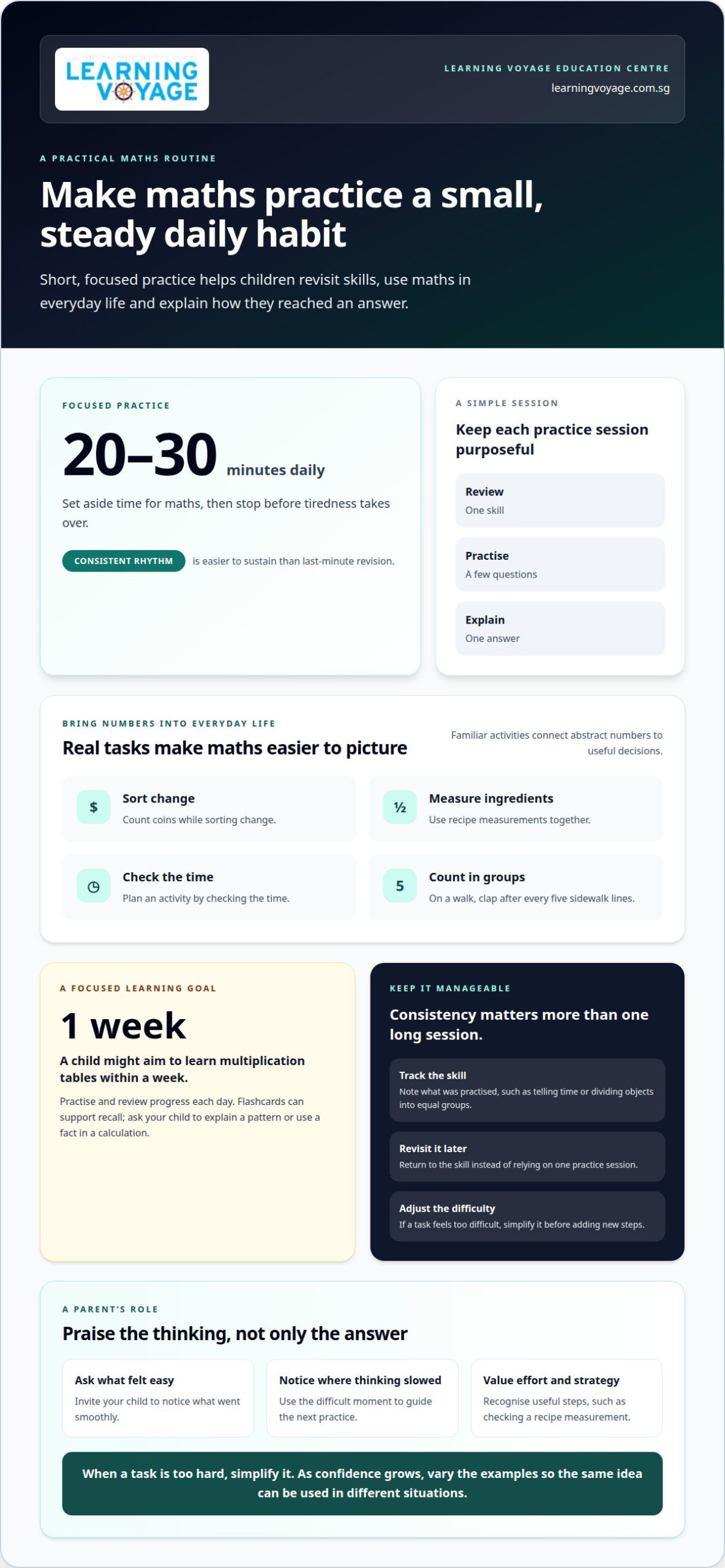
A regular routine helps children retain ideas between lessons. Set aside 20 to 30 minutes daily for focused maths practice, then stop before tiredness takes over. A simple session might review one skill, solve a few questions, and finish by explaining one answer. This predictable rhythm makes practice easier to sustain than last-minute revision before a test.
Everyday tasks make abstract numbers easier to picture. Ask your child to count coins while sorting change, measure recipe ingredients or check the time when planning an activity. On a walk, clap after every five sidewalk lines to practise counting in groups. These moments show how maths helps with real decisions, not just textbook exercises.
Purposeful practice targets a skill instead of filling pages without reflection. Flashcards can help children recall multiplication facts. After each card, ask them to explain a pattern or use the fact in a calculation. A child might aim to learn multiplication tables within a week, practising and reviewing progress each day.
Parents can help by setting a calm, consistent study routine and linking practice to familiar activities. Ask what felt easy, where their thinking slowed and which example helped most. Praise effort and strategy, such as checking a recipe measurement, rather than focusing only on correct answers. This helps keep mistakes useful instead of making homework frustrating.
Consistency matters more than one long study session. Keep a brief record of the skill practised, such as telling time or dividing objects into equal groups, and revisit it later. If a task is too difficult, simplify it before adding new steps. As confidence grows, vary the examples so your child can apply the same idea in different situations.
3. Core arithmetic operations and place value
Begin with counting objects, then connect number names to actual quantities. A child may recite “one, two, three” without knowing that three counters represent three objects. Ask them to touch each counter once while counting, then match the group to the numeral 3. This simple step links spoken numbers, written symbols and amounts. Number lines and counters can make those relationships visible before calculations become more complex.
Place value explains why a digit changes meaning by position. In 47, the 4 represents four tens, while the 7 represents seven ones. Build the number with blocks or draw four tens-rods and seven single units. Then regroup one ten as ten ones to show why 47 can also be represented as three tens and seventeen ones. This model supports addition and subtraction that involve carrying or borrowing.
Practise addition, subtraction, multiplication and division as connected operations. For example, 4 × 3 means four groups of three, while 12 ÷ 3 asks how many groups of three make twelve. A related fact family, such as 4 × 3 = 12 and 12 ÷ 4 = 3, helps children see those links. Ask them to explain what each number represents, not only calculate the answer.
Fractions and decimals also depend on understanding quantities and place. Fold a paper strip into four equal parts to show that one part is one quarter. Compare 0.5 with one half using a drawing divided into ten equal squares. In geometry, count equal sides or compare shapes by their properties. Visual models give children a way to test whether a written answer makes sense.
When a calculation goes wrong, identify the exact step before repeating the whole exercise. If 36 + 28 becomes 514, the child may have combined digits without regrouping. Use place-value blocks to represent both numbers, then combine the tens and ones. Short practice with different examples can reveal whether the idea holds beyond one question. Secure number sense makes later topics, including algebra, easier to approach.
4. Foundations across Singapore school pathways
In Singapore, students progress through primary, secondary and junior college maths. Topics change, but earlier understanding remains the foundation for later work. A pupil who struggles to interpret fractions may find ratios or algebra harder because these topics depend on relationships between quantities. Recognising the connection helps families focus on the underlying skill, not just the latest difficult question.
For a step-by-step learning sequence, start with counting and number recognition, then build place value and the four operations. Next, strengthen fractions, decimals and geometry before moving to concepts that combine several skills. Revisit earlier ideas through new examples at each stage. Move on when your child can explain and apply a method, not merely repeat a memorised answer.
As students approach the PSLE, secondary school and later examinations, a strong foundation supports more demanding questions. A word problem may call for arithmetic, followed by a diagram or equation to represent the situation. If exam practice reveals a gap, identify the missing prerequisite rather than repeating the whole paper. For example, difficulty simplifying an algebraic expression may point to weak multiplication or fraction skills.
Pathways can differ, so match practice to your child’s current level and syllabus. A Primary 6 pupil may need to secure number relationships, while a Secondary 3 student may need those same relationships within algebra. Ask the child to show where a method becomes confusing, then return to that step. This turns exam stress into a clearer learning plan, rather than a judgement about ability. For families looking further ahead toward higher education abroad, Education and Training offers personalised guidance on meeting international university entry requirements.
For a parent wondering how to build a strong math foundation, the key is continuity: connect each new topic to a skill already learned. Keep a short record of recurring gaps and the examples that helped resolve them. If your child needs structured support with school maths, explore Singapore primary maths tuition as one option for reinforcing essential concepts.
Learning Voyage Education Centre: Secondary 4 E-Mathematics Tuition
Learning Voyage Education Centre can help when a student understands individual methods but struggles to apply them across Secondary 4 E-Mathematics questions. Tuition can provide structured support with syllabus concepts and problem-solving, helping students identify gaps and strengthen the steps behind their answers. If your child is working on A-Mathematics instead, Secondary 4 A-Mathematics Tuition is also available, alongside Secondary 3 E-Mathematics and A-Mathematics Tuition.
Consider extra support when independent revision leaves recurring questions unresolved, or exam preparation becomes stressful because earlier concepts remain uncertain. Focused guidance can help a student work through difficult topics with greater clarity and confidence.
To discuss maths support, contact Learning Voyage Education Centre.
Give your next maths step a clear direction
Progress often starts with one useful question: what makes your child hesitate? It may be starting a new problem, explaining a method or staying calm during revision. Naming the difficulty gives families a clearer next step than adding worksheets without a specific purpose. For parents seeking broader ways to support confidence and reduce performance anxiety, mindset coach Salarah K Starre highlights the importance of reframing subconscious doubts to encourage calm and self-belief.
Think of how to build a strong math foundation as an ongoing process, not a race to cover more topics. Notice what your child can do independently, where they pause and which explanations help them move forward. This gives you a starting point for considering suitable support and making exam preparation more manageable.
If you’d like to discuss your child’s maths learning needs, contact Learning Voyage Education Centre. A thoughtful next step can help your child approach new challenges with greater confidence.
Frequently Asked Questions
What foundational math skills should students master first?
Before tackling complex calculations, students benefit from understanding mathematical symbols and relationships. For example, the equals sign means both sides have the same value, so 3 + 4 = 5 + 2 is true even though the numbers appear in a different order. Recognising simple patterns and explaining what a symbol means can prevent confusion when questions become more abstract.
How much daily practice is needed to build strong math skills?
There is no ideal study-session length for every student. Choose a focused period that suits your child’s attention and homework load, and finish while they can still describe what they learned. On a busy evening, a few carefully considered questions may be more useful than practising until frustration sets in. Adjust the routine if concentration or understanding changes.
What are effective ways to practice math and retain concepts?
Ask your child to make up a question, then solve and explain it. This shows whether they can use an idea flexibly, rather than recognise it only in familiar exercises. To compare concepts, draw two rectangles with the same perimeter but different areas. Discussing why the measurements differ can clarify ideas students might otherwise confuse.
How can I improve math problem-solving and critical thinking?
Try working backwards when a question gives a final result and asks for an earlier value. If a number is multiplied by 3 and then becomes 18, reverse the steps by dividing 18 by 3. For a difficult problem, test a simpler example first and notice which conditions still matter. These approaches help students choose strategies instead of guessing.
What math foundation is expected in Singapore schools at each level?
The concepts a student is expected to learn depend on their level and school syllabus. Use class materials and assessment feedback to see what is being taught. Compare your child’s work with the methods their teacher expects, then note where understanding breaks down. If the final answer is wrong, for instance, ask them to explain one step aloud to help locate the difficulty.