
What if another full practice paper isn’t what your A-Level Mathematics revision needs? If you’re putting in the hours but still repeating mistakes, it can be hard to know whether to revisit a topic, practise a different question type or work on timing. Learning how to prepare for a level math exam means turning each attempt into useful feedback, not simply adding more questions to your workload.
A steady plan starts with what you find difficult, then builds understanding, method choice and exam technique step by step. This guide will help you identify syllabus gaps, correct misconceptions, practise under timed conditions and manage pressure across your papers. For students who continue to face hurdles during independent revision, Learning Voyage’s H2 Mathematics tuition uses the Plug-the-Gaps technique in small-group classes of 6 to 9 students. Trial classes are available for both maths and science. Whether you’re revising independently or receiving extra support, the aim is the same: make each practice session count so you can approach the exam with a clearer plan and greater confidence.
Key Takeaways
- Start with the current syllabus and your own work to pinpoint which gaps need attention first.
- Strengthen understanding by recalling a concept, explaining it, solving a basic example and then trying a mixed application.
- Choose focused questions, mixed practice or timed papers according to the skill you want to build.
- To learn how to prepare for a level math exam, match your revision plan to your exam dates, available study time and priority gaps.
- If the same hurdles persist, targeted Mathematics support can help identify what is getting in the way and guide your next steps.
How to Prepare for an A-Level Math Exam: Start with a Clear Syllabus Diagnosis
Exam pressure can make every topic feel urgent. You may have spent hours revising and completed plenty of questions, yet still be unsure what to tackle next. The first step in working out how to prepare for a level math exam is not to guess or start another full paper. It’s to build a clear picture of what you know, what you can apply and where your working breaks down.
Use the current Singapore-Cambridge A-Level Mathematics syllabus as your map, then test your understanding against your own work. Check the latest official syllabus and examination documents from the Singapore Examinations and Assessment Board (SEAB) before relying on specific topic wording or paper-format details, as these can change. Keep H2 Mathematics distinct from O-Level Additional Mathematics. Earlier knowledge can support your learning, but it is not a substitute for checking the H2 syllabus itself.
Turn the A-Level Mathematics syllabus into a revision map
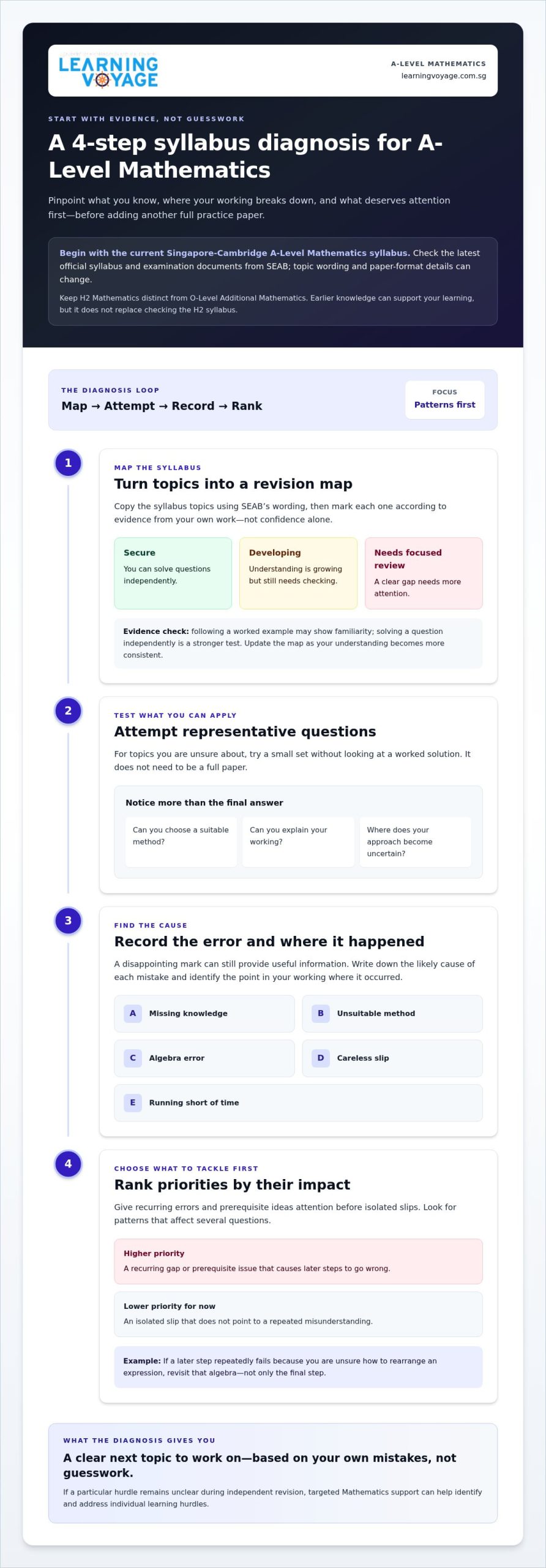
Copy the syllabus topics into a checklist, using SEAB’s wording so your map reflects what you’re expected to study. Mark each topic as secure, developing or needing focused review. Base each mark on evidence, not confidence alone. Following a worked example may show familiarity, but solving a question independently is a stronger test.
Keep the map simple enough to update. As practice shows more consistent understanding, move a topic from “developing” to “secure”.
Use practice questions to locate the real learning gaps
Before deciding that a topic is secure, try a small set of representative questions without looking at a worked solution. They don’t need to make up a full paper. The aim is to see how you approach different demands, including choosing a method and explaining your working, rather than counting how many questions you complete.
For each mistake, note its likely cause: missing knowledge, an unsuitable method, an algebra error, a careless slip or running short of time. This turns a disappointing mark into useful information.
Use a repeatable diagnosis:
- Map syllabus topics against the current official documents.
- Attempt representative questions for topics you’re unsure about.
- Record the error and where it occurred in your working.
- Rank priorities, giving recurring errors and prerequisite ideas attention before isolated slips.
For example, if a later step repeatedly goes wrong because you’re unsure how to rearrange an expression, revisiting that algebra may help more than redoing the final step alone. Prioritise patterns that affect several questions. If independent revision leaves a particular hurdle unclear, Learning Voyage’s Plug-the-Gaps technique is designed to identify and address individual learning hurdles in Mathematics tuition. A precise diagnosis gives your next revision session direction, rather than leaving you to study by guesswork.
Build A-Level Math Understanding Before Increasing Timed Practice
Knowing a formula by heart is useful, but it doesn’t tell you when to use it. In an A-Level Mathematics question, the challenge may be recognising the idea being tested, selecting a suitable method and connecting it to another concept. If you practise speed before you can make those choices, you may simply repeat the same uncertainty under tighter time pressure.
Give understanding room to grow first. Use a short review cycle: recall the idea without notes, explain it in your own words, work through a basic example, then attempt a question that applies it in a less familiar way. Each step checks something different. If recall is shaky, revisit the concept. If you can explain it but get stuck on the application, practise choosing and adapting methods.
Move from formula recall to method selection
Before writing calculations, pause to identify what the question appears to test. Ask yourself which ideas might apply, what conditions must hold, and what the question asks you to find or show. State relevant assumptions in words before using a formula. This small habit can help prevent automatic substitution when the situation calls for a different approach.
Then practise with questions that look different from your worked examples. A problem about a changing quantity, for instance, may require you to connect a mathematical relationship to what its result means in context. Don’t rush to match keywords with a memorised procedure. Explain why the method fits, and check whether the answer makes sense for the question.
Make revision notes useful for retrieval and application
Close your textbook and write a brief summary from memory. Check it against your course materials, correct any gaps and keep the final version concise. A useful topic sheet should capture the key idea, the conditions for applying a method, a worked example with reasoning, and a common trap to watch for. Copying several pages of notes can feel productive, but it may not show whether you can retrieve or use the ideas independently.
Keep recurring misconceptions visible. For example, if you often choose a method because a question contains a familiar word without checking the conditions, write that warning beside the relevant concept. Bring it into your next practice session and deliberately test whether you can avoid the same mistake.
Use this self-check before increasing the pace: Can I explain why this method works, state when it applies, and recognise a question where it would not be suitable? If you can recall a formula but can’t answer those questions, strengthen the concept before moving on to heavier timed practice. That’s a practical part of how to prepare for a level math exam: build understanding that holds up when a question is unfamiliar, rather than relying on recognition alone.
If guided discussion would help you make sense of a difficult concept, JC Mathematics tuition can offer structured support as you work towards applying ideas more independently.
Choose A-Level Math Practice That Improves Accuracy, Timing, and Confidence
Not every practice session should look like an exam. If a method still feels uncertain, a full paper may show that you’re stuck without helping you understand why. Choose questions to match the skill you need to build, then increase the challenge as your reasoning becomes more reliable. Purposeful practice can make preparation feel manageable rather than like a race against the clock.
When should students use topic drills, mixed questions, or full papers?
Topic drills help repair a specific concept or method gap. Mixed questions make you decide which approach fits, without being told the topic in advance. Full papers rehearse sustained focus and exam technique across topics. Use them at different stages, not as interchangeable measures of progress.
A useful progression is to rebuild a method with focused questions, mix it with other topics once the steps make sense, then attempt timed sections or a full paper. Timing should not replace understanding, but a brief timed set can reveal whether you’re spending too long on a question or struggling to move on. If the method is still unclear, return to untimed practice first.
Match each practice format to a clear purpose:
| Practice method | Best use | What to record | Next action |
|---|---|---|---|
| Topic questions | Repair a specific idea or method | Where the reasoning or working breaks down | Review the gap, then try a similar question independently |
| Mixed questions | Practise recognising which method fits | How you chose an approach and whether it was suitable | Review method selection and attempt another varied question |
| Timed section or full paper | Rehearse pacing, focus and exam technique | Time lost, unanswered parts and accuracy under pressure | Target the cause, then practise that skill before another timed attempt |
Review every practice attempt with an error log
After checking your work, record the question type, what caused the error, the corrected reasoning and one follow-up task. Keep concept gaps separate from careless errors or incomplete explanations. For example, a sign error may call for a checking habit, while an incorrect method choice needs practice identifying what the question asks.
Don’t stop at reading the solution. Set selected questions aside and redo them later without looking at the worked answer. If the same mistake returns, it’s a pattern to address, not a reason to label yourself as weak at Mathematics. A clear error log can help you decide what to practise next and how to prepare for a level math exam with greater purpose.
For students who would benefit from guided practice applying H2 Mathematics methods, JC Mathematics tuition can provide structured support alongside independent revision.
Create a Realistic A-Level Math Revision Schedule for the Time You Have
A revision plan should reduce pressure, not become another source of it. If you’re balancing H2 Mathematics with other subjects, schoolwork and family commitments, a schedule packed with tasks may look reassuring but can be hard to follow. Start with the time you genuinely have, the exam dates on your current timetable and the priority gaps you’ve identified. Then give each study session a clear purpose.
Plan revision sessions around priorities, not panic
Build your plan in this order:
- Mark the exam dates. Use the latest official timetable to see how much preparation time is available and which papers need attention first.
- List your Mathematics priorities. Start with recurring difficulties and concepts that support other areas, while keeping topics you’ve already studied active through short retrieval reviews.
- Fit sessions around existing commitments. Choose study slots you can realistically protect alongside your other subjects, schoolwork and rest.
- Give every session a specific task. Replace “revise calculus” with an action such as explaining a method from memory, correcting an error pattern or attempting questions that test a particular skill.
Leave space to return to difficult questions. If every slot is filled with new material, there’s no room to learn from a mistake or revisit an idea that needs more work. A balanced plan might pair a priority topic with a brief review of earlier learning, then leave a later slot for questions you couldn’t yet solve. You don’t need to prescribe the same amount of Mathematics revision every day. Consistency and a manageable workload matter more than an unrealistic timetable.
Adjust the plan as the exam approaches
Your priorities can change. Earlier in your preparation, allow more room to revisit concepts and rebuild methods. As exams approach, use practice to consolidate learning and rehearse how you’ll apply it across questions. Check the current examination timetable to order paper-specific review, and leave time for practical preparation, such as organising permitted materials. Avoid making unverified assumptions about paper formats; consult official examination documents for current details.
Review your plan regularly. If a topic remains difficult, break it into a smaller task, such as explaining one method or working through a particular type of question, instead of repeatedly scheduling “revise topic”. If practice reveals a new gap, adjust the next suitable session rather than abandoning the whole plan. Protect sleep and breaks, too. Sacrificing rest to squeeze in more revision isn’t a reliable planning strategy.
Learning how to prepare for a level math exam includes knowing when a plan needs to change. If independent revision keeps leaving the same H2 Mathematics hurdles unresolved, explore structured JC Mathematics tuition support as one option for working through them.
Get Targeted Support for A-Level Math When Independent Revision Stalls
Struggling with a Mathematics topic doesn’t mean a student hasn’t tried hard enough. A student may review notes, redo questions and still repeat the same error because the reason behind it isn’t clear. Support is a practical option when careful independent revision isn’t resolving a persistent hurdle. It can provide another explanation and a clearer next step, while keeping the student actively involved in learning.
Recognise when a persistent gap needs another explanation
One difficult question or an isolated slip isn’t enough to conclude that a student needs extra help. Look for a pattern instead: does the same misunderstanding appear in different questions, or does the student struggle to explain why a method applies even after checking the solution? These signs can point to a gap that needs a different explanation or more focused practice.
Before a support discussion, bring attempted work and the student’s error log. Include the question, the original working and what remains confusing. This gives a tutor something specific to discuss, rather than relying on a general feeling that “Maths isn’t going well”. For students seeking one-to-one guidance with syllabus hurdles, private providers such as Medic Tutors Kent offer tailored tuition in A-Level maths and science to address individual learning needs. The aim is to clarify the hurdle and help the student approach the next question with greater understanding and confidence. Support does not guarantee a particular grade, but a clear explanation can make revision feel less like guesswork.
Connect structured Mathematics tuition to a personal revision plan
At Learning Voyage, the Plug-the-Gaps approach is used in Mathematics tuition to identify and address individual learning hurdles. It can help connect classroom learning with the student’s own revision priorities, so support focuses on where understanding or working breaks down rather than treating every topic as equally difficult.
Small-group classes have 6 to 9 students, creating a setting for guided learning and interaction. A student can bring a question from independent practice, explain where they became unsure and use the discussion to clarify the next step. The insight can then feed back into their revision plan: revisit a concept, practise a related question or check whether the same difficulty appears elsewhere. Progress is a learning process, not a guaranteed result, and each student’s needs may differ.
If your family is considering extra support, Learning Voyage offers trial classes for both maths and science. A JC Mathematics trial class is an opportunity to consider whether structured H2 Mathematics support fits the student’s learning needs. For enrolment details, contact the centre. Asking for help is not a sign that a student should have solved every gap alone; it can be one thoughtful way to keep moving forward.
Take the Next Step with a Clearer Sense of Direction
You don’t need to feel completely certain before moving forward. A useful next step is simply to choose one action that makes revision feel more manageable, whether that means reviewing a stubborn concept, adjusting your study plan or seeking another explanation. Learning how to prepare for a level math exam isn’t about removing every challenge at once. It’s about helping your child meet each one with more clarity and confidence.
If extra guidance would help your family decide what to focus on next, explore a JC Mathematics trial class at Learning Voyage. It’s an opportunity to consider whether structured support feels right for your student’s learning needs.
Explore a JC Mathematics trial class and take the next step at a pace that feels right. With a thoughtful plan and the right support, your child can keep moving forward with confidence.
Frequently Asked Questions
How early should I start preparing for an A-Level Mathematics exam?
Start as soon as you begin studying the syllabus, rather than waiting until revision season. Early preparation gives you time to notice which ideas need another explanation and revisit them without crowding out your other subjects. If the exam is already approaching, start now by checking what you can solve independently and what still causes difficulty. The best approach to how to prepare for a level math exam depends on your starting point and available time.
How can I revise A-Level Mathematics if I have fallen behind?
You can still make progress by narrowing the task. First, check what remains in the syllabus and identify topics that may affect your ability to solve other questions. Choose one specific task, such as understanding a method or correcting a repeated error, and fit it into a realistic plan alongside your other subjects. Don’t try to catch up by reading everything at once. Focused work helps you see what to tackle next.
Should I do past-year papers every day before my A-Level Math exam?
No. Daily full papers may leave too little time to understand why an answer went wrong. Use past-year questions to practise applying ideas, but vary the format: choose a few questions on a topic when you need to strengthen a method, then use mixed questions to practise selecting an approach. A full paper can help you rehearse focus and pacing. After each attempt, review your working and decide what the next session should address.
How do I stop making careless mistakes in A-Level Mathematics?
Build a checking habit around the errors you actually make. If signs or algebra steps often go wrong, review those parts before moving on. If you misread questions, underline what you’re asked to find and check that your final answer responds to it. Leave time to scan your working, not just the final result. Keep a record of recurring slips so you can practise a specific checking action instead of simply telling yourself to be more careful.
Are notes or practice questions more important for A-Level Math revision?
Both have a role, but neither is enough on its own. Notes can help you organise definitions, conditions and reasoning; practice shows whether you can recall and apply them without guidance. For example, after reviewing a method, close your notes and try a question that uses it. If you get stuck, return to the relevant explanation, then attempt a fresh question. This keeps revision active and helps prevent note-making from becoming the whole study session.
What should I do in the final week before an A-Level Mathematics exam?
Use the final week to consolidate rather than rebuild your entire preparation. Check the official exam timetable and any current instructions, then organise your remaining review around the papers ahead. Revisit familiar errors, attempt selected questions and make sure you know what materials you need for the exam. Avoid staying up late to force in more work. Rest, meals and breaks help you arrive with energy to focus on the questions.
Can tuition help if I understand the lessons but still do poorly in practice papers?
Yes. Understanding a lesson and applying its ideas independently are different skills, so a low practice result can point to difficulty choosing a method, linking steps or managing pressure. A tutor can review actual attempts with the student and help identify where the reasoning shifts off course. Learning Voyage provides JC Mathematics tuition for students who need structured support. This can complement independent revision, but no tuition can guarantee a particular grade or result.