
A full revision notebook can still leave a child unsure what to use and when. A PSLE Science revision workshop in Punggol can help your child practise five connected skills: interpreting questions, identifying variables in experiments, reading data, diagnosing errors and writing clear answers. The focus should be on applying science ideas, not simply adding more notes.
It’s understandable to feel frustrated when revision takes hours but the same mistakes keep appearing, or when exam pressure makes a familiar concept suddenly difficult to explain. Focused practice can make the next step clearer: identify what a question is testing, use evidence from a table or graph, and show the reasoning behind an answer.
This article explains what to practise and how each skill supports PSLE Science preparation, from fair-test reasoning to reviewing incorrect responses. You’ll also see how written practice and targeted revision can help your child build confidence steadily, at a pace that supports learning without adding unnecessary stress.
Key Takeaways
- Use diagrams and experiment examples to make abstract science ideas easier to see, then practise applying those ideas to new questions.
- Underline command words and identify exactly what each question asks before choosing relevant facts or evidence.
- Turn repeated mistakes into useful corrections by recording the missing concept, key detail and reason the answer needs to change.
- Practise explaining open-ended answers in writing, then compare each response with the marking scheme to spot gaps in reasoning.
- Build exam readiness through focused practice that strengthens accuracy and confidence without simply adding more revision notes.
1. The Revision Notebook Is Full—Can PSLE Science Tuition in Punggol Help My Child Find What Matters?
Yes, when revision helps a child find and use the right idea. A PSLE Science workshop in Punggol can make notebook work more purposeful through diagrams, experiment examples and data interpretation. The aim is not to add pages, but to help your child connect an existing note to a question and explain when that idea applies.
Try a notebook search at home. Give your child a science question, let them attempt it, then ask them to find a relevant note. Notice what causes difficulty: the label may be unclear, the concept may not be recognised, or the explanation may have been copied without being understood. Each points to a different next step.
A simple diagram can make an experiment easier to reason through. Picture two containers holding equal amounts of water, but with different exposed surface areas. Keep the other relevant conditions the same. Water evaporates faster from the container with the larger exposed surface area. A labelled sketch makes the comparison visible and helps your child connect the changed factor with the result.
Experimental questions deserve focused practice because they test inquiry skills as well as science knowledge. Have your child identify the factor changed, the result observed and the conditions kept constant. Then use a table or graph to determine what the evidence shows. A fair comparison changes the intended factor while keeping other relevant conditions the same.
Use a short weekly routine to keep this skill active. Set aside 15 minutes for data, graph or experimental reasoning. Choose one unfamiliar graph or experiment question, ask your child to explain what the evidence shows, then compare that explanation with the question’s conditions. This builds practice without requiring another full set of notes.
For P5 and P6 revision, bring one question that caused difficulty and the notebook entry your child thought would help. These give a workshop a concrete starting point. A parent can also review one successful notebook search beside one unsuccessful search, checking whether labels name concepts and corrections remain scientifically accurate.
For a session in Punggol, use the published address to plan the route from Punggol MRT, and compare its schedule with your child’s school and home revision routine. Look for stated learning activities, such as diagram work, experiment reasoning or graph interpretation, so the session’s focus is clear before registration.
Reviews are most useful when they describe a specific learning experience, such as clearer explanations or more confident use of evidence. Treat individual results as personal accounts, not a promise of the same outcome. For registration, follow the organiser’s stated steps and deadline, and keep the session details with the question your child plans to bring.
2. Command words and question interpretation
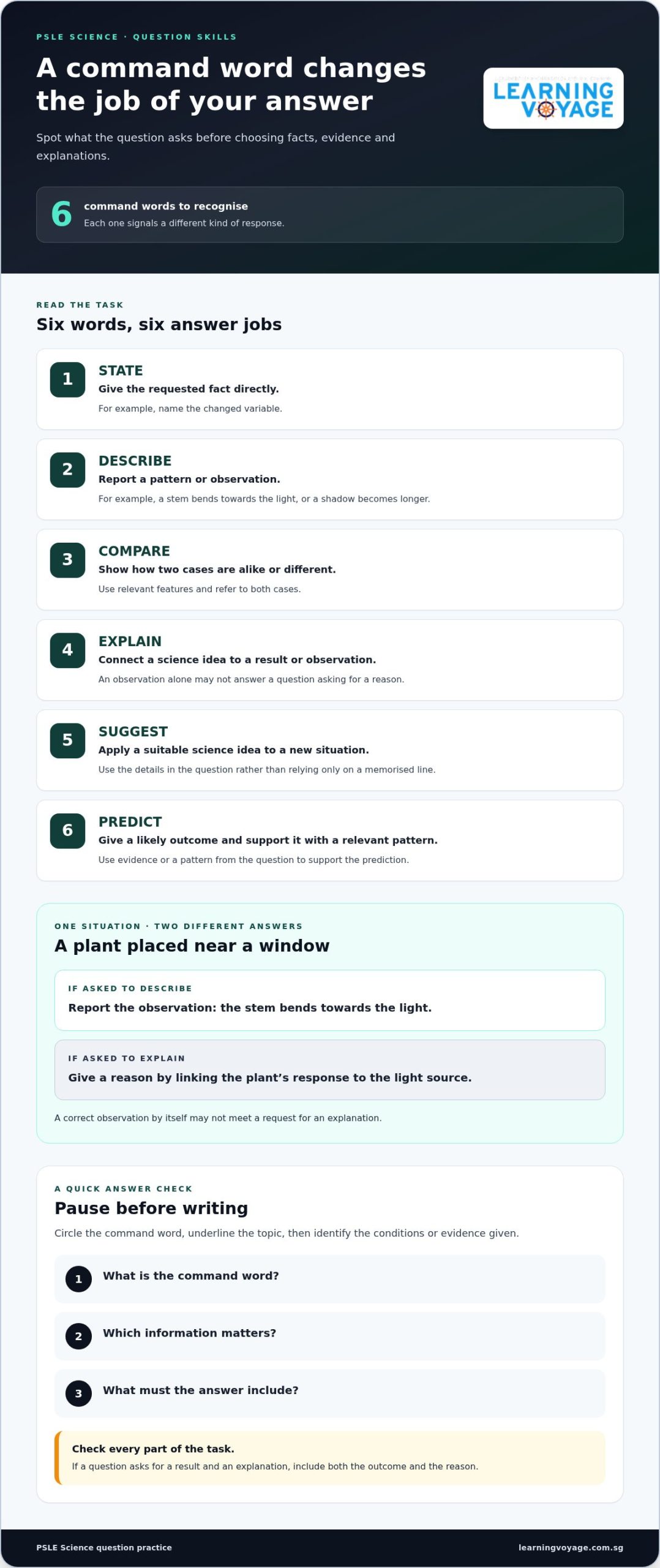
A child can know the science concept and still miss what the question is asking. The command word signals what the answer must do. Before writing, ask your child to circle that word, underline the topic, then identify any conditions or evidence given in the question.
Consider a question about a plant placed near a window. “Describe” asks for an observation, such as the stem bending towards the light. “Explain” asks for a reason, linking the plant’s response to the light source. An accurate observation alone may not satisfy a request for an explanation.
Practise matching common command words with the work they require:
- State: Give the requested fact directly, such as naming the changed variable.
- Describe: Report a pattern or observation, such as a shadow becoming longer.
- Compare: Show how two cases are alike or different using relevant features.
- Explain: Connect a science idea to the result or observation.
- Suggest: Apply a suitable science idea to a new situation.
- Predict: Give a likely outcome and support it with a relevant pattern.
Command words guide the answer, but the rest of the question matters too. If a question asks why one object cools faster, note what differs between the objects and what remains the same. Then connect that condition to heat transfer. A familiar phrase can still introduce a new application, so pupils should use the details in front of them rather than repeat a memorised line.
Parents can help by asking three focused prompts during practice: “What is the command word?”, “Which information matters?”, and “What must your answer include?” For a question asking pupils to compare two habitats, the child should name both and describe a relevant difference. Writing only about one habitat leaves the comparison incomplete.
Teach your child to pause after drafting. Match each sentence against the command word and check that it answers every part. For “State the result and explain why,” the response needs both an outcome and a reason. If the answer includes a correct fact but misses the reason, add the missing link instead of rewriting everything.
When repeated errors come from unclear concepts, a focused learning gap review can help connect the question’s wording with the science idea needed. This keeps practice purposeful: pupils learn to read carefully, select evidence and shape an answer that fits the task.
Treat experimental-based questions as a separate skill to practise, including fair-test design, variable identification and data interpretation. A weekly home routine can include 20–30 minutes of mixed application questions, so pupils practise choosing how to respond rather than only recalling facts. For PSLE Science revision, have your child answer open-ended questions in writing and compare each response against a marking scheme. This makes it easier to check whether the answer meets the question’s demand.
Give more revision time to weak areas and experimental-based questions than to topics your child already knows well. For multiple-choice practice, ask your child to identify the tested concept, eliminate clearly wrong options and check that the selected answer addresses every part of the question. A revision notebook is helping when your child can find and explain the relevant idea, recognise its conditions, and use it in another question with less support over time. That progress shows whether your child can transfer the idea, not just remember a phrase.
4. Primary 6 error diagnosis and exam readiness
A wrong answer is useful only when your child can explain the mistake. In Primary 6, review each error for a missing keyword, an unused science concept or an incomplete answer structure. The goal is to identify the thinking gap, not simply copy the correct response into a notebook.
For example, a pupil may write that a metal spoon feels colder than a wooden spoon. If the question asks for an explanation, the response needs the relevant idea about heat transfer, not just the observation. Ask your child to mark the question’s key condition, identify the concept, then explain how it supports the answer.
A practical correction entry captures the original difficulty, the accurate science idea, a short explanation of the correction and the question conditions. These details help your child avoid repeating a memorised answer in the wrong situation. If the question involves a comparison, record what changes and what stays constant.
For multiple-choice practice, pause before selecting an option. First identify the concept being tested. Then eliminate options that conflict with the question’s evidence. Finally, check that the chosen response addresses every part of the question. A plausible option can still be wrong if it ignores a condition or answers only part of the task.
Keep an error log, but make it a working tool rather than another pile of notes. During the weekly home routine, set aside 15 minutes to redo one recurring error. Cover the correction, attempt the question again, and explain why the revised answer fits. If the same mistake returns, revisit the concept before attempting another similar question.
A suggested improvement cycle uses weeks 1–3 for diagnosis and repair. Use this phase to sort errors into concept gaps, misunderstood wording and careless omissions. Then practise the specific weakness. A child who repeatedly misses key terms needs to check answer language; one who misreads diagrams needs careful evidence-based practice.
Exam readiness also means keeping the final seven days before the examination steady. Maintain established revision routines instead of adding unfamiliar methods that increase stress. Use notes for preparation, and check current SEAB instructions rather than assuming tuition materials are permitted in the examination.
Parents can support confidence by asking for the reason behind a correction, not demanding a perfect answer on the first attempt. Focused science tuition can help a Primary 6 pupil work through recurring gaps with guided practice. Progress becomes visible when the child can spot the error, repair the idea and apply it to a different question.
5. Written open-ended question practice
A science idea is not secure until a child can explain it clearly. In PSLE open-ended questions, pupils must turn concepts into written answers that address the question. Recalling a fact silently is different from explaining how it applies to a particular situation.
Set aside 20 minutes in the weekly home routine for written explanation practice. Begin with active retrieval: let your child explain a concept without notes, then write the explanation from memory. Afterward, compare the response with a marking scheme. This reveals whether the answer includes the required idea and connects it to the question’s details.
Use a question about a food chain as an example. If the question asks what may happen when the number of insects falls, the child should link the change to an animal that eats those insects. A useful response names the relationship and explains the likely effect. Writing only “the animals decrease” may not show which animal is affected or why.
Try this sequence for each open-ended response:
- Identify the task. Underline what the question asks the pupil to explain, describe or predict.
- Select relevant evidence. Note the given observation, comparison or condition.
- Recall the concept. State the science idea that explains the evidence.
- Write the link. Connect the concept to the specific situation in the question.
- Review against the marking scheme. Find missing ideas, then revise the answer in the child’s own words.
Marking schemes are most useful as learning tools, not scripts to copy. Ask your child to highlight the idea represented by each answer point. Then check whether the response explains that idea in context. If a scheme expects cause and effect, a fact without the link may leave the reasoning incomplete.
Parents can make corrections manageable by focusing on one gap at a time. If a response names the correct concept but ignores a condition in the question, ask the child to add that condition. If the explanation is hard to follow, have them rewrite it as a clear cause-and-effect sentence. Short, focused edits teach more than copying a complete model answer.
Keep earlier attempts beside revised answers. This lets pupils see the exact change in their reasoning, rather than judging progress only by whether an answer feels familiar. Over time, they can practise with questions from different topics and learn to adapt concepts instead of relying on memorised wording. The result is a more deliberate response, built from evidence, scientific understanding and clear written reasoning.
Keep retrieval separate from checking: choose a science concept, put notes aside, and ask your child to explain it in their own words before writing. The written version should come from memory too, rather than being assembled while looking at a page. Bring the notes back only after the attempt is complete. This gives practice a clear order: recall first, write next, check afterward. It keeps the task focused on producing an explanation independently.
5. PSLE Science revision workshops in Punggol for 2026
For 2026 preparation, choose a workshop that follows the Singapore primary science curriculum and gives pupils practice applying what they learn. The Ministry of Education’s primary science syllabus is the official reference for curriculum information. Use it to compare a workshop’s stated topic coverage with your child’s current school learning.
A useful workshop should make its learning focus clear. Check whether it gives pupils practice with science concepts, inquiry skills and applying ideas to new situations. For example, a child who can recall a topic but struggles with unfamiliar questions may benefit from guided application practice rather than another session focused only on recall.
Consider how the workshop fits your child’s current needs. If they find school revision difficult to organise, look for a clear sequence from reviewing a topic to attempting related questions. If they already understand the content, practice that asks them to transfer ideas to a new context may be more useful.
Timing matters too. Compare the session schedule with school commitments and the family’s existing revision routine. A workshop should support steady preparation, not create a last-minute rush or displace the independent practice your child needs to retain learning.
Ask your child what they worked on after a session. A specific answer, such as describing a new way to approach a question, makes the learning focus easier to assess. If they cannot explain the session’s purpose, discuss which topics or skills would make the next revision activity more meaningful.
Parents can also use the MOE syllabus as a reference when reviewing workshop descriptions. Look for a clear connection to primary science learning, rather than broad claims about exam success. The activity details matter: they show whether pupils will engage with concepts, practise applying them and reflect on their understanding.
For families in Punggol, consider the venue and travel plan alongside the learning focus. Review the published location and session details before arranging the journey. A practical fit makes it easier for your child to attend without disrupting school, rest or home revision.
If your child needs continued support beyond a revision session, explore primary science learning support as part of a steady learning plan. The right next step is the one that matches your child’s current needs and helps them approach the 2026 PSLE with greater confidence.
Learning Voyage Education Centre: Secondary 4 E-Mathematics Tuition
Learning Voyage Education Centre offers Secondary 4 E-Mathematics Tuition for students who need structured support with O-Level mathematics. This is a separate learning need from PSLE Science preparation, but it may suit families supporting an older child alongside a younger pupil’s exam journey.
Consider this tuition when your Secondary 4 student needs help strengthening mathematical understanding and working through challenging topics. Learning Voyage Education Centre also offers Secondary 4 A-Mathematics Tuition, Secondary 3 A-Mathematics Tuition and Secondary 3 E-Mathematics Tuition.
For families planning support across different school levels, choose the subject and level that match the student’s current needs. Contact Learning Voyage Education Centre or visit its website to learn more.
Let the next practice session build confidence
Your child’s next step doesn’t need to be another stack of notes. Choose one question that felt difficult, then help them explain what they understand, what remains unclear and what they’ll try differently. That small reflection gives the next revision session a clear purpose and helps exam preparation feel more manageable.
A PSLE Science revision workshop in Punggol can be one part of that learning path. The most useful support meets a pupil at their current level and helps them move forward with confidence. Progress takes shape through steady practice, thoughtful guidance and the courage to try again after a mistake.
If you’re planning support for your child’s wider learning journey, contact Learning Voyage Education Centre to explore the next step. Every learner deserves room to grow, and a calm, purposeful start can help your child approach what comes next with greater confidence.
Frequently Asked Questions
The Revision Notebook Is Full—Can PSLE Science Tuition in Punggol Help My Child Find What Matters?
Yes, focused science tuition can help a child identify which notes are useful and where understanding is still shaky. Ask your child to choose a notebook page for a question about a dissolving substance, then explain why that page applies. If the explanation relies on copying rather than understanding, that signals what to revisit. A tutor can use this response to guide the next practice task.
PSLE Science workshop reviews and results from Punggol students
Reviews are most useful when they describe specific experiences, such as clearer explanations or more confident use of evidence. Treat individual results as personal accounts, not a promise of the same outcome.