
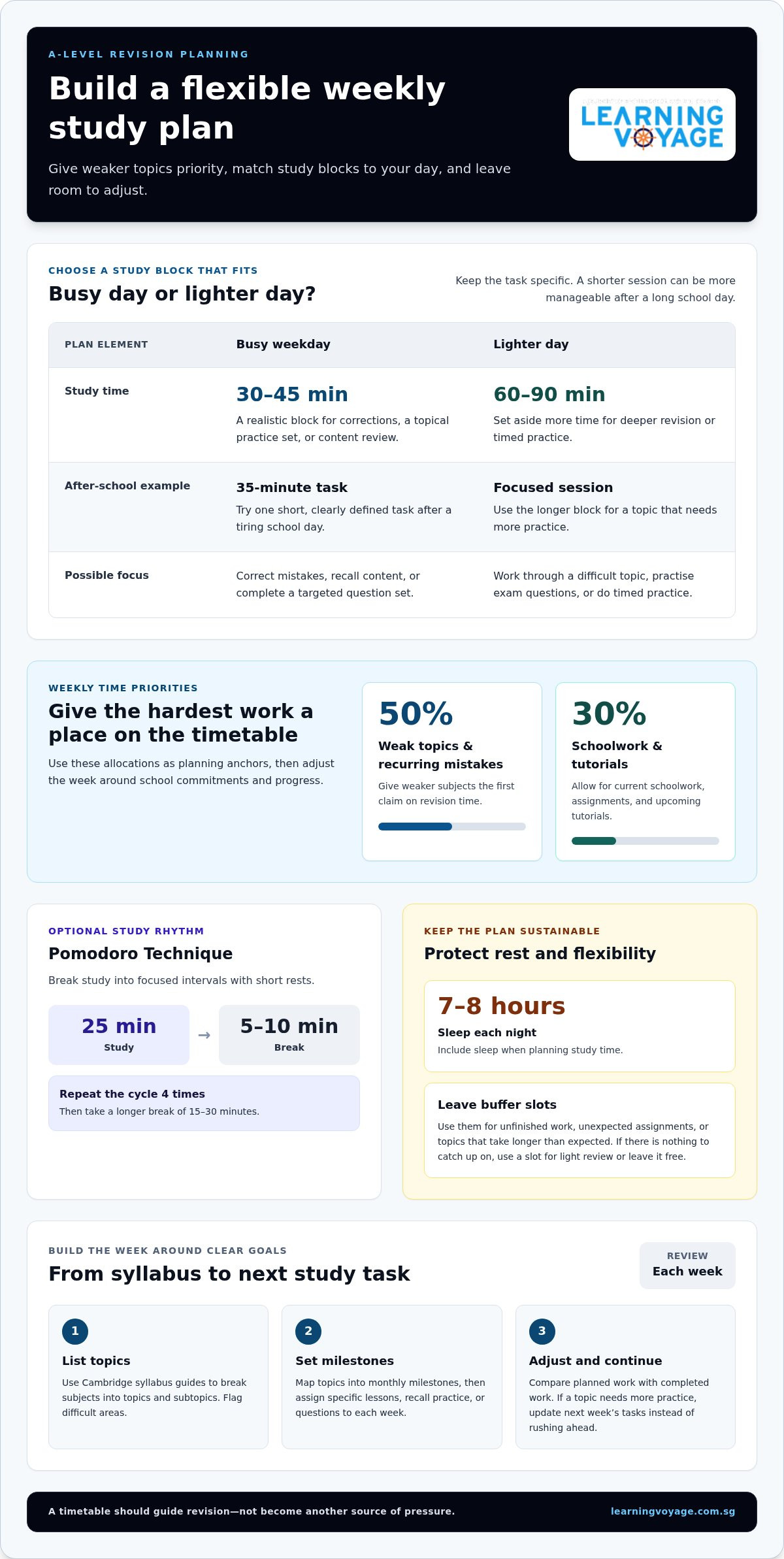
A weaker subject should get the first claim on your revision time, not the scraps left at the end of the week. If you’re deciding how to create a study plan for A levels, start by giving 50% of your weekly revision time to weak topics and recurring mistakes. Then schedule specific practice, including past-paper questions, and leave buffer slots so you can adjust when schoolwork or a difficult topic takes longer than expected.
It’s understandable if a timetable feels hard to stick to, especially when lessons, assignments and exam stress compete for your attention. A useful plan isn’t rigid: it gives you direction while leaving room to adapt as you learn. This guide explains how to set clear goals, identify which subjects need more attention, build past papers into your routine and reset your schedule if you fall behind. You’ll also learn how a study buddy or small group can support accountability when sessions have focused goals. With manageable steps and regular adjustments, revision can feel less overwhelming and more purposeful.
Key Takeaways
- Turn mistakes into a practical revision list, then adjust your schedule around the topics that need attention.
- Break the syllabus into manageable milestones so weekly study tasks connect to your longer-term goals.
- Use active recall and exam questions to check what you can remember and apply, not just what you have reread.
- Make study-group sessions purposeful by agreeing on a shared goal and keeping the discussion focused.
- When a Mathematics topic remains difficult, structured tuition can provide guided practice and help close learning gaps.
What if you fall behind your revision plan?
Pause and identify what disrupted your timetable. Then revise the next week’s tasks instead of trying to complete everything at once. A missed session is useful information: it may show that a topic needs more time or that your schedule needs more flexibility.
-
Review mistakes and adjust the plan
Start with marked work and sort each mistake by cause: forgotten knowledge, a misunderstood concept or an error applying a method. This turns a disappointing score into a clear next step. For example, if several Mathematics errors stem from the same method, schedule targeted practice before attempting another full paper.
Use 20 minutes to review mistakes or prepare questions before tuition. Write each question beside the relevant topic, then use the answers to choose your next revision task. After tuition, spend 15 to 20 minutes filing notes and marking difficult questions. Avoid simply adding missed work to an already full timetable; decide which task matters most and move lower-priority work into a buffer slot.
-
Review the timetable each week
Set aside time each week to compare planned work with completed work. Check which subjects received attention, which tasks were repeatedly postponed and whether your understanding is improving. If you keep delaying essay practice, for instance, replace a long session with a shorter, clearly defined task.
Adjust the coming week’s schedule around school commitments, assignments and topics that still cause errors. Keep buffer slots for catch-up work so one delayed task doesn’t crowd out every other subject. If a session was unrealistic after a long school day, move it to a lighter period or divide it into smaller tasks. Change the timetable, not the learning goal.
-
Adjust revision during exam periods
As exams approach, shift from broad coverage to the subjects and question types that need the most practice. Consider the order of upcoming papers and focus revision on the nearest exam, while keeping a brief review of later subjects. Don’t spend every session repeating familiar material simply because it feels reassuring.
Use a practical weekday structure: allow 30 minutes for a snack and rest after school, schedule 45 minutes for timed practice or corrections in the evening, then review summary notes for 20 minutes. Keep sleep in the plan too, allowing enough rest each night. If stress or a difficult paper disrupts your schedule, assess what remains and reassign tasks across the next available sessions. A timetable should guide your revision through the exam period, not become another source of pressure.
Can I get help setting up my study plan?
Yes. Start revising at the beginning of the academic year, then build a plan around your school timetable and exam goals. Divide each subject into topics, set weekly milestones and review your progress regularly to keep the schedule realistic.
-
Break subjects into topics
Use the official Cambridge syllabus guides to list each subject’s topics and subtopics. Turn broad areas into tasks you can complete and review, such as recalling key Biology terms or practising a specific Mathematics method. Flag difficult topics so they receive deliberate attention rather than being left until revision feels urgent.
For each topic, write a clear action and a way to assess it. “Review Chemistry” is too broad; “summarise one concept, then answer related questions” defines the task. This makes progress easier to track and helps you choose the next study block.
-
Set weekly and monthly milestones
Use monthly milestones to map the syllabus, then divide each milestone into weekly tasks. For example, a monthly goal could be to cover a set of connected topics, while the weekly plan assigns specific lessons, recall practice, or questions. Leave room for current schoolwork and upcoming tutorials, which should take 30% of weekly revision time.
At the end of each week, compare completed work with your milestone. If a topic needs more practice, adjust the next week’s plan instead of rushing ahead with gaps. Set personal deadlines a couple of days before homework and assessment due dates, leaving time to correct mistakes before submission.
-
Schedule study blocks and rest
Choose study blocks that fit your energy after school. A busy weekday can hold 30 to 45 minutes for corrections, a topical practice set, or content review. On a lighter day, schedule 60 to 90 minutes for deeper revision or timed practice. A short, specific 35-minute task may feel more realistic after a tiring school day than a 90-minute block.
If you prefer the Pomodoro Technique, study for 25 minutes, then take a 5-10-minute break. Repeat the cycle four times before a longer break of 15 to 30 minutes. Include 7-8 hours of sleep each night when planning study, so revision doesn’t consume the rest your routine needs.
-
Plan buffers and leisure time
Add buffer slots to your weekly schedule for unfinished work, unexpected assignments or topics that take longer than expected. Keep these slots flexible. If nothing needs catching up, use one for light review or leave it free rather than filling every opening with another task.
Protect leisure time as deliberately as study blocks. For example, a student might use Friday from 8pm to 8.45pm to file notes, then keep the rest of the evening free. A Sunday session from 10am to 11.30am could hold focused Mathematics revision. Adjust those examples around your own commitments, and keep each week manageable.
Setting academic goals and prioritising weaker subjects
Build your timetable around school, tuition and CCA, then assign sessions according to each subject’s needs. Balance H1, H2 and H3 revision by considering syllabus demands, current progress and difficult topics. Adjust the time for each subject as those needs change.
-
Prioritise weaker subjects
Review recent tests and classwork, then identify which subject has the clearest gaps. Assign 50% of weekly revision time to weak topics and recurring mistake types, while keeping sessions for other subjects. If Chemistry errors repeatedly involve applying a concept, schedule practice on that skill before adding more time to material you already handle confidently.
Use the 80/20 principle to help identify high-priority material, not as a promise of results. Focus first on topics that recur in mistakes or underpin later learning, and record why each one needs attention.
-
Set clear, achievable learning goals
Write each goal as an action with clear evidence of completion. Instead of “get better at Physics,” try “explain a concept from memory, then solve a related question and mark the working.” This makes learning easier to measure and shows whether the session strengthened recall or exposed another gap.
Match each goal to the subject and syllabus level. An H2 Mathematics session might focus on applying one method to exam questions, while an H1 session could target explaining a key idea clearly. Check your answers, not just the time spent studying. A practical answer to how to create a study plan for A levels is to connect each session to a visible learning outcome.
-
Set manageable goals and deadlines
Break a large academic target into tasks that fit your actual week. If an assignment or assessment is due, set a personal deadline a couple of days beforehand. This leaves time to review your work and address unclear points rather than discovering a gap at the last moment.
Put deadlines beside each task and check them when planning the next week. Avoid scheduling every subject at maximum intensity; leave room for schoolwork, tuition and CCA commitments.
- Build realistic weekday and weekend blocks. Enter fixed commitments first, including school, tuition and CCA. Then choose weekday sessions that suit your energy and reserve a weekend block for a larger task, such as reviewing a topic across several lessons. A realistic timetable reflects the student’s actual week, not an idealised one.
- Match study time to subject needs. Give each H1, H2 and H3 subject regular attention, then shift emphasis when progress or upcoming schoolwork changes. A difficult H2 topic may need more practice this week, while an H1 subject with secure understanding may need a shorter recall session. Reassess the balance when you review completed goals.
How Much Time Should You Spend on Past Papers?
Use past papers to test whether you can apply knowledge, not simply to count completed papers. For Singapore-Cambridge A-Level syllabuses, use official Cambridge syllabus guides to map topics. Get exam-date notices and past-paper materials through your school, and match each paper to your subject code and syllabus.
- Begin with active recall. Close your notes and write down what you remember about one topic. Then reopen them and mark missing details. A focused session can combine 20 minutes of topic review, 20 minutes of active recall, 30 minutes of exam questions, 10 minutes checking answers, and 10 minutes recording mistakes. This helps you see which knowledge you can retrieve without prompts.
- Choose the right amount of paper practice. Start with topical questions when a method or concept is uncertain. Move to timed sections or full papers when you can attempt a wider mix independently. Mark each attempt carefully, including your working and explanations. A finished paper without review may leave the same misconceptions intact.
- Space out retrieval practice. Revisit a topic later in the same week, the following week, several weeks later and again before the exam. Each time, try recalling key ideas before reading your notes. If you cannot explain a step or retrieve a definition, add that gap to your next practice session.
- Interleave related learning. Instead of completing every question on one familiar skill, alternate topics or question types within a session. For example, practise a Mathematics technique, switch to another topic, then return to the first skill with a new question. Interleaving helps you decide which method fits, as exam questions often require.
- Use marking schemes to study mark allocation. Compare your response with the scheme and identify the step that earned each mark. For a 6-mark question, check whether you supplied the required reasoning, units, or explanation, not merely a final answer. Record recurring errors in a correction log, then turn each one into a short recall prompt.
- Protect the routine that supports learning. Fit paper practice around school and include meals, movement and rest in your timetable. A short walk between study blocks can provide a reset; a regular meal helps prevent revision from replacing basic care. Avoid sacrificing sleep to complete one more paper, since tiredness can make careful reading and recall harder.
Studying with a buddy or group
A study group can make revision more accountable, but conversation alone won’t strengthen understanding. Give each session a shared academic goal, a clear structure and space for every student to explain a concept in their own words.
- Choose a focused group. Keep an A-Level study group to 3-5 members, so each student has room to contribute. Choose peers who are willing to prepare, listen, and work towards shared goals. A group that spends its time comparing stress or discussing unrelated topics can leave everyone feeling busier without completing useful revision.
Agree on a subject and topic before meeting. For example, a Physics group might tackle a difficult concept, while a Mathematics group works through questions that require different methods. Matching the session to a current learning need helps prevent group time from becoming an unfocused substitute for independent study.
- Set one result for the session. Before meeting, write down what the group should be able to do by the end. That might mean explaining a concept without notes, comparing approaches to a question or identifying why an answer lost marks. A specific goal gives the session direction and helps the group judge whether the time was well spent.
Keep the target manageable. If a topic contains several difficult ideas, choose one for discussion and note the rest for later. This prevents exam stress from pushing students to rush through everything at once.
- Rotate roles to keep everyone active. Ask one student to explain a solution, another to challenge a step and another to record unresolved questions. Change roles at the next meeting. Explaining a method reveals gaps that quiet rereading can hide, while a peer’s question may show where an answer needs clearer reasoning.
Make room for different confidence levels. A student who feels unsure can begin by asking a prepared question, then try explaining one step. The group should correct errors respectfully and focus on the work, not judge the person who made them.
- Connect group work with tuition and independent revision. Spend 20 minutes reviewing mistakes or preparing questions before tuition, then bring one unresolved point to the session. Afterward, each student should complete a related question independently. This shows whether the explanation has transferred into individual work, rather than only making sense during discussion.
Before the group ends, assign each member a follow-up task and a time to report back. Keep the plan specific: practise a question type, summarise a concept or correct a marked response. Schedule the next session around those tasks and use it as a check-in.
Learning Voyage Education Centre: Secondary 4 E-Mathematics Tuition
Learning Voyage Education Centre offers Secondary 4 E-Mathematics Tuition for students who need guided support alongside independent revision. If recurring mistakes make it difficult to follow your study plan, tuition can help identify the specific learning gaps and work through them systematically.
Learning Voyage’s small-group Mathematics and Science tuition uses the “Plug-the-Gaps” technique to identify and address learning hurdles. Students can bring challenging topics and revision questions to guide further practice. This support may suit students who need clearer explanations or a structured way to strengthen their understanding of E-Mathematics.
For help with Secondary 4 E-Mathematics, contact Learning Voyage Education Centre to discuss your next step.
Take the Next Step with a Plan You Can Follow
Understanding how to create a study plan for A levels is only the beginning. Use your timetable as a working guide: notice what helps you learn, respond when a subject becomes challenging and keep moving towards your academic goals without expecting every week to go perfectly.
If Mathematics is a sticking point for your family, Learning Voyage Education Centre offers Secondary 4 E-Mathematics Tuition, Secondary 4 A-Mathematics Tuition and Secondary 3 A-Mathematics Tuition. Guided support can give students space to work through difficult ideas and build confidence in their learning, while parents gain a clearer next step when revision at home feels frustrating.
Reach out to discuss the support that fits your student’s Mathematics needs. Contact Learning Voyage Education Centre and take the next step towards a steadier revision journey.
Frequently Asked Questions
Can I adjust my schedule in between?
Yes. Treat your timetable as a working plan, not a fixed contract. If a CCA commitment or unexpected school task takes an evening, move the most important revision task to an open slot and postpone lower-priority work. Avoid squeezing every missed task into the next day. A schedule that reflects your actual week is more useful than one that looks perfect but repeatedly falls apart.
How Many Hours Should You Study for A Levels?
As a starting point, some A-Level students may find 2-4 focused hours of independent study on school days useful, with additional revision at weekends. Treat this as a guide, not a target to meet at any cost. Your school workload, subject combination, energy and current understanding all affect what is realistic. Use completed tasks and recall quality to decide whether your study time is working.
How do I deal with assignments that take me longer to complete than expected?
Pause and work out what is slowing you down: unclear instructions, missing knowledge or a task that needs more steps. Divide the assignment into smaller actions, such as planning, completing a section and checking your response. If you’re stuck on a concept, note a precise question and continue with another part where possible. Rework your schedule around the remaining tasks instead of sacrificing sleep to finish everything at once.
How many hours should A-Level students study each day and week?
For independent study, a suggested weekly allocation is 18-19 hours for three A-Level subjects or 19-20 hours for four. These totals include weekly review and exam practice, so they aren’t hours for new content alone. Spread them across the week according to lessons and commitments. If the total leaves no room for rest or assignments, review the workload and give priority to tasks linked to current learning needs.
What are effective A-Level revision methods, such as active recall and spaced repetition?
Use active recall to test what you can produce without looking at your notes. For example, close your textbook and write the steps of a process, then check what you missed. Spaced repetition means returning to the material later rather than reviewing it only once. Keep a short list of concepts that still need prompts, and include them in future revision until you can explain them clearly.
How to schedule past-year papers and timed practice in an A-Level study plan?
Match practice to your readiness and each paper’s format. Begin with questions on topics you’ve studied, then try timed sections that combine skills. Once you can manage those independently, use a past-year paper to practise moving between questions under exam conditions. Set aside separate time to review your answers and note where you lost marks, so your next session responds to what the paper revealed.
How to track progress and adjust an A-Level study plan when falling behind?
Use a simple tracker with three labels: completed independently, completed with help and needs another attempt. This shows more than a list of finished sessions because it records how secure each topic feels. During your weekly review, choose topics marked for another attempt and identify a manageable next action. If a task keeps being postponed, reduce its scope or replace it with a more specific step.
How much sleep and break time should students include in an A-Level study schedule?
Plan for 7-8 hours of sleep each night, and place breaks between focused study periods rather than waiting until you feel exhausted. After a demanding session, step away from your desk, stretch, or have a drink before returning to work. Keep leisure and meals in the schedule as real commitments. Cutting them repeatedly to fit in extra revision can make a timetable harder to sustain.