
The nearest class isn’t always the best fit. A sec 3 pure physics tutor should help your child practise practical questions, interpret data and tackle topics such as velocity-time graphs, moments and equilibrium, while keeping the journey manageable enough for regular attendance. For example, a velocity-time graph showing speed rising from 4 m/s to 12 m/s over four seconds has a gradient of 2.0 m/s² and an area of 32 m, representing acceleration and displacement.
It’s understandable to worry when a student can memorise a formula but still feels unsure about choosing the right method under exam pressure. Clear, guided practice at Learning Voyage Education Centre can help turn that uncertainty into a more confident approach, one step at a time.
This guide explains what useful Secondary 3 Pure Physics support can cover, how students can build skill in practical-based questions and data interpretation, and what to weigh when comparing class location and transport. You’ll also see how to judge whether a class’s teaching approach and travel demands can fit your family’s routine.
Key Takeaways
- Build practical-question confidence by learning to plan measurements, record observations and explain what data shows.
- Compare the full journey from Punggol, including transfers and the effect of travel time on your family’s weekly routine.
- Use moments and equilibrium questions to practise identifying pivots, perpendicular distances and balanced turning effects.
- Judge a lesson’s fit by how clearly the tutor explains ideas, responds to mistakes and helps your child work through unfamiliar questions.
- Look for Physics tuition that connects core concepts with structured exam practice, so students can approach problems with greater confidence.
Practical-based questions and data interpretation
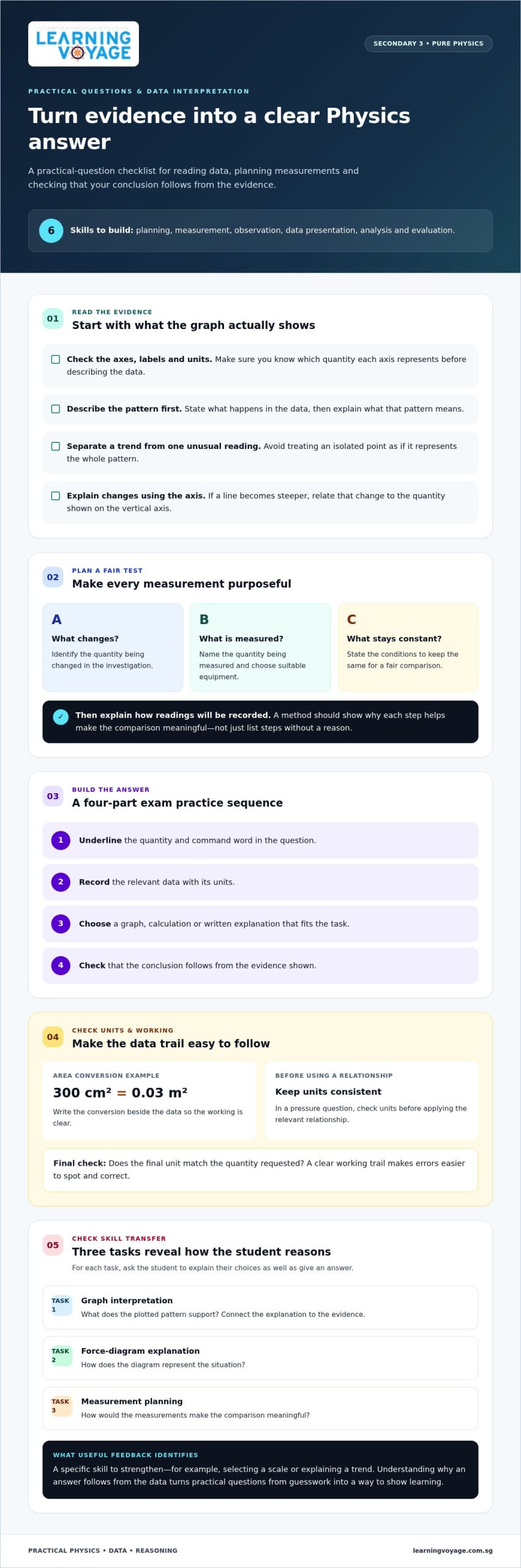
Practical Physics asks students to connect evidence with scientific reasoning. A student may know a formula but feel unsure when a question presents unfamiliar results. A useful diagnostic can include interpreting a graph, explaining a measurement choice, and evaluating observations. These tasks show whether the student can apply concepts, not just recall terms.
For graph interpretation, start with the axes, labels and units. Describe the pattern before explaining what it means. If a line becomes steeper, relate that change to the quantity shown on the vertical axis. Distinguish a trend from an isolated reading. This sequence connects visual data with a written explanation.
Measurement questions test whether students understand what makes a comparison fair. Ask them to identify the quantity being changed, the quantity being measured, and the conditions to keep constant. Then they can choose suitable measuring equipment and explain how to record readings. This foundation strengthens practical skills and helps a student justify a method rather than list steps without purpose.
Unit conversion can reveal careful data handling. For example, an area of 300 cm² is equivalent to 0.03 m². In a pressure question, the student must use consistent units before applying the relevant relationship. Ask them to write the conversion beside the data, then check whether the final unit matches the quantity requested. A clear working trail makes errors easier to spot and correct.
The 2027 G3 Pure Physics K323 syllabus includes planning, measurement, observation, data presentation, analysis and evaluation. These skills can be practised through short, focused questions. A student might decide how to organise readings in a table, describe a pattern, then suggest whether the evidence supports a claim. Each response should connect the observation to a reason.
Exam-style practice should develop in deliberate steps:
- Underline the quantity and command word in the question.
- Record relevant data with its units.
- Choose a graph, calculation or written explanation that fits the task.
- Check that the conclusion follows from the evidence shown.
A sec 3 pure physics tutor in Punggol can help students strengthen this reasoning through guided practice. Parents can look for feedback that identifies a specific skill, such as selecting a scale or explaining a trend. When a student understands why an answer follows from the data, practical questions become a chance to show learning, not a source of guesswork.
When a student understands why an answer follows from the evidence, the next step is to check whether that reasoning transfers to a different practical context. An initial Secondary 3 Physics diagnostic lesson in Singapore can use three original, age-appropriate tasks: graph interpretation, force-diagram explanation and measurement planning. Each task can prompt the student to explain choices as well as give an answer. In the graph task, ask what the plotted pattern supports; in the force-diagram task, ask how the diagram represents the situation; and in the planning task, ask how measurements would make the comparison meaningful. Reviewing the reasoning across these tasks can help identify which practical skill needs further attention.
Punggol classroom location and transport
A Physics class can fit the timetable on paper yet feel difficult after a long school day. For families in Punggol, compare the complete journey, not just the classroom address. The reference venue is 8 Fourth Avenue, Singapore 268674, near Sixth Avenue MRT. It is not a physical Punggol branch, so students travelling from Punggol need to account for the trip to that location.
Before choosing a centre-based class, map the journey from home or school to the classroom. Include the walk to the station, train transfers, the final walk, and the return trip after lessons. A route that looks simple on a map may feel tiring when a student carries school materials or travels during a busy period. Try the route at the lesson time, then consider whether it remains manageable alongside homework and rest.
Class size also affects how closely a teacher can follow each student’s reasoning. In one Singapore tuition example, a small-group tutorial has three students. A smaller group can make it easier to notice a skipped step in an equation, but size alone doesn’t show how lessons work. Look at whether students can ask questions, explain their methods, and receive feedback on mistakes. Those moments help a teacher identify gaps before they become habits.
Online Physics classes remove the commute, which may help when travel from Punggol makes attendance difficult. The trade-off is that students need a suitable place to work and must stay engaged through a screen. For a sample lesson, check whether the teacher can explain diagrams clearly, invite students to show working, and respond to questions in real time. Practical skills also need thoughtful teaching online, with clear discussion of equipment, measurements and observations.
For scheduling, compare the lesson period with school dismissal, travel time and other commitments. A reference Secondary 3 Physics tutorial is approximately 1.5 hours weekly. Treat that as a planning guide, then consider how the student will manage the journey and review class notes afterwards. A predictable schedule can help families protect study time without turning every lesson day into a rush.
Use this checklist before settling on a format:
- Map the full trip to the named classroom, including the return journey.
- Ask how the teacher tracks each student’s understanding during group lessons.
- For online lessons, check how diagrams, equations and questions are handled.
- Compare the class period with school, homework and the family’s weekly routine.
The right choice balances teaching interaction with a realistic journey. An in-person class may suit a student who benefits from discussion; a format without a commute may better suit a tight schedule. Consider the address, lesson time and teaching approach together, so transport supports learning rather than becoming another source of exam stress.
Moments and equilibrium
A ruler balanced on a pivot offers a clear starting point for moments. A moment describes the turning effect of a force around a pivot. Its size depends on the force and the perpendicular distance from the pivot to the force’s line of action. In an examination question, students must identify both before choosing a calculation.
Use this example: a perpendicular 25 N force acts 0.48 m from a pivot. Multiply the force by the perpendicular distance: 25 × 0.48 = 12 N m. The answer is a turning moment, not a force or a distance. Writing the unit matters because it shows what the calculation represents.
Students often lose marks by measuring from the pivot to an object’s edge rather than to the force’s line of action. Make that distinction visible. First mark the pivot. Then draw or extend the force’s direction. Finally, identify the shortest distance between the pivot and that line. This sequence supports independent reasoning when a diagram looks unfamiliar.
Equilibrium questions add a balancing condition. If an object is stationary and balanced, clockwise moments equal anticlockwise moments about the same pivot. In the 12 N m example, the turning effect in the opposite direction must also total 12 N m for the moments to balance. Students should name each direction before comparing the values.
A reliable method for school practice is to:
- Mark the pivot and label each force with its direction.
- Find the perpendicular distance for each force.
- Calculate each moment using force multiplied by distance.
- Compare clockwise and anticlockwise totals, then state whether they balance.
The method also helps students explain changes. Moving a force farther from the pivot increases its turning effect if the force stays the same. A force acting through the pivot has no turning effect about it because its perpendicular distance is zero. These comparisons test conceptual understanding, not just substitution into an equation.
For combined science revision, students can practise describing diagrams aloud before calculating. Ask them which force turns the object clockwise and which turns it anticlockwise. Then have them show every distance and unit in their working. This makes progress easier to identify: a correct setup with an arithmetic slip needs different support from a mistaken pivot or distance.
A door provides a familiar example outside class. Its hinges act as the pivot, while pushing near the handle creates a turning effect. Examination diagrams may be less familiar, but the same steps apply. Calm, repeated reasoning helps students approach moments and equilibrium as a sequence of decisions rather than formulas to memorise.
Do Punggol Physics tutors offer trial lessons or assessment sessions?
In Punggol, trial lessons and assessment sessions don’t follow one standard format. A trial lets a student experience the teaching approach; an assessment identifies specific learning gaps. Some tuition arrangements provide one of these, while others begin with regular lessons. The useful question is what the session helps your child understand about their learning.
A focused assessment should reveal more than whether a student can recall a formula. For Secondary 3 Pure Physics, it can explore how they interpret a diagram, select relevant information and explain their reasoning. A question about forces, for example, can show whether the student distinguishes the forces acting on an object from the object’s motion. That difference points to a more useful next step than a score alone.
A trial lesson offers useful evidence. Notice whether the tutor explains a difficult idea in clear steps, then gives the student a chance to apply it independently. If a student struggles with an equation, does the tutor identify the mistaken step or simply provide the answer? That interaction can help parents judge whether the pace and teaching style suit their child.
Before deciding, consider what the session should reveal:
- Conceptual understanding: Can the student explain why a method applies?
- Working habits: Do they show steps and use units in calculations?
- Response to guidance: Can they correct an error after an explanation?
- Learning priorities: Does the feedback identify a topic or skill to practise next?
One short session cannot reveal every strength or difficulty. Treat it as a starting point, not a verdict on a student’s ability. A child who hesitates at first may show strong reasoning after a prompt; another may calculate accurately but struggle to explain the result. Separating these patterns helps parents respond calmly instead of letting examination stress define the conversation.
Useful feedback after an assessment connects an observed difficulty with a practical action. For example, if a student selects the wrong equation, the next practice can focus on identifying known quantities and the value the question asks for. If written explanations are unclear, practise linking evidence to a conclusion. This makes progress easier to discuss at home and gives the student a clear learning target.
For families comparing a sec 3 pure physics tutor in Punggol, the session’s value lies in the evidence it provides. A trial helps you observe teaching and student interaction; an assessment helps pinpoint what needs attention. Either can make the next decision more informed when feedback is specific, respectful and connected to the student’s actual work.
Physics tuition
Useful Physics tuition turns a formula into a method students can apply in unfamiliar questions. For Secondary 3 learners, that means connecting concepts, calculations and written explanations. A student studying forces, for example, should identify the forces first, find the resultant, then relate it to acceleration. This sequence makes each decision visible instead of encouraging guesswork under examination pressure.
Consider a 3.0 kg trolley pulled with 14 N while a 5 N resistive force acts against it. The resultant force is 9 N to the right, so its acceleration is 3.0 m/s² to the right. A strong learning sequence asks the student to draw the forces, subtract opposing forces, then apply the relationship between resultant force, mass and acceleration. Each stage reveals where understanding needs work.
Linking topics also matters. A 2.0 kg bag raised vertically by 1.5 m gains 30 J of gravitational potential energy when gravitational field strength is 10 N/kg. The calculation connects mass, height and gravitational field strength. In electricity, a 6.0 Ω resistor carrying 0.50 A has a potential difference of 3.0 V and power of 1.5 W. Practising relationships across topics helps students choose an appropriate equation.
A clear study routine can develop those connections progressively:
- Review a concept, then explain it using correct Physics terms.
- Work through a guided example, showing units and each calculation step.
- Try a related question independently and compare the reasoning.
- Record recurring errors, such as confusing energy, power or force.
A flexible twelve-week learning sequence can provide a structure for revisiting topics and addressing gaps. The useful measure is not simply how many questions a student completes. Look for evidence that they can select relevant information, explain why an equation applies, and check whether an answer’s unit fits the quantity. These habits help make revision purposeful, especially when exam stress makes a long worksheet feel overwhelming.
Parents can support progress by discussing one specific question after each lesson. Ask what the student found difficult and which step helped them move forward. If they can explain why a trolley accelerates to the right, rather than only repeat 3.0 m/s², they are showing connected understanding. Regularly reviewing this reasoning gives families a clearer picture than marks alone.
For structured support with Secondary 3 Physics concepts, explore Physics tuition and guided practice. Choose learning that helps your child connect equations, concepts and exam responses, building confidence through deliberate steps.
Uniform acceleration from rest to 14 m/s over 7 seconds means 49 m travelled. A 750 N force over 0.15 m² produces 5000 Pa; 60 N along 2.5 m does 150 J of work. A component at 9 V and 1.5 A has 6 Ω resistance; a wave at 330 m/s with a 0.66 m wavelength has a frequency of 500 Hz.
Learning Voyage Education Centre: Secondary 4 E-Mathematics Tuition
Learning Voyage Education Centre offers Secondary 4 E-Mathematics Tuition for students building confidence with the demands of upper-secondary mathematics. If your family is also planning support beyond Physics, this can provide a focused path through E-Maths concepts and exam preparation. Students at other stages can explore Secondary 3 E-Mathematics Tuition, Secondary 3 A-Mathematics Tuition or Secondary 4 A-Mathematics Tuition, depending on their subject and level.
Choosing support that matches the student’s current syllabus keeps learning purposeful. A clear understanding of the topics causing difficulty can help families decide which mathematics course fits their next step.
For course details or to discuss the next step, contact Learning Voyage Education Centre.
Set a Steady Course for the Next Step
The next step is to turn your child’s current questions into a clear learning priority. Choose one area they find difficult, then discuss what support would help them approach it with greater independence. A calm, practical plan can make exam preparation feel less like pressure and more like progress your family can recognise.
Finding a sec 3 pure physics tutor in Punggol is one part of that plan. Consider what kind of guidance will help your child stay curious, build stronger study habits and feel more prepared for the work ahead. A focused conversation about their learning goals can help the family decide what to pursue next.
To explore learning support, contact Learning Voyage Education Centre. With thoughtful guidance and steady effort, your child can move forward with greater confidence.
Frequently Asked Questions
How to choose a suitable Sec 3 Pure Physics tutor for O-Level preparation?
Choose a tutor who can align lessons with your child’s school syllabus, explain difficult ideas clearly and help them learn from marked work. Ask how feedback turns into focused practice, such as revisiting a misunderstood concept before attempting a harder application question. Also consider whether your child feels comfortable asking questions. From 2027, the Singapore-Cambridge Secondary Education Certificate replaces the earlier N- and O-Level examination certificates, so check that preparation matches the student’s examination route.
How to compare Pure Physics tuition centres and private tutors in Punggol?
Compare how each option explains concepts, responds to mistakes, checks your child’s working and develops practical-question skills. For a centre, factor in the full journey to the venue near Sixth Avenue MRT and the approximately 1.5-hour weekly lesson; for a private tutor, compare the lesson format and feedback with your child’s needs.
Sec 3 Pure Physics tuition centres near Punggol MRT
The reference venue is at 8 Fourth Avenue, near Sixth Avenue MRT, and is not a physical Punggol branch. Students travelling from Punggol should consider the full journey, including transfers and the return trip.