Learning Voyage – Math and Science Specialist



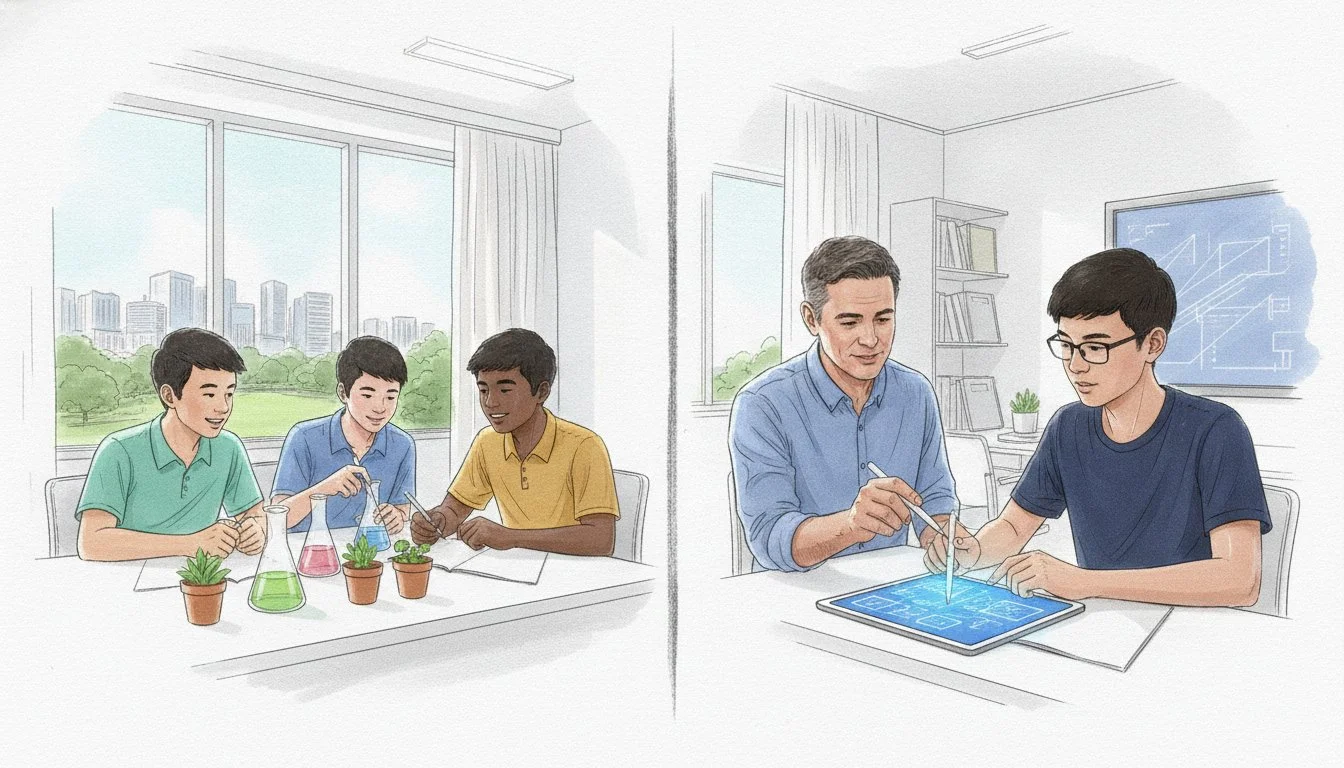
By Andy Woo August 8, 2026
Singapore Science Tuition: Group vs Private Tutor 2026
Many parents believe that a S$180 per hour private tutor is the safest harbor for a child struggling with Science, yet the most profound academic transformations often occur when students experience the collaborative benefits of small group science tuition. It’s disheartening to watch your child grapple with the 2026 syllabus, where the new focus on “Ways of Thinking and Doing” makes traditional rote memorization feel like a sinking ship. You want more than just a functional passing grade; you want a confident explorer who can tackle complex Open-Ended Questions with precision and curiosity.
We understand the pressure of the 2026 PSLE and O-Level updates, from the removal of the “Cells” topic to the increased emphasis on experimental design. This article provides a definitive comparison between individual coaching and structured group formats to help you chart the right course for your child’s voyage. You’ll discover a clear framework for deciding which format will best plug the gaps in your child’s understanding. We examine how different environments impact student confidence, cost-effectiveness in a 9% GST environment, and the specific pedagogical techniques needed to move from a ‘C’ or ‘U’ grade to a triumphant ‘A’.
Key Takeaways
- Learn how to navigate the 2026 MOE syllabus changes, including the shift away from rote memorization toward inquiry-based application and experimental design.
- Identify the specific benefits of small group science tuition, where peer interactions and standardized teaching methods help students master the “keyword game” in Open-Ended Questions.
- Evaluate whether your child requires the intensive focus of a private tutor for severe learning gaps or the dynamic, collaborative environment of a specialist center.
- Discover how the “Plug-the-Gaps” technique ensures your child receives personalized attention to overcome individual hurdles while benefiting from a supportive social setting.
- Gain a clear decision-making framework to choose an educational partner that transforms academic anxiety into lasting confidence and character growth.
The Science Tuition Dilemma: Understanding Your Child’s Learning Needs
Science in Singapore is often perceived as a daunting ocean. For many families, the transition into the 2026 academic year brings a tide of anxiety. It isn’t just the students feeling the pressure; parents often find themselves submerged in the same “exam stress” as their children. This is particularly evident within Singapore’s extensive shadow education system, where the search for the right support becomes a high-stakes mission for academic survival.
We often see a distinct “Science Barrier” during Primary 5 or Secondary 3. These years represent a significant shift in depth and complexity. Suddenly, a child who once cruised through lower primary finds themselves struggling to stay afloat. It’s rarely a lack of effort. Instead, it’s the sudden demand for precision in a syllabus that now prioritizes inquiry over memorization. Understanding the benefits of small group science tuition starts with recognizing that these hurdles are a natural part of the learning voyage, requiring a more specialized navigational tool than simple home revision.
Identifying Academic Hurdles in Science
The 2026 MOE syllabus demands more than just knowing facts. Students must now “Inquire like Scientists,” a shift that leaves many feeling adrift. We see three main anchors holding students back: the difficulty of applying abstract concepts to novel, real-world scenarios, the “Keyword Trap” in Open-Ended Questions (OEQs) where a missing term results in zero marks, and a lack of higher-order thinking skills needed to plan and interpret experiments. For those in the Primary Science or Secondary Science streams, these hurdles can feel insurmountable without a lighthouse to guide them toward clarity.
The Emotional Toll of Exam Stress on Singaporean Families
When grades dip to a ‘C’ or ‘U’, the home environment often becomes strained. Frustration can inadvertently turn into pressure, creating a cycle of “panic tutoring” that rarely yields results. Professional mentorship serves a dual purpose: it provides the academic scaffolding required for success and restores family harmony. By shifting the focus from mere survival to a strategic “learning voyage,” we help students regain their confidence. One of the key benefits of small group science tuition is the realization that they aren’t navigating these choppy waters alone. Peer support, combined with expert guidance, transforms the educational experience into a journey of personal growth rather than a functional necessity.
Benefits of Small Group Science Tuition vs. Private Tutors
Choosing the right vessel for your child’s education requires more than just looking at the price tag. While private tutors offer a 1-to-1 ratio, they often lack the systemic consistency found in established centers. One of the primary benefits of small group science tuition is the balance between personalized attention and a standardized, high-quality curriculum. In 2026, group tuition monthly benchmarks range from S$180 for primary levels to S$480 for H2 Chemistry, providing a more sustainable investment for families compared to the escalating hourly rates of private coaching. Beyond the financial aspect, the group format provides a “fleet” advantage where students learn from one another’s inquiries.
Consistency is key for academic success. Private tutors are often “lone sailors” whose teaching quality can vary significantly based on their individual schedule or energy levels. In contrast, tuition centers registered with the Committee for Private Education (CPE) must adhere to rigorous standards. This ensures that the materials, pedagogical techniques, and assessment methods are aligned with the latest MOE changes. Students don’t just receive help with homework; they follow a charted course designed to build character and academic mastery simultaneously. This structured approach is vital for navigating the complex requirements of the 2026 syllabus.
The Power of Peer-to-Peer Learning and Inquiry
Peer interaction is one of the most significant benefits of small group science tuition, as Science is a collaborative discovery. In a small group setting, students witness the diverse ways their peers approach a problem. This environment offers several advantages:
- The Protege Effect: Explaining a concept to a peer solidifies a student’s own understanding.
- Collective Learning: Seeing a classmate’s mistake in an Open-Ended Question prevents the same error later.
- Healthy Motivation: Group dynamics drive students to excel in a supportive, high-pressure environment.
When a student hears a peer ask a question they hadn’t considered, it sparks a deeper level of inquiry. This social resilience is a critical skill that private tutoring cannot replicate.
Resource Accessibility: Specialized Materials and Science Labs
A private tutor rarely has the capacity to develop the proprietary worksheets and extensive question banks that a specialist center curates over decades. These resources are essential for mastering the “Keyword game” required for distinction grades. For younger students, our Primary Science Tuition provides the foundational scaffolding needed to navigate these complex concepts. Access to structured revision workshops further ensures that students are prepared for the rigors of national examinations. If you’re concerned about your child being lost in a crowd, our Plug-the-Gaps technique offers the precision of private tutoring with the dynamic energy of a group.
Evaluating Private Tutors: When Is One-on-One Instruction Necessary?
While we advocate for the navigational advantages of a structured classroom, there are specific instances where a solo voyage is required. Private tutors are often sought as a temporary harbor for students facing severe learning gaps or those with special educational needs that require a bespoke pace. In these niche cases, the immediate, undivided attention of a coach can help stabilize a student who is significantly behind the school curriculum. However, parents should weigh this against the long-term benefits of small group science tuition, which prepares students for the collaborative nature of higher education and professional scientific inquiry.
One significant risk often overlooked in the 1-to-1 format is the “Crutch Effect.” In a private setting, a student may become overly dependent on the tutor’s constant prompts and immediate corrections. This creates a false sense of security. Without the “fleet” environment of peers to test their ideas against, students may struggle to develop the independent problem-solving stamina required for the rigorous 2026 national examinations. True academic growth requires a student to navigate challenges with guidance, not just follow a path cleared entirely by someone else.
Catering to Specialized Learning Profiles
For students managing specific behavioral or focus-related challenges, a private setting offers a controlled environment with fewer distractions. This can be essential for initial stabilization. The trade-off, however, is the loss of diverse perspectives. Science is fundamentally about inquiry and the exchange of ideas. When a child only interacts with one adult, they miss the chance to hear how others interpret a complex experiment or plan a scientific investigation. This social dimension is a hallmark of the benefits of small group science tuition, fostering a deeper, more resilient understanding of the subject.
The Convenience and Logistics Trade-off
The primary draw for many busy Singaporean families is the flexibility of scheduling and the elimination of travel time. While having a tutor come to your home is convenient, it often lacks a dedicated “learning environment.” The domestic setting is filled with subtle distractions, from the television in the next room to the presence of siblings. This can make it difficult to maintain the professional boundaries necessary for intense academic work. As concepts become more complex, many parents find their children need the specialized resources of a center, often transitioning to Secondary Science Tuition to benefit from a more structured and results-driven atmosphere.
Vetting quality remains a significant challenge in the private market. With current 2026 regulations prohibiting MOE teachers from giving paid private tuition, finding a qualified freelance coach who truly understands the nuances of the “Ways of Thinking and Doing” framework is increasingly difficult. Many parents find that the standardized excellence of an established center provides a more reliable compass for their child’s academic success.

Navigating the 2026 Science Syllabus: PSLE, O-Level, and Beyond
The 2026 academic year marks a significant course correction in Singapore’s Science education. MOE’s shift away from rote memorization toward inquiry-based learning means students can no longer rely on a textbook as their only life raft. Mastery now requires “Ways of Thinking and Doing.” This is where the benefits of small group science tuition become clear. In a collaborative setting, students don’t just learn facts; they learn to navigate the “CER” framework (Claim, Evidence, Reasoning) which is now the backbone of Booklet B in the PSLE Science paper. With the removal of topics like “Cells” to reduce memorization fatigue, the focus has shifted toward experimental design and inquiry skills.
For O-Level candidates, the “Keyword game” has become even more rigorous. “Almost right” is no longer a safe harbor. Examiners look for specific scientific terminology to award marks in Open-Ended Questions. If a student explains a concept correctly but omits the mandatory keywords, they risk losing significant ground. This precision is difficult to master in a vacuum. One of the benefits of small group science tuition is the opportunity to see how different students apply these keywords, allowing for a broader understanding of how to hit the mark every time.
Mastering Open-Ended Questions (OEQs) and Keywords
Common “trap” questions in the 2026 Science papers often involve novel experimental setups. Students are now asked to plan, design, or interpret data rather than simply stating a scientific law. Memorizing the textbook is a sinking ship strategy for modern exams. At Learning Voyage, we decode question intent by teaching students to identify “command words” that dictate the required response depth. We move beyond the “what” and focus heavily on the “how” and “why,” ensuring students are prepared for the 10 high-weightage OEQs in the revamped PSLE format.
Preparing for High-Stakes Transitions
The jump from Lower Secondary Science to Pure Physics or Pure Chemistry is often where students encounter the roughest seas. Secondary 1 and 2 serve as the anchor for everything that follows. Without a solid foundation in these early years, the Secondary 3 jump can lead to a grade collapse as concepts become more abstract and mathematically intensive. If you are looking for a compass to guide this transition, consider Finding a Hougang Tuition Centre that prioritizes conceptual transformation over rote drills.
Ready to secure your child’s academic future and navigate these syllabus changes with confidence? Speak with our specialists at Learning Voyage today to chart a path toward Science distinction.
Finding Your Compass: Why Learning Voyage’s Small Groups Offer the Best of Both Worlds
Choosing between a private tutor and a tuition centre shouldn’t feel like choosing between a lifeboat and a compass. At Learning Voyage, we provide both. Our small group coaching is designed to steer students through the rough seas of national exams, ensuring they don’t just survive but thrive. One of the greatest benefits of small group science tuition at our centre is the proprietary “Plug-the-Gaps” technique. This method allows us to identify individual learning hurdles while maintaining the dynamic energy of a group. It’s the precision of a private tutor combined with the social resilience of a peer environment, ensuring your child never feels lost in the crowd.
Principal Andy Woo, who founded Learning Voyage in 2011, believes that education is a transformative process. It isn’t just about grades; it’s about building the character and confidence needed to navigate life’s challenges. By limiting our class sizes, we ensure that every student receives the bespoke quality of attention they deserve. This precision-guided approach turns academic functional necessity into a voyage of personal achievement. We don’t just teach Science; we mentor future thinkers who approach problems with a calm, methodical hand, even when the academic tides are high.
The ‘Plug-the-Gaps’ Technique: A Precision-Guided Approach
Our methodology follows two critical steps to ensure no student is left adrift. First, we identify the specific conceptual “leak” in the student’s foundation. Whether it’s a misunderstanding of energy forms or a struggle with experimental variables, we find the exact source of the grade dip. Second, we customize the “Plug” through targeted exercises and mentorship. This isn’t a one-size-fits-all drill. It’s a bespoke intervention that addresses the primary fear of many Singaporean parents: their child being overlooked in a large classroom. You can learn more about our Plug-the-Gaps methodology to see how we maintain high standards of academic excellence.
Building Confidence and Higher-Order Thinking Skills
We have seen countless students transform their results from “U” or “C” grades to “A” distinctions. This isn’t magic; it’s the result of steady, methodical progress. We focus on higher-order thinking skills required for PSLE and O-Level Science, preparing students for the intellectual demands of a STEM-focused future. By fostering inquiry and logical reasoning, we bridge the gap between a child’s natural curiosity and rigorous academic requirements. These are the lasting benefits of small group science tuition that extend far beyond a single examination paper. If you’re ready to start this journey, check our class schedules for 2026 and find the right slot for your child.
Charting a Course for Science Excellence in 2026
Navigating the 2026 Science syllabus requires a strategic partner who understands that inquiry is the new currency of academic success. We’ve explored how the shift away from rote memorization demands a more sophisticated approach than traditional drills can offer. By embracing the unique benefits of small group science tuition, students gain the collaborative resilience and conceptual clarity needed to master complex Open-Ended Questions. This environment fosters a deeper engagement with the subject, turning functional necessity into a transformative process of personal growth.
Under the expert mentorship of Principal Andy Woo, our small group coaching ensures that no child is left adrift. Our proprietary “Plug-the-Gaps” technique provides the precision of personalized attention within a dynamic social setting, transforming academic anxiety into a triumphant voyage of discovery. It’s about building character alongside grades, ensuring your child is prepared for the challenges of PSLE, O-Levels, and beyond.
Secure your child’s spot for 2026 and Plug the Gaps in their Science mastery today!
Every student deserves to navigate high-pressure environments with a calm and steady hand. We’re here to help your child find their compass and achieve the results they’ve always been capable of reaching at their own pace.
Frequently Asked Questions
Is group tuition or private tuition more effective for Primary Science?
Effectiveness depends on the student’s needs, but group tuition is often superior for the 2026 syllabus due to its inquiry-based nature. Peer interaction models the “Ways of Thinking and Doing” framework required by the MOE. While private coaching offers undivided attention, it lacks the peer modeling essential for collaborative discovery. Small groups provide a supportive fleet where students learn to navigate complex concepts together, building social resilience alongside academic mastery.
How much does Science tuition cost in Singapore for 2026?
In 2026, group tuition for Primary levels typically ranges from S$180 to S$280 per month, while O-Level Pure Science groups range from S$320 to S$450. Private 1-to-1 tutors charge between S$30 and S$180 per hour depending on their experience and the academic level. All fees at registered centres are subject to 9% GST, which must be factored into your household budget to ensure a sustainable educational voyage.
What is the ideal class size for a Science tuition centre?
The ideal class size is generally between 6 and 10 students. This “sweet spot” ensures that our mentors can apply the “Plug-the-Gaps” technique to address individual conceptual leaks without losing the dynamic energy of a group. This balance allows for personalized guidance while harvesting the collaborative benefits of small group science tuition, ensuring every student remains on a steady course toward distinction and personal growth.
Can my child switch from a private tutor to group tuition mid-year?
Switching mid-year is a common and often necessary maneuver if your child’s progress has plateaued. Moving from the dependency of a private tutor to a structured group environment can reignite a student’s competitive spirit and interest. Our specialists help bridge any initial gaps to ensure the transition into our learning voyage is smooth. It ensures they are well-prepared before the high-pressure national examination season begins.
How does Learning Voyage handle different learning speeds in a group?
We manage varying paces through our proprietary “Plug-the-Gaps” methodology. While the group explores a core concept, our mentors identify specific hurdles for each student and provide bespoke “plugs” or targeted exercises. This ensures that faster learners are challenged with higher-order thinking tasks while those needing more time are not left adrift. It maintains a cohesive yet personalized educational experience that respects each student’s unique learning rhythm.
What should I look for when vetting a Science tutor in Singapore?
Vetting a Science tutor requires looking beyond basic qualifications to verify their understanding of the 2026 syllabus shift toward experimental design and the CER framework. For tuition centres, ensure they are registered with the Committee for Private Education (CPE). A quality mentor should act as a seasoned navigator, focusing on building character and conceptual understanding rather than just functional rote learning or providing temporary homework help.
Does group tuition help with Science Open-Ended Questions (OEQs)?
Yes, group settings are particularly powerful for mastering the “Keyword game” in OEQs. By analyzing peer responses, students learn why “almost right” answers fail to garner marks and how to apply the Claim-Evidence-Reasoning structure effectively. This is one of the primary benefits of small group science tuition. Collective feedback helps students refine their precision and avoid common examination traps that lead to significant mark loss.
Is it too late to start Science tuition in the middle of Secondary 4?
It is not too late, though the voyage requires more intensive effort. Starting in mid-Secondary 4 allows for strategic gap-plugging through our Intensive Revision Workshops. We focus on high-weightage topics and exam techniques to stabilize grades. Even a few months of targeted mentorship can move a student from a “U” or “C” grade to a more confident and successful O-Level outcome before they reach the final harbor.


