
What if the secret to a distinction isn’t working harder, but learning how to navigate the hidden icebergs within the updated 2026 syllabus? Many students in Singapore find themselves adrift, studying until midnight only to see their results stall at a frustrating C6 or B4. You likely recognize the panic that sets in during a Paper 2 session when an unfamiliar “Space Physics” question appears, or the confusion when a student provides a “describe” answer for an “explain” prompt. It’s a common struggle, and we believe every learner deserves a steady hand to guide them through these turbulent academic waters.
This article identifies the critical common mistakes in o level physics that prevent even the most dedicated students from reaching their full potential. We will provide you with a clear roadmap to fix these conceptual gaps and tactical pitfalls using proven strategies. We’ll explore how to master the new assessment structure, which now features a mandatory Section B in Paper 2, and refine your analytical compass to ensure you’re fully prepared for the 2026 examinations.
Key Takeaways
- Learn how to stop the silent leak of marks by mastering the 2/3 Significant Figures rule and navigating the “prefix nightmare” of SI unit conversions.
- Bridge the divide in challenging topics like Electricity and Forces by correcting the deep-seated misconceptions that often keep students tethered to a C grade.
- Identify and rectify common mistakes in o level physics within the updated 2026 Practical Paper, specifically focusing on the high-stakes planning question and graphing precision.
- Discover the “Plug-the-Gaps” technique, a proprietary methodology designed to help you navigate individual learning hurdles and chart a steady course toward an A1 distinction.
Identifying the Hidden ‘Icebergs’ in O-Level Physics
Think of the O-Level Physics paper as a vast, unpredictable ocean. For many students in Singapore, the journey toward a distinction feels like sailing through a thick fog where the most dangerous obstacles are the ones they can’t see. We often categorize common mistakes in o level physics into two distinct groups: tactical blunders and deep-seated conceptual gaps. While a tactical blunder might be a simple unit conversion error, a conceptual gap is far more insidious. It’s a disconnect between theory and application that leaves even the most hardworking students stranded at a C5 or B4 grade, regardless of how many hours they spend with their noses in a textbook.
The Singapore Examinations and Assessment Board (SEAB) has progressively steered the syllabus toward higher-order thinking. In the 2026 examinations, the emphasis isn’t just on recalling Newton’s Second Law; it’s about applying that law to a complex, real-world scenario you’ve never seen before. This shift from “what” to “how” and “why” is exactly where many students hit those hidden icebergs. To succeed, you must identify the common mistakes in o level physics that often go unnoticed until the results slip is released.
Why ‘Knowing the Formula’ Isn’t Enough
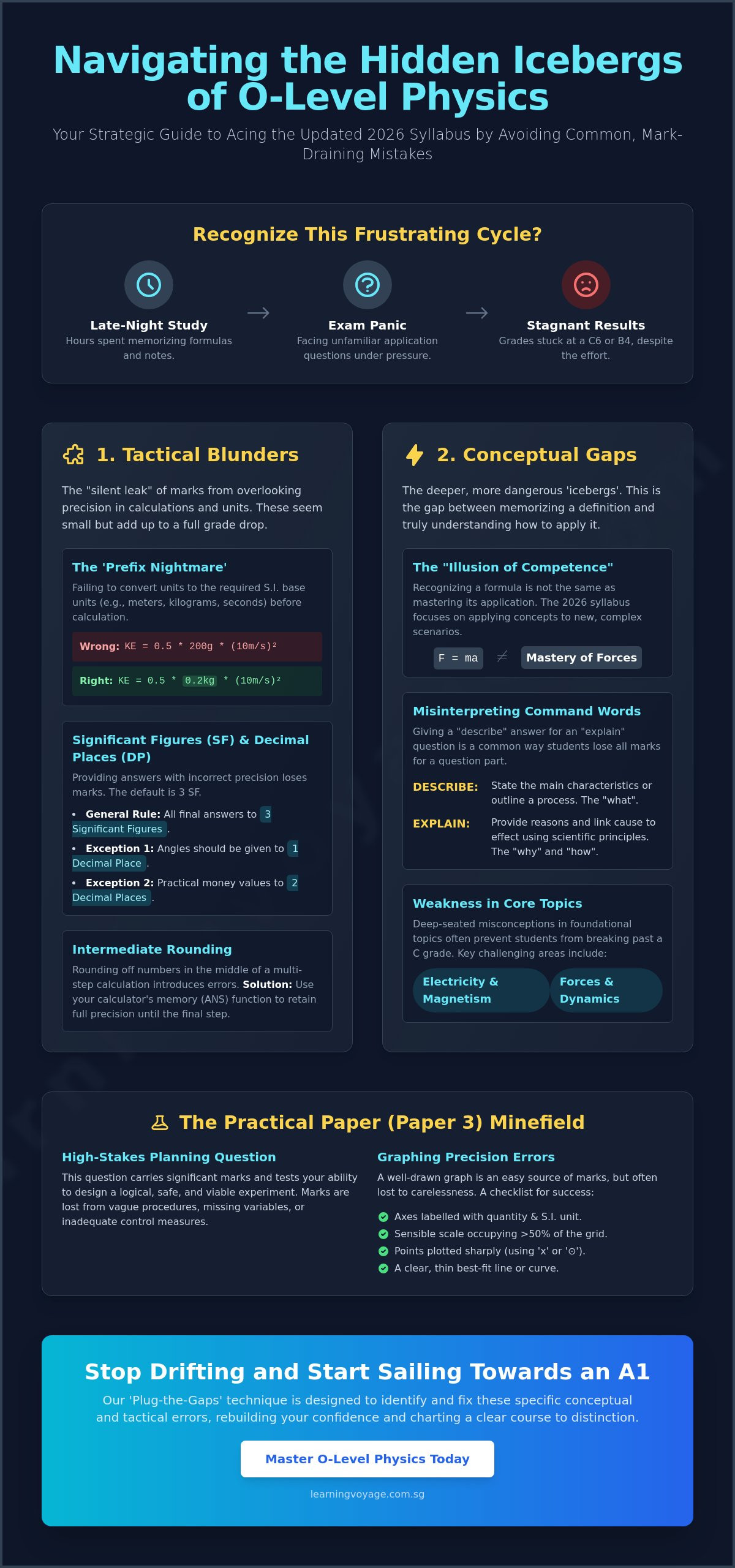
Many students fall into the “illusion of competence.” They recognize the formula F=ma and assume they’ve mastered the chapter. However, when faced with a question involving multiple forces on an inclined plane, they freeze. This happens because recognizing a fact is not the same as understanding its mechanics. According to research in physics education, students often struggle to transfer knowledge from a simplified classroom example to a novel problem. A conceptual gap is quite simply the missing bridge between knowing a definition and knowing how to use it as a tool. At Learning Voyage, we focus on building that bridge rather than just handing out more notes.
The Emotional Toll of Exam Stress
We also need to talk about the emotional weight of this voyage. What parents often dismiss as “careless mistakes” are usually symptoms of exam-induced cognitive overload. When a student panics in the middle of a high-pressure Paper 2 session, their working memory shrinks. They forget to check their significant figures or misread a “describe” question as an “explain” one. Transforming parent frustration into supportive mentorship is the first step in rebuilding a child’s confidence. Once a student feels they have a reliable compass and a steady hand guiding them, they can approach the daunting Section B application questions with the calm precision needed for an A1.
The ‘Precision’ Trap: Tactical Errors in Units and Calculations
Imagine you’ve charted a perfect course across the ocean, only to strike a hidden reef because your compass was off by a fraction of a degree. In the context of the national examinations, precision isn’t just a preference; it’s the language of the subject itself. One of the most frequent common mistakes in o level physics involves treating numerical values with a lack of rigor. Students often focus so intently on the complex physics theories that they neglect the fundamental arithmetic that anchors their answers. This leads to a “silent leak” of marks that can easily be the difference between an A1 and a B3.
The “prefix nightmare” is a primary culprit for many calculation errors. It’s deceptively easy to forget to convert centimeters to meters or grams to kilograms in the heat of an exam. However, since most Physics formulas, such as those for Gravitational Potential Energy or Kinetic Energy, require S.I. units, failing to convert these prefixes results in an answer that is off by orders of magnitude. Another tactical error is “Intermediate Rounding.” If you round off your values at every step of a multi-part question, your final result will drift significantly from the accepted value. You must keep the full value in your calculator’s memory until the very end of the voyage.
Significant Figures and Decimal Places
The SEAB and Cambridge examiners are meticulous about Significant Figures (SF). The general rule of thumb for O-Level Physics is to provide final answers to 3SF. Providing too many or too few figures suggests a lack of understanding of measurement precision. There are, however, specific exceptions you must navigate. Angles should typically be recorded to 1 decimal place, while monetary values in practical applications require 2 decimal places. Precision is the anchor of a solid Physics answer; without it, your hard work simply drifts away. If you find these technicalities overwhelming, our Secondary 4 Pure Physics Tuition provides the structured practice needed to make these habits second nature.
Vector Direction and Sign Conventions
In kinematics and dynamics, the failure to distinguish between scalars and vectors is a common shipwreck for many students. Confusing speed with velocity or distance with displacement often leads to incorrect sign conventions in calculations. For instance, in work done or gravitational potential energy questions, the negative sign is not just a mathematical detail; it represents the direction of the force relative to the displacement. Drawing a clear, labeled free-body diagram acts as a safety net. It allows you to visualize the forces at play and ensures your signs remain consistent throughout the calculation, preventing a total collapse of your logic during high-pressure moments.
Conceptual Gaps: Bridging the Divide in Forces and Electricity
While tactical errors are the surface ripples of an exam paper, conceptual gaps are the deep-sea trenches that can swallow a student’s confidence whole. Many common mistakes in o level physics stem from a fundamental misunderstanding of how the physical world operates, often because students rely on their “common sense” intuition rather than rigorous scientific theory. For example, in thermal physics, a frequent pitfall is confusing “Heat” with “Temperature” during phase changes. Students often struggle to explain why the temperature of a melting ice cube remains at 0°C even as it absorbs thermal energy. They fail to realize that the energy is being used to break intermolecular bonds rather than increase the average kinetic energy of the particles.
Similarly, wave motion presents its own set of challenges that can leave a student feeling adrift. A recurring error is the failure to distinguish between the direction of wave travel and the actual motion of the medium’s particles. In a transverse wave, such as light or water waves, the particles oscillate perpendicular to the path of energy transfer. In longitudinal waves, like sound, they move parallel. Forgetting this distinction leads to incorrect diagrams and lost marks in those high-stakes descriptive questions that require precise terminology.
Dynamics and Newton’s Laws
Newton’s Laws of Motion are perhaps the most misunderstood part of the entire syllabus. The most persistent error we see is the belief that a net force is required to keep an object moving at a constant speed. If a ship is cruising at a steady velocity across the Singapore Strait, the forward thrust is perfectly balanced by resistive forces; this means the resultant force is exactly zero. Distinguishing between Newton’s Third Law (Action-Reaction pairs) and balanced forces acting on a single object is another major hurdle. At our physics-tuition-hougang center, we use specific pedagogical techniques to help students visualize these interactions, ensuring they don’t drift into the wrong conclusions during Paper 2.
The ‘Current’ Confusion in DC Circuits
In the world of DC circuits, the “used up” current myth remains a significant barrier to an A1 grade. Current is the rate of flow of charge; it isn’t a fuel that disappears as it passes through a resistor. Misunderstanding potential dividers often leads to errors in predicting the “brightness of bulbs” in complex arrangements. Students frequently fail to apply the V=IR relationship correctly in parallel branches, or they fall into the “Short Circuit” trap, where they ignore a path of zero resistance. Mastering these common mistakes in o level physics requires a shift from rote memorization to a holistic understanding of how energy is distributed across a circuit. This clarity is what transforms a struggling student into a confident problem solver.
The Practical Paper (Paper 3): Planning and Execution Errors
If Paper 2 is the theoretical chart of your physics voyage, Paper 3 represents the live maneuvers in unpredictable waters. Practical exams are often the source of intense exam stress because they require a blend of steady hands and sharp analytical thinking. Many students treat the lab session as a secondary concern, yet it contributes significantly to your final grade. One of the most persistent common mistakes in o level physics is the failure to record data with the required precision of the instruments provided. If you’re using a meter rule marked in millimeters, your readings must reflect that precision; recording a length as 15cm instead of 15.0cm is a silent leak of marks that can sink an otherwise excellent paper.
Another area where students frequently lose their bearings is the distinction between a “precaution” and a “source of error.” This is a nuance that examiners at the SEAB level watch closely. A precaution is a proactive step you take to ensure safety or improve accuracy, such as switching off a circuit between readings to prevent wire heating. Conversely, a source of error is an unavoidable factor that explains why your experimental results don’t perfectly match the theory, such as heat loss to the surroundings in a thermal physics experiment. Mixing these up suggests a lack of experimental maturity.
Mastering the Planning Question
The planning question, typically worth 5 to 6 marks, is the anchor of the updated 2026 Paper 3. Students often drift off course by failing to clearly identify the independent and dependent variables right at the start. To secure full marks, your procedure must be a step-by-step guide so logical that another person could replicate your experiment without guidance. You must include essential keywords like “repeat and average” to show you understand reliability, and specify which variables must be kept constant to ensure a fair test. For those who need to strengthen these investigative skills, our secondary-science-tuition program offers the hands-on guidance necessary to master these nuances.
Graphing and Data Analysis
Your graph is the visual evidence of your experimental voyage. The “ultimate graphing sin” in O-Level Physics is connecting the dots like a simple map rather than drawing a single, thin, and smooth line of best fit. When calculating the gradient, examiners require you to use a “large triangle” that covers at least half of your drawn line; using a small triangle increases the percentage error and results in a penalty. Additionally, ensure your plotted points occupy more than half of the provided grid. A cramped graph is difficult for examiners to read and often leads to inaccuracies in your final analysis. To ensure your practical skills are as sharp as your theoretical knowledge, consider joining our Secondary 4 Pure Physics Tuition before the next exam cycle begins.
Charting a Course to Excellence with the ‘Plug-the-Gaps’ Technique
Every ship needs a hull free of leaks to reach the distant horizon of success. While identifying common mistakes in o level physics is a vital first step, the true transformation happens when you systematically repair those vulnerabilities before they sink your grade. This is where our proprietary plug-the-gaps technique serves as your most reliable rudder. Instead of the “drill and kill” method that many students use to exhaustion, we focus on surgical precision. We help you pinpoint exactly where your conceptual understanding is faltering, whether it’s the nuances of electromagnetism or the intricacies of the new 2026 Space Physics topic.
Moving beyond rote memorization requires a fundamental shift in how you perceive the subject. Physics isn’t a collection of disconnected facts; it’s a cohesive story of how the universe functions. By focusing on higher-order thinking, we empower you to tackle application questions that leave others stranded. You’ll stop asking “Which formula do I use?” and start asking “What is the physical principle at play here?” This shift is what turns a student struggling with common mistakes in o level physics into an analytical thinker capable of securing an A1 distinction.
Why Small Group Coaching Works
The journey to academic excellence shouldn’t be a lonely one. While some parents look for one-on-one home tuition, they often find that the lack of peer interaction can lead to academic stagnation. In our small group settings, students benefit from the dynamic environment where seeing the questions their peers ask often uncovers blind spots they didn’t know they had. This environment builds character and resilience. It teaches you that every learner faces hurdles, but with the right mentorship, those hurdles are merely stepping stones. For parents looking for a supportive environment, you can read our guide to Hougang tuition centres that transform results.
Your Final Revision Voyage
As the exam season approaches, your preparation must become more focused and intentional. Our Intensive Revision Workshops are specifically designed to be the lighthouse that guides you through the final storm of the school year. During these sessions, we condense the most challenging parts of the syllabus into actionable strategies. You’ll learn to build a study timetable that prioritizes your weakest topics, ensuring that no “leak” goes unaddressed. Remember, your starting point doesn’t define your final destination. With a methodical hand and a clear roadmap, the horizon of an A1 distinction is well within your reach.
Navigating Your Final Stretch to Distinction
The journey toward an A1 is rarely a straight line; it is a series of deliberate course corrections that refine both your understanding and your execution. By mastering the 2026 syllabus updates and eliminating the common mistakes in o level physics that often sink high-potential students, you’re doing more than just preparing for an exam. You’re building the mental fortitude and precision required for lifelong achievement. Whether it’s perfecting your significant figures or mastering the high-stakes practical planning question, every small adjustment brings the horizon of distinction into sharper focus.
Under the expert mentorship of Principal Tutor Andy Woo, our small group focus ensures that no student is left to drift in a sea of confusion. We utilize our proprietary ‘Plug-the-Gaps’ Technique to provide the personalized attention needed to transform exam stress into quiet confidence. This is your opportunity to move beyond rote memorization and embrace a transformative path of discovery. Secure your spot in our O-Level Physics classes and start plugging your gaps today!
Your potential is vast, and with the right compass in hand, there’s no limit to how far you can go on this academic voyage. We look forward to helping you reach your destination with confidence and clarity.
Frequently Asked Questions
What is the most common mistake in O-Level Physics Section B?
The most frequent error in Section B is providing a generic textbook definition that ignores the specific context of the scenario. Because Section B now consists of mandatory application questions in the 2026 syllabus, you must tailor your explanation to the variables and data given in the prompt. Simply stating a law isn’t enough; you must demonstrate how that law governs the specific situation to avoid the “vague answer” trap.
How many significant figures should I use for my final answers?
You should generally record your final numerical answers to 3 significant figures to meet SEAB requirements. However, you must navigate specific exceptions, such as recording angles to 1 decimal place or keeping exact values for certain constants. Using too many or too few figures suggests a lack of precision. It is one of the most persistent common mistakes in o level physics that results in a silent loss of marks.
Can I lose marks for not showing my working even if the answer is correct?
Yes, you can certainly lose marks because the marking scheme allocates specific “method marks” for the logical steps you take. If you jump straight to the answer and make a slight calculation error, you lose everything. By showing your formula and substitution clearly, you create a safety net. This allows examiners to award partial credit even if your final calculation hits a reef at the last moment.
What is the difference between ‘describe’ and ‘explain’ in Physics questions?
A ‘describe’ question asks you to state the observations or the “what,” while ‘explain’ demands the underlying scientific reasoning or the “why.” If you’re asked to describe a graph, you might mention its increasing gradient. If asked to explain it, you must reference the physical laws, such as Newton’s Second Law, causing that specific trend. Confusing these two command words often prevents students from reaching their full potential.
How do I avoid ‘careless’ errors in the MCQ Paper 1?
To avoid “careless” errors in Paper 1, you should use the elimination method to rule out obviously incorrect distractors immediately. Always double-check the units provided in the options; examiners often include answers that are numerically correct but utilize the wrong S.I. prefix. Read every word of the question carefully. Sometimes a single word like “not” or “constant” completely changes the required logical path for your calculation.
Is it possible to improve from a F9 to an A1 in six months?
It is entirely possible to achieve a significant grade jump if you move away from rote memorization and adopt a diagnostic approach. Success requires a steady hand and a methodical plan to identify and repair your individual learning hurdles. By focusing on high-weight topics and mastering exam techniques, you can turn your academic voyage around. Many students have transformed their results by replacing panic with a clear, guided strategy.
What should I focus on for the Physics Practical Planning question?
You must focus on identifying the independent, dependent, and control variables with absolute clarity right at the start. Your procedure should be written as a step-by-step guide that includes specific details like the range of measurements and the precise equipment used. Don’t forget to mention “repeating and averaging” to ensure the reliability of your data. This planning component is a critical 6-mark anchor in the updated Paper 3 assessment.
How does the ‘Plug-the-Gaps’ technique help with O-Level Physics?
The ‘Plug-the-Gaps’ technique is a proprietary methodology that identifies the specific common mistakes in o level physics that are unique to your own learning journey. Instead of sailing aimlessly through piles of past-year papers, we help you pinpoint the exact concepts where your understanding is leaking. This diagnostic approach ensures your revision time is spent repairing the most critical gaps, leading to much faster and more sustainable grade improvements.