
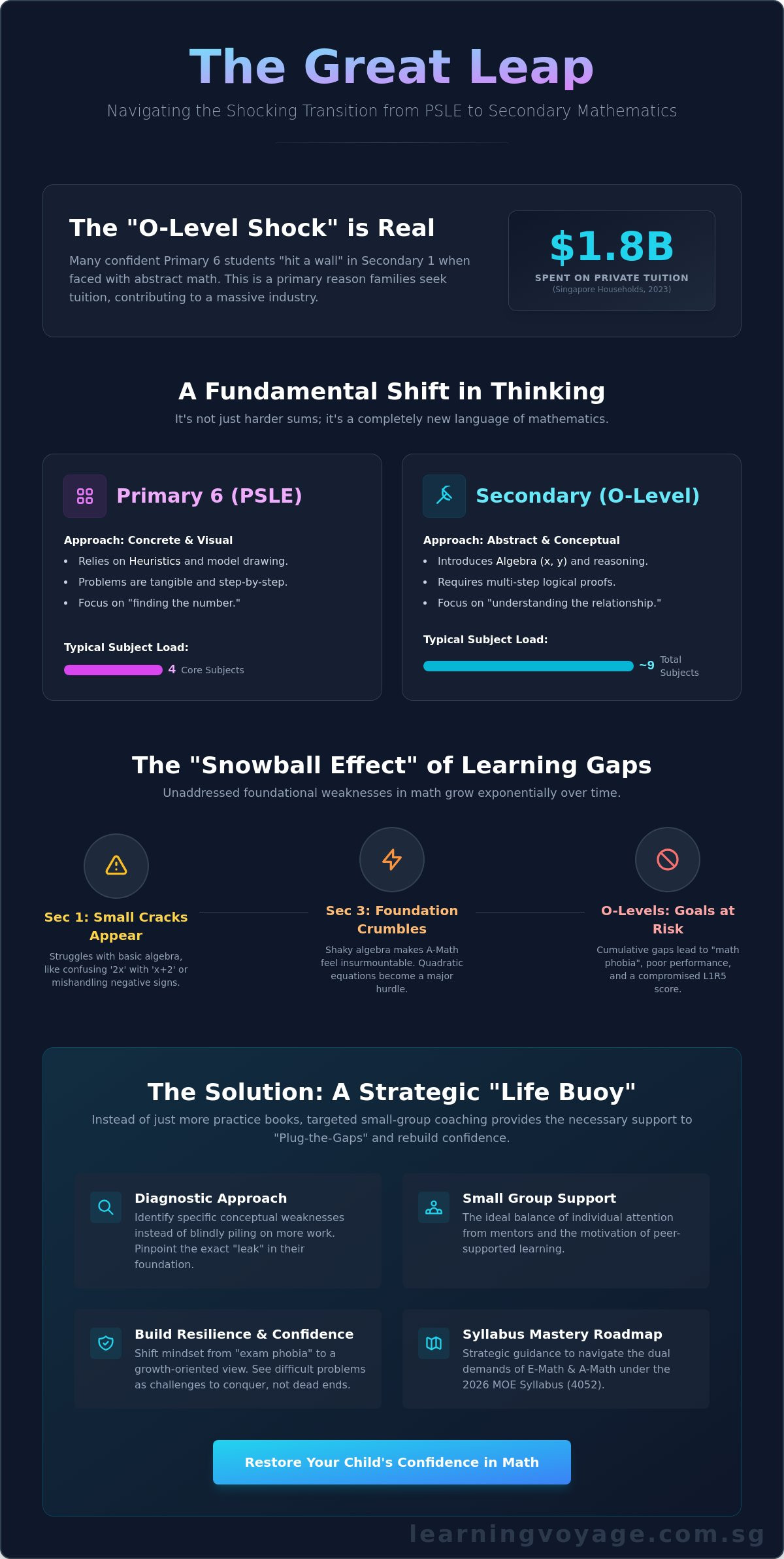
Imagine your child, once a confident Primary 6 math whiz, staring blankly at a page of “x” and “y” variables during their first term of Secondary 1. This sudden shift from concrete heuristics to abstract algebra often triggers a sharp decline in confidence; it’s a common “storm” that many families face when seeking secondary math tuition in Singapore. You likely feel the mounting pressure as the 2026 O-Level syllabus moves toward complex, multi-step reasoning questions. According to a report by The Straits Times, Singapore households spent approximately $1.8 billion on private tuition in 2023, reflecting a collective desire to provide students with a steady “life buoy” in a competitive academic sea.
We understand the frustration of seeing your child work hard without seeing results. This guide promises to show you how to identify specific learning gaps and navigate the rigorous MOE syllabus to achieve O-Level excellence. We’ll explore the 2026 tuition landscape, break down the latest Syllabus 4052 requirements, and provide a clear roadmap to restore your child’s confidence and secure those elusive distinctions through our proprietary “Plug-the-Gaps” methodology.
Key Takeaways
- Understand the critical shift from PSLE heuristics to abstract algebra to prevent your child from losing confidence during the demanding Secondary 1 transition.
- Discover why the “Plug-the-Gaps” philosophy is more effective for improving failing grades than simply piling on more assessment books.
- Learn how specialized secondary math tuition in a small group setting serves as a “life buoy,” providing the ideal balance of individual attention and peer support.
- Develop a strategic roadmap to navigate the 2026 O-Level syllabus, ensuring your child manages the dual demands of E-Math and A-Math for a stellar L1R5.
- Shift your child’s perspective from exam phobia to a growth mindset by focusing on specific conceptual wins and building long-term mathematical resilience.
Navigating the Secondary Math Transition: Why the Jump from PSLE is a Shock
The transition from Primary 6 to Secondary 1 is often described by Singaporean parents as “hitting a wall.” In primary school, math relies heavily on visual heuristics and model drawing. However, the 2026 O-Level Mathematics syllabus (Syllabus 4052) introduces a level of abstract reasoning that these models simply cannot support. This sudden “O-Level shock” is a leading reason why families seek secondary math tuition within the first few months of the school year. It’s not just about harder numbers; it’s about a fundamental change in how a student must think. If these conceptual gaps aren’t addressed early, they snowball. By the time a student reaches Secondary 3, a shaky foundation in basic algebra makes Advanced Mathematics (A-Math) feel like an insurmountable mountain.
This jump also involves a massive increase in subject load. Students move from four core subjects to as many as nine. This expansion dilutes their focus and tests their mental stamina. A 2023 report in The Straits Times highlighted how the pressure of the Singapore education system often peaks during these transitional years. When a student spends ten hours a day balancing school, CCAs, and new subjects like Geography or Literature, their ability to “steer” through complex quadratic equations at home diminishes. Without a steady hand to guide them, many lose their mathematical footing before they even reach the end of Term 2. This makes Secondary 1 the “make or break” year for mathematical confidence.
Algebra: The New Language of Secondary Math
Algebra is the “alphabet” of high school mathematics. Many students who excelled at PSLE struggle because they try to “translate” variables back into concrete blocks. They view “x” as a mystery to be avoided rather than a tool to be used. Common misconceptions often arise when moving from numbers to letters, such as confusing 2x with x+2 or failing to distribute negative signs across brackets. If your child is struggling to form equations from word problems, they aren’t failing at math; they’re failing at the language of math. Specialized coaching focuses on this linguistic shift, ensuring students don’t just memorize steps but actually understand the “grammar” of algebraic manipulation.
The Emotional Journey of the Secondary Student
The jump isn’t just academic; it’s deeply personal. A string of “C” or “D” grades in Sec 1 can shatter a child’s self-image, leading to a “math phobia” that persists until the GCE O-Levels. At Learning Voyage Education Centre, we view ourselves as a mentor rather than just a tutor. We recognize that academic results are tied to character and resilience. By providing a supportive “life buoy” in the form of small-group coaching, we help students navigate their fears. Our goal is moulding them into responsible young adults who view a difficult problem not as a dead end, but as a challenge they’re equipped to conquer. This transformation turns a stressful school journey into a path of self-discovery and excellence.
How to Identify and “Plug” Hidden Gaps in Your Child’s Foundation
When math grades begin to dip, the instinctive reaction for many Singaporean parents is to head to the nearest bookstore and load up on more assessment books. It’s a well-intentioned move, but it often addresses the symptom rather than the cause. If your child has a conceptual “leak” in their foundation, pouring in more practice is like filling a bucket with a hole in the bottom. This is where the danger of the “snowball effect” lies. In cumulative subjects like Mathematics, a shaky understanding of Secondary 1 linear equations inevitably leads to a complete breakdown when they encounter Secondary 3 A-Mathematics. Effective secondary math tuition must act as a diagnostic tool, pinpointing the exact moment the student lost their way on the journey.
Identifying these red flags early is vital. If your child spends over 20 minutes on a single structured question or consistently “blanks out” during weighted assessments despite studying hard, they likely have a hidden gap. These fractures usually appear during the transition to abstract reasoning. Without intervention, these small hurdles grow into a deep-seated “math phobia” that can derail their O-Level goals. The goal isn’t just to do more work; it’s to do the right work.
Step 1: Diagnostic Review of Past Test Papers
Sit down with your child and review their last three exam papers. You aren’t looking for the final score; you’re looking for patterns. Are the marks lost to “careless” calculation errors, or is there a consistent failure to start questions in a specific topic? Topic-specific gaps, like struggling only with Circle Properties, are easier to fix than skill-specific gaps, such as a general inability to manipulate algebraic fractions. We often recommend using Post-It Notes for active error correction. This simple method allows students to categorize their mistakes, turning a failed paper into a roadmap for improvement. It shifts the focus from “I’m bad at math” to “I need to master this specific skill.”
Step 2: Checking for Higher-Order Thinking Skills
The 2026 O-Level syllabus (Syllabus 4052) places a heavy emphasis on real-world context. Ask your child to explain “why” a certain formula works rather than just “how” to use it. If they can solve a standard textbook equation but struggle when that same concept is buried in a word problem about interest rates or architecture, their understanding is likely superficial. The “Plug-the-Gaps” technique is a diagnostic life buoy that identifies specific conceptual hurdles to prevent them from derailing a student’s entire mathematical journey. By focusing on higher-order thinking, we ensure they can navigate even the most unfamiliar exam questions with confidence. If you’re noticing these gaps at home, exploring our Plug-the-Gaps methodology can provide the targeted support your child needs to regain their footing.
Mastering the O-Level Syllabus: A Step-by-Step Strategy for Excellence
Succeeding in the GCE O-Levels requires more than just raw talent; it demands a strategic roadmap that begins long before the final exam year. The journey from Secondary 1 to the final papers in Secondary 4 is a marathon, not a sprint. Many parents often ask, “When is the best time to enroll in secondary math tuition?” While some wait until the prelims, the most successful students start building their foundation early. This proactive approach allows them to master the basics of algebra and geometry before the complexity of the upper secondary syllabus hits. By the time they reach the critical Secondary 3 year, they’ve already “plugged” the foundational gaps that often cause others to sink under the weight of new topics.
Holiday breaks offer a unique opportunity for high-impact intensive revision. Instead of letting knowledge fade during the long June or December vacations, these periods can be used to consolidate learning and get ahead of the school term. Our intensive workshops act as a vital “life buoy” for students who feel they’re drifting behind. These sessions provide a focused environment to tackle difficult chapters without the daily distractions of school CCAs and heavy homework loads. This focused time helps in moulding them into responsible young adults who take ownership of their academic progress.
The Strategic Balance: E-Math vs A-Math
One of the biggest hurdles for Upper Secondary students is balancing the demands of E-Math and A-Math. While E-Math focuses on a broad range of practical applications, A-Math requires a completely different “mental gear” for topics like calculus and advanced trigonometry. There is a significant overlap between the two; mastering A-Math concepts often makes E-Math feel significantly easier. However, the reverse isn’t always true. Balancing these two subjects is critical for overall L1R5 excellence. If you’re aiming for top marks, check out our guide to scoring A1 in O-Level A-Math for a deeper dive into specific exam strategies and common pitfalls to avoid. For students who find the abstract demands of Syllabus 4049 particularly challenging, our dedicated additional mathematics tuition programme provides a structured pathway through complex topics like Calculus and Trigonometry to restore confidence and secure distinction.
Active Learning Techniques for Retention
Rote memorization of formulas is a recipe for disaster in the 2026 O-Level syllabus (Syllabus 4052). Modern exam papers focus on “Paper 2” challenges that require students to tackle long-form, multi-part questions in unfamiliar contexts. We encourage students to move beyond memorizing formulas and instead understand the derivations behind them. In our small group coaching sessions, we use the “Teach-Back” method. This technique involves a student explaining a concept to their peers, which is a powerful way to ensure they’ve truly internalized the material. Small groups (max 6-8 students) provide the perfect environment for this peer learning, fostering a sense of community and restored confidence that one-on-one home tuition often lacks.
Managing Exam Stress and Building Mathematical Confidence
Breaking the cycle of academic anxiety requires more than just extra practice; it requires a fundamental shift in mindset. Math phobia isn’t a myth. It’s a paralyzing fear that often stems from a series of academic setbacks, leading students to believe they simply aren’t “math people.” In the high-pressure environment of Singaporean schools, this fear often peaks during the weighted assessment seasons. Specialized secondary math tuition provides a sanctuary where students can fail safely, learn from their mistakes, and eventually achieve the “small wins” necessary to rebuild their shattered confidence. These incremental successes are the building blocks of a growth mindset, transforming “I can’t do this” into “I haven’t mastered this yet.”
Parental support is the anchor in this journey. While it’s natural to focus on the final grade, setting realistic, short-term goals is far more effective for long-term success. Instead of demanding an “A” immediately, celebrate when a child masters a specific “gap” like quadratic expansion or circle properties. Creating a distraction-free learning environment at home that mirrors exam conditions also helps desensitize students to the pressure of the ticking clock. When the home and the tuition centre work in harmony, the student feels supported rather than pressured.
The Countdown to O-Levels: A Revision Timeline
Success is rarely accidental; it’s scheduled. We recommend that students begin their intensive topical revision by the end of Secondary 3. This ensures that all foundational concepts are “plugged” before the final year begins. By the time they reach the “T-minus 6 months” mark in Secondary 4, the focus must shift toward timed practice and full mock papers. This phase is about building exam stamina and refining technique. For many, our Intensive Revision Workshops act as the final life buoy, providing a structured environment to navigate the most challenging parts of the syllabus before the national examinations begin.
Building Character Through Mathematics
At Learning Voyage Education Centre, we believe that tackling a difficult math problem is a lesson in resilience. It’s about staying in the seat when things get tough and finding the courage to try a different approach when the first one fails. Our mission goes beyond grades; we’re moulding students into responsible young adults ready to face any future challenge with poise. We once mentored a student who joined us with a “U” grade and a complete avoidance of the subject. By focusing on character growth and persistence rather than just drills, they moved from a “U” to an “A” within eighteen months. This transformation was a journey of self-discovery that proved mathematical excellence is as much about heart as it is about logic.
If your child is currently struggling with exam anxiety, don’t wait for the next report card to take action. You can reach out to us today to begin the journey of restoring their confidence and securing their academic future.
Why Small Group Coaching is the Ultimate Life Buoy for Your Child
While many parents initially seek one-on-one home tuition for its perceived intensity, this isolated environment can sometimes backfire. Without the presence of peers, a student may feel the “spotlight effect,” where every mistake feels magnified under the tutor’s constant gaze. In contrast, specialized secondary math tuition at Learning Voyage Education Centre in a small group setting provides a balanced ecosystem. We limit our classes to 6-8 students to provide the perfect balance of individual attention and independence. This setting acts as a collective life buoy; students realize that the rigours of the Singapore secondary math syllabus are a shared challenge, not a solitary burden.
Our proprietary “Plug-the-Gaps” technique thrives in this social environment. Instead of a “one-size-fits-all” lecture, we tailor the journey for every student. While one student might be navigating the complexities of trigonometry, another might be steering through algebraic fractions. This customized approach ensures no time is wasted on concepts already mastered. For families seeking a similarly structured and supportive path in other subjects, our Secondary Science Tuition offers a holistic academic journey that mirrors our mathematical philosophy of excellence and self-discovery.
Personalised Attention in a Social Setting
In a small, supportive group, the fear of asking “silly” questions evaporates. Students often find it less intimidating to speak up when they see their peers grappling with the same abstract concepts. This shared experience is transformative; it builds character and restores the confidence needed to face the GCE O-Levels. Under the leadership of Mr. Andy Woo, every session is guided by a “Dedicated Guide” who understands the high-pressure environment of Singaporean schools. As a seasoned veteran, Mr. Woo ensures that instruction remains rigorous yet nurturing. This consistent mentorship helps in moulding them into responsible young adults who aren’t afraid to take academic risks.
Ready to Start the Journey?
The first step toward O-Level excellence is identifying where the “leaks” in your child’s foundation are. We invite you to book a trial session to experience the “Plug-the-Gaps” difference firsthand. During this first diagnostic session, we’ll review your child’s recent test papers to pinpoint specific hurdles that assessment books alone can’t fix. Please bring along their latest weighted assessment or mid-year exam results. This data is crucial for us to map out a customized roadmap for their success. Don’t let your child continue to drift through the school year without a clear direction. Contact Learning Voyage Education Centre today to navigate your child’s path to math excellence and turn their academic struggle into a journey of success.
Chart a Clear Course for O-Level Success
The journey through the Singapore secondary school system doesn’t have to be a turbulent one. By understanding the shift from primary heuristics to abstract algebra and proactively identifying foundation gaps, your child can regain their academic footing. We’ve explored how a strategic roadmap for E-Math and A-Math, combined with stress management, turns exam seasons into opportunities for self-discovery. Choosing the right secondary math tuition is about finding a dedicated guide who understands the high-pressure environment of local schools. Since 2011, Principal Tutor Andy Woo has led Learning Voyage with a commitment to moulding students into responsible young adults. Our small group coaching and proprietary “Plug-the-Gaps” technique provide the personalized attention needed to navigate the 2026 syllabus with confidence. Success is within reach when you have the right life buoy to support your child’s unique learning pace. Secure your child’s distinction; view our class schedules now. Every student deserves the opportunity to excel and discover their true potential on this transformative journey of excellence.
Frequently Asked Questions
Is secondary math tuition necessary if my child did well in PSLE?
PSLE success doesn’t guarantee secondary performance because the 2026 syllabus shifts from concrete model-drawing to abstract algebraic manipulation. A student scoring an AL1 can still struggle with the transition to variables and multi-step reasoning. Approximately 15% of students experience a grade dip in Secondary 1 as they fail to bridge this conceptual gap. Starting secondary math tuition early ensures these new mathematical “languages” are mastered before they become permanent hurdles.
What is the difference between E-Math and A-Math tuition?
E-Math focuses on foundational life skills and broad applications while A-Math provides the abstract reasoning required for H2 Math in Junior College. E-Math is compulsory for all, but A-Math is an elective that introduces complex topics like calculus and advanced trigonometry. Our tuition for both subjects ensures students manage the different “mental gears” required for each, preventing a struggle in one from dragging down their overall L1R5 score.
How does the “Plug-the-Gaps” technique actually work in a classroom?
The “Plug-the-Gaps” technique begins with a methodical diagnostic review of the student’s recent test papers from the last 6 months. Instead of a generic lecture, we identify the exact 1 or 2 steps in a problem where the student consistently falters. By focusing only on these specific fractures, we save time and restore confidence quickly. This targeted approach ensures the foundation is solid before we steer into more complex O-Level topics.
Can my child join the tuition mid-way through the school year?
Yes, students can join our classes at any point in their academic journey. Because we utilize small group coaching rather than a rigid, one-size-fits-all lecture format, we can customize the starting point for your child. Whether they join in January or after the June holidays, we immediately apply our diagnostic methods to address the specific topics their school is currently teaching, ensuring they don’t drift behind their peers.
How much time should a secondary student spend on math practice weekly?
A secondary student should ideally dedicate 3 to 5 hours of focused math practice per week outside of school hours. Consistency is far more important than marathon sessions; spending 45 minutes daily helps maintain “mathematical muscle memory.” During our secondary math tuition sessions, we teach students how to make these practice hours more efficient by focusing on higher-order thinking questions that appear in the latest SEAB Syllabus 4052.
Will small group coaching be effective for a student who is very shy?
Small group coaching is often the perfect environment for shy students because it’s less intimidating than a large classroom. A group of 6 to 8 students creates a nurturing “life buoy” where they feel safe to ask questions without the “spotlight effect” of one-on-one sessions. They see that their peers also face challenges, which reduces the fear of failure and helps in moulding them into confident, responsible young adults.
How do you handle students with different learning paces in the same group?
We handle varying paces by providing customized tasks and individual feedback within the same small group session. While the group might share a common topic, each student works on specific “gaps” identified in their diagnostic review. This allows a faster student to steer into advanced problem-solving while a student needing more support can focus on mastering foundational concepts. This flexibility ensures every child succeeds at their own pace.
What results can I expect after three months of secondary math tuition?
Within 90 days, you can expect to see a significant restoration of your child’s confidence and a clearer understanding of foundational topics. While a complete grade transformation takes time, most students show a 10% to 15% improvement in their weighted assessment scores after the first term of consistent coaching. More importantly, they’ll stop avoiding their math homework and start approaching difficult problems with a resilient growth mindset.